

Building a custom car is a passion project that allows owners to create a vehicle that reflects their personal style, performance goals, and driving preferences.
Whether it is a classic restoration, a custom hot rod, a restomod, an off-road build, or a completely unique vehicle created from individual components, a custom built car often represents a significant investment of time and money.
However, insuring a custom built car can be more complicated than insuring a standard factory vehicle.
Traditional auto insurance companies usually calculate coverage based on factory specifications, standard equipment, and market data. A custom built vehicle may have:
- Hand-built components
- Aftermarket engines
- Custom suspension systems
- Modified interiors
- Specialty paintwork
- Performance upgrades
- Rare or hard-to-replace parts
Because of these differences, standard insurance policies may not provide enough protection for the actual value of the vehicle.
To properly protect a custom built car, owners need to understand specialized insurance options, valuation methods, required documentation, and how insurers evaluate modified vehicles.
This guide explains how to get insurance for a custom built car, what coverage options are available, how much it may cost, and how to protect your investment.
What Is a Custom Built Car?
A custom built car is a vehicle that has been significantly modified, rebuilt, or constructed using non-standard parts and components.
Unlike a factory vehicle that comes directly from a manufacturer, a custom built car may be created through:
- Extensive modifications
- Complete restoration
- Individual component assembly
- Performance upgrades
- Unique design changes
Custom cars can include everything from mildly modified vehicles to completely unique builds.
Types of Custom Built Cars That Need Specialized Insurance
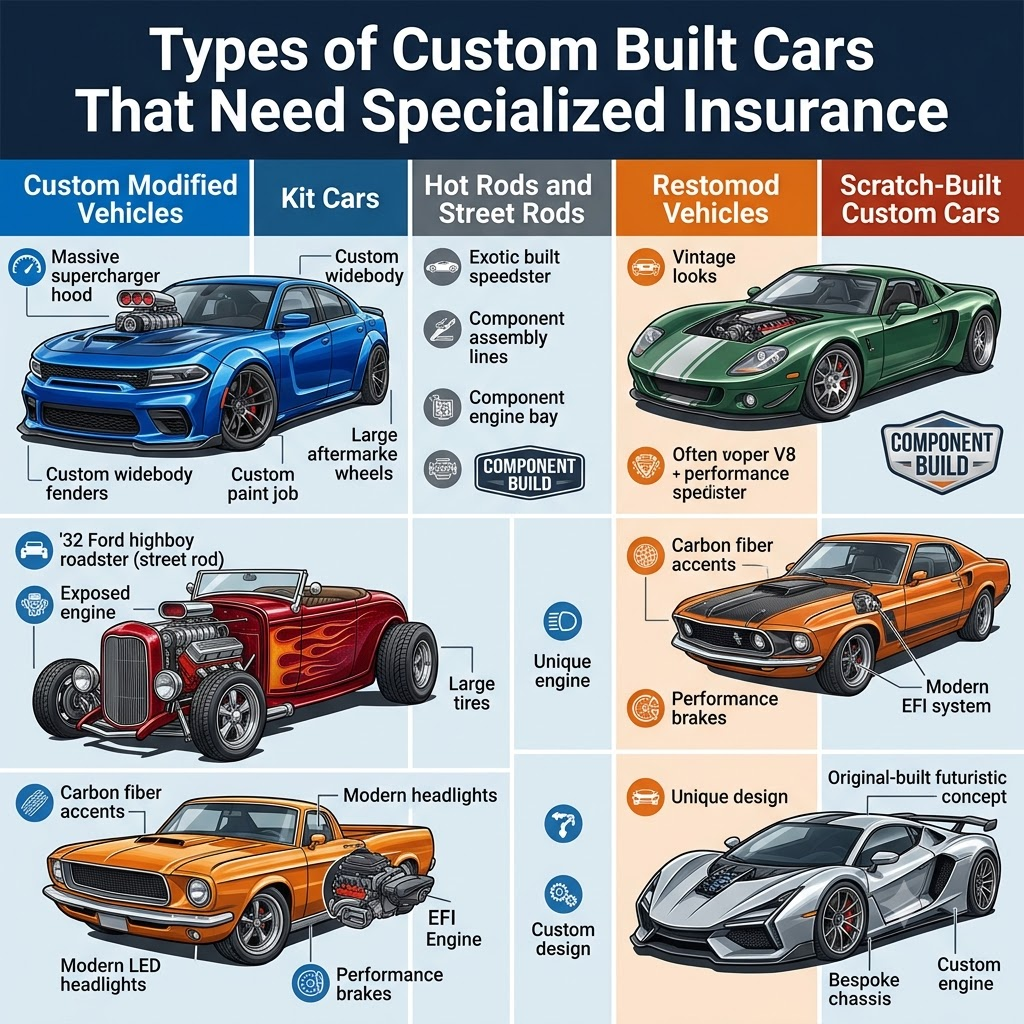
Custom Modified Vehicles
These are factory vehicles that have been heavily upgraded.
Examples include:
- Modified muscle cars
- Tuned sports cars
- Lifted trucks
- Performance vehicles
- Customized SUVs
Common modifications include:
- Engine upgrades
- Turbochargers
- Suspension changes
- Custom wheels
- Exhaust systems
- Body modifications
Kit Cars
Kit cars are vehicles assembled using aftermarket body shells, chassis, and mechanical components.
Examples include:
- Replica sports cars
- Classic recreations
- Custom-built performance cars
Insurance companies often evaluate kit cars differently because they may not have standard factory values.
Hot Rods and Street Rods
Hot rods and street rods are commonly customized vehicles built for style and performance.
They often include:
- Custom engines
- Modified transmissions
- Handmade interiors
- Unique bodywork
- Specialty paint
Because many components are custom-made, replacement costs can be difficult to determine.
Restomod Vehicles
A restomod combines classic vehicle styling with modern technology.
Examples include:
- Classic cars with modern engines
- Updated suspension systems
- Modern braking systems
- Digital dashboards
- Improved safety features
Restomods can be extremely valuable because they combine rarity with expensive upgrades.
Scratch-Built Custom Cars
Some vehicles are built almost entirely from individual parts.
These may include:
- Custom frames
- One-off body designs
- Unique engines
- Handmade components
Scratch-built vehicles often require the most detailed insurance evaluation.
Why Standard Car Insurance May Not Be Enough for a Custom Built Car
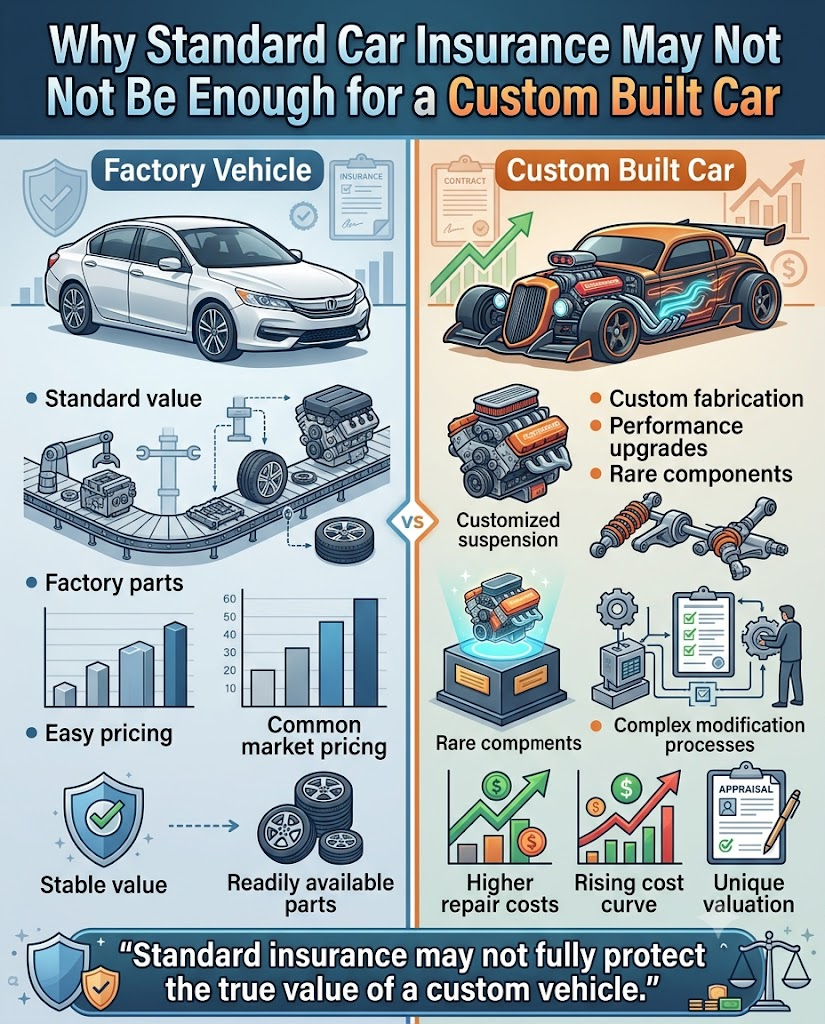
Factory Insurance Valuation Does Not Reflect Custom Value
Standard auto insurance usually determines a vehicle’s value using:
- Age
- Mileage
- Condition
- Market prices
- Vehicle history
However, a custom car’s value often comes from:
- Labor hours
- Rare components
- Custom fabrication
- Performance upgrades
- Unique design features
Example:
A 1968 classic car may have a market value of $35,000.
After a professional restoration:
- Custom engine: $20,000
- Interior upgrade: $15,000
- Paintwork: $12,000
- Suspension upgrades: $8,000
The vehicle may now represent a $90,000 investment.
A standard policy may not recognize that additional value.
Custom Parts May Not Be Automatically Covered
Many standard insurance policies cover factory equipment but may have limited coverage for aftermarket additions.
Custom parts may include:
- Engine modifications
- Custom wheels
- Performance parts
- Audio systems
- Custom interiors
- Specialty paint
- Body modifications
Without proper coverage, an owner may receive only the value of the original vehicle.
Repairing a Custom Vehicle Can Be More Expensive
A standard vehicle can usually be repaired using widely available replacement parts.
Custom cars may require:
- Fabrication work
- Specialty mechanics
- Rare components
- Custom paint matching
- Hand-built replacements
This increases repair costs after an accident.
Types of Insurance Coverage for Custom Built Cars
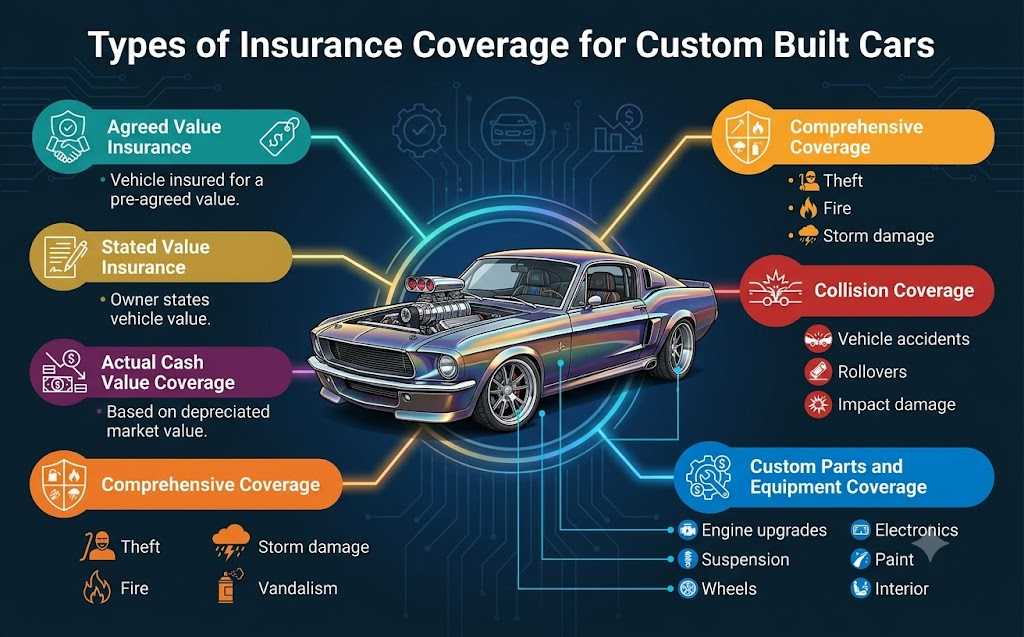
Agreed Value Insurance
Agreed value insurance is one of the most popular options for custom vehicles.
Under this type of policy:
- The owner and insurer agree on the vehicle value before coverage begins.
- The agreed amount is used if the vehicle is declared a total loss.
Example:
You and the insurer agree your custom car is worth $75,000.
If the vehicle is totaled in a covered accident, the payout is based on that agreed value rather than standard market depreciation.
Stated Value Insurance
Stated value coverage allows the owner to declare the vehicle’s value.
However, the insurer may still consider factors such as:
- Actual cash value
- Vehicle condition
- Policy terms
The payout may not always equal the stated amount.
Actual Cash Value Coverage
Actual cash value coverage pays based on the vehicle’s market value at the time of loss.
This is common with standard auto insurance but may not be ideal for custom builds.
Problems include:
- Difficulty proving value
- Depreciation concerns
- Lower settlement amounts
Comprehensive Coverage for Custom Cars
Comprehensive coverage protects against non-collision damage.
It may cover:
- Theft
- Fire
- Weather damage
- Vandalism
- Falling objects
- Animal damage
For valuable custom vehicles, comprehensive coverage is often essential.
Collision Coverage for Custom Built Cars
Collision coverage protects against:
- Accidents
- Vehicle impacts
- Rollover damage
- Collision with objects
For custom cars, collision coverage should account for:
- Custom parts
- Fabrication costs
- Specialty repairs
Custom Parts and Equipment Coverage
Custom parts and equipment coverage protects aftermarket upgrades.
It may cover:
- Performance upgrades
- Custom wheels
- Suspension modifications
- Engine upgrades
- Interior changes
- Electronics
This coverage is especially important if modifications represent a large portion of the vehicle’s value.
How to Get Insurance for a Custom Built Car: Step-by-Step Process
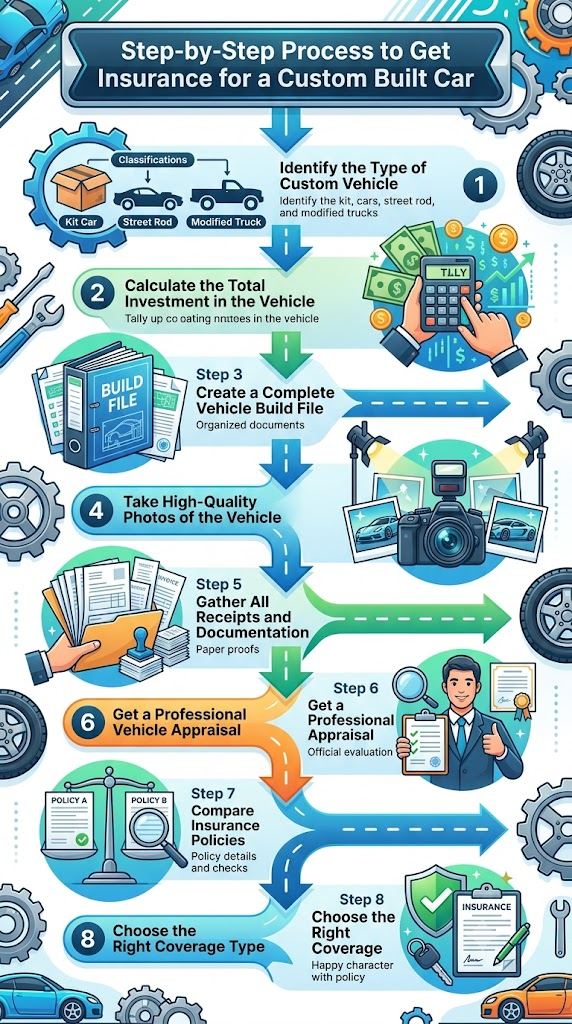
Step 1: Determine Your Vehicle’s Value
Before contacting insurers, calculate the total investment in your vehicle.
Include:
Parts Costs
Examples:
- Engine components
- Transmission
- Suspension parts
- Wheels and tires
Labor Costs
Include:
- Fabrication
- Painting
- Mechanical work
- Installation
Custom Features
Examples:
- Interior upgrades
- Electronics
- Performance systems
Keep receipts for everything.
Step 2: Collect Documentation
Insurance companies need proof of the vehicle’s condition and value.
Important documents include:
- Vehicle title
- Registration
- Build receipts
- Parts invoices
- Restoration records
- Professional appraisals
- Photos
- Modification lists
Step 3: Create a Complete Build Sheet
A build sheet provides insurers with details about the vehicle.
Include:
- Vehicle history
- Engine specifications
- Transmission details
- Suspension upgrades
- Brake upgrades
- Interior modifications
- Exterior changes
- Paint information
- Wheel and tire specifications
A detailed build sheet helps insurers understand what they are covering.
Step 4: Get a Professional Appraisal
A professional appraisal can help establish the vehicle’s value.
An appraiser may evaluate:
- Quality of workmanship
- Parts used
- Vehicle rarity
- Current market demand
- Overall condition
This is especially useful for:
- Classic custom cars
- High-value builds
- Show vehicles
Step 5: Find an Insurance Company That Covers Custom Vehicles
Not every insurer specializes in custom cars.
Look for companies that offer:
- Modified vehicle coverage
- Classic car insurance
- Agreed value policies
- Custom equipment protection
Large insurers may cover some modified vehicles, while specialty insurers often provide more suitable policies.
Best Insurance Companies for Custom Built Cars
Finding the right insurance company is one of the most important steps when protecting a custom built vehicle.
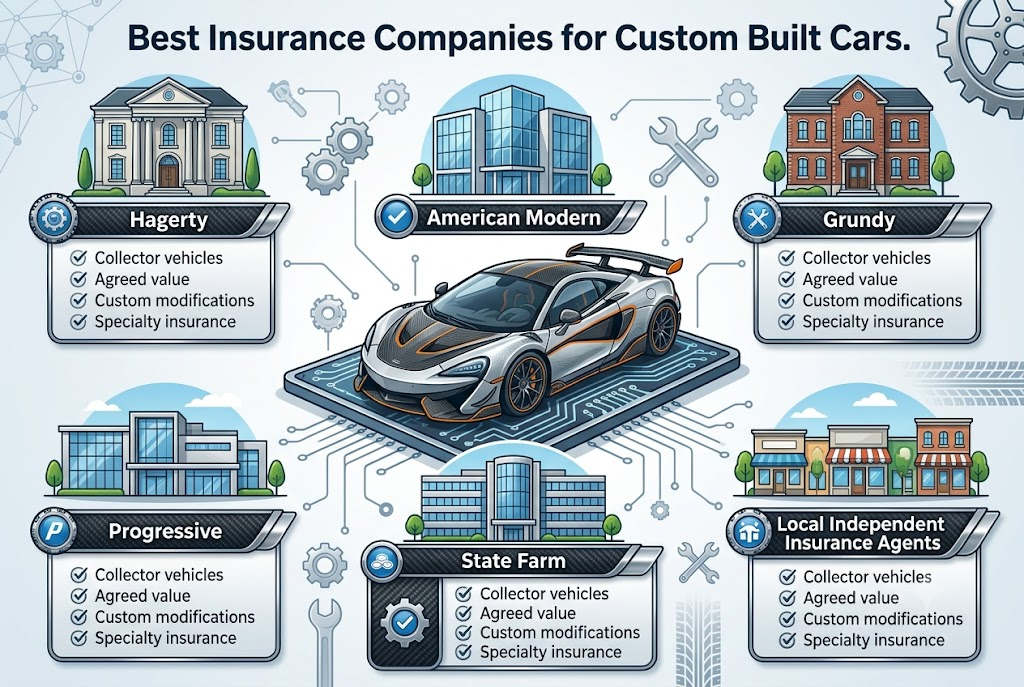
Many standard auto insurers focus on factory vehicles and may not fully understand the value of custom modifications.
Specialty insurers often provide better options because they are designed for:
- Classic cars
- Modified vehicles
- Custom builds
- Collector vehicles
- Kit cars
- Restorations
The best insurer depends on:
- Vehicle type
- Build value
- Usage
- Location
- Modification level
- Coverage needs
Specialty Insurance Companies for Custom Cars
Hagerty
Specialty insurers such as Hagerty focus heavily on classic and collector vehicles.
They may offer coverage designed around:
- Agreed value policies
- Custom modifications
- Restoration projects
- Collector vehicles
These policies are often designed for owners who want protection based on the vehicle’s actual investment rather than standard depreciation.
American Modern
American Modern provides insurance solutions for specialty vehicles, including certain collector and modified vehicles.
Coverage options may include:
- Custom vehicle protection
- Classic vehicles
- Restoration projects
- Specialty equipment
Grundy
Grundy specializes in collector and classic vehicle insurance.
It is commonly associated with:
- Custom cars
- Street rods
- Classic builds
- Show vehicles
Policies may focus on agreed value protection.
Progressive
Progressive may insure some modified vehicles depending on:
- Vehicle type
- Modifications
- Location
- Coverage requirements
For moderate customizations, standard insurers may still be an option.
State Farm
State Farm may provide coverage for certain modified vehicles.
Approval usually depends on:
- Vehicle details
- Documentation
- Modification level
- State regulations
Local Independent Insurance Agents
Independent agents can be useful because they can compare multiple insurance companies.
They may help owners find insurers that specialize in:
- Custom builds
- High-value vehicles
- Modified cars
- Unusual vehicle situations
How Much Does Custom Built Car Insurance Cost?
The cost of insuring a custom built car varies significantly.
Unlike standard vehicles, custom car insurance is usually based on:
- Vehicle value
- Build quality
- Usage
- Storage conditions
- Driving history
- Coverage type
A $25,000 custom vehicle and a $150,000 professional build will have very different insurance costs.
Factors That Affect Custom Car Insurance Rates
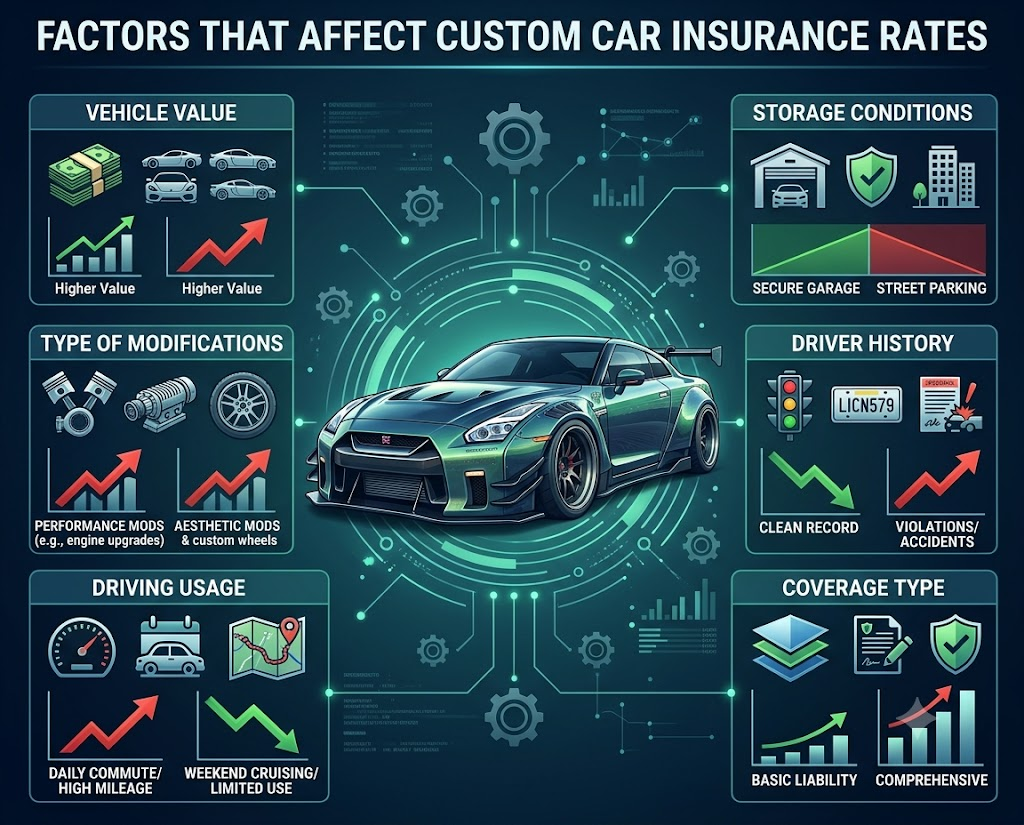
Vehicle Value
Higher-value vehicles generally cost more to insure.
Factors include:
- Replacement cost
- Custom components
- Rarity
- Market demand
A one-of-a-kind vehicle may require specialized valuation.
Type of Modifications
Insurance companies consider what has been changed.
Examples:
Lower impact modifications:
- Wheels
- Paint upgrades
- Interior changes
Higher impact modifications:
- Engine swaps
- Turbo systems
- Racing modifications
- Custom chassis work
Driving Usage
How you use the vehicle affects insurance pricing.
Common categories include:
Show Vehicle
Used mainly for:
- Car shows
- Exhibitions
- Events
Usually lower risk.
Weekend Driver
Used occasionally for:
- Leisure driving
- Short trips
- Events
Often preferred by specialty insurers.
Daily Driver
Using a custom vehicle every day may increase insurance costs because of:
- More miles
- Higher accident exposure
- More wear
Storage Conditions
Where you keep your custom car matters.
Insurers may consider:
- Garage storage
- Security systems
- Climate-controlled facilities
- Neighborhood safety
A vehicle stored in a locked garage may receive better rates than one parked outside.
Driver History
Insurance companies still evaluate:
- Accidents
- Traffic violations
- Claims history
- Driving experience
A clean driving record can help reduce premiums.
Can You Insure a Car Built From Parts?
Yes, but it can be more complicated than insuring a factory vehicle.
Vehicles built from individual components may require additional evaluation.
Examples include:
- Kit cars
- Custom chassis vehicles
- Homemade vehicles
- Scratch-built cars
Requirements for Insuring a Car Built From Parts
Insurance companies may request:
Vehicle Identification Information
This may include:
- VIN
- Registration documents
- Title information
Construction Documentation
Helpful documents include:
- Build receipts
- Parts invoices
- Assembly records
- Photos during construction
Safety Inspection Records
Some insurers may require proof that the vehicle meets legal safety requirements.
Possible inspections include:
- Brake inspection
- Lighting inspection
- Safety equipment verification
- State inspection requirements
Insurance for Kit Cars
Kit cars often require specialized insurance because they do not follow standard factory valuation methods.
Examples:
- Replica vehicles
- Custom sports cars
- Classic recreations
Insurance companies may evaluate:
- Kit manufacturer
- Builder experience
- Components used
- Final vehicle quality
How to Insure a Kit Car Before It Is Finished
Some insurers offer coverage during the construction phase.
This may protect:
- Parts already purchased
- Stored components
- Work in progress
Documentation is extremely important during the build.
Keep:
- Receipts
- Photos
- Construction records
Insurance Requirements for Home-Built Vehicles
Home-built vehicles often require more documentation than professionally built vehicles.
Insurers may want:
Proof of Ownership
Examples:
- Receipts
- Bills of sale
- Component ownership records
Vehicle Inspection
The vehicle may need inspection to confirm:
- Safety standards
- Legal compliance
- Vehicle identity
Detailed Build Records
Include:
- Engine source
- Frame information
- Suspension details
- Brake system
- Electrical components
How Photos Help Insure a Custom Built Car
Photos are one of the most important documents for custom vehicle insurance.
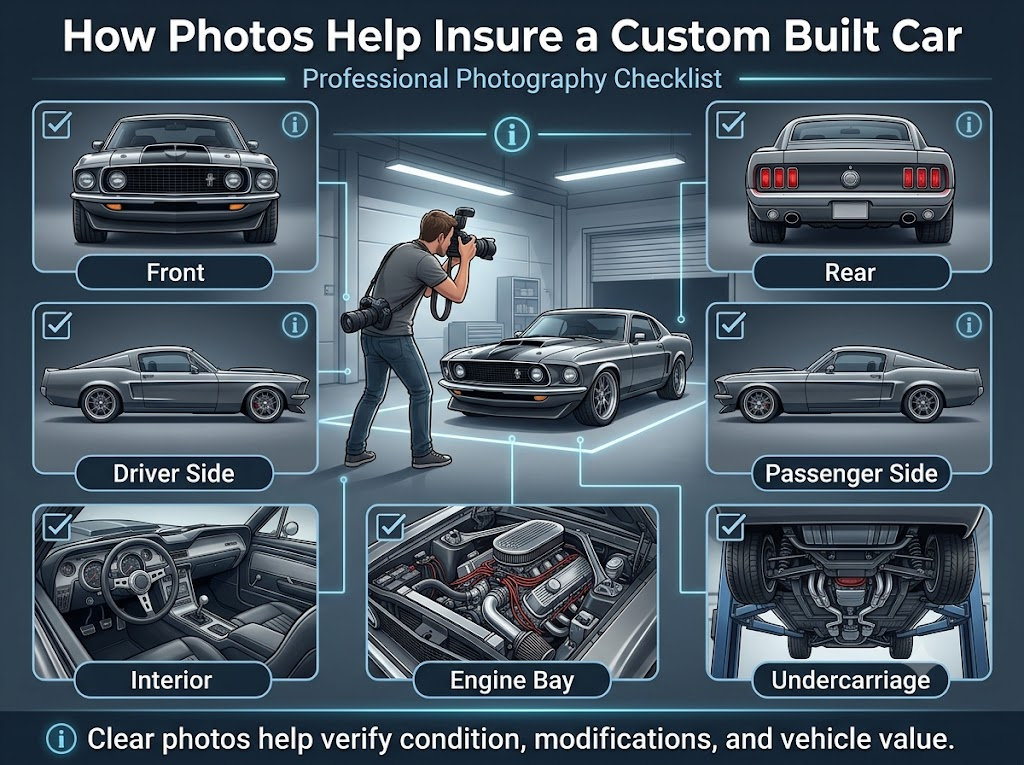
Insurance companies may request pictures showing:
Exterior
Include:
- Full vehicle view
- Paint condition
- Body modifications
- Wheels and tires
Interior
Show:
- Custom seats
- Dashboard upgrades
- Audio systems
- Interior materials
Engine Bay
Include:
- Engine modifications
- Performance parts
- Custom components
Undercarriage
Important for:
- Suspension modifications
- Exhaust systems
- Frame condition
How Often Should You Update Custom Car Insurance?
You should review your policy whenever major changes are made.
Update your insurer after installing:
- New engine
- Performance upgrades
- Custom interior
- Expensive wheels
- Suspension changes
- Paintwork
- Body modifications
A vehicle that increases in value over time may become underinsured if the policy is not updated.
Can You Get Full Coverage on a Custom Built Car?
Yes, but coverage depends on:
- Vehicle value
- Insurance company
- Documentation
- Modification details
Full coverage may include:
Comprehensive Coverage
Protects against:
- Theft
- Fire
- Weather damage
- Vandalism
Collision Coverage
Protects against:
- Accidents
- Impact damage
- Rollover incidents
Custom Equipment Coverage
Protects:
- Modified parts
- Specialty equipment
- Custom components
Common Reasons Custom Car Insurance Claims Become Difficult
Poor Documentation
Without proof of modifications, insurers may struggle to determine value.
Keep:
- Receipts
- Photos
- Appraisals
- Build records
Incorrect Vehicle Value
A common mistake is insuring a custom vehicle for its original factory value.
Example:
A vehicle purchased for $15,000 receives $50,000 in modifications.
The final build value may be much higher than the original purchase price.
Using a Standard Policy for a Specialty Vehicle
A regular policy may not properly cover:
- Custom parts
- Labor costs
- Rare components
Specialized coverage may be necessary.
Not Reporting New Modifications
Adding expensive upgrades without updating insurance can create coverage gaps.
What Happens If a Custom Built Car Is Totaled?
A total loss settlement depends on the type of policy.
Agreed Value Policy
The insurer pays the agreed amount listed in the policy.
Example: Agreed value: $100,000
Covered total loss: Potential payout based on agreed value.
Actual Cash Value Policy
The insurer determines market value at the time of loss.
This can be challenging for unique vehicles because comparable sales may be limited.
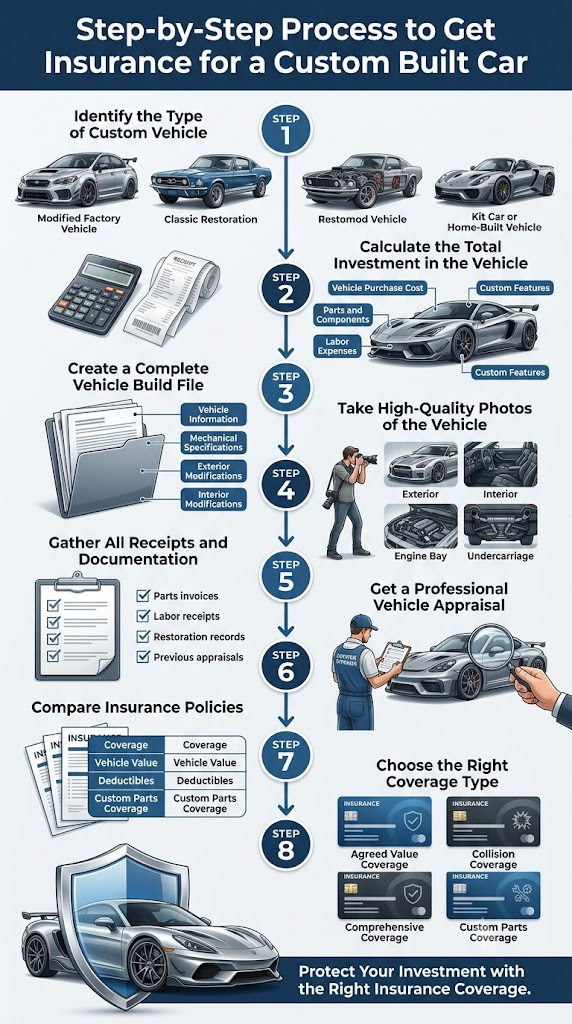
Step-by-Step Process to Get Insurance for a Custom Built Car
Getting insurance for a custom built car requires more preparation than insuring a regular vehicle.
Insurance companies need detailed information about the vehicle because:
- Factory pricing does not apply
- Replacement costs are different
- Custom components may be difficult to value
- Repair requirements may be specialized
Following the right steps can help you find proper coverage and avoid claim problems later.
Step 1: Identify the Type of Custom Vehicle
Before contacting insurance companies, determine what category your vehicle falls into.
Common categories include:
Modified Factory Vehicle
A standard vehicle with aftermarket upgrades.
Examples:
- Modified Mustang
- Lifted truck
- Tuned sports car
- Customized SUV
Classic Restoration
A classic vehicle restored with original or upgraded components.
Examples:
- Vintage muscle cars
- Classic European vehicles
- Antique vehicles
Restomod Vehicle
A classic vehicle upgraded with modern technology.
Examples:
- Modern engine swap
- Updated suspension
- Modern brakes
- Digital electronics
Kit Car or Home-Built Vehicle
A vehicle assembled using aftermarket components.
Examples:
- Replica sports cars
- Custom chassis builds
- Scratch-built vehicles
The insurance process may differ depending on the category.
Step 2: Calculate the Total Investment in the Vehicle
Before applying for insurance, determine how much the vehicle is actually worth.
Many owners underestimate their vehicle’s value because they only consider the purchase price.
A custom vehicle’s value may include:
Vehicle Purchase Cost
Include:
- Original vehicle purchase price
- Donor vehicle cost
- Chassis cost
Parts and Components
Include:
- Engine upgrades
- Transmission
- Suspension components
- Brakes
- Wheels and tires
- Exhaust systems
- Electronics
Labor Expenses
Do not forget professional labor costs.
Examples:
- Fabrication work
- Painting
- Mechanical installation
- Upholstery
- Custom bodywork
Custom Features
Include:
- Interior upgrades
- Sound systems
- Performance equipment
- Custom lighting
- Specialty accessories
Step 3: Create a Complete Vehicle Build File
A detailed build file makes the insurance process much easier.
Your build file should include:
Vehicle Information
- Year
- Make
- Model
- VIN
- Mileage
- Registration details
Mechanical Specifications
Include:
- Engine type
- Horsepower upgrades
- Transmission details
- Suspension setup
- Brake system
- Cooling system
Exterior Modifications
Include:
- Body changes
- Paint details
- Custom panels
- Wheels
- Tires
- Lighting upgrades
Interior Modifications
Include:
- Seats
- Dashboard
- Electronics
- Audio systems
- Custom materials
Step 4: Take High-Quality Photos of the Vehicle
Photos help insurers understand the condition and value of your custom car.
Take clear images of:
Exterior Views
Capture:
- Front view
- Rear view
- Driver side
- Passenger side
- Overall vehicle condition
Interior
Photograph:
- Seats
- Dashboard
- Custom features
- Electronics
Engine Bay
Show:
- Engine upgrades
- Performance components
- Custom parts
Undercarriage
Important for showing:
- Suspension modifications
- Exhaust systems
- Frame condition
Step 5: Gather All Receipts and Documentation
Documentation is one of the strongest tools for proving your vehicle’s value.
Keep:
✅ Parts invoices
✅ Labor receipts
✅ Restoration records
✅ Paint receipts
✅ Engine documentation
✅ Wheel and tire receipts
✅ Performance upgrade records
✅ Previous appraisals
Without documentation, an insurer may have difficulty verifying the cost of modifications.
Step 6: Get a Professional Vehicle Appraisal
A professional appraisal can help establish an accurate value.
An appraiser may evaluate:
- Build quality
- Component quality
- Market demand
- Craftsmanship
- Vehicle condition
- Rarity
An appraisal is especially useful for:
- High-value custom cars
- Show vehicles
- Rare builds
- Restomods
Step 7: Compare Insurance Policies
Do not choose insurance based only on price.
Compare:
- Coverage limits
- Valuation method
- Modification coverage
- Usage restrictions
- Deductibles
- Claim handling
Important questions to ask insurers:
- Are custom parts covered?
- Is the vehicle insured at agreed value?
- Are labor costs included?
- Are upgrades automatically covered?
- Are there mileage restrictions?
Step 8: Choose the Right Coverage Type
The best policy depends on how you use your custom vehicle.
Agreed Value Coverage for Custom Cars
For many custom vehicles, agreed value is often the preferred option.
Benefits include:
- Clear vehicle value before a loss
- Better protection for unique builds
- Less disagreement during claims
This is especially useful because custom vehicles often do not have easy market comparisons.
Comprehensive Coverage
Comprehensive coverage helps protect against non-collision damage.
It may cover:
- Theft
- Fire
- Storm damage
- Vandalism
- Falling objects
Custom cars can be attractive theft targets, making this coverage important.
Collision Coverage
Collision coverage protects against:
- Accidents
- Crashes
- Vehicle impacts
- Rollover damage
For expensive builds, collision coverage helps protect your investment after a major accident.
Custom Parts Coverage
Custom parts coverage protects modifications that are not included in standard vehicle equipment.
Examples:
- Performance engines
- Custom wheels
- Suspension upgrades
- Interior upgrades
- Specialty electronics
Common Mistakes When Insuring a Custom Built Car
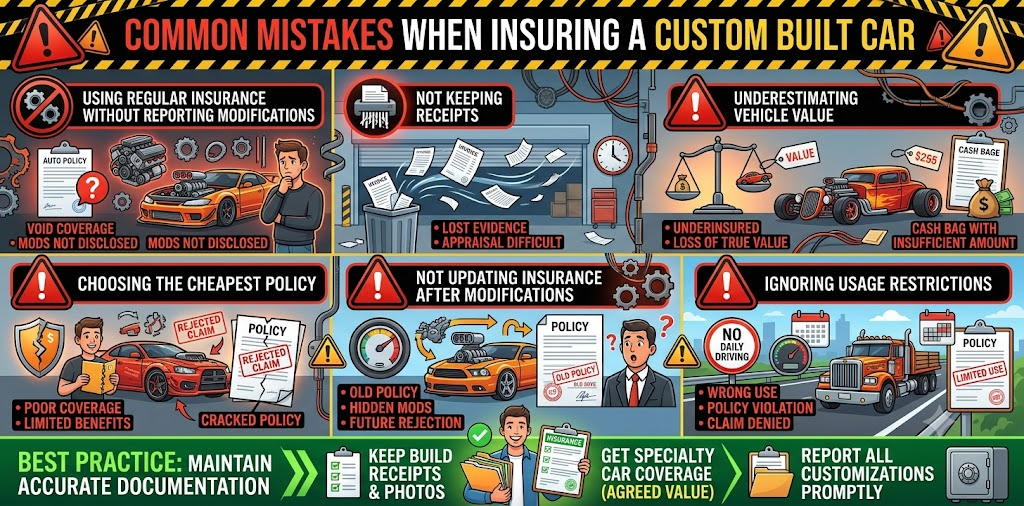
Mistake 1: Using Regular Insurance Without Reporting Modifications
A common mistake is insuring a heavily modified vehicle like a factory car.
Problems may include:
- Insufficient coverage
- Lower claim payments
- Disputes about vehicle value
Always disclose modifications.
Mistake 2: Not Keeping Receipts
Without receipts, proving the value of your vehicle becomes harder.
Keep records from the beginning of the build.
Mistake 3: Underestimating Vehicle Value
Many owners insure only the purchase price.
Example:
- Vehicle purchase: $20,000
- Modifications: $60,000
- Total investment: $80,000
Insuring the vehicle for only $20,000 creates a major coverage gap.
Mistake 4: Choosing the Cheapest Policy
The cheapest policy may not provide:
- Custom parts protection
- Agreed value coverage
- Proper claim support
A lower premium can result in a large financial loss after an accident.
Mistake 5: Not Updating Insurance After Modifications
A vehicle’s value can change significantly during a build.
Update insurance after adding:
- Engine upgrades
- Custom interiors
- Expensive wheels
- Performance components
- Major restoration work
Mistake 6: Ignoring Usage Restrictions
Some specialty policies have restrictions.
Examples:
- Limited mileage
- No daily commuting
- Storage requirements
- No racing use
Understand policy rules before purchasing.
How to Lower Insurance Costs for a Custom Built Car
Custom car insurance can be expensive, but several strategies can help reduce costs.
Store the Vehicle Securely
Insurance companies may view secure storage positively.
Consider:
- Locked garage
- Security systems
- Vehicle tracking devices
Maintain a Clean Driving Record
Your driving history affects insurance pricing.
Avoid:
- Speeding violations
- Accidents
- Insurance claims
Choose Appropriate Coverage Limits
Avoid paying for unnecessary coverage while maintaining enough protection for your vehicle value.
Use the Vehicle as Intended
A vehicle used occasionally for shows and weekend drives may cost less to insure than a daily-driven custom car.
Install Security Features
Security upgrades may help reduce theft risk.
Examples:
- Alarm systems
- GPS tracking
- Immobilizers
- Secure parking
Review Your Policy Annually
Custom vehicles often change over time.
Review coverage after:
- New modifications
- Increased vehicle value
- Restoration completion
- Major upgrades
Final Checklist: How to Insure a Custom Built Car
Before purchasing insurance, complete this checklist:
✅ Determine your vehicle category
✅ Calculate total build investment
✅ Create a detailed build sheet
✅ Photograph the entire vehicle
✅ Keep all receipts and invoices
✅ Get a professional appraisal if needed
✅ Compare specialty insurers
✅ Choose agreed value coverage when appropriate
✅ Add custom parts protection
✅ Update insurance after modifications
✅ Understand policy restrictions
Benefits of Specialized Custom Car Insurance
Specialty policies often provide:
Better Vehicle Valuation
The policy can recognize the actual investment in the vehicle.
Protection for Custom Components
Coverage can include:
- Modified engines
- Custom interiors
- Specialty equipment
Better Understanding of Unique Vehicles
Specialty insurers are more familiar with:
- Custom builds
- Rare vehicles
- Collector markets
Final Thoughts: How to Get Insurance for a Custom Built Car
Getting insurance for a custom built car requires more preparation than insuring a standard vehicle, but the right coverage can protect your investment.
The most important steps are:
- Understand your vehicle’s true value
- Keep detailed documentation
- Choose the right type of insurance
- Report all modifications
- Consider agreed value coverage
- Work with insurers experienced with custom vehicles
A custom car is more than transportation. It represents hundreds of hours of work, specialized parts, and personal investment.
The biggest mistake owners make is assuming a standard insurance policy will automatically protect everything they have built.
By choosing appropriate coverage and maintaining proper records, you can enjoy your custom vehicle while knowing your investment is protected.