
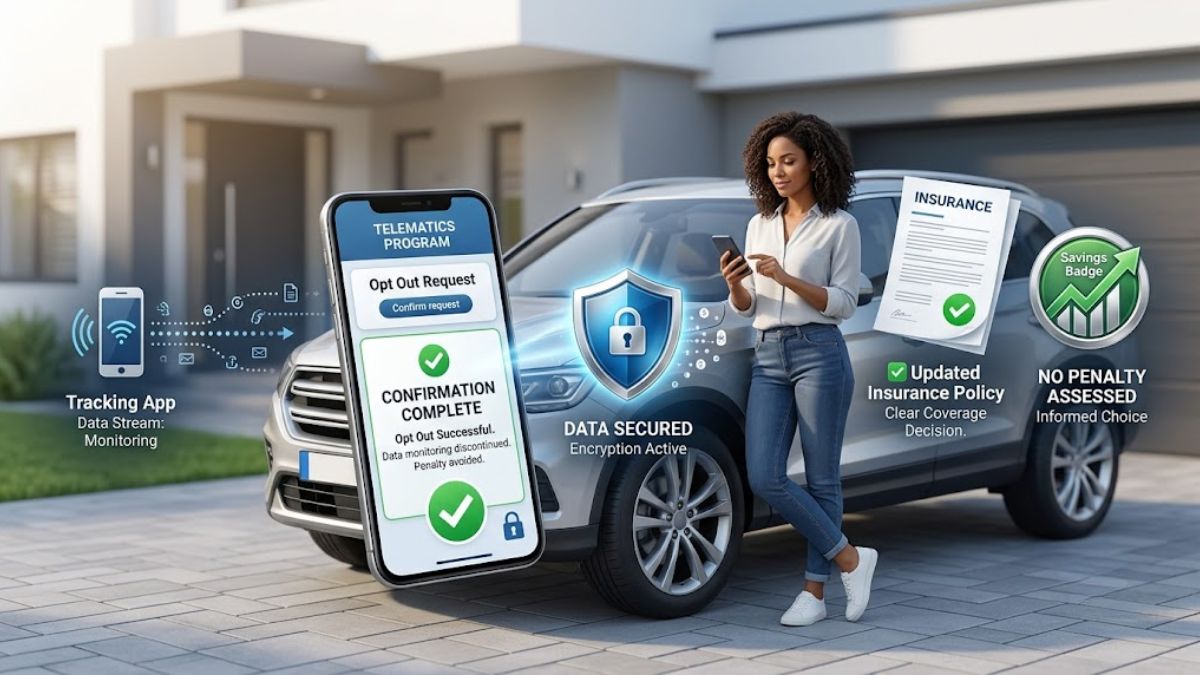

Many auto insurance companies now offer usage-based insurance (UBI) programs that use mobile apps or connected devices to monitor driving habits. These programs are designed to reward safer drivers with possible discounts by tracking behaviors such as:
- Speeding
- Hard braking
- Rapid acceleration
- Phone use while driving
- Driving times
- Mileage
- Location patterns (depending on the program)
While some drivers save money through these programs, others prefer not to share their driving data or feel uncomfortable with continuous monitoring.
A common question among policyholders is:
Can you opt out of an insurance tracking app without penalty?
For drivers who value privacy or do not want their driving behavior monitored, understanding how to opt out of insurance tracking app without penalty is important.
In most cases, drivers can choose to leave a telematics program without losing their existing auto insurance coverage. However, opting out may result in losing a potential discount, enrollment reward, or participation-based savings offer.
This guide explains how to opt out of insurance tracking app without penalty, how insurance tracking apps work, whether insurers can increase your rates after opting out, and the steps you should take to avoid unexpected issues.
What Is an Insurance Tracking App?
An insurance tracking app is a smartphone application or device-based program offered by insurance companies to monitor driving behavior.
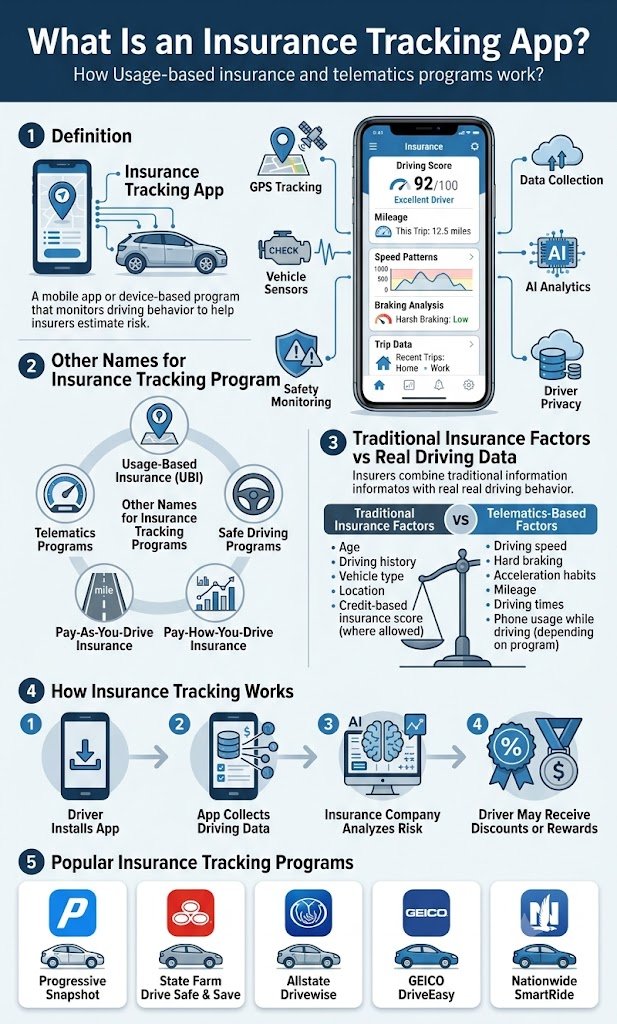
These programs are also known as:
- Usage-Based Insurance (UBI)
- Telematics Programs
- Safe Driving Programs
- Pay-As-You-Drive Insurance
- Pay-How-You-Drive Insurance
Instead of calculating premiums only using traditional factors such as:
- Age
- Driving history
- Vehicle type
- Location
- Credit-based insurance score (where allowed)
Insurance companies use real driving data to estimate risk more accurately.
Examples of popular insurance tracking programs include:
- Progressive Corporation Snapshot
- State Farm Drive Safe & Save
- Allstate Drivewise
- GEICO DriveEasy
- Nationwide Mutual Insurance Company SmartRide
Each program has different rules regarding participation, discounts, data collection, and cancellation.
Why Do Insurance Companies Offer Tracking Apps?
Insurance companies use telematics because driving behavior can provide more accurate information about risk.
Traditional insurance pricing relies heavily on historical data and general statistics. Telematics allows insurers to analyze individual driving habits.
For example:
A driver who:
- Avoids speeding
- Brakes smoothly
- Drives mostly during safer hours
- Does not frequently use a phone while driving
may represent a lower risk compared with a driver who:
- Frequently brakes aggressively
- Drives late at night
- Speeds regularly
Insurance companies use this information to reward safer drivers.
Why Do Some Drivers Want to Opt Out?
Although tracking apps can provide discounts, not everyone wants to participate.
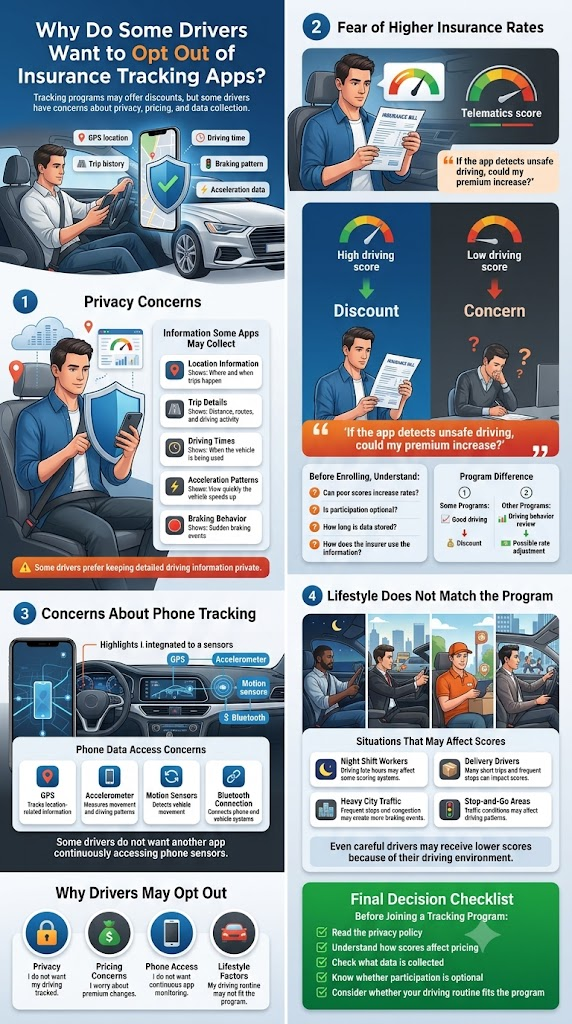
Common reasons drivers choose not to use insurance tracking apps include:
Privacy Concerns
Many drivers do not want insurance companies collecting detailed information about their driving habits.
Depending on the program, collected data may include:
- Trip details
- Driving times
- Location information
- Acceleration patterns
- Braking behavior
Some people prefer keeping their driving information private.
Fear of Higher Insurance Rates
Some drivers worry:
“If the app detects unsafe driving, will my insurance premium increase?”
This concern is common because telematics programs do not always work the same way.
Some programs only provide discounts for good driving, while others may adjust rates based on driving behavior.
Before enrolling, drivers should understand:
- Whether poor scores can increase premiums
- Whether participation is optional
- How long data is stored
- How the insurer uses the information
Concerns About Phone Tracking
Many apps rely on smartphone sensors, including:
- GPS
- Accelerometer
- Motion sensors
- Bluetooth connections
Drivers may not want another app continuously accessing their phone data.
Lifestyle Does Not Match the Program
Some drivers may naturally receive lower scores because of their routine.
Examples:
- Night shift workers driving late hours
- People who drive in heavy city traffic
- Delivery drivers
- Drivers in areas with frequent stop-and-go traffic
Even safe drivers may receive poor scores because of circumstances beyond their control.
Can You Opt Out of an Insurance Tracking App?
In most cases, yes.
Insurance tracking programs are generally optional, especially when they are offered as a discount program.
You can usually:
- Decline enrollment before joining
- Remove the app after enrollment
- Stop using the tracking device
- Contact your insurer and request removal
However, the exact process depends on your insurance company and state regulations.
Does Opting Out Cancel Your Insurance Policy?
No.
Choosing not to participate in a telematics program normally does not cancel your auto insurance policy.
Your regular coverage continues, including:
- Liability coverage
- Collision coverage
- Comprehensive coverage
- Uninsured/underinsured motorist coverage
- Other policy benefits
The main impact is usually related to discounts.
For example:
A driver may receive a 10% participation discount for joining a tracking program. If they opt out, that discount may be removed.
Will My Insurance Rates Increase If I Opt Out?
Usually, opting out does not cause a penalty or surcharge.
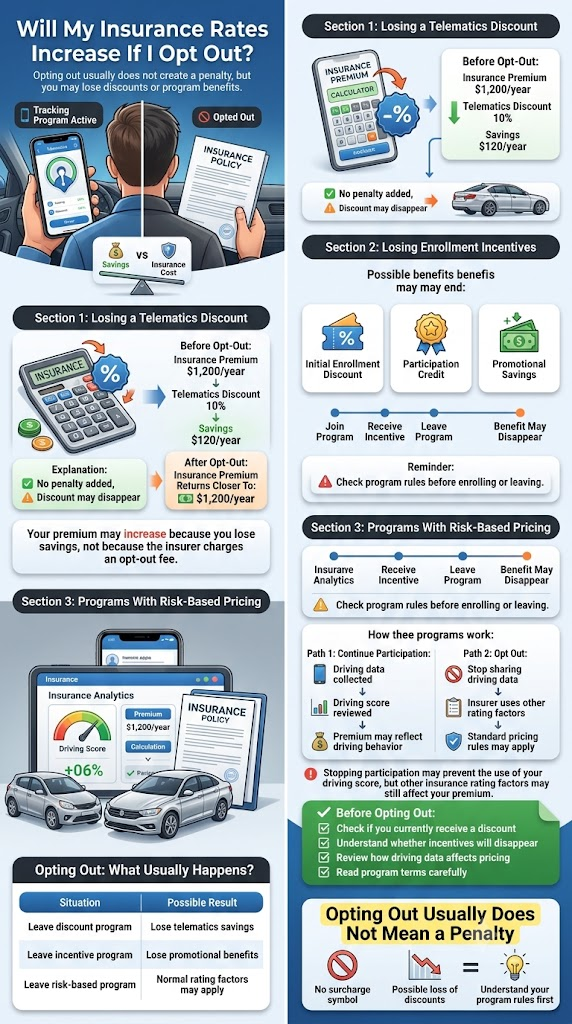
However, there are situations where your premium may change.
Situation 1: Losing a Discount
The most common result is losing a telematics discount.
Example:
- Current premium: $1,200 per year
- Tracking discount: 10%
- Savings: $120 per year
If you opt out, your premium may return closer to the original $1,200 amount.
The insurer is not charging a penalty. You are simply losing the discount.
Situation 2: Enrollment Incentives
Some insurers offer:
- Initial enrollment discounts
- Participation credits
- Promotional savings
If you leave the program, those benefits may disappear.
Situation 3: Programs With Risk-Based Pricing
Some telematics programs use driving data to adjust premiums.
In these cases, stopping participation may prevent the insurer from using your driving score, but the company may apply normal rating factors instead.
Always check the program rules before enrolling.
How to Opt Out of Insurance Tracking App Without Penalty?
If you decide that a telematics program is not right for you, opting out is usually a straightforward process.
However, it is important to follow the correct steps so you do not accidentally lose discounts, create confusion with your insurer, or leave the program incorrectly.
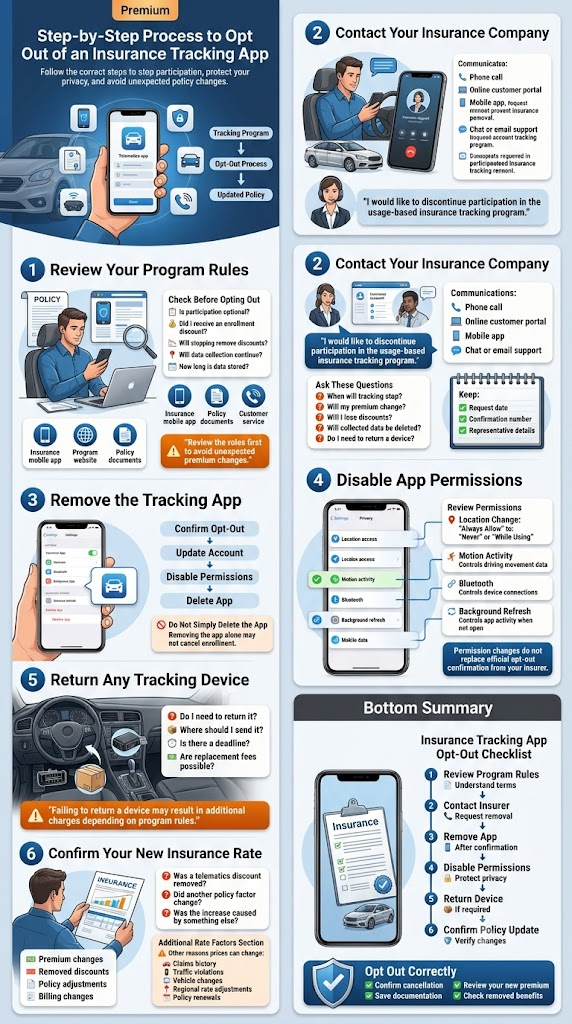
Step 1: Review Your Insurance Tracking Program Rules
Before opting out, check the terms and conditions of your insurer’s tracking program.
Look for information about:
- Whether participation is optional
- Whether you received an enrollment discount
- Whether stopping participation removes discounts
- Whether your driving data will continue being collected
- How long your data will be stored
You can usually find these details through:
- Your insurance company’s mobile app
- The telematics program website
- Your policy documents
- Your insurer’s customer service department
Understanding the rules first helps you avoid unexpected changes to your premium.
Step 2: Contact Your Insurance Company
The safest way to opt out is to contact your insurance provider directly.
You can usually request removal through:
- Phone call
- Online customer portal
- Mobile insurance app
- Email or chat support
When contacting your insurer, clearly state:
“I would like to discontinue participation in the usage-based insurance tracking program.”
Ask the representative:
- When will tracking stop?
- Will my premium change?
- Will I lose any discounts?
- Will previously collected data be deleted?
- Do I need to return a tracking device?
Keep a record of:
- The date you requested removal
- Confirmation number
- Representative name (if available)
This documentation can help if there are future billing issues.
Step 3: Remove the Insurance Tracking App
If your insurer uses a smartphone-based program, you may need to remove the app from your device.
General steps:
- Open your phone settings
- Find the insurance tracking app
- Disable permissions first
- Delete the application
Before deleting the app, confirm that your insurer has officially removed you from the program.
Simply uninstalling the app may not always cancel participation.
Your insurer may still consider you enrolled until the account is updated.
Step 4: Disable App Permissions
Some drivers prefer to remove access before deleting the application.
Review permissions such as:
- Location access
- Motion activity
- Bluetooth access
- Background app refresh
- Mobile data access
For example:
A driver may change location settings from:
“Always Allow”
to:
“Never” or “While Using the App”
However, changing permissions alone may not officially remove you from the program.
Always complete the opt-out process with your insurer.
Step 5: Return Any Tracking Device
Some insurance programs use a physical telematics device that plugs into your vehicle.
These devices are often connected through:
- OBD-II port under the dashboard
- Vehicle connectivity systems
- Manufacturer-installed technology
If your insurer provided a device, ask:
- Do I need to return it?
- Where should I send it?
- Is there a deadline?
- Are there replacement charges?
Failing to return a device may result in additional fees depending on the program rules.
Step 6: Confirm Your New Insurance Rate
After opting out, review your updated policy documents.
Check for:
- Premium changes
- Removed discounts
- Policy adjustments
- Billing changes
Your insurance company should provide updated information showing any changes.
If your rate increases unexpectedly, ask:
- Was a telematics discount removed?
- Was any other policy factor changed?
- Was the increase related to something else?
Do not assume every increase is caused by opting out.
Insurance premiums can change because of:
- Renewals
- Claims history
- Traffic violations
- Vehicle changes
- Regional rate adjustments
What Happens to Your Driving Data After You Opt Out?
Many drivers are concerned about what happens to their previously collected information.
When you leave a tracking program, the insurer may:
- Stop collecting new driving data
- Keep previous data for a certain period
- Use historical information for claims or compliance purposes
- Delete data according to its privacy policy
Data retention rules vary by:
- Insurance company
- State regulations
- Program agreement
Before enrolling in any telematics program, review the privacy policy carefully.
Important questions to ask:
- How long is my driving data stored?
- Who can access my information?
- Is my data shared with third parties?
- Can I request deletion of my information?
Can an Insurance Company Force You to Use a Tracking App?
Generally, insurance companies cannot force existing customers to use a tracking app.
You usually have the choice to:
- Participate and receive possible discounts
- Decline participation
- Use traditional insurance pricing
However, some insurers or programs may be structured differently.
For example:
- A policy sold specifically as a usage-based product may require tracking.
- A discount program may require participation to receive savings.
Always check your policy terms.
What If I Already Enrolled and Do Not Like My Driving Score?
Some drivers enroll expecting a discount but later discover their score is lower than expected.
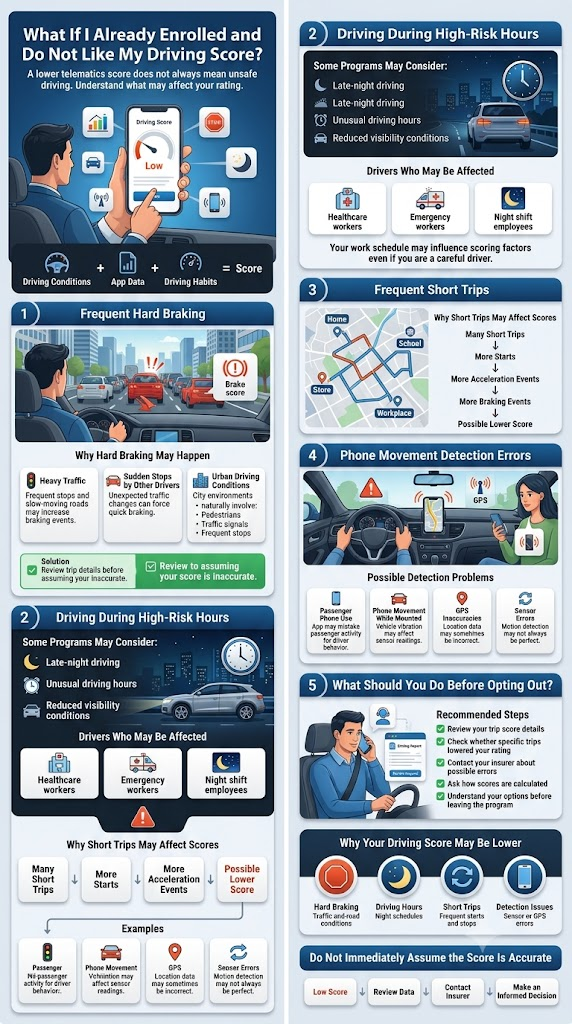
Common reasons include:
Frequent Hard Braking
This may happen because of:
- Heavy traffic
- Sudden stops by other drivers
- Urban driving conditions
Driving During High-Risk Hours
Some programs consider late-night driving riskier.
This can affect:
- Shift workers
- Healthcare employees
- Emergency workers
Frequent Short Trips
Many short trips can create more braking and acceleration events.
Phone Movement Detection Errors
Some apps may incorrectly identify:
- Passenger phone use
- Phone movement while mounted
- GPS inaccuracies
If you believe your score is inaccurate, contact your insurer before opting out.
Does Opting Out Affect Future Insurance Applications?
Usually, opting out of a tracking program does not negatively affect your ability to buy insurance later.
Future insurers generally focus on factors such as:
- Driving record
- Claims history
- Vehicle information
- Coverage choices
- Location
Declining telematics does not normally count as a driving violation or insurance problem..
How to Opt Out of Major Insurance Tracking Programs
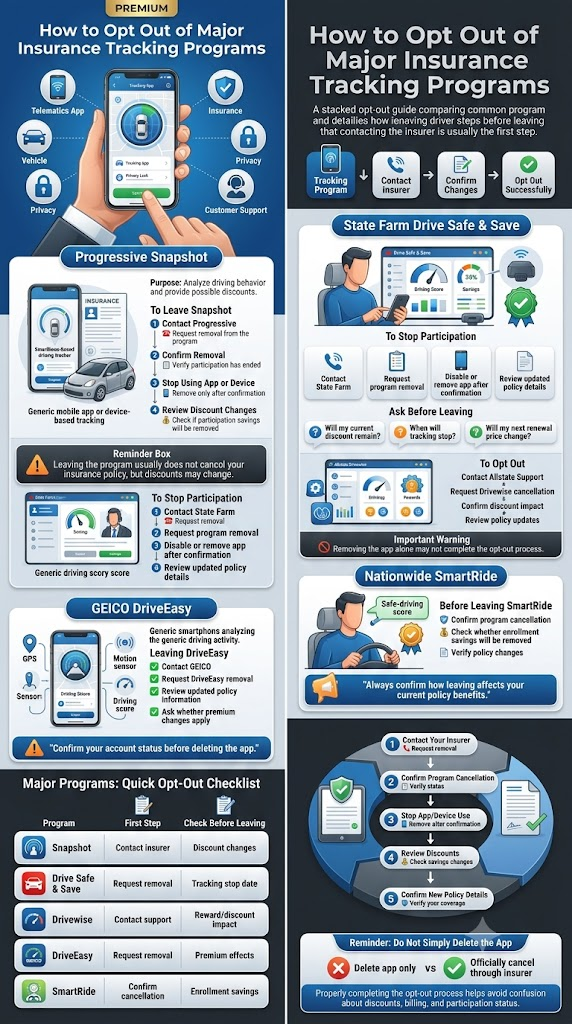
Progressive Snapshot
Progressive Corporation offers the Snapshot program, which tracks driving behavior through a mobile app or device.
Drivers who participate may receive a discount based on their driving habits.
If you decide to leave Snapshot:
- Contact Progressive and request removal
- Stop using the Snapshot app or device after confirmation
- Ask whether any participation discount will be removed
- Confirm your updated premium
Some drivers may see their discount removed after leaving the program, but opting out does not usually cancel their policy.
State Farm Drive Safe & Save
State Farm Drive Safe & Save uses driving information to calculate possible savings.
Drivers who want to stop participation can:
- Contact State Farm
- Request removal from the program
- Disable or remove the app after confirmation
Before leaving, ask:
- Will my current discount remain?
- When will tracking stop?
- Will my next renewal price change?
Allstate Drivewise
Allstate Drivewise monitors driving habits to provide rewards or discounts.
To opt out:
- Contact Allstate customer support
- Request cancellation of Drivewise participation
- Confirm whether your discount will change
Removing the app alone may not complete the opt-out process.
GEICO DriveEasy
GEICO DriveEasy uses smartphone technology to analyze driving behavior.
If you no longer want to participate:
- Contact GEICO
- Request removal from DriveEasy
- Review your updated policy details
Ask whether your premium will be affected after leaving.
Nationwide SmartRide
Nationwide Mutual Insurance Company SmartRide is a telematics program designed to reward safer driving.
Drivers leaving SmartRide should:
- Confirm program cancellation
- Check whether enrollment savings will be removed
- Verify policy changes
How to Lower Insurance Rates Without a Tracking App
Opting out of a tracking program does not mean you cannot save money on car insurance.
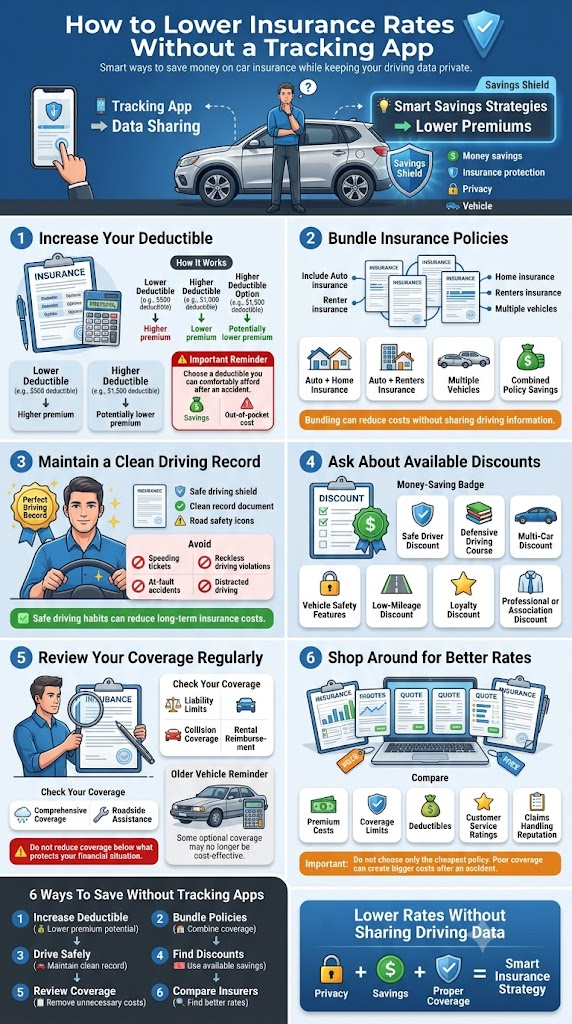
There are many other ways to reduce premiums.
Increase Your Deductible
A higher deductible can reduce your monthly premium.
For example:
- A $500 deductible usually costs more than a $1,000 deductible.
- A $1,500 deductible may lower premiums further.
However, choose a deductible amount you can comfortably afford after an accident.
Bundle Insurance Policies
Many insurers offer discounts when customers combine policies.
Examples:
- Auto insurance + homeowners insurance
- Auto insurance + renters insurance
- Multiple vehicles on one policy
Bundling can provide savings without sharing driving data.
Maintain a Clean Driving Record
Safe driving habits still matter even without telematics.
Avoid:
- Speeding tickets
- Reckless driving violations
- At-fault accidents
- Distracted driving violations
A clean record can help reduce long-term insurance costs.
Ask About Available Discounts
Many drivers miss discounts they already qualify for.
Ask your insurer about:
- Safe driver discounts
- Defensive driving course discounts
- Multi-car discounts
- Vehicle safety feature discounts
- Low-mileage discounts
- Loyalty discounts
- Professional or association discounts
Review Your Coverage Regularly
You may be paying for coverage you no longer need.
Review:
- Liability limits
- Collision coverage
- Comprehensive coverage
- Rental reimbursement
- Roadside assistance
For older vehicles, removing certain optional coverages may reduce premiums.
However, avoid reducing coverage below what protects your financial situation.
Shop Around for Better Rates
Insurance companies calculate risk differently.
A driver who does not receive a telematics discount with one insurer may find a lower premium elsewhere.
Compare:
- Premium costs
- Coverage limits
- Deductibles
- Customer service ratings
- Claims handling reputation
Do not choose only based on the lowest price. A cheaper policy with poor coverage can create problems after an accident.
Pros and Cons of Opting Out of Insurance Tracking Apps
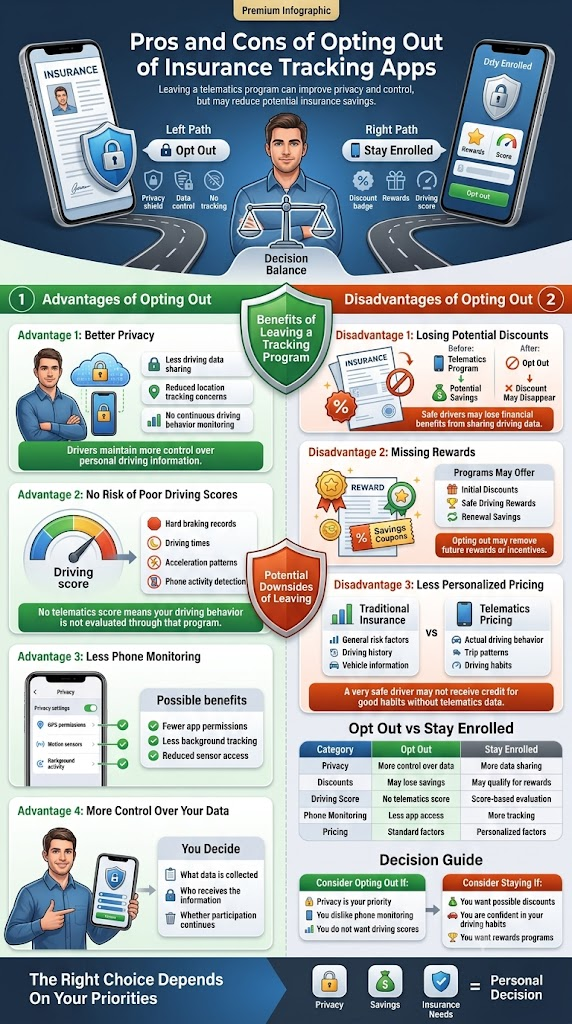
Advantages of Opting Out
Better Privacy
You avoid sharing detailed driving information with your insurer.
No Risk of Poor Driving Scores
Your premium will not be influenced by:
- Hard braking records
- Driving times
- Acceleration patterns
- Phone activity detection
Less Phone Monitoring
You can reduce app permissions and background tracking.
More Control Over Your Data
You decide whether your driving information is collected.
Disadvantages of Opting Out
Losing Potential Discounts
The biggest downside is losing possible savings.
Safe drivers may benefit financially from telematics programs.
Missing Rewards
Some programs provide:
- Initial discounts
- Safe driving rewards
- Renewal savings
Opting out may remove these benefits.
Less Personalized Pricing
Traditional insurance pricing uses broader risk factors.
A very safe driver may not receive credit for good habits without telematics data.
Common Mistakes When Opting Out of an Insurance Tracking App
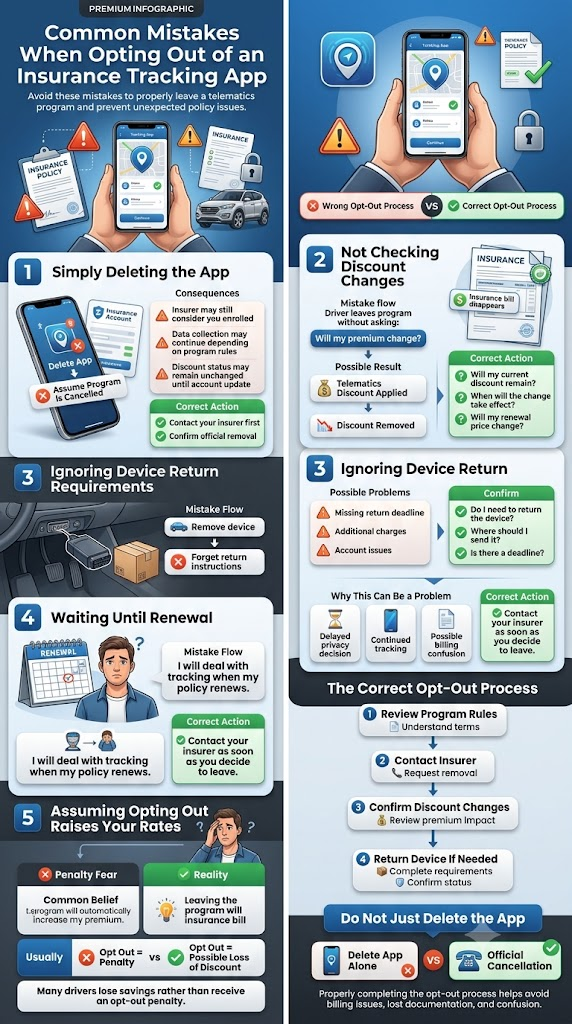
Mistake 1: Simply Deleting the App
Removing the app from your phone does not always cancel enrollment.
The insurer may continue considering you part of the program.
Mistake 2: Not Checking Discount Changes
Some drivers are surprised when their premium changes because they did not confirm whether their discount would remain.
Always ask before leaving.
Mistake 3: Ignoring Device Return Requirements
If you received a physical tracking device, failing to return it may create unnecessary issues.
Mistake 4: Waiting Until Renewal
If you are uncomfortable with tracking, do not wait until your policy renewal date.
Contact your insurer as soon as possible.
Mistake 5: Assuming Opting Out Raises Your Rates
Many drivers avoid leaving telematics because they fear punishment.
In most cases, the main impact is losing a discount, not receiving a penalty.
Final Checklist Before Opting Out of an Insurance Tracking App
Use this checklist before canceling participation:
Confirm Your Decision
☐ Review why you want to leave the program
☐ Check whether privacy concerns, inaccurate scores, or lack of savings are the main reasons
☐ Compare your current discount with potential savings elsewhere
Contact Your Insurance Company
☐ Request official removal from the tracking program
☐ Ask when data collection will stop
☐ Confirm whether your policy will change
☐ Ask whether any discount will be removed
☐ Request written confirmation if available
Review Your Policy Changes
☐ Check your updated premium
☐ Confirm your coverage remains unchanged
☐ Verify your billing amount
☐ Review your next policy documents
Remove Tracking Access
☐ Delete the insurance app after confirmation
☐ Disable location permissions
☐ Remove Bluetooth or device connections
☐ Return any physical tracking device if required
Save Documentation
Keep:
☐ Confirmation emails
☐ Cancellation details
☐ Customer service reference numbers
☐ Updated policy documents
This can help resolve any future disputes.
Questions to Ask Your Insurance Company Before Opting Out
Before leaving a telematics program, ask these questions:
About Your Premium
- Will my insurance rate change after opting out?
- Will I lose my current discount?
- Is there any cancellation fee?
- Will my renewal price be affected?
About Your Data
- What driving information has been collected?
- How long will my data be stored?
- Can I request deletion of my data?
- Is my information shared with third parties?
- Who can access my driving records?
About Future Participation
- Can I rejoin the program later?
- Will I qualify for the same discount if I return?
- Can I switch to another savings program?
Who Should Consider Opting Out of Insurance Tracking Apps?
Not every driver benefits from telematics programs.
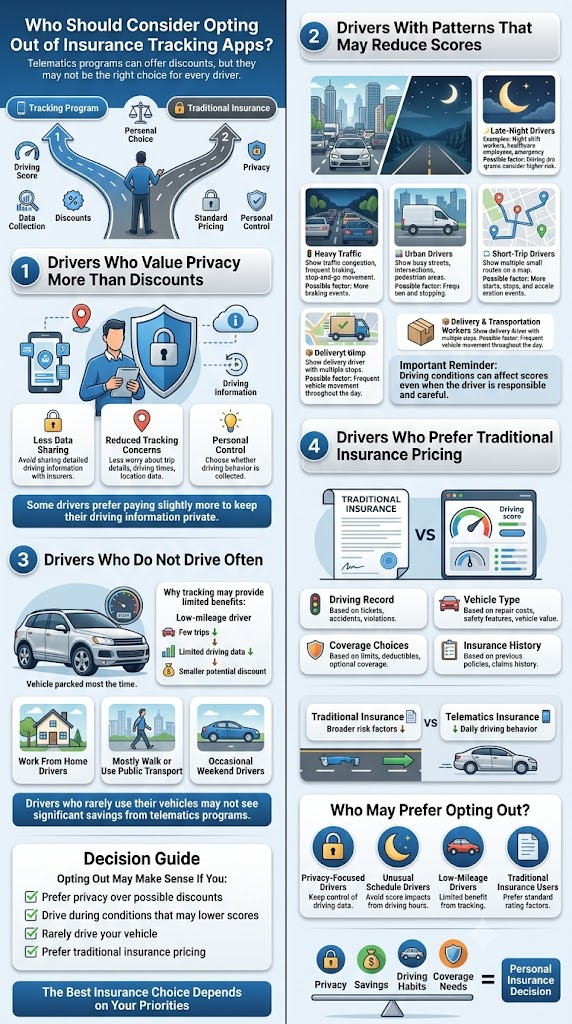
Opting out may make sense for drivers who:
Value Privacy More Than Discounts
Some drivers are comfortable paying slightly more to avoid sharing detailed driving information.
For these drivers, privacy may be more important than potential savings.
Have Driving Patterns That May Reduce Scores
Telematics programs may not work well for people who:
- Drive during late-night hours
- Commute in heavy traffic
- Frequently drive in urban areas
- Make many short trips
- Work in delivery or transportation jobs
These driving conditions may affect scores even when the driver is responsible.
Do Not Drive Often
Low-mileage drivers may not always benefit significantly from tracking programs, especially if the discount is small.
Prefer Traditional Insurance Pricing
Some drivers prefer premiums based on traditional factors such as:
- Driving record
- Vehicle type
- Coverage choices
- Insurance history
They may not want their premium connected to daily driving behavior.
Who May Benefit From Keeping an Insurance Tracking App?
Opting out is not always the best financial decision.
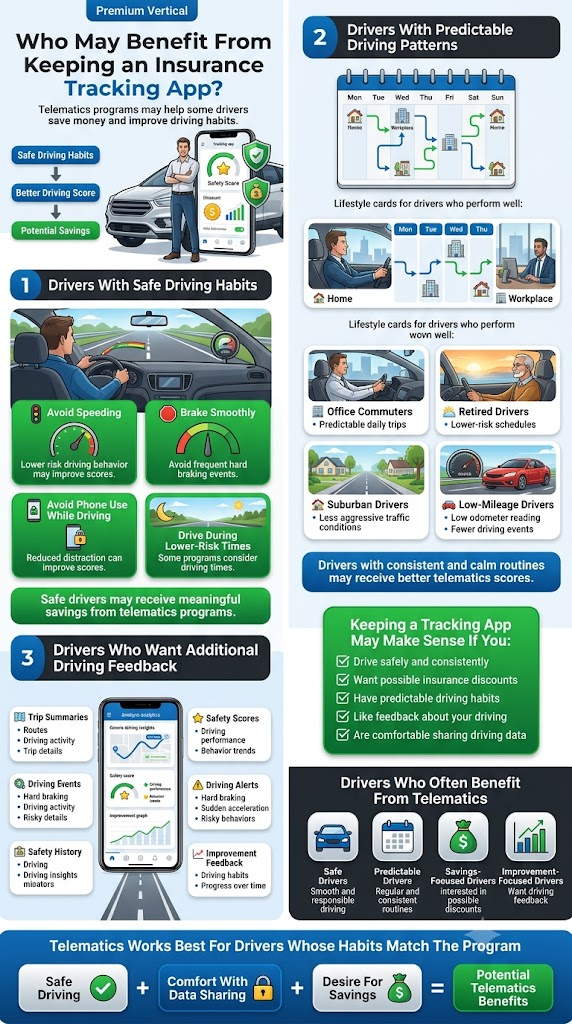
Telematics may benefit drivers who:
Have Safe Driving Habits
Drivers who consistently:
- Avoid speeding
- Brake smoothly
- Avoid phone use while driving
- Drive during lower-risk times
may receive meaningful discounts.
Drive Predictably
Drivers with regular schedules and calm driving patterns often perform well in these programs.
Examples:
- Office commuters
- Retired drivers
- Suburban drivers
- Low-mileage drivers
Want Additional Driving Feedback
Some programs provide insights that help drivers improve habits.
Features may include:
- Trip summaries
- Safety scores
- Driving alerts
- Feedback on risky behaviors
Are Insurance Tracking Apps Worth It?
Whether a tracking app is worth using depends on your priorities.
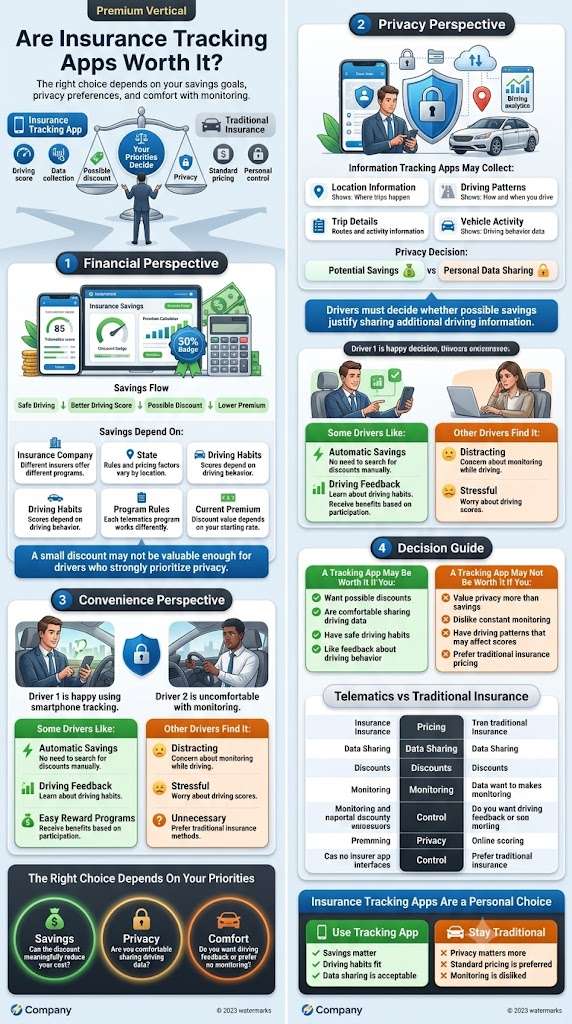
Financial Perspective
A safe driver may save money through telematics.
However, savings vary depending on:
- Insurance company
- State
- Driving habits
- Program rules
- Current premium
A small discount may not be worth it for someone who strongly values privacy.
Privacy Perspective
Tracking apps collect information that traditional insurance policies do not require.
Drivers should decide whether potential savings justify sharing:
- Driving patterns
- Location information
- Trip details
- Vehicle activity
Convenience Perspective
Some drivers enjoy automatic savings and driving feedback.
Others find tracking:
- Distracting
- Stressful
- Unnecessary
The right choice depends on personal comfort.
Alternatives to Insurance Tracking Apps
If you want lower insurance costs without telematics, consider these options:
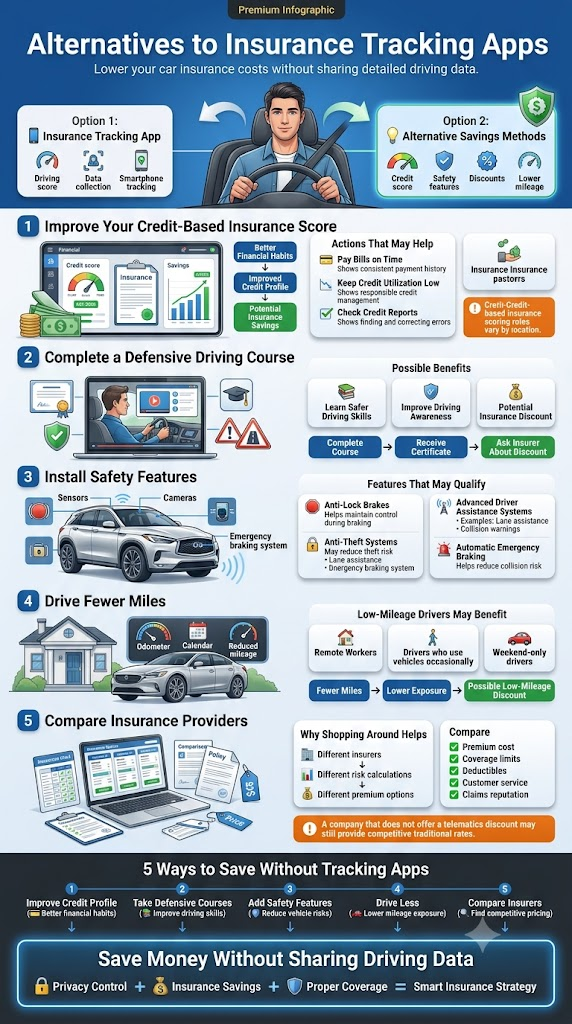
Improve Your Credit-Based Insurance Score
In states where insurers can use credit-based insurance scores, maintaining good financial habits may help reduce premiums.
Actions that may help include:
- Paying bills on time
- Keeping credit utilization low
- Checking credit reports for errors
Complete a Defensive Driving Course
Many insurers offer discounts for approved safety courses.
These courses can help drivers improve skills while reducing insurance costs.
Install Safety Features
Some vehicles qualify for discounts because of features such as:
- Anti-lock brakes
- Anti-theft systems
- Advanced driver assistance systems
- Automatic emergency braking
Drive Fewer Miles
Some insurers offer low-mileage discounts for drivers who do not use their vehicles frequently.
Compare Insurance Providers
Different insurers evaluate risk differently.
A driver who does not want telematics may find better pricing with another company that offers competitive traditional rates.
Final Thoughts: How to Opt Out of an Insurance Tracking App Without Penalty
Opting out of an insurance tracking app is usually possible without losing your insurance coverage or facing a direct penalty.
The most common consequence is losing a telematics discount rather than receiving a surcharge.
Before leaving a program:
- Contact your insurer directly
- Confirm how your premium will change
- Understand what happens to your data
- Remove app access properly
- Keep confirmation records
Insurance tracking apps can provide savings for some drivers, but they are not the only way to reduce car insurance costs. The best choice depends on your driving habits, privacy preferences, and financial priorities.
A driver should choose the option that provides the right balance between affordable coverage, privacy, and peace of mind.