


Many parents ask the same question when their son or daughter leaves home:
Can I keep my adult child on my car insurance if they move out?
The answer is sometimes, but it depends on several factors.
Most insurance companies consider where your child lives, who owns the vehicle, whether they are financially independent, and the insurer’s specific underwriting rules.
Keeping someone on your policy when they no longer qualify could lead to denied claims, policy cancellation, or accusations of misrepresentation.
This guide explains everything you need to know before deciding whether your adult child should remain on your auto insurance policy.
Can I Keep My Adult Child on My Car Insurance If They Move Out?
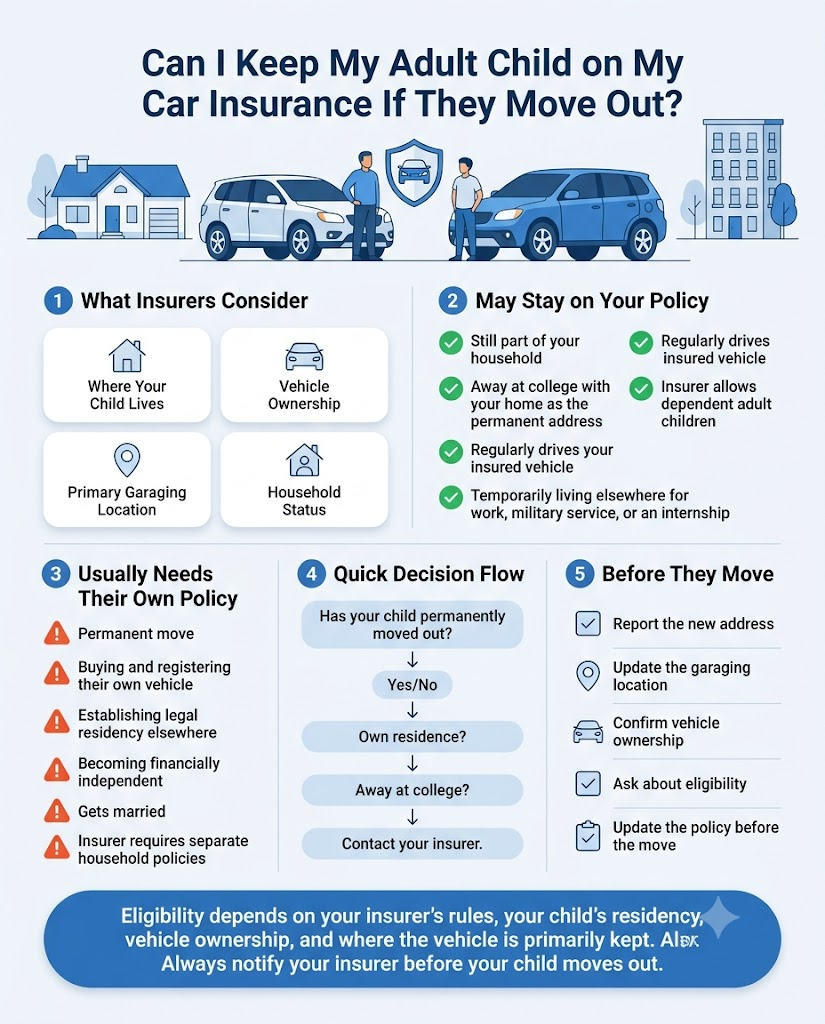
There is no universal rule.
Whether your adult child can remain on your car insurance depends on your insurance company’s underwriting guidelines and your family’s specific circumstances.
Insurers generally consider factors such as where your child lives, who owns the vehicle, where the vehicle is primarily parked, and whether your child is still considered a member of your household.
Your adult child may be able to stay on your policy if:
- They are still considered part of your household.
- They are away at college but maintain your home as their permanent residence.
- They regularly drive a vehicle insured under your policy.
- Your insurer allows dependent adult children to remain insured.
- They are temporarily living elsewhere due to work, military service, or an internship but still maintain strong ties to your household.
Your adult child will usually need their own policy if:
- They permanently move to another home.
- They purchase and register their own vehicle.
- They establish legal residency at a different address.
- They are financially independent and no longer part of your household.
- They get married and form a separate household.
- Your insurer requires separate policies for drivers who live at different addresses.
Because every insurance company has its own eligibility requirements, it’s important to notify your insurer before your child moves out.
Updating your policy promptly can help ensure you have the correct coverage and avoid potential issues if you need to file a claim.
Why Insurance Companies Care Where Someone Lives
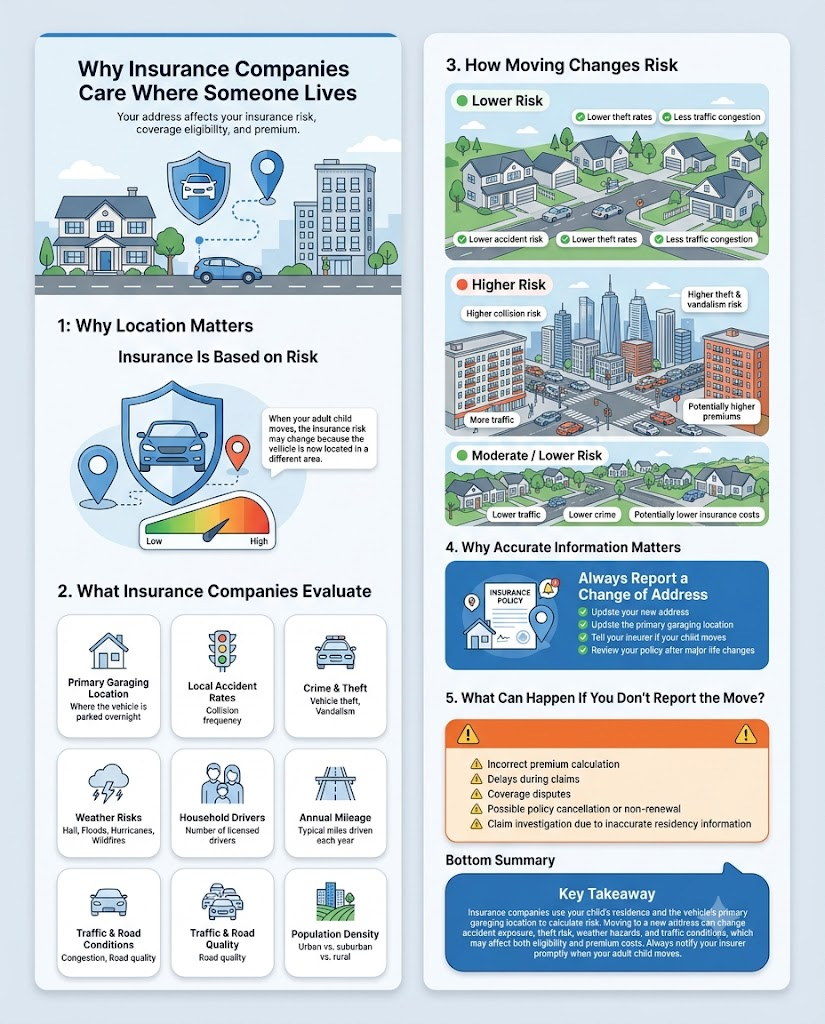
Car insurance premiums are based on risk, and one of the biggest factors insurers consider is where a driver and their vehicle are primarily located.
When your adult child moves to a new address, the level of risk associated with insuring them may change, which can affect both eligibility and premium costs.
Insurance companies evaluate several factors, including:
- Where the vehicle is parked overnight (primary garaging location)
- Local accident rates
- Vehicle theft and crime rates
- Weather-related risks, such as hail, floods, hurricanes, or wildfires
- The number of licensed drivers in the household
- Typical annual mileage
- Road conditions and traffic density
- Population density and urban versus rural locations
When your adult child moves out, many of these factors can change significantly.
For example, a driver relocating from a quiet suburban neighborhood to a busy downtown area in Chicago may face a higher likelihood of accidents, vehicle theft, or vandalism.
Likewise, moving from a low-risk rural community to a densely populated city can increase insurance costs because claims tend to occur more frequently in urban areas.
On the other hand, moving to a smaller town with lighter traffic and lower crime rates could potentially reduce the overall risk.
Because insurance premiums are calculated using these location-based factors, insurers need accurate residency and vehicle garaging information.
Failing to report a change of address could result in an incorrect premium, delays during the claims process, or, in some cases, reduced coverage or policy cancellation if the insurer determines that important information was not disclosed.
What Does “Household Member” Mean?
One of the most important terms in auto insurance is household member because it often determines who can be covered under the same policy.
While the exact definition varies by insurance company, a household member is generally someone who:
- Lives in your home most of the time
- Shares your primary residence
- Has regular access to your insured vehicles
- Is expected to drive your vehicles on a regular basis
Insurance companies use this definition because people living in the same household usually have frequent access to each other’s vehicles, which affects the overall risk of the policy.
Someone who permanently lives at another address is generally not considered a household member, even if they visit often or borrow your car occasionally.
However, there are exceptions. For example, many insurers continue to consider full-time college students as members of their parents’ household if the family home remains their permanent residence.
If your adult child has permanently moved out, established a new residence, or formed a separate household, your insurer may require them to have their own auto insurance policy.
Does Age Matter?
Surprisingly, age alone is usually not the deciding factor when determining whether your adult child can stay on your car insurance.
Whether your child is:
- 19 years old
- 22 years old
- 27 years old
- 35 years old
the more important question for most insurers is:
Where do they live?
Insurance companies generally place greater importance on residency and household status than on a driver’s age. A 30-year-old who still lives with their parents may be eligible to remain on the family policy if the insurer’s guidelines allow it.
On the other hand, a 20-year-old who has permanently moved into their own apartment may need a separate policy because they are no longer part of the same household.
Age can still influence how much you pay for insurance. Younger drivers often have higher premiums due to their limited driving experience and higher statistical accident risk.
However, when it comes to whether your adult child can remain on your policy, residency, vehicle ownership, and the insurer’s underwriting rules are usually far more important than their age.
Situations Where Your Adult Child May Stay on Your Policy
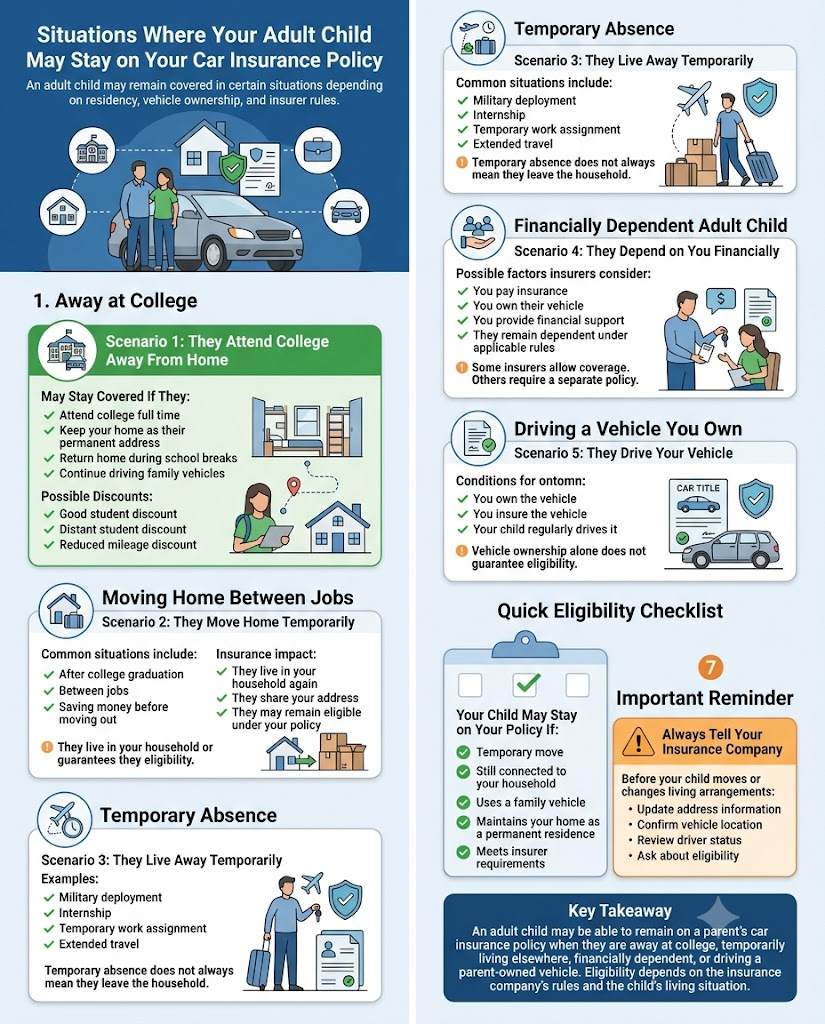
When an adult child moves out, they do not always need to immediately purchase their own car insurance policy.
In some situations, insurance companies may allow them to remain covered under a parent’s policy, depending on factors such as residency, vehicle ownership, financial dependency, and the insurer’s specific rules.
Let’s look at the most common situations where your adult child may be able to stay on your policy.
Scenario 1: They Attend College Away From Home
This is one of the most common exceptions.
Many insurance companies allow full-time college students to remain on their parent’s auto insurance policy even if they live away from home during the school year.
Typically, insurers may require that the student:
- Attends college full time
- Maintains the parent’s home as their permanent residence
- Plans to return home during school breaks
- Does not establish a permanent household elsewhere
- Continues to have access to or drive vehicles insured under the family policy
Because college students often move temporarily for education rather than permanently establishing a new residence, many insurers still consider them part of the household.
In addition, families may qualify for discounts such as:
- Good student discounts
- Distant student discounts
- Low-mileage discounts
These discounts can help reduce the cost of keeping a young driver insured.
Example
Emily attends college 250 miles away from her parents’ home.
She lives in a dorm for nine months each year but returns home during summer and holidays. Her driver’s license and permanent address remain connected to her parents’ home, and she uses the family vehicle when visiting.
In many cases, Emily may be allowed to remain on her parents’ auto insurance policy.
However, families should still notify their insurer because requirements vary between companies.
Scenario 2: They Move Home Between Jobs
Another common situation occurs when an adult child temporarily moves back home.
Examples include:
- Returning home after graduation
- Looking for employment
- Recovering financially after losing a job
- Saving money before getting their own place
If your child actually lives in your home, shares your address, and has access to your vehicles, insurers generally consider them part of the household.
Because they are once again living at the same residence, keeping them on your policy is often straightforward.
However, you should still update your insurer if their living situation changes.
Scenario 3: They Live Away Temporarily
Some adult children leave home for short-term situations but do not establish a permanent residence elsewhere.
Examples include:
- Military deployment
- Temporary work assignments
- Internships
- Seasonal employment
- Extended travel
In these situations, some insurers may allow the child to remain on the parent’s policy, especially if:
- The absence is temporary
- They maintain their original home address
- They continue to have ties to the household
Insurance rules can vary significantly, so it is important to confirm coverage before the temporary move begins.
Scenario 4: They Depend Financially on You
Financial dependency can sometimes affect whether an adult child can remain on a parent’s policy.
Some insurers may consider factors such as:
- Whether you provide financial support
- Whether you own the vehicle they drive
- Whether you pay their insurance costs
- Whether they are still considered a dependent under applicable rules
Example
Your 24-year-old daughter rents an apartment, but:
- You pay her tuition
- You own the vehicle she drives
- You pay her insurance premium
- You continue providing significant financial support
Some insurers may allow her to remain covered.
Other companies may require her to obtain her own policy because she has a separate residence.
Because insurance companies handle these situations differently, it is important to ask your insurer directly.
Scenario 5: They Drive a Vehicle You Own
Vehicle ownership is another important factor.
A parent-owned vehicle may sometimes remain insured under the parent’s policy even when an adult child drives it.
For example:
- You own the vehicle title
- You pay the insurance premium
- The vehicle is insured under your policy
- Your child regularly drives the vehicle
Some insurers may allow this arrangement.
However, you must still provide accurate information about:
- Where your child lives
- Where the vehicle is usually parked
- How frequently your child drives it
- Who the primary driver is
Simply owning the vehicle does not automatically guarantee that your child can remain covered.
If your child has moved out permanently and keeps the vehicle at their own residence, the insurer may require policy changes or a separate policy.
Key Takeaway
An adult child may be able to stay on a parent’s car insurance policy if their move is temporary, they remain connected to the household, or the insurer allows continued coverage under specific circumstances.
The most common situations include:
✔ Attending college away from home
✔ Temporarily moving back home
✔ Short-term work or military assignments
✔ Remaining financially dependent
✔ Driving a parent-owned vehicle
However, every insurance company has different rules. Always notify your insurer about changes in residence, vehicle use, and ownership to make sure your coverage remains valid.
When Your Adult Child Usually Needs Their Own Insurance
Most insurers require separate coverage once your child establishes an independent household.
Common examples include:
- Renting an apartment
- Buying a house
- Getting married
- Purchasing their own vehicle
- Permanently relocating
- Starting a full-time career in another city
These changes often signal that your child is no longer part of your household for insurance purposes.
Does Vehicle Ownership Matter?
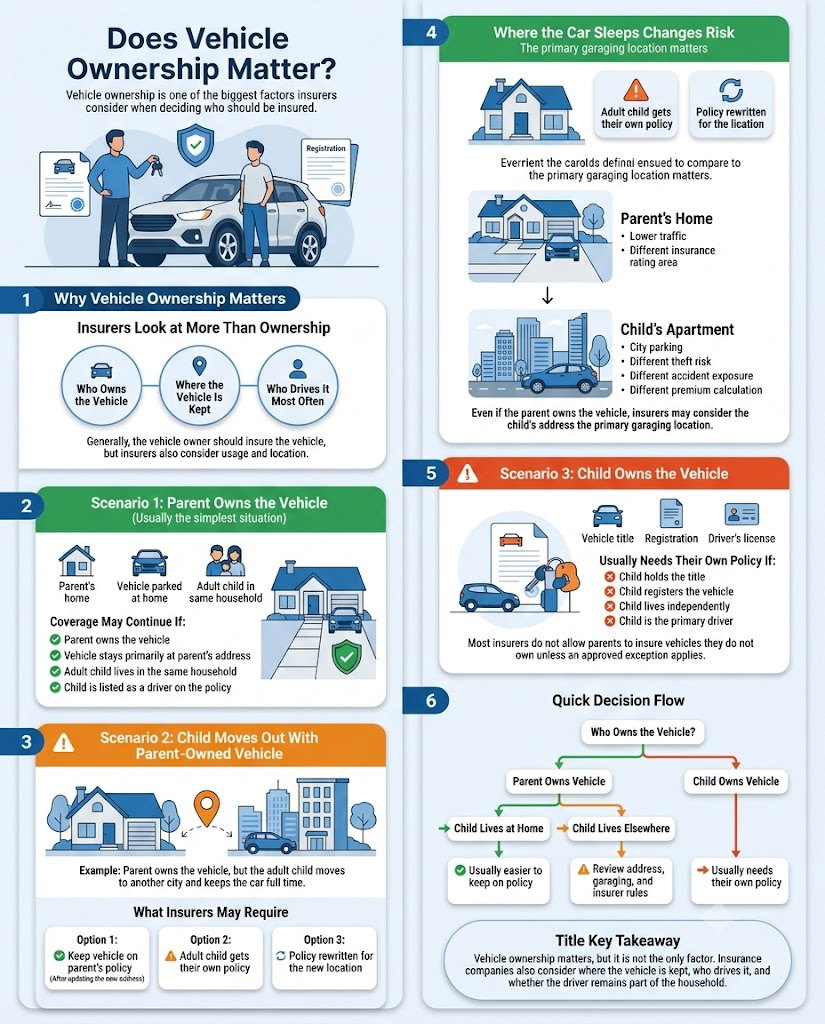
Yes. Vehicle ownership is one of the biggest factors insurers consider.
Generally, the owner of a vehicle should insure it. However, insurance companies also look at who drives the vehicle most often and where it is kept.
Here are some common situations.
Parent Owns the Car, Adult Child Lives at Home
This is the simplest situation.
If:
- The parent owns the vehicle
- The vehicle is primarily kept at the parent’s address
- The adult child lives in the same household
The child can usually remain on the parent’s policy.
Parent Owns the Car, Adult Child Moves Out
This situation is more complicated.
Suppose:
- You own the vehicle.
- Your 25-year-old son moves to another city.
- He keeps the car with him full time.
- The car is parked overnight at his apartment.
Even though you own the vehicle, many insurers will consider the new address the primary garaging location.
Some insurers may:
- Allow the vehicle to remain on your policy after updating the address
- Require your child to obtain their own policy
- Require the policy to be rewritten for the new location
Never assume ownership alone allows you to keep the same coverage.
Adult Child Owns the Vehicle
If your child:
- Holds the title
- Registers the vehicle
- Lives independently
They will usually need their own insurance policy.
Most insurers do not allow parents to insure vehicles they do not own unless there is an approved exception.
What Happens If Your Adult Child Moves to Another State?
Moving to another state often changes the insurance requirements.
Each state has its own rules regarding:
- Minimum liability limits
- Personal injury protection (PIP)
- Uninsured motorist coverage
- Registration requirements
- Insurance filing deadlines
For example:
If your daughter moves from Texas to Florida, she may need:
- A Florida driver’s license
- Florida vehicle registration
- An insurance policy that meets Florida requirements
Keeping her on your Texas policy indefinitely may not comply with state laws or insurer rules.
Can My Child Keep My Address for Insurance?
Some parents wonder if their child can simply continue using the family address.
Doing so may be acceptable if the address is still the child’s legal and primary residence, such as when they are away at college.
However, using your address after permanently moving elsewhere can create serious problems.
If an insurer discovers that:
- The vehicle is regularly kept somewhere else
- The driver actually lives elsewhere
- The policy lists an incorrect garaging address
It may:
- Increase the premium
- Adjust coverage
- Cancel or non-renew the policy
- Investigate claims more closely
Providing inaccurate residency information can also be considered material misrepresentation.
What Is “Primary Garaging”?
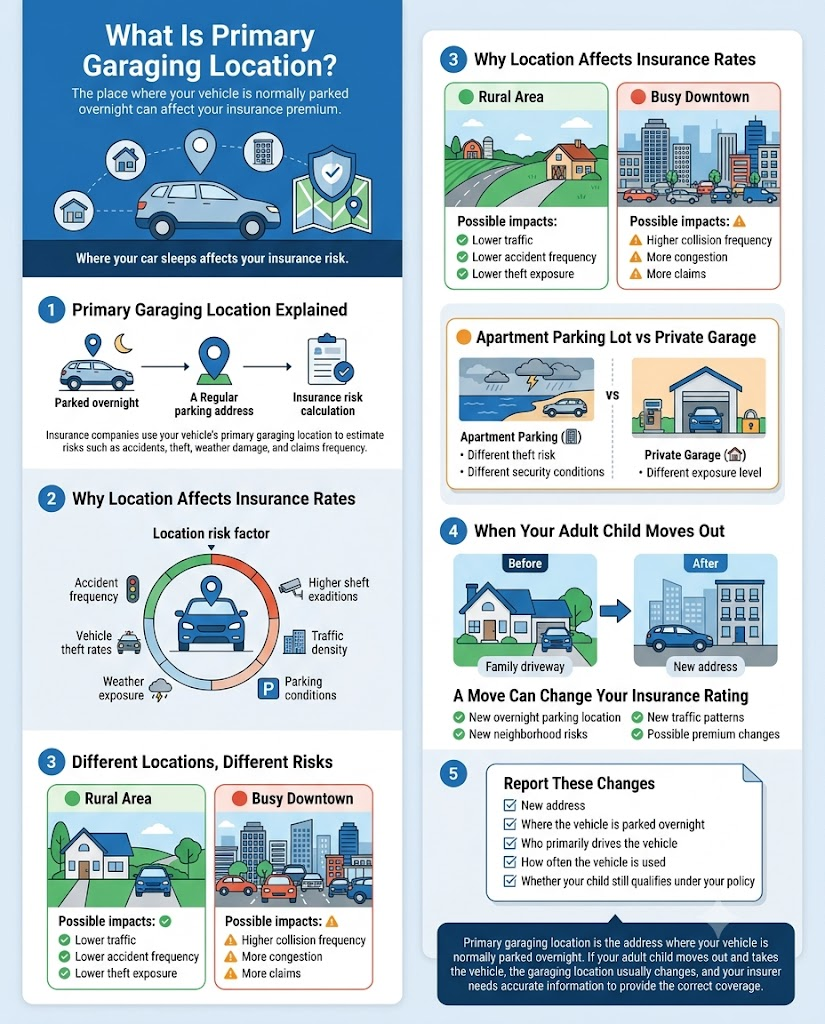
Insurance companies want to know where a vehicle is normally parked overnight.
This is called the primary garaging location.
It affects premiums because different neighborhoods have different risks.
For example:
| Garaging Location | Possible Impact |
|---|---|
| Rural area | Lower accident and theft risk |
| Busy downtown | Higher collision frequency |
| High-crime neighborhood | Higher theft risk |
| Coastal region | Greater storm exposure |
| Apartment parking lot | Different risk than a private garage |
If your adult child moves out and takes the vehicle, the garaging location usually changes.
Your insurer needs to know about that change.
How Insurance Companies Verify Residency
Insurance companies have several ways to confirm where drivers live.
They may compare information from:
- Driver’s license records
- Vehicle registration
- Credit-related address records (where permitted by law)
- Claim investigations
- Accident reports
- Repair shop records
- Public records
- Policy applications
If the listed address does not match where the vehicle is actually kept, the insurer may ask for additional documentation.
What If My Child Rarely Drives?
Driving frequency also matters.
If your adult child only occasionally borrows your vehicle while visiting home, they may not need to be listed as a regular driver, depending on your insurer’s rules and whether permissive use applies.
However, if they regularly use one of your vehicles, even if they live elsewhere, you should discuss the situation with your insurer to determine whether they should be listed on the policy.
Can Married Adult Children Stay on Their Parents’ Policy?
Usually, no.
Marriage often means the child has formed a separate household.
If they:
- Live with their spouse
- Own or jointly own a vehicle
- Have a different permanent address
They will generally need their own insurance policy.
If they temporarily live with you after marriage, your insurer can explain whether they qualify to remain on your policy during that period.
Common Mistakes Parents Make
Keeping an adult child on your policy when they no longer qualify can create unexpected problems.
Some common mistakes include:
Not Reporting a Move
Parents sometimes forget to notify the insurer after their child relocates.
Even if coverage continues temporarily, failing to report a change in residency could affect future claims.
Assuming College Rules Apply Forever
Many insurers make exceptions for full-time students.
Those exceptions often end once the student graduates or establishes a permanent residence elsewhere.
Ignoring Vehicle Ownership
If the adult child owns and registers the vehicle, they will often need a policy in their own name.
Using the Wrong Garaging Address
Listing the parents’ home as the vehicle’s location when it is actually kept elsewhere can result in incorrect premiums and potential coverage issues.
Never Reviewing the Policy
Families often renew the same policy year after year without updating driver information.
Any major life change should prompt a review of the policy details.
Does Keeping Your Adult Child on Your Policy Save Money?
In many cases, yes.
Family auto insurance policies are often less expensive than purchasing separate policies because insurers may offer:
- Multi-driver discounts
- Multi-vehicle discounts
- Loyalty discounts
- Bundling discounts
- Lower administrative costs
However, those savings only apply if your child is eligible to remain on your policy.
Trying to save money by keeping someone on a policy when they no longer qualify could lead to much greater financial consequences if a claim is denied or the policy is canceled.
Will My Premium Go Up If My Child Moves Out?
It depends.
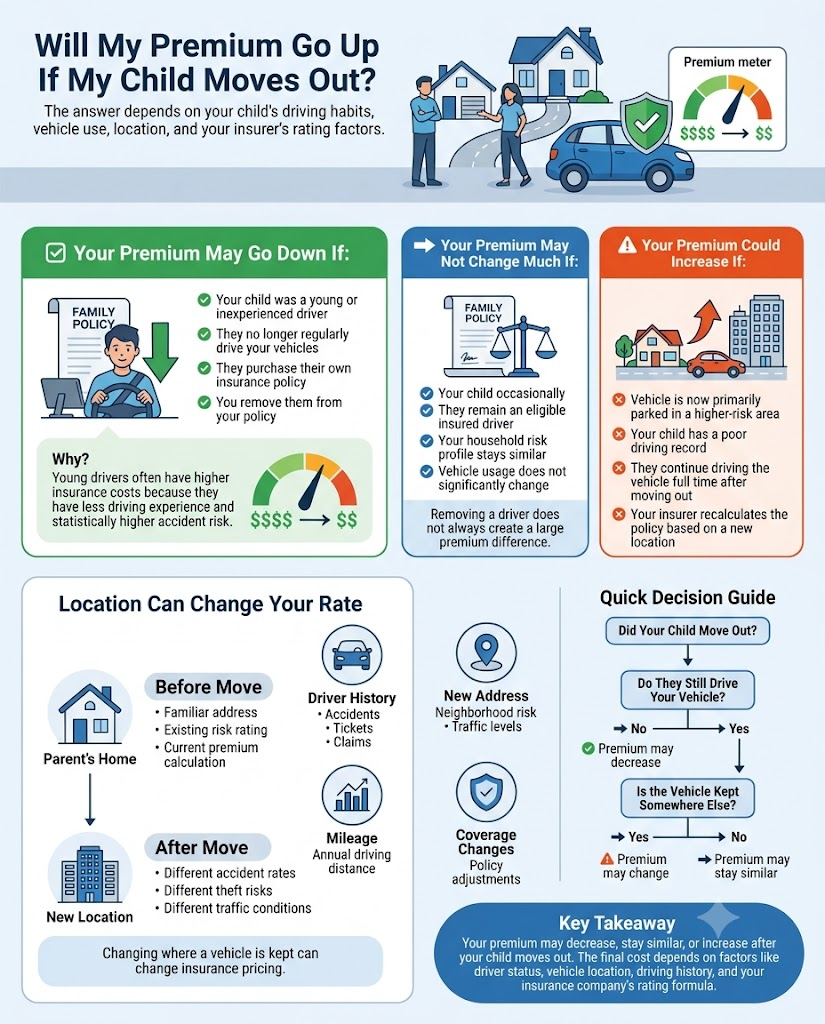
Several factors influence your premium after your adult child leaves home.
Your Premium May Decrease If
- Your child was a young or inexperienced driver.
- They no longer regularly drive your vehicles.
- They purchase their own insurance.
- You remove them from your policy.
Young drivers are statistically involved in more accidents, so removing them may lower your premium.
Your Premium May Stay About the Same If
- Your child still occasionally drives your vehicle.
- They remain an eligible insured under your policy.
- The overall risk profile of your household does not change significantly.
Your Premium Could Increase If
- The insured vehicle is now primarily garaged in a higher-risk area.
- Your child has a poor driving record.
- They continue driving the vehicle full time after moving out.
- Your insurer updates the policy based on the new location.
Every insurer uses its own rating formula, so there is no universal answer.
What Should You Do Before Your Child Moves Out?
A little planning can prevent coverage problems later.
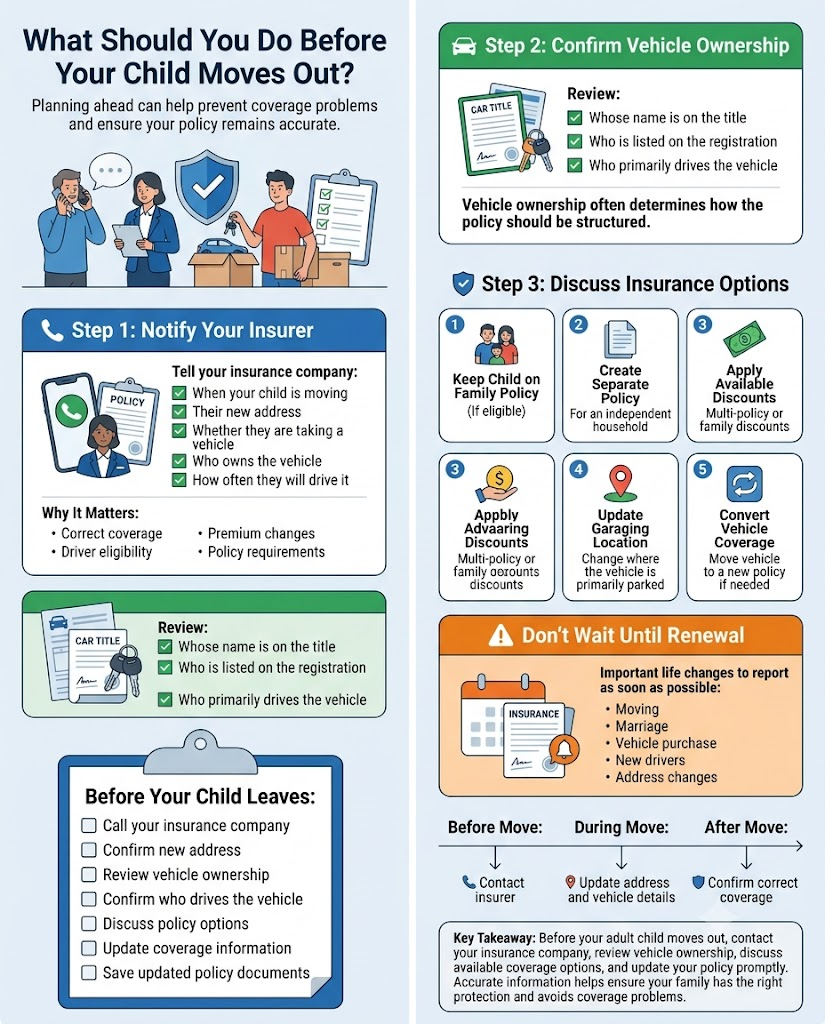
Contact Your Insurance Company
Tell your insurer:
- When your child is moving
- Their new address
- Whether they are taking a vehicle
- Who owns the vehicle
- How often they will drive it
This allows the insurer to determine the correct coverage.
Review Vehicle Ownership
Determine:
- Whose name is on the title
- Who is listed on the registration
- Who primarily uses the vehicle
Ownership often affects how the policy should be written.
Ask About Available Options
Your insurer may offer solutions such as:
- Keeping your child on the family policy
- Creating a separate policy with the same insurer
- Applying multi-policy discounts
- Adjusting the garaging location
- Converting the vehicle to a new policy
Update Your Policy Promptly
Do not wait until renewal.
Life changes should be reported as soon as practical, including:
- Moving
- Marriage
- Vehicle purchases
- New drivers
- Address changes
Prompt updates help ensure your policy reflects your current situation.
Questions to Ask Your Insurance Company
Before deciding whether your adult child should remain on your policy, consider asking:
- Can my adult child stay on my policy after moving out?
- Does your company define them as a household member?
- Does attending college change the rules?
- Can they stay on my policy if I own the vehicle?
- Will moving to another state require a separate policy?
- Will my premium change?
- Are there discounts available if they start their own policy?
- Should the vehicle’s garaging address be updated?
- Does marriage affect eligibility?
- What documentation do you need after the move?
Getting clear answers in advance can help avoid misunderstandings later.
Key Takeaways
- Adult children can sometimes remain on a parent’s car insurance, but eligibility depends on the insurer’s rules.
- Residency is usually more important than age.
- Full-time college students often qualify to stay on a parent’s policy while attending school away from home.
- Permanent moves, marriage, buying a vehicle, or establishing a separate household often require a new policy.
- Vehicle ownership and the primary garaging location are important factors.
- Always inform your insurance company when your child moves or there is a major life change.
- Keeping policy information accurate helps avoid coverage disputes and unexpected claim issues.
Conclusion
So, can you keep your adult child on your car insurance if they move out? The answer is it depends on the circumstances and your insurer’s requirements.
A temporary move for college or a short-term absence may still allow your child to remain on your policy. However, if they establish a permanent residence, purchase their own vehicle, get married, or become financially independent, they will often need separate coverage.
Because every insurance company has its own underwriting guidelines, the safest approach is to contact your insurer before the move.
Confirm whether your child remains eligible, update any changes to the vehicle’s garaging location or ownership, and make sure your policy accurately reflects your family’s current situation.
Taking these steps can help you maintain the right coverage and avoid surprises if you ever need to file a claim.