

Buying a vehicle comes with ongoing financial responsibilities. While regular maintenance can help prevent many problems, unexpected mechanical failures can still happen. A transmission failure, engine issue, electrical malfunction, or major repair can cost thousands of dollars.
Many vehicle owners look for protection beyond the manufacturer’s warranty and often compare two options: mechanical breakdown insurance vs extended warranty.
Although both options help cover expensive repairs, they work differently. One is an insurance product, while the other is a service contract designed to extend repair coverage after the original warranty expires.
Understanding the differences between mechanical breakdown insurance and extended warranty coverage can help you choose the right protection based on your vehicle, budget, and risk level.
What Is Mechanical Breakdown Insurance?
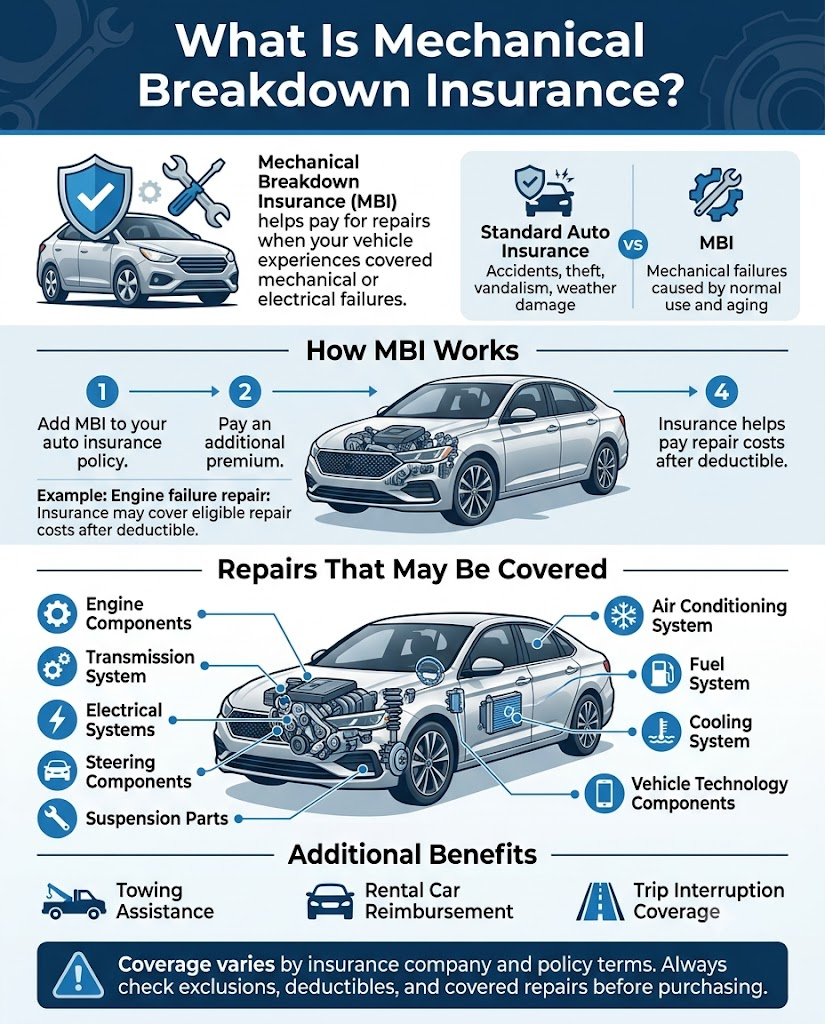
Mechanical breakdown insurance (MBI) is a type of auto insurance coverage that helps pay for repairs when your vehicle experiences certain mechanical or electrical failures.
Unlike standard auto insurance, which typically covers accidents, theft, vandalism, and weather-related damage, mechanical breakdown insurance focuses on failures caused by normal use and aging.
MBI works similarly to other insurance coverages. You pay a premium to add the coverage to your auto insurance policy, and if a covered mechanical problem occurs, the insurer helps pay for eligible repairs after you meet the deductible.
For example, if your vehicle’s engine fails due to an internal mechanical problem, mechanical breakdown insurance may help cover the repair costs if the failure meets the policy requirements.
Examples of Repairs That May Be Covered by MBI
Coverage varies by insurer, but mechanical breakdown insurance may include protection for:
- Engine components
- Transmission systems
- Electrical systems
- Steering components
- Suspension parts
- Air conditioning systems
- Fuel systems
- Cooling systems
- Certain technology components
Some policies may also include additional benefits such as:
- Towing assistance
- Rental car reimbursement
- Trip interruption coverage
However, coverage depends on the specific insurance company and policy terms.
What Is an Extended Warranty?
An extended warranty, also known as a vehicle service contract, is a protection plan that extends repair coverage after the original manufacturer warranty expires.
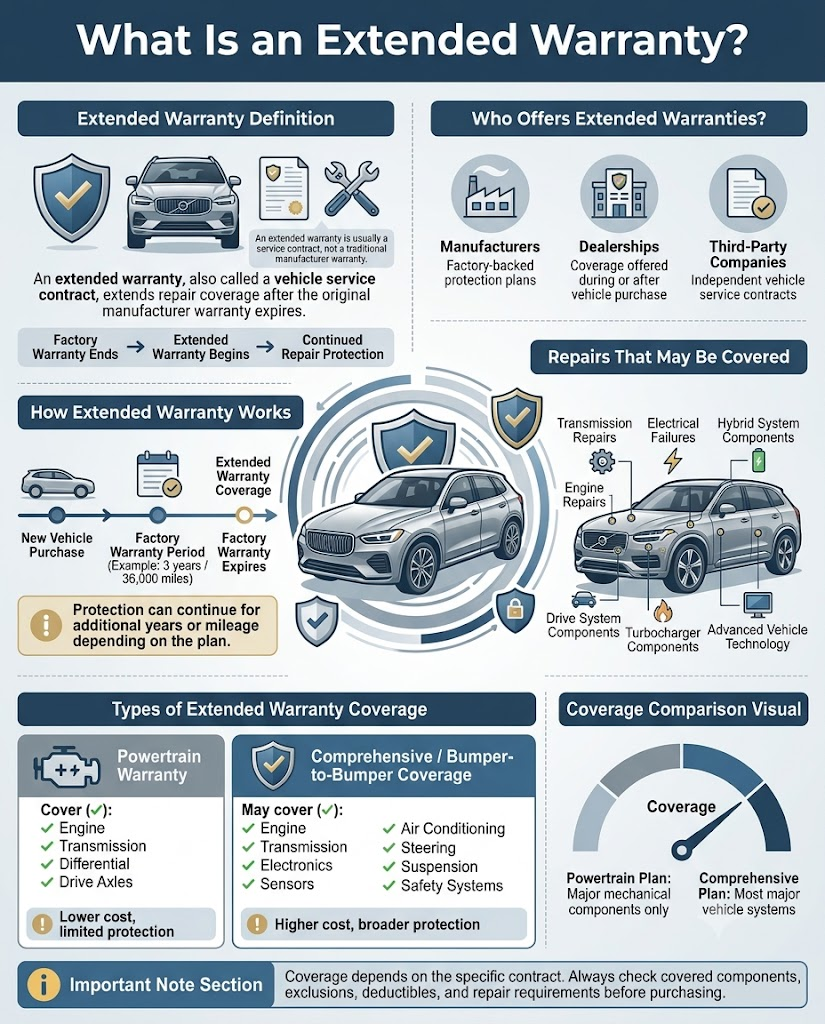
Despite the name, an extended warranty is usually not technically a warranty. It is a contract between the vehicle owner and a provider that outlines which repairs and components are covered.
Extended warranties are commonly offered by:
- Vehicle manufacturers
- Dealerships
- Third-party warranty companies
For example, if your factory warranty expires after 3 years or 36,000 miles, an extended warranty may extend protection for several additional years or miles.
Examples of Repairs That May Be Covered by an Extended Warranty
Depending on the plan, coverage may include:
- Engine repairs
- Transmission repairs
- Drive system components
- Electrical failures
- Turbocharger components
- Hybrid system components
- Advanced vehicle technology
Extended warranty plans usually come in different levels:
Powertrain Warranty
A powertrain plan generally covers major components such as:
- Engine
- Transmission
- Differential
- Drive axles
It is usually the cheapest option but provides limited protection.
Comprehensive or Bumper-to-Bumper Coverage
A more extensive plan may cover:
- Engine
- Transmission
- Electronics
- Sensors
- Air conditioning
- Steering
- Suspension
- Safety systems
These plans cost more because they cover more vehicle components.
Mechanical Breakdown Insurance vs Extended Warranty: Key Difference
The biggest difference between mechanical breakdown insurance and an extended warranty is how they are structured.
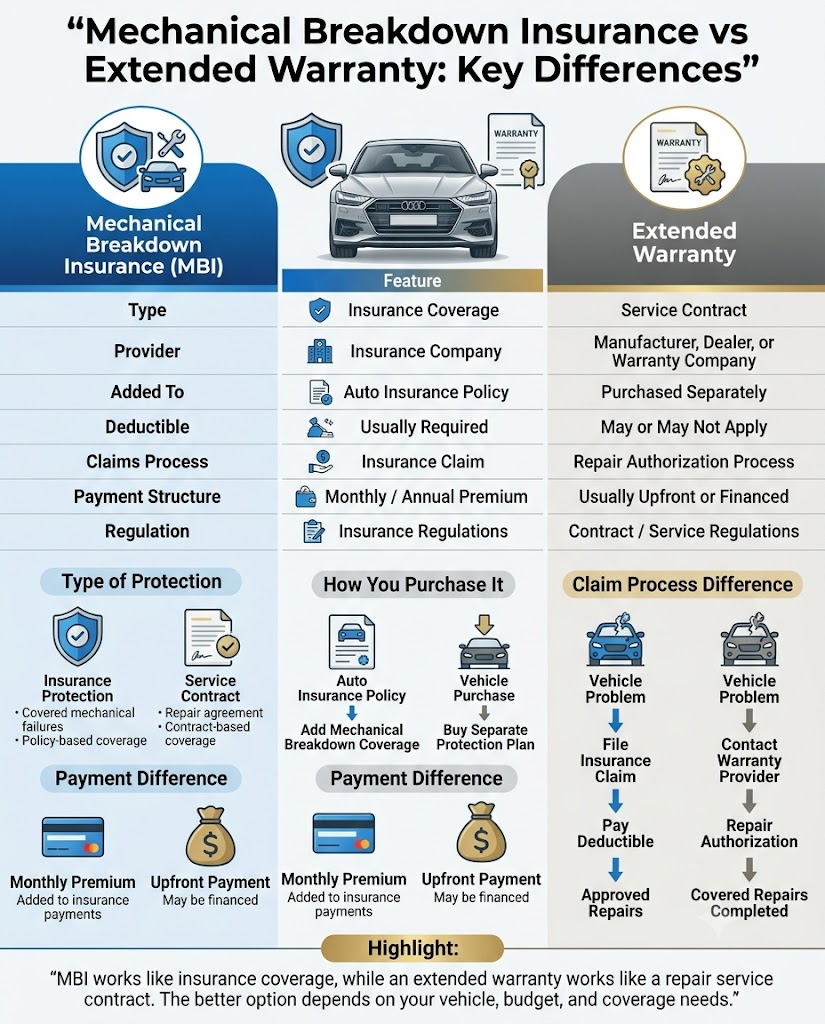
| Feature | Mechanical Breakdown Insurance | Extended Warranty |
|---|---|---|
| Type | Insurance coverage | Service contract |
| Provider | Insurance company | Manufacturer, dealer, or warranty company |
| Added To | Auto insurance policy | Purchased separately |
| Deductible | Usually required | May or may not apply |
| Claims Process | Insurance claim | Repair authorization process |
| Payment Structure | Monthly/annual premium | Usually upfront or financed |
| Regulation | Insurance regulations | Contract/service regulations |
How Mechanical Breakdown Insurance Works
Mechanical breakdown insurance works through your existing auto insurance provider.
You typically:
- Add MBI to your auto insurance policy
- Pay an additional premium
- Continue normal vehicle ownership
- File a claim if a covered mechanical failure occurs
- Pay your deductible
- Insurance pays the remaining approved repair costs
For example:
Your vehicle develops a transmission problem.
- Repair cost: $4,000
- MBI deductible: $250
- Your payment: $250
- Insurance payment: $3,750
The exact amounts depend on your policy limits and coverage terms.
How Extended Warranty Works
An extended warranty works through a service contract provider.
The process usually involves:
- Purchasing the warranty plan
- Taking the vehicle to an approved repair facility
- Getting repair authorization
- Paying any deductible or fees
- The warranty company pays the approved repair amount
For example:
Your vehicle’s turbocharger fails after the factory warranty expires.
- Repair cost: $2,500
- Warranty covers turbocharger repairs
- You pay only the deductible if required
However, warranty providers often have specific rules about maintenance records, approved repair shops, and covered components.
Major Differences Between Mechanical Breakdown Insurance and Extended Warranty
Insurance-Based Protection vs Contract-Based Protection
The most important difference is the legal structure.
Mechanical breakdown insurance is part of an insurance policy. It is regulated like other insurance products and works through the claims process.
An extended warranty is a service contract. It provides coverage according to the terms written in the agreement.
This difference affects:
- Claim handling
- Coverage limits
- Cancellation policies
- Consumer protections
Availability
Mechanical breakdown insurance is not available everywhere and is not offered by every insurance company.
Many insurers only provide MBI for:
- Newer vehicles
- Vehicles below certain mileage limits
- Certain makes and models
Extended warranties are generally more widely available because they can be purchased from manufacturers, dealerships, and third-party providers.
Cost Differences
Mechanical breakdown insurance is often cheaper than an extended warranty because it is added as an insurance option.
Extended warranties usually require a larger upfront payment.
Typical cost factors include:
Mechanical Breakdown Insurance Cost Factors
- Vehicle age
- Vehicle mileage
- Vehicle type
- Driving history
- Insurance company
Extended Warranty Cost Factors
- Coverage level
- Vehicle reliability
- Repair costs
- Contract length
- Mileage limits
A luxury vehicle with expensive parts will usually cost more to protect under either option.
Pros and Cons of Mechanical Breakdown Insurance
Mechanical breakdown insurance can be a valuable option for drivers who want protection against unexpected repair costs without purchasing a traditional extended warranty. However, it also has limitations that should be considered before adding it to your policy.
Advantages of Mechanical Breakdown Insurance
Often More Affordable Than Extended Warranties
One of the biggest advantages of mechanical breakdown insurance is cost.
Because MBI is added to an existing auto insurance policy, the additional premium is often lower than purchasing a separate extended warranty plan.
For drivers who want basic protection against expensive mechanical failures without paying thousands upfront, MBI can be an attractive option.
Easier Integration With Auto Insurance
Since mechanical breakdown insurance is part of your auto insurance policy, managing coverage can be simpler.
You usually have:
- One insurance provider
- One payment system
- One place to manage claims
This can be more convenient than dealing with a separate warranty company.
Coverage for Unexpected Mechanical Failures
Mechanical breakdown insurance can help protect against expensive repairs that are not caused by accidents.
Examples include:
- Engine failure
- Transmission problems
- Electrical system failures
- Cooling system issues
Without coverage, these repairs can create significant financial stress.
Available for Some Used Vehicles
Many drivers assume only new cars can have mechanical protection. However, some insurance companies offer MBI for newer used vehicles that meet eligibility requirements.
This can be useful for people who buy:
- Certified pre-owned vehicles
- Low-mileage used cars
- Recently purchased vehicles outside factory warranty
May Include Additional Benefits
Some mechanical breakdown insurance policies may include benefits beyond repairs, such as:
- Roadside assistance
- Towing
- Rental vehicle reimbursement
- Trip interruption assistance
These benefits can reduce inconvenience when a breakdown occurs away from home.
Disadvantages of Mechanical Breakdown Insurance
Limited Availability
One of the biggest drawbacks of MBI is that it is not offered by every insurance company.
Some insurers only provide it in certain states or for specific vehicles.
Eligibility may depend on:
- Vehicle age
- Mileage
- Vehicle manufacturer
- Vehicle usage
Older vehicles may not qualify.
Coverage May Be More Limited Than Expected
Many drivers assume mechanical breakdown insurance covers every repair. However, policies usually exclude certain items.
Common exclusions may include:
- Routine maintenance
- Oil changes
- Brake pads
- Tires
- Filters
- Wear-and-tear items
- Damage caused by neglect
Always review the policy before purchasing.
Deductibles Apply
Unlike some warranty plans that may cover repairs with minimal out-of-pocket costs, MBI usually requires a deductible.
For example:
- Repair cost: $2,000
- Deductible: $500
- Insurance pays: $1,500
The deductible amount affects the overall value of the coverage.
Coverage Ends After Certain Limits
Mechanical breakdown insurance usually has limits based on:
- Vehicle age
- Mileage
- Policy duration
Once your vehicle exceeds those limits, you may no longer qualify for coverage.
For example, an insurer may only offer MBI until a vehicle reaches:
- 7 years old
- 100,000 miles
The exact limits depend on the insurance provider.
Pros and Cons of Extended Warranty
Extended warranties can provide longer-term protection, especially for drivers who plan to keep their vehicles for many years. However, they also come with potential disadvantages.
Advantages of Extended Warranty
Longer Coverage Period
The biggest benefit of an extended warranty is extending protection beyond the factory warranty.
For example:
A manufacturer warranty may cover:
- 3 years
- 36,000 miles
An extended warranty may provide coverage for:
- 5 years
- 100,000 miles
This can be useful for drivers who keep vehicles long-term.
More Coverage Options
Extended warranties usually offer multiple coverage levels.
You can choose between:
Basic Coverage
Usually protects major mechanical components.
Comprehensive Coverage
May include many systems similar to factory warranty protection.
This allows drivers to select coverage based on their budget and vehicle needs.
Protection Against Rising Repair Costs
Modern vehicles contain expensive technology, including:
- Advanced driver assistance systems
- Sensors
- Touchscreen systems
- Turbochargers
- Hybrid components
A single repair can cost thousands of dollars.
An extended warranty can protect against these unexpected expenses.
Manufacturer-Backed Options Available
Many vehicle manufacturers offer official extended protection plans.
These plans may provide:
- Factory-trained technicians
- Genuine parts
- Authorized repair facilities
- Better compatibility with the vehicle
This can provide more confidence compared with some third-party warranty providers.
May Increase Vehicle Resale Appeal
A transferable extended warranty can make a used vehicle more attractive to buyers.
A buyer may feel more comfortable purchasing a vehicle that still has repair protection.
Disadvantages of Extended Warranty
Higher Upfront Cost
Extended warranties often require a significant payment.
Depending on the vehicle and coverage level, the cost can range from hundreds to several thousand dollars.
For some drivers, the money spent on the warranty may exceed their actual repair costs.
Coverage Restrictions
Extended warranties are not unlimited repair plans.
They often exclude:
- Maintenance services
- Wear-and-tear parts
- Cosmetic damage
- Pre-existing problems
- Damage caused by misuse
Some contracts contain detailed conditions that must be followed.
Claims Can Be More Complicated
Warranty claims may require:
- Approval before repairs begin
- Using specific repair facilities
- Maintenance documentation
- Inspection reports
A repair may be denied if it does not meet contract requirements.
Third-Party Warranty Quality Varies
Not all extended warranties are the same.
Some third-party providers may have:
- Limited repair networks
- Strict claim rules
- Lower coverage limits
- Difficult cancellation policies
Researching the provider is important before purchasing.
Mechanical Breakdown Insurance vs Extended Warranty: Which Is Cheaper?
The cost difference depends on your vehicle and coverage needs.
Generally:
Mechanical breakdown insurance may be cheaper if:
- You have a newer vehicle
- You already have auto insurance with a provider offering MBI
- You want protection against major failures only
Extended warranty may cost more but provide broader protection if:
- You want longer coverage
- You plan to keep your vehicle many years
- You want manufacturer-backed repair support
Example:
A driver with a 2-year-old vehicle may find MBI for a small monthly increase on their insurance policy.
A driver with a 5-year-old vehicle may prefer an extended warranty because factory coverage has expired and repairs become more likely.
Mechanical Breakdown Insurance vs Extended Warranty for New Cars
When buying a new vehicle, many drivers wonder whether they need additional protection beyond the manufacturer’s warranty. S
ince new cars already come with factory coverage, the decision between mechanical breakdown insurance and an extended warranty depends on how long you plan to keep the vehicle and your risk tolerance.
Is Mechanical Breakdown Insurance Worth It for a New Car?
Mechanical breakdown insurance can be useful for newer vehicles because many insurers only offer it when a car is still relatively new and has lower mileage.
Advantages for new car owners include:
- Lower premiums compared with many extended warranty plans
- Protection after certain mechanical failures
- Coverage that can continue after the factory warranty expires
- Easy management through your existing auto insurance provider
For example, if you purchase a new vehicle with a 3-year factory warranty and add MBI during the first few years of ownership, you may have additional protection once the manufacturer coverage ends.
However, MBI may not provide the same level of coverage as a factory-backed extended warranty.
Is an Extended Warranty Worth It for a New Car?
An extended warranty can make sense for drivers who plan to keep their new vehicle for a long time.
For example:
- You plan to own the car for 8 to 10 years
- The vehicle has expensive technology
- Repair costs are expected to be high
- You prefer predictable repair expenses
Many manufacturers offer extended warranty plans that continue factory-style protection after the original warranty ends.
These plans may provide benefits such as:
- Authorized dealerships
- Factory-trained technicians
- Original equipment parts
- Manufacturer-backed support
However, buying an extended warranty immediately is not always necessary.
Some new vehicles are highly reliable, and the cost of the warranty may exceed the repair expenses you actually experience.
Mechanical Breakdown Insurance vs Extended Warranty for Used Cars
Used vehicle owners often face a greater risk of expensive repairs because the factory warranty may have expired and vehicle components may already have significant wear.
The right choice depends on the vehicle’s age, mileage, reliability history, and expected repair costs.
When Mechanical Breakdown Insurance Makes Sense for Used Cars
MBI can be a good choice when:
- The vehicle is relatively new
- Mileage is still within insurer limits
- You want affordable protection
- You already have a preferred insurance company
For example:
A three-year-old vehicle with 40,000 miles may qualify for mechanical breakdown insurance and still have many years of useful life remaining.
In this situation, MBI can provide protection against major unexpected failures without paying a large upfront warranty cost.
When an Extended Warranty Makes Sense for Used Cars
An extended warranty may be better when:
- The factory warranty has expired
- You plan to keep the vehicle for many years
- Repairs are expensive
- The vehicle has advanced technology
Used luxury vehicles are a common example.
A vehicle that costs $60,000 new may lose value quickly, but replacement parts and repairs can remain expensive.
An extended warranty may help reduce the financial risk of ownership.
Mechanical Breakdown Insurance vs Extended Warranty for High-Mileage Vehicles
High-mileage vehicles require special consideration because repair risk increases as components age.
A vehicle with:
- 100,000+ miles
- Poor maintenance history
- Known reliability problems
may not qualify for MBI or may have limited warranty options.
MBI for High-Mileage Vehicles
Mechanical breakdown insurance is usually less suitable for older, high-mileage vehicles because insurers often have eligibility restrictions.
Many companies require vehicles to be below a certain:
- Age limit
- Mileage limit
If your vehicle is already older, MBI may not be available.
Extended Warranty for High-Mileage Vehicles
Some extended warranty companies offer plans for higher-mileage vehicles.
However, these plans are often:
- More expensive
- More restrictive
- Limited in coverage
Before purchasing, check:
- Covered components
- Repair limits
- Deductible amount
- Maintenance requirements
- Exclusions
A warranty may not always be financially beneficial for an older vehicle if premiums are close to expected repair costs.
Which One Is Better for Luxury Cars?
Luxury vehicles often have expensive repair costs because they use advanced technology and specialized components.
Examples of expensive repairs include:
- Air suspension replacement
- Turbocharger failure
- Advanced electronics
- Adaptive safety systems
- Complex transmissions
For luxury vehicles, an extended warranty may provide stronger protection because repair costs can remain high even after depreciation.
However, mechanical breakdown insurance can still be valuable if the vehicle qualifies and the premium is reasonable.
Which One Is Better for Electric and Hybrid Vehicles?
Electric and hybrid vehicles have different repair considerations compared with traditional gasoline vehicles.
Common expensive components include:
- Battery systems
- Electric motors
- Power electronics
- Charging systems
Many EVs already include separate manufacturer warranties for battery systems.
Before purchasing additional coverage, check:
- Battery warranty length
- Coverage exclusions
- Electric drivetrain protection
- Technology coverage
An extended warranty may provide broader coverage for EV-specific components, but the value depends heavily on the vehicle and manufacturer.
Factors to Consider Before Choosing Between MBI and Extended Warranty
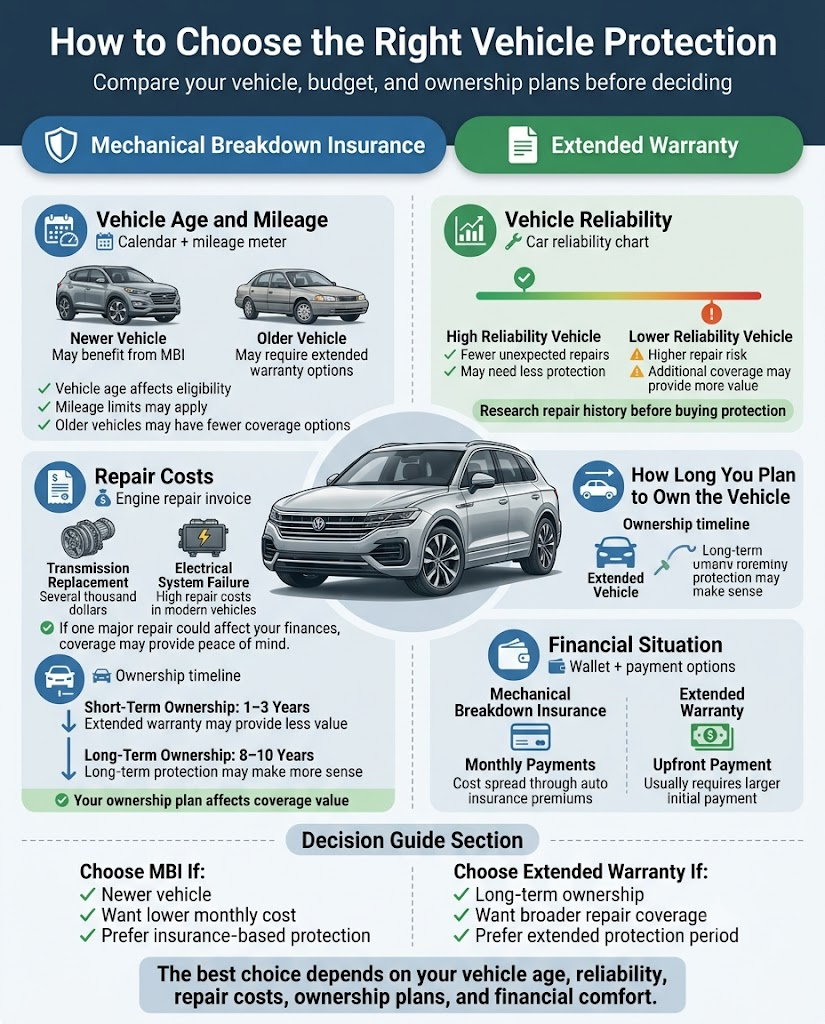
Vehicle Age and Mileage
Your vehicle’s age and mileage are among the most important factors.
A newer vehicle may benefit from MBI, while an older vehicle may require an extended warranty.
Vehicle Reliability
Research your vehicle’s reliability history.
Reliable vehicles may not need expensive protection.
Less reliable vehicles with costly repairs may benefit more from additional coverage.
Repair Costs
Consider the average cost of major repairs.
For example:
- A transmission replacement can cost several thousand dollars.
- An electrical system failure in a modern vehicle can also be expensive.
- If one major repair would create financial difficulty, coverage may provide peace of mind.
How Long You Plan to Own the Vehicle
Your ownership timeline matters.
If you sell the vehicle within a few years, an expensive extended warranty may not provide enough value.
If you plan to keep the vehicle for a decade, long-term protection may make more sense.
Your Financial Situation
Consider whether you prefer:
Paying Monthly
Mechanical breakdown insurance spreads the cost through insurance premiums.
Paying Upfront
Extended warranties often require a larger initial payment.
Choose the option that fits your budget and risk preference.
Mechanical Breakdown Insurance vs Extended Warranty: Detailed Comparison
Both mechanical breakdown insurance and extended warranties can protect you from unexpected vehicle repair bills, but they serve different purposes. The better option depends on your vehicle, ownership plans, and budget.
| Feature | Mechanical Breakdown Insurance | Extended Warranty |
|---|---|---|
| Type of Protection | Insurance coverage | Vehicle service contract |
| Provider | Auto insurance company | Manufacturer, dealership, or third-party company |
| Cost | Usually lower monthly premium | Usually higher upfront cost |
| Payment Method | Added to insurance premium | Paid upfront or financed |
| Coverage Length | Often limited by vehicle age and mileage | Can extend several years beyond factory warranty |
| Deductible | Usually required | Depends on contract |
| Availability | Limited to certain vehicles and insurers | Widely available |
| Repair Facility Choice | Depends on insurance policy | Depends on warranty contract |
| Coverage Options | Usually fewer options | Multiple plans available |
| Best For | Newer vehicles needing affordable protection | Long-term owners wanting extended coverage |
Common Mistakes When Buying Mechanical Breakdown Insurance or Extended Warranty
Choosing the wrong protection plan can lead to wasted money or unexpected repair costs. Many drivers make mistakes because they assume these products cover everything.
Mistake 1: Assuming All Repairs Are Covered
Neither mechanical breakdown insurance nor extended warranty covers every vehicle problem.
Many exclusions apply, including:
- Regular maintenance
- Oil changes
- Brake replacement
- Tire replacement
- Cosmetic damage
- Wear-and-tear parts
Always review the contract before purchasing.
Mistake 2: Buying Coverage Without Checking Vehicle Eligibility
Some drivers purchase coverage without confirming whether their vehicle qualifies.
For mechanical breakdown insurance, check:
- Maximum vehicle age
- Mileage limits
- Vehicle restrictions
For extended warranties, check:
- Covered vehicle types
- Contract duration
- Coverage limitations
Buying a plan that does not match your vehicle can result in poor value.
Mistake 3: Choosing the Cheapest Plan Only
The lowest-priced option may provide limited protection.
A cheaper plan may exclude expensive components such as:
- Turbochargers
- Electronics
- Advanced safety systems
- Air conditioning components
Focus on coverage quality rather than just price.
Mistake 4: Ignoring Deductibles
A low premium with a high deductible may not provide enough financial protection.
Example: Repair cost: $3,000
Plan A:
- Premium: Lower
- Deductible: $1,000
Plan B:
- Premium: Higher
- Deductible: $250
The cheaper plan may cost more when you actually need repairs.
Mistake 5: Not Checking Repair Requirements
Some plans require repairs to be performed at specific locations.
Before purchasing, ask:
- Can I choose my own mechanic?
- Are dealership repairs required?
- Is pre-approval needed?
- How are emergency repairs handled?
Understanding these rules can prevent claim problems later.
How to Choose Between Mechanical Breakdown Insurance and Extended Warranty
The right choice depends on your situation.
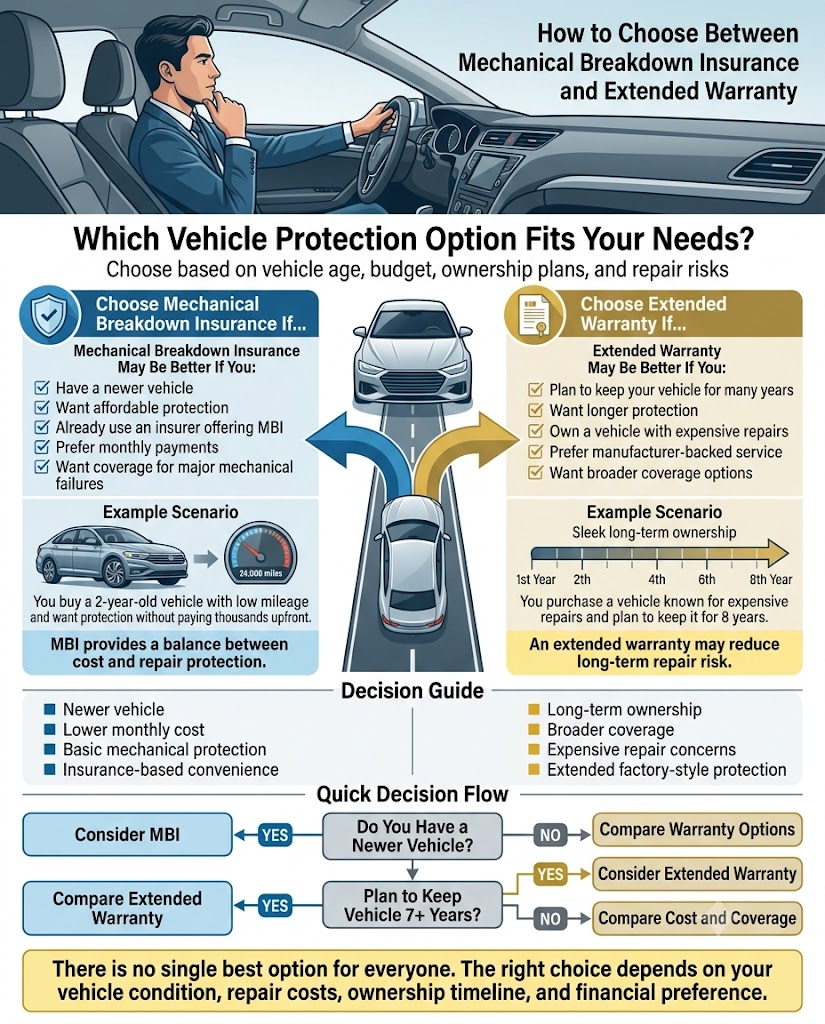
Choose Mechanical Breakdown Insurance If
MBI may be better if you:
- Have a newer vehicle
- Want affordable protection
- Already use an insurer that offers MBI
- Prefer monthly payments
- Want coverage against major mechanical failures
Example:
You purchase a two-year-old vehicle with low mileage and want protection without spending thousands upfront.
Mechanical breakdown insurance may provide a good balance between cost and protection.
Choose an Extended Warranty If
An extended warranty may be better if you:
- Plan to keep your vehicle for many years
- Want longer protection
- Own a vehicle with expensive repairs
- Prefer manufacturer-backed service
- Want broader coverage options
Example:
You purchase a vehicle known for expensive repairs and plan to drive it for the next eight years.
An extended warranty may reduce your financial risk.
Can You Have Both Mechanical Breakdown Insurance and an Extended Warranty?
In some cases, drivers may have access to both options, but having both is not always necessary.
Before purchasing both, compare:
- Coverage overlap
- Premium costs
- Deductibles
- Exclusions
If both plans cover the same repair, you may be paying twice for similar protection.
A better approach is usually choosing one strong coverage option that matches your vehicle and ownership plans.
Is Mechanical Breakdown Insurance Better Than an Extended Warranty?
There is no universal winner because they protect against different risks.
Mechanical breakdown insurance is often better for drivers who want:
- Lower cost protection
- Simple insurance management
- Coverage for newer vehicles
Extended warranties are often better for drivers who want:
- Longer coverage periods
- More plan choices
- Manufacturer-backed repairs
The best option depends on your vehicle’s reliability, repair costs, and how long you plan to keep it.
Example Scenarios
Scenario 1: New Car Owner
Vehicle:
- 1 year old
- Low mileage
- Reliable brand
Best option:
Mechanical breakdown insurance may be enough because the vehicle already has factory warranty protection.
Scenario 2: Luxury Used Vehicle Owner
Vehicle:
- 5 years old
- Expensive repairs
- Advanced technology
Best option:
An extended warranty may provide better protection because individual repairs can be extremely expensive.
Scenario 3: Long-Term Vehicle Owner
Vehicle:
- Purchased new
- Planning to keep for 10 years
Best option:
A manufacturer-backed extended warranty may provide stronger long-term coverage.
Scenario 4: Budget-Conscious Driver
Vehicle:
- Newer used car
- Wants affordable protection
Best option:
Mechanical breakdown insurance may offer protection without a large upfront expense.
Questions to Ask Before Buying Coverage
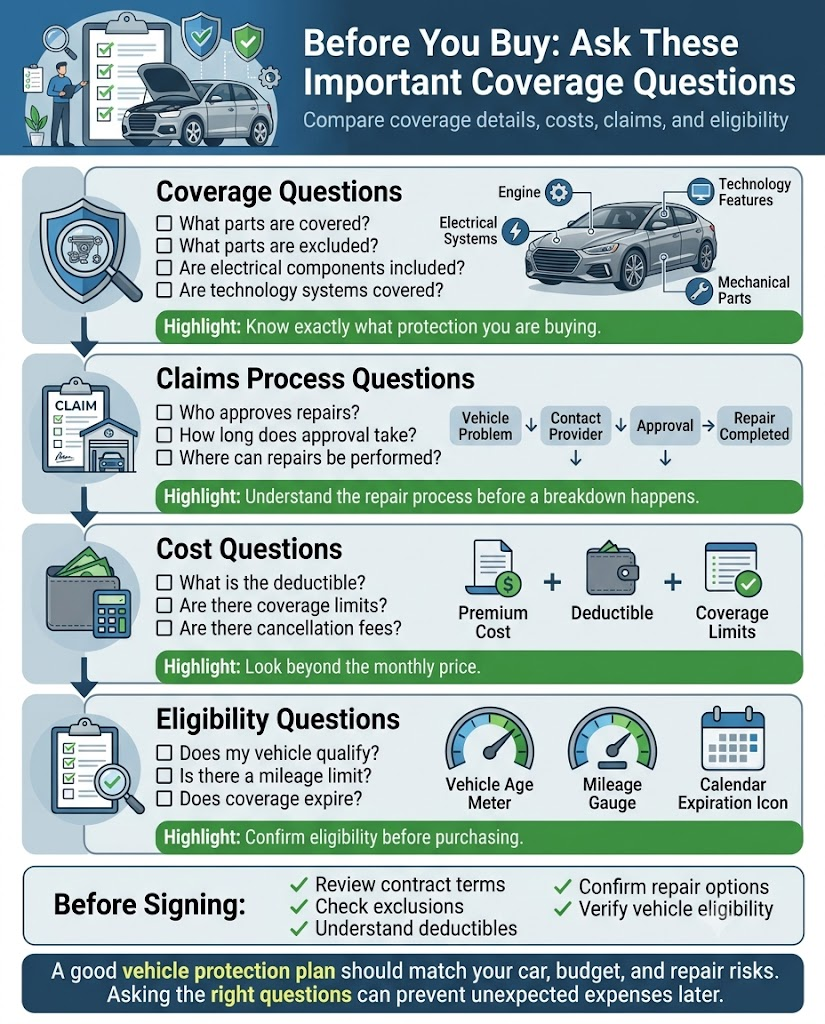
Before purchasing either option, ask:
About Coverage
- What parts are covered?
- What parts are excluded?
- Are electrical components included?
- Are technology systems covered?
About Claims
- Who approves repairs?
- How long does approval take?
- Where can repairs be performed?
About Costs
- What is the deductible?
- Are there coverage limits?
- Are there cancellation fees?
About Vehicle Requirements
- Does my vehicle qualify?
- Is there a mileage limit?
- Does coverage expire?
Final Verdict: Mechanical Breakdown Insurance vs Extended Warranty
Choosing between mechanical breakdown insurance vs extended warranty depends on your vehicle, financial situation, and how long you plan to keep your car.
Neither option is automatically better for every driver.
Mechanical breakdown insurance is generally better for drivers who want affordable protection added to their existing auto insurance policy. It works well for newer vehicles that still meet eligibility requirements and owners who want protection against major unexpected repairs without paying a large upfront cost.
An extended warranty may be a better choice for drivers who want longer-term coverage, broader protection options, or manufacturer-backed repairs. It can be especially useful for vehicles with expensive components or owners who plan to keep their vehicles for many years.