
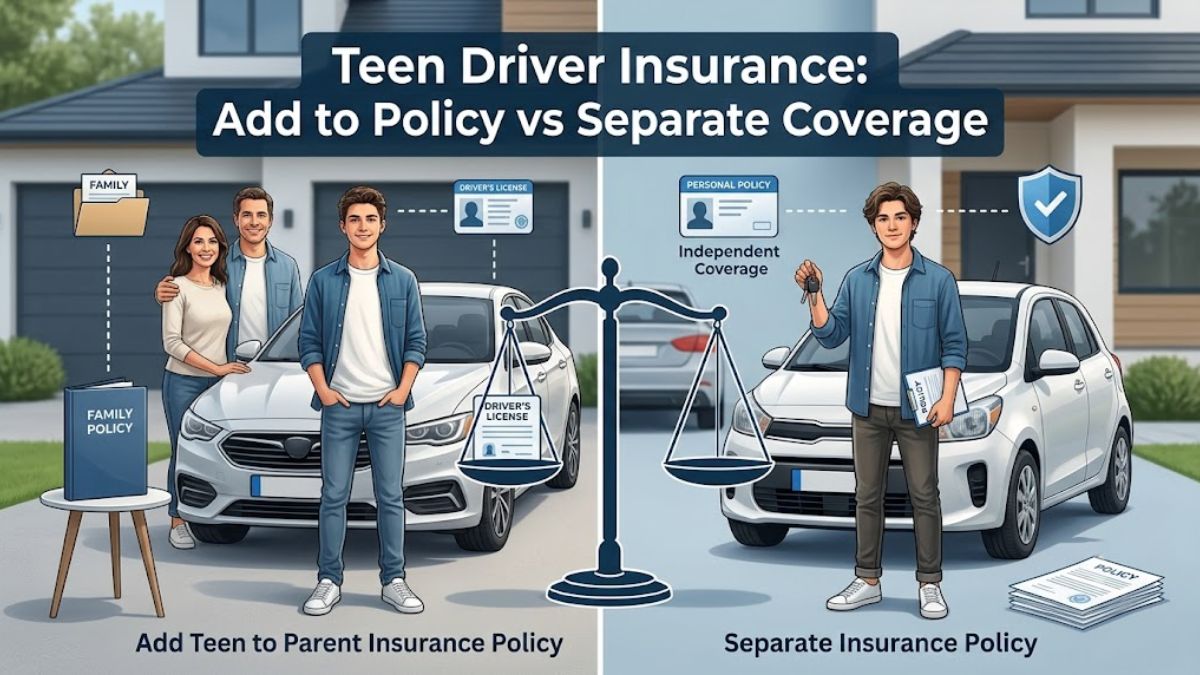

When a teenager earns their driver’s license, families face an important insurance decision: should the new driver be added to the parent’s existing auto insurance policy, or should they get their own separate car insurance policy?
Adding A Newly Licensed Teen to Insurance vs Separate Policy is a common question for parents who want to balance affordability, coverage, and their teen’s growing independence. For most families, adding a newly licensed teen to an existing policy is the more affordable option. However, there are situations where a separate policy may make more sense, especially when the teen owns their own vehicle, lives independently, or needs different coverage options.
Understanding the differences between these two choices can help parents avoid coverage issues, reduce unnecessary costs, and make sure their teen driver is properly protected.
Why Insurance Changes When a Teen Gets Licensed
A learner’s permit usually does not affect insurance rates as much as a full driver’s license. Once a teenager becomes a licensed driver, insurance companies consider them an active risk on the policy.
Teen drivers typically have higher insurance costs because they:
- Have limited driving experience
- Are statistically more likely to be involved in accidents
- Are more likely to receive speeding tickets or traffic violations
- May not fully understand dangerous driving situations
- Have less experience driving in different weather and road conditions
Because of this increased risk, adding a newly licensed teen can significantly increase a family’s premium.
The Insurance Information Institute notes that young drivers generally represent a higher risk category, which is why insurers charge higher rates for teen drivers.
Adding A Newly Licensed Teen to Insurance vs Separate Policy
For most families, adding a newly licensed teen to the parent’s insurance policy is usually the cheaper and simpler option. It allows the teen to benefit from family discounts and existing coverage.
A separate policy may be better if the teen owns their own vehicle, lives independently, or wants to manage their own insurance and build a personal insurance history. The best choice depends on the teen’s living situation, vehicle ownership, and financial independence.
Option 1: Adding a Newly Licensed Teen to Your Existing Insurance Policy
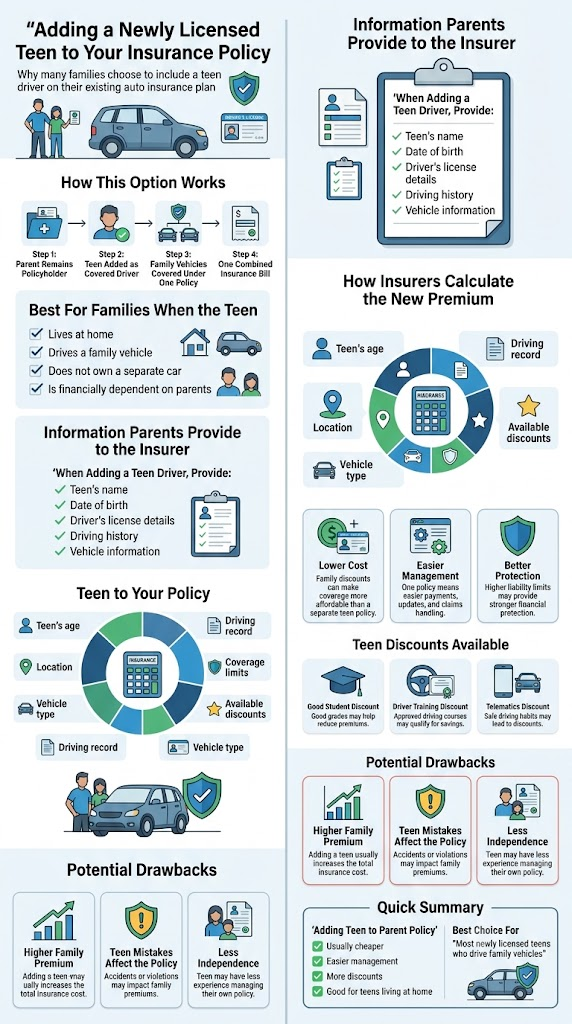
The most common choice for families is adding the teen driver to the parent’s auto insurance policy.
Under this arrangement:
- The parent remains the primary policyholder
- The teen is listed as a covered driver
- All vehicles on the policy may be considered available to the teen
- The family receives one combined insurance bill
This option is usually recommended when the teen:
- Lives at home
- Drives a family vehicle
- Does not own their own car
- Is still financially dependent on parents
How Adding a Teen Driver Works
When a teenager receives their license, parents usually need to contact their insurance company and provide:
- Teen’s name
- Date of birth
- Driver’s license information
- Driving history
- Information about vehicles they will drive
The insurer then calculates the updated premium based on factors such as:
- Teen driver’s age
- Location
- Vehicle type
- Driving record
- Coverage limits
- Discounts available
Advantages of Adding a Teen to Your Insurance Policy
Usually Lower Cost Than a Separate Policy
One of the biggest benefits is affordability.
Insurance companies often provide better pricing when multiple drivers and vehicles are combined under one policy.
A separate teen policy may cost significantly more because the teenager:
- Has no insurance history
- Has limited credit history
- Is considered a high-risk driver
By staying on a family policy, the teen benefits from:
- Parent’s existing relationship with the insurer
- Multi-driver discounts
- Multi-vehicle discounts
- Existing coverage structure
Easier Policy Management
Managing one policy is simpler.
Parents can:
- Pay one monthly premium
- Manage coverage changes
- Handle claims through one insurer
- Review all household vehicles together
This can be especially useful when the teen is still learning responsible vehicle ownership.
Access to Better Coverage Limits
A family policy may have higher liability limits than a basic teen policy.
Higher liability coverage helps protect family assets if the teen causes:
- Property damage
- Serious injuries
- A major accident
Since inexperienced drivers have a higher accident risk, stronger liability protection can be valuable.
Teen Can Benefit From Discounts
Many insurers offer discounts for young drivers, including:
Good Student Discount
Students who maintain strong grades may qualify for lower premiums.
Requirements often include:
- Minimum GPA
- Proof of academic performance
- Full-time student status
Driver Training Discount
Completing an approved driver education program may reduce rates.
Telematics Discount
Some insurers offer programs that track driving behavior through:
- Mobile apps
- Plug-in devices
- Vehicle technology
Safe driving habits may lead to savings.
Disadvantages of Adding a Teen to Your Policy
Although adding a teen is usually cheaper, there are some drawbacks.
Higher Family Insurance Premium
Adding a teenage driver can increase the total policy cost substantially.
The increase depends on:
- State regulations
- Insurance company
- Teen’s age
- Vehicle being driven
- Coverage levels
Families should expect a noticeable premium adjustment.
Teen’s Driving Mistakes Can Affect Parents
If the teen causes an accident, the claim may affect the family policy.
Possible consequences include:
- Higher future premiums
- Loss of discounts
- Policy review by the insurer
Because everyone shares the same policy, one driver’s actions can impact the entire household.
Limited Independence for the Teen
A teen listed on a parent’s policy may not learn all aspects of managing insurance.
They may not experience:
- Paying premiums independently
- Choosing coverage
- Managing their own policy
- Building their insurance history
For some families, independence is an important factor.
Option 2: Getting a Separate Insurance Policy for a Teen Driver
With a separate policy:
- The teen becomes the primary policyholder
- The teen pays their own premium
- The vehicle is usually titled and insured under the teen’s name
- Coverage decisions are made independently
This arrangement is less common for newly licensed drivers because of the higher cost, but it can be useful in certain situations.
How a Teen’s Separate Policy Works
To purchase their own insurance policy, a teen usually needs:
- A vehicle registered in their name
- A valid driver’s license
- Proof of ownership or permission to insure the vehicle
- Personal information required by the insurer
The insurance company evaluates the teen based on:
- Age
- Driving experience
- Location
- Vehicle type
- Driving record
- Coverage limits
- Insurance history
Because the teen has little or no prior insurance history, the insurer may charge higher rates.
Advantages of a Separate Teen Insurance Policy
Builds Independent Insurance History
One major benefit is that the teen starts building their own insurance record.
Maintaining continuous coverage can help them later when they:
- Move out permanently
- Buy another vehicle
- Rent a home
- Apply for their own insurance in adulthood
A history of responsible insurance ownership may help demonstrate lower risk over time.
Gives the Teen More Financial Responsibility
A separate policy can teach important financial lessons.
The teen learns how to:
- Pay insurance bills
- Understand coverage options
- Manage policy renewals
- Compare insurance rates
- Make responsible vehicle decisions
This can be valuable preparation for independent adulthood.
Keeps the Parent’s Policy Separate
A separate policy prevents the teen’s driving activity from directly affecting the parent’s policy.
For example, if the teen:
- Gets a speeding ticket
- Has an accident
- Receives a claim
The impact is generally limited to the teen’s own insurance policy.
However, parents should understand that some insurers may still require household members to be disclosed, especially if the teen lives at home or has access to family vehicles.
Allows Customized Coverage Choices
A teen may choose coverage based on their own situation.
For example:
A teen driving an older paid-off vehicle may choose:
- Lower coverage costs
- Different deductible options
- Liability-focused coverage
A teen with a newer vehicle may choose:
- Comprehensive coverage
- Collision coverage
- Higher liability limits
A separate policy allows more individual decision-making.
Disadvantages of a Separate Teen Insurance Policy
Usually Much More Expensive
The biggest disadvantage is cost.
Teen drivers often pay higher premiums because insurers have limited information about their driving behavior.
A separate policy can cost more because the teen does not benefit from:
- Family policy discounts
- Multi-driver discounts
- Long-term customer discounts
- Parent insurance history
In many cases, keeping a teen on a parent’s policy is significantly cheaper.
Limited Insurance History
A newly licensed driver has no proven track record.
Insurance companies do not yet know whether the teen is:
- A safe driver
- A frequent risk-taker
- Likely to file claims
Until the teen builds a history, premiums may remain high.
More Responsibility for the Teen
Managing an individual insurance policy requires maturity.
The teen must handle:
- Premium payments
- Renewal dates
- Coverage decisions
- Claims communication
Missing payments can cause:
- Policy cancellation
- Coverage gaps
- Higher future premiums
May Not Be Allowed in Some Situations
A teen cannot always simply create a separate policy.
Insurance companies may require a teen living in the household to be added to the family policy if:
- They regularly drive family vehicles
- They share the same address
- They are financially dependent on parents
Trying to exclude a household driver without informing the insurer can create coverage problems.
Adding Teen to Parent Policy vs Separate Policy: Cost Comparison
The cost difference between these options can be significant.
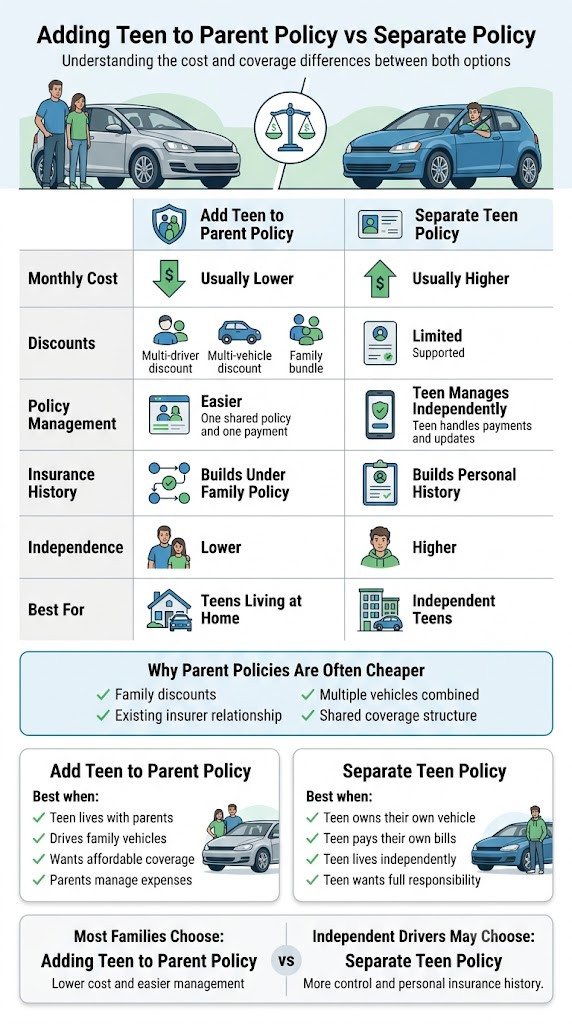
| Factor | Added to Parent Policy | Separate Teen Policy |
|---|---|---|
| Monthly cost | Usually lower | Usually higher |
| Discounts | More available | Limited |
| Policy management | Easier | Teen manages independently |
| Insurance history | Builds under family policy | Builds personal history |
| Independence | Lower | Higher |
| Best for | Teens living at home | Independent teens |
When Should Parents Choose a Separate Policy?
A separate policy may make sense if:
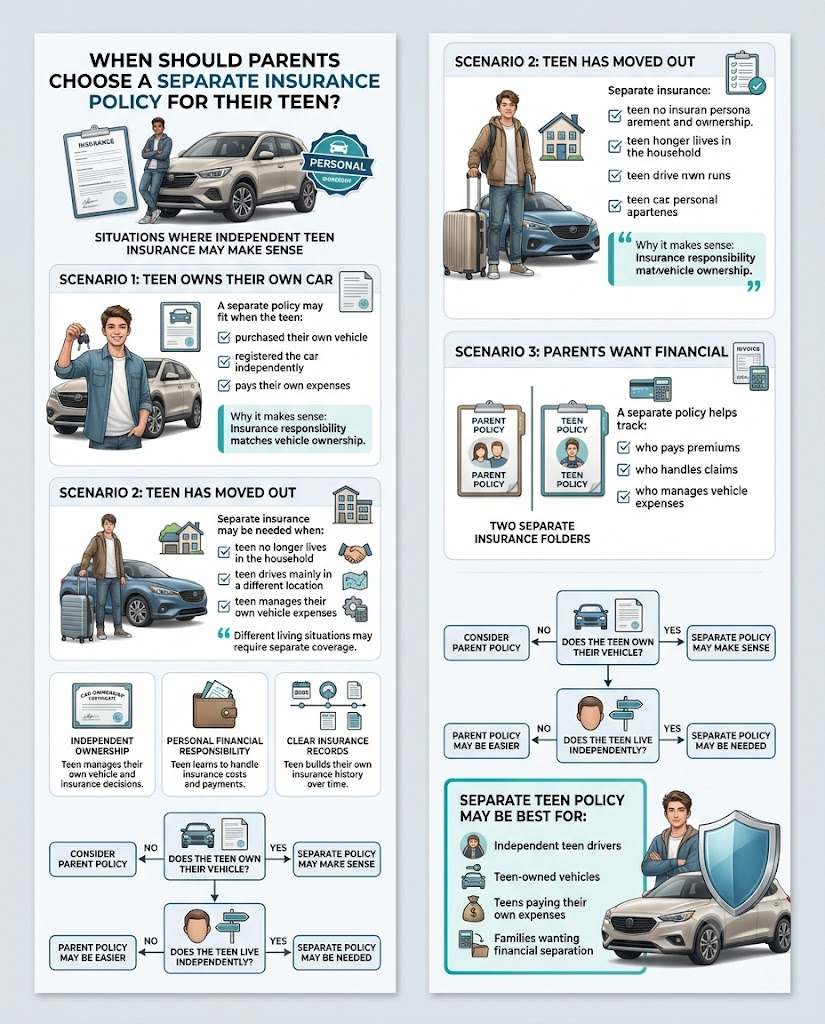
The Teen Owns Their Own Car
If the teen purchased and titled their own vehicle, a separate policy may be practical.
For example:
- Teen buys a used car with their own money
- Teen registers the vehicle independently
- Teen pays their own expenses
A personal policy may better match ownership responsibility.
The Teen Has Moved Out
If the teen no longer lives in the household, separate insurance may be necessary.
Examples:
Parents Want Clear Financial Separation
Some families prefer keeping financial responsibilities separate.
A separate policy makes it easier to track:
- Who pays premiums
- Who handles claims
- Who manages vehicle expenses
When Should Parents Keep the Teen on Their Policy?
Adding the teen to the family policy is usually better when:
- The teen lives at home
- Parents own the vehicle
- Teen is still in school
- Family wants the lowest possible cost
- Teen occasionally drives household vehicles
For most newly licensed teenagers, this is the more affordable and practical choice.
Choosing the Right Option Based on Different Situations
There is no single answer that works for every family. The better choice depends on the teen’s age, living situation, vehicle ownership, financial independence, and how much responsibility the family wants the teen to have.
Most newly licensed teens are better off being added to their parents’ policy, but certain circumstances make a separate policy a better option.
Scenario 1: Teen Lives at Home and Drives a Family Vehicle
Best option: Add the teen to the parent’s insurance policy
This is the most common situation.
Example:
A 17-year-old gets their driver’s license and occasionally drives:
- The family SUV
- A parent’s sedan
- A shared household vehicle
In this situation, a separate policy usually does not make financial sense.
Adding the teen to the family policy allows them to:
- Access existing coverage
- Benefit from household discounts
- Avoid the high cost of starting their own policy
Parents should inform the insurer that the teen is a licensed driver, even if they rarely drive.
Failing to disclose a licensed household driver can create problems if the teen is involved in an accident.
Scenario 2: Teen Owns Their Own Vehicle
Possible options: Add to parent policy or create separate policy
When a teen owns a vehicle, families have two possible approaches.
Option 1: Add the Teen and Vehicle to the Parent Policy
This is often the cheaper choice.
Benefits include:
- Lower overall premium
- Access to family discounts
- Easier claims management
The vehicle can usually be insured under the family policy while the teen is listed as a driver.
Option 2: Create a Separate Policy
A separate policy may make sense if:
- The teen purchased the vehicle independently
- The teen pays all vehicle expenses
- Parents want financial separation
However, premiums are often higher because the teen lacks insurance history.
Scenario 3: Teen Goes Away to College
Best option depends on location and vehicle use
College situations can be complicated because insurance rules vary by insurer and state.
Parents should consider:
If the Teen Leaves the Car at Home
The teen may be able to remain on the family policy with a reduced rate.
Some insurers offer discounts for students who:
- Attend school far from home
- Do not regularly drive
- Leave their vehicle behind
If the Teen Takes a Vehicle to College
The family should notify the insurer because:
- The garaging location changes
- Risk factors may change
- The state insurance requirements may differ
A separate policy may become necessary if the student permanently moves and establishes a new residence.
Scenario 4: Teen Becomes Financially Independent
Best option: Separate policy
Once a teen becomes financially independent, having their own insurance may be more appropriate.
Examples:
- Teen has a full-time job
- Teen pays their own bills
- Teen owns their vehicle
- Teen has moved into their own home
A separate policy helps establish financial independence and allows the young adult to manage their own insurance decisions.
How Vehicle Choice Affects Teen Insurance Costs
The vehicle a teen drives has a major impact on insurance premiums.
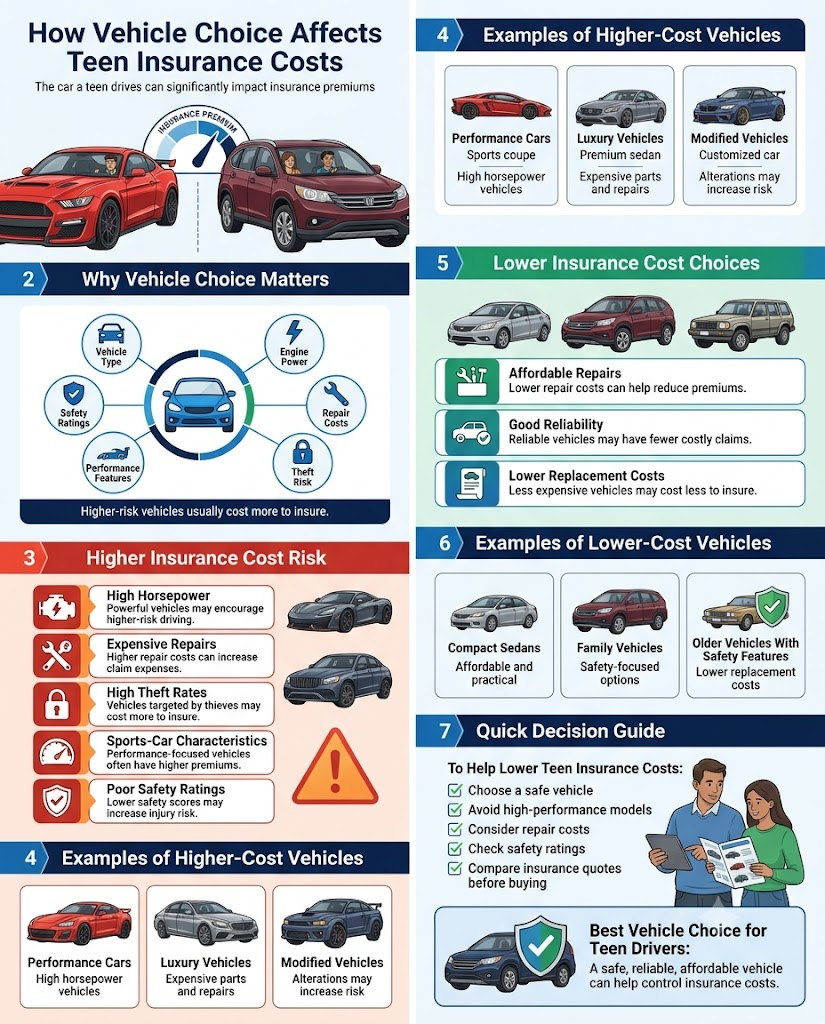
A newly licensed driver driving a high-performance vehicle will usually pay much more than someone driving a practical, affordable vehicle.
Vehicles That May Increase Teen Insurance Rates
Insurance costs are often higher for vehicles with:
- High horsepower
- Expensive repair costs
- High theft rates
- Sports-car characteristics
- Poor crash safety ratings
Examples include:
- Performance cars
- Luxury vehicles
- Modified vehicles
Vehicles That May Reduce Teen Insurance Costs
Parents looking to control insurance expenses often choose vehicles with:
- Strong safety ratings
- Affordable repairs
- Good reliability
- Lower replacement costs
Examples include:
- Compact sedans
- Family vehicles
- Older vehicles with safety features
Should a Teen Have Full Coverage Insurance?
The answer depends on the vehicle’s value and financing situation.
If the Vehicle Is Financed
Most lenders require:
- Comprehensive coverage
- Collision coverage
This protects the lender’s financial interest in the vehicle.
If the Vehicle Is Paid Off
Families can decide whether full coverage is worth the cost.
Factors to consider:
- Vehicle value
- Repair costs
- Teen’s driving experience
- Family’s ability to replace the vehicle
For a newer vehicle, full coverage is usually worth considering because replacing it after an accident can be expensive.
Liability Coverage Considerations for Teen Drivers
Teen drivers create a higher liability risk because inexperienced drivers are more likely to make mistakes.
Many families choose higher liability limits than the state minimum requirements.
Higher limits can provide additional protection if the teen causes:
- Serious injuries
- Multiple-vehicle accidents
- Significant property damage
A low-cost policy with minimum coverage may leave families financially exposed after a major accident.
Common Mistakes Parents Make When Insuring a New Teen Driver
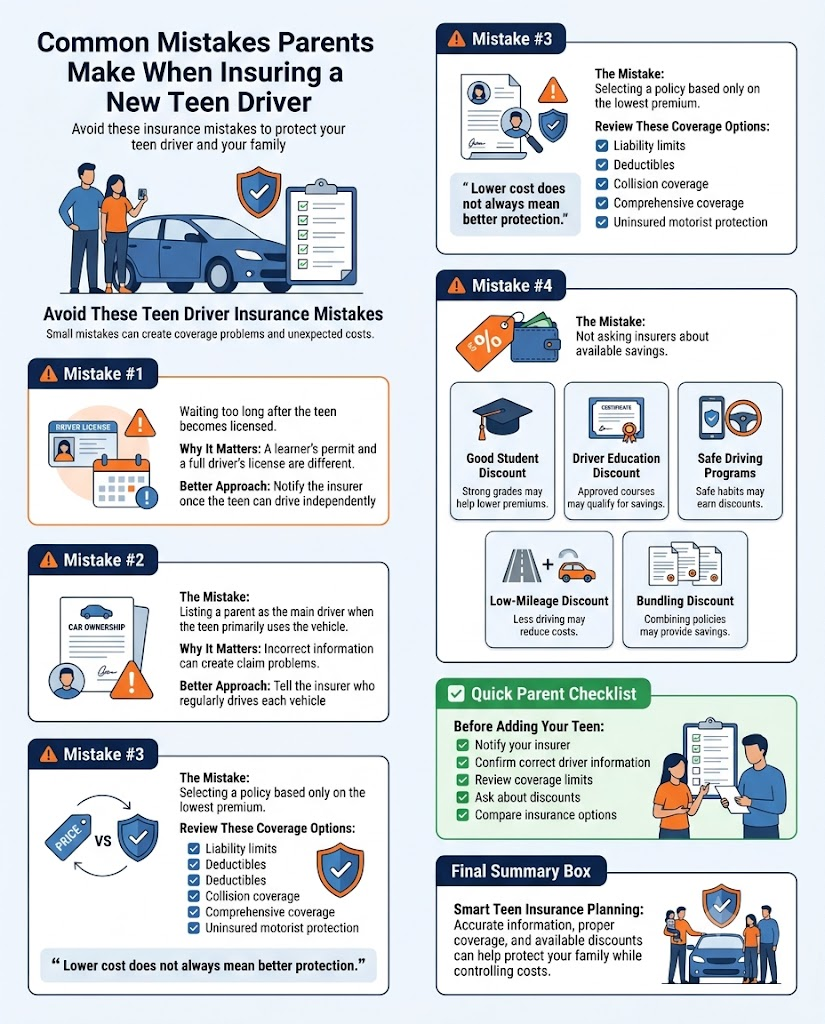
Not Adding the Teen Immediately
One of the biggest mistakes is waiting too long after the teen becomes licensed.
A learner’s permit and a full driver’s license are different situations.
Once the teen is legally allowed to drive independently, the insurer should be notified.
Listing the Wrong Primary Driver
Some families incorrectly list a parent as the main driver of a vehicle that is primarily used by the teen.
This practice, sometimes called rate evasion or misrepresentation, can create serious claim problems.
The insurer should know who regularly drives each vehicle.
Choosing the Cheapest Coverage Only
The cheapest insurance policy may not provide enough protection.
Parents should review:
- Liability limits
- Deductibles
- Collision coverage
- Comprehensive coverage
- Uninsured motorist protection
Not Asking About Discounts
Families often miss available savings.
Ask insurers about:
- Good student discounts
- Driver education discounts
- Safe driving programs
- Low-mileage discounts
- Bundling discounts
How to Lower Insurance Costs After Adding a Teen Driver
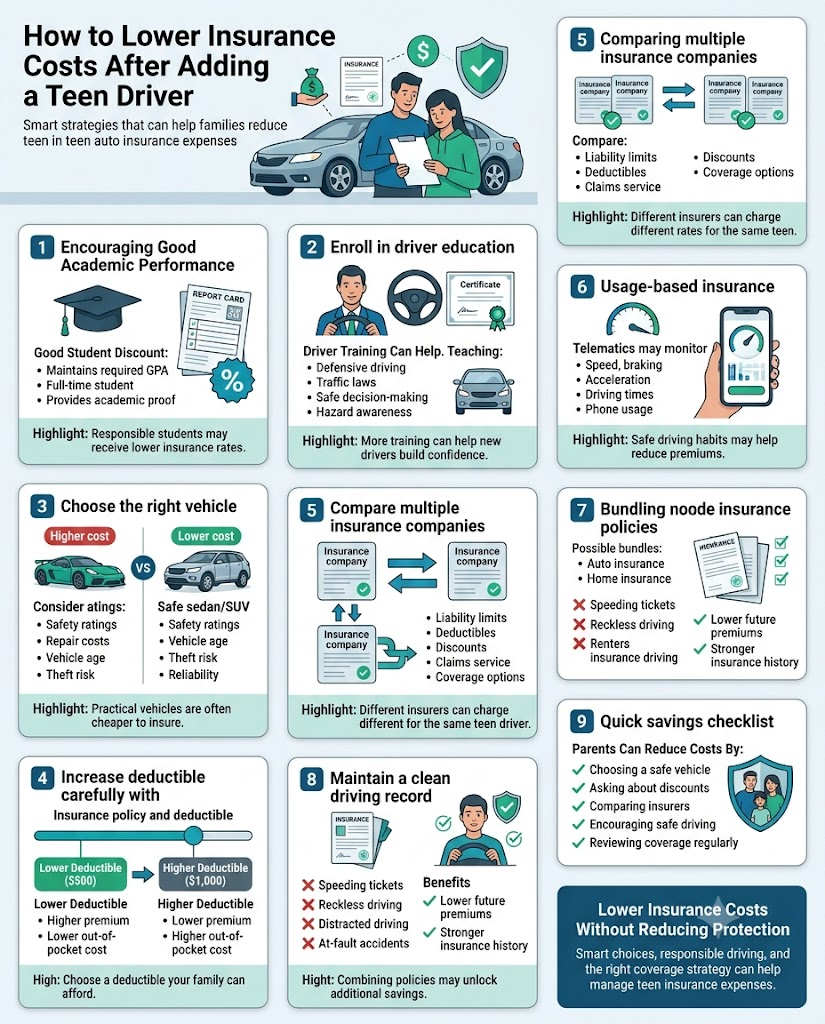
Encourage Good Academic Performance
Many insurance companies offer discounts to students who maintain good grades.
A good student discount may be available if the teen:
- Maintains a certain GPA
- Is enrolled full-time
- Provides proof of academic performance
Since younger drivers are considered higher risk, insurers often reward responsible behavior both in school and behind the wheel.
Parents should ask their insurer about eligibility requirements because discount rules vary.
Enroll the Teen in Driver Education
Completing an approved driver training program can sometimes reduce insurance costs.
These programs help teens learn:
- Defensive driving techniques
- Traffic laws
- Safe decision-making
- Hazard awareness
Driver education may also reduce the chance of accidents by giving new drivers more experience before driving independently.
Choose the Right Vehicle
The vehicle a teen drives can make a major difference in insurance costs.
A safe, affordable vehicle is usually less expensive to insure than a powerful or expensive one.
When choosing a teen’s vehicle, consider:
- Safety ratings
- Repair costs
- Vehicle age
- Theft risk
- Reliability
A practical used sedan or small SUV is often more affordable to insure than a sports car.
Increase the Deductible Carefully
A higher deductible can reduce monthly insurance premiums.
For example:
A policy with a $1,000 deductible may cost less than a policy with a $500 deductible.
However, families should only choose a deductible they can comfortably afford after an accident.
A lower premium is not helpful if the family cannot pay the out-of-pocket cost when a claim happens.
Compare Multiple Insurance Companies
Insurance rates for teen drivers vary significantly between companies.
One insurer may charge much more than another for the same teen driver.
Families should compare:
- Liability limits
- Deductibles
- Discounts
- Claims service
- Coverage options
Shopping around can reveal significant savings.
Consider Usage-Based Insurance Programs
Some insurers offer telematics programs that monitor driving habits.
These programs may track:
- Speed
- Braking patterns
- Acceleration
- Driving times
- Phone usage while driving
Safe driving habits may help reduce premiums.
However, families should understand how the program works before enrolling because driving data may be used to calculate rates.
Bundle Insurance Policies
Families who have multiple insurance products may qualify for discounts.
Examples include bundling:
- Auto insurance
- Home insurance
- Renters insurance
A household with multiple policies may receive better pricing compared with purchasing each policy separately.
Maintain a Clean Driving Record
The teen’s driving behavior has a major impact on future insurance costs.
Avoiding:
- Speeding tickets
- Reckless driving
- Distracted driving violations
- At-fault accidents
can help keep premiums lower over time.
A clean record also helps the teen build a positive insurance history.
Parent Policy vs Separate Policy: Decision Checklist
Use the following checklist to decide which option fits your family.
Choose Adding the Teen to Your Policy If
✅ The teen lives at home
✅ The teen drives a family vehicle
✅ Parents want the lowest possible cost
✅ The teen is still financially dependent
✅ Parents manage vehicle expenses
✅ The family wants simpler policy management
For most newly licensed teenagers, this is the most practical option.
Consider a Separate Policy If
✅ The teen owns their own vehicle
✅ The teen pays their own expenses
✅ The teen lives independently
✅ The teen wants financial responsibility
✅ Parents want separate insurance records
✅ The teen has different coverage needs
A separate policy provides independence but usually costs more.
Long-Term Impact on the Teen’s Insurance Future
The decision made when a teen first gets licensed can affect their insurance experience for years.
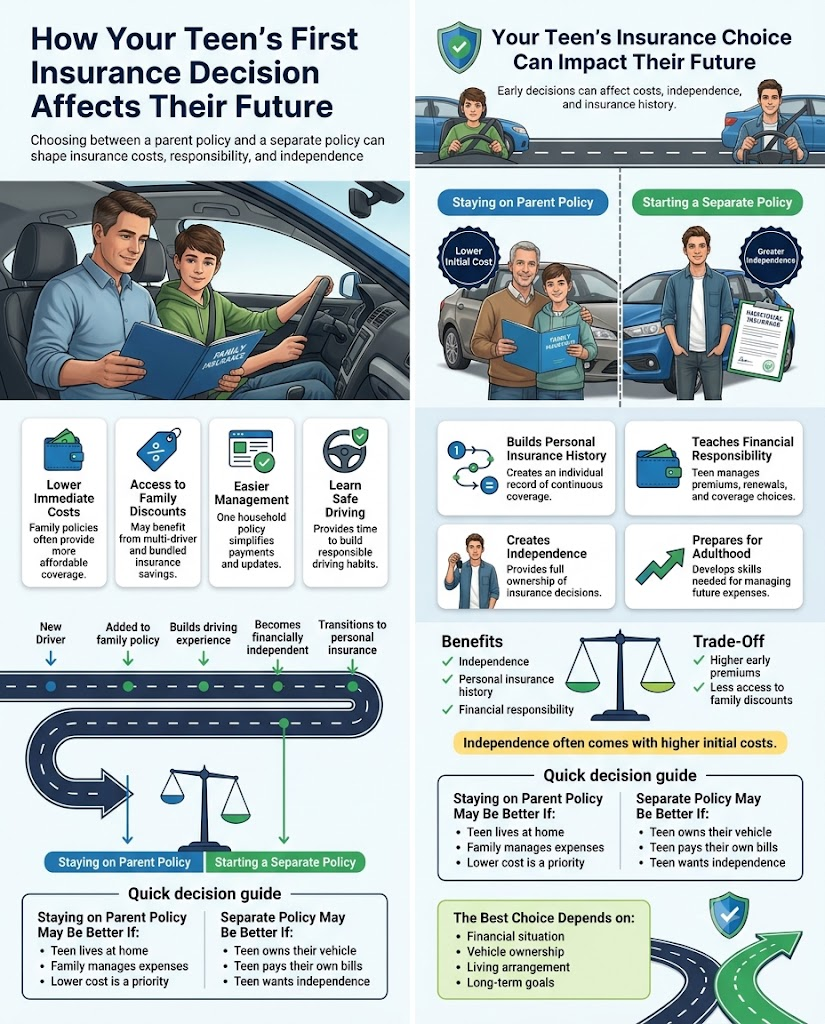
Staying on a Parent Policy
Benefits:
- Lower immediate costs
- Access to family discounts
- Easier management
- Opportunity to learn safe driving
Many young adults remain on family policies until they become financially independent.
Starting a Separate Policy
Benefits:
- Builds personal insurance history
- Teaches financial responsibility
- Creates independence
However, higher premiums during the early years are often the tradeoff.
Final Recommendation: Adding a Teen vs Separate Policy
For most newly licensed teenagers who live at home, adding them to the parent’s insurance policy is usually the better choice.
It is generally:
- More affordable
- Easier to manage
- Better for families sharing vehicles
A separate policy becomes more appropriate when the teen:
- Owns their own vehicle
- Lives independently
- Pays their own expenses
- Wants full financial responsibility
Before making a decision, parents should contact their insurance company, compare costs, review coverage limits, and consider the teen’s long-term needs.
The right choice is not only about saving money today. It is about creating a safe insurance setup that protects the teen driver while preparing them for financial independence.