


Moving to another state is a major life event, whether you’re leaving for college, starting a new job, or relocating permanently. Along with updating your address and driver’s license, you may wonder what happens to your car insurance. One of the most common questions is:
Can I stay on my parents’ car insurance if I move out of state?
The answer is sometimes, but it depends on several factors, including your permanent residence, the state you move to, who owns the vehicle, and your insurance company’s rules. Some insurers allow out-of-state drivers to remain on a family policy under certain circumstances, while others require a separate policy once you establish residency elsewhere.
Understanding these rules before you move can help you avoid coverage gaps, denied claims, or paying more than necessary.
Can You Stay on Your Parents’ Car Insurance If You Move Out of State
In some situations, yes, you can remain on your parents’ car insurance policy after moving to another state.
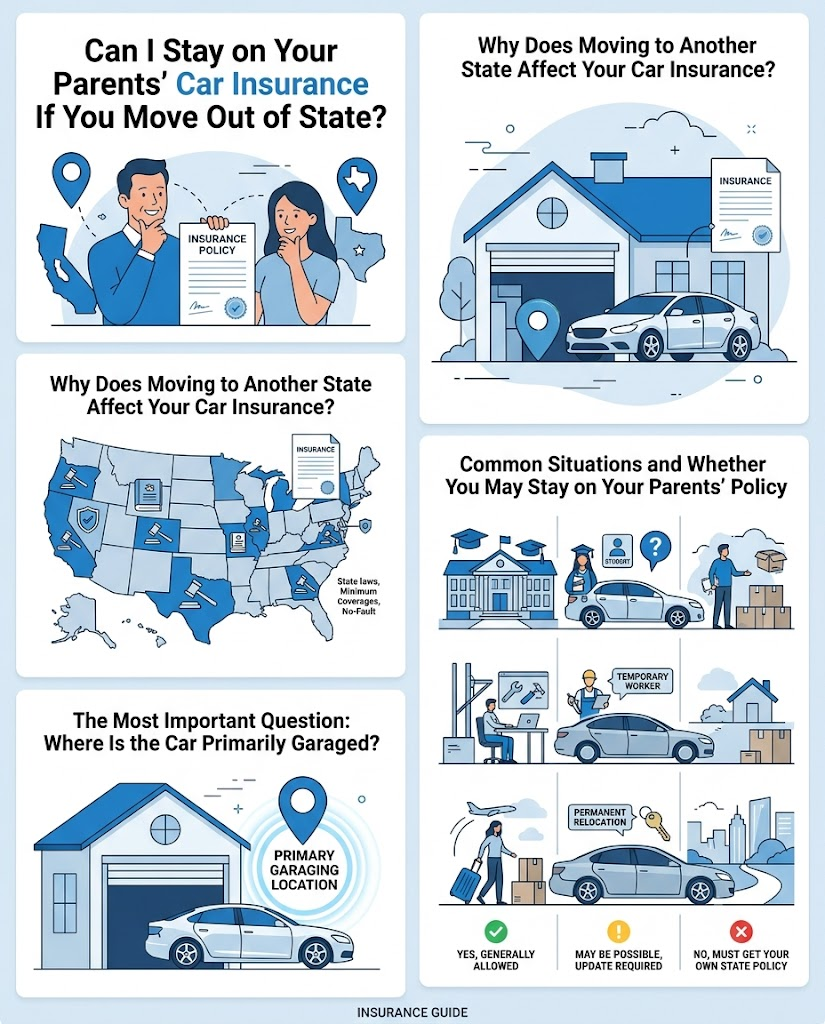
However, it is not automatically allowed.
Insurance companies consider factors such as:
- Your permanent residence
- Whether you are a full-time student
- Who owns the vehicle
- Where the vehicle is primarily kept
- State insurance laws
- The insurer’s underwriting guidelines
If your move is temporary, you may be able to stay on the family policy. If you permanently relocate and establish residency in another state, you will often need your own policy.
Why Does Moving to Another State Affect Your Car Insurance?
Auto insurance is regulated at the state level.
Each state has different:
- Minimum liability requirements
- Personal injury protection (PIP) rules
- Uninsured motorist requirements
- Registration laws
- Insurance filing requirements
- Premium rating factors
For example, if your parents live in one state but your car is now driven daily in another, the insurance company needs accurate information to properly assess the risk.
Failing to update the insurer could lead to problems if you file a claim.
The Most Important Question: Where Is the Car Primarily Garaged?
One of the biggest factors insurers consider is where the vehicle spends most of its time.
If the car is:
- Parked at your parents’ home most of the year, remaining on their policy may be possible.
- Parked at your new home in another state year-round, the insurer may require policy changes.
Insurance premiums are based partly on where the vehicle is regularly kept because accident rates, theft risks, weather, and repair costs vary by location.
Common Situations and Whether You May Stay on Your Parents’ Policy
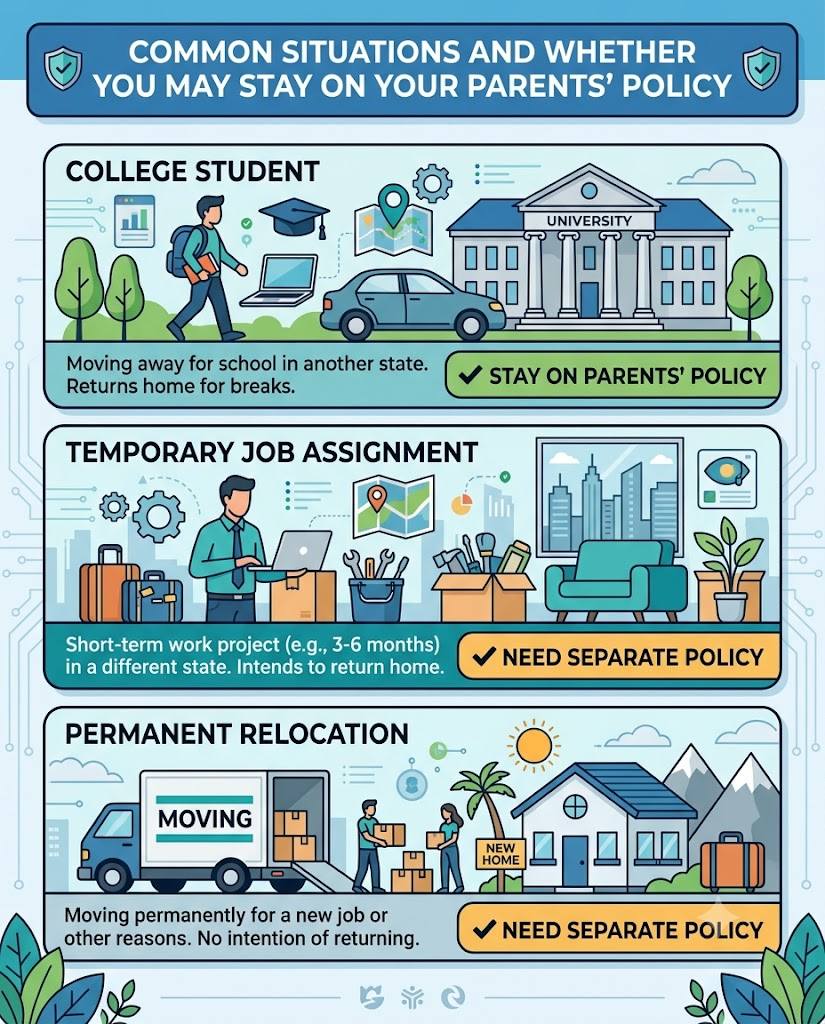
Situation 1: You Moved Away for College
Many insurers allow college students to remain on their parents’ policy even if they attend school in another state.
This is especially common if:
- Your parents’ home remains your permanent address.
- You return home during breaks.
- The vehicle is still considered part of the household policy.
However, your parents should notify the insurance company that the vehicle is regularly used in another state.
Situation 2: You Accepted a Temporary Job Assignment
If your move is temporary and you still maintain legal residence with your parents, some insurers may continue your coverage.
Examples include:
- Internship
- Military training
- Temporary work contract
- Seasonal employment
Every insurer has different guidelines, so it is important to verify your eligibility.
Situation 3: You Permanently Relocated
If you:
- Rent or buy a home
- Change your driver’s license
- Register your vehicle in the new state
- Become a resident
you will likely need your own insurance policy that meets your new state’s legal requirements.
Does It Matter Who Owns the Vehicle?
Yes.
Vehicle ownership plays a major role in determining whether you can stay on your parents’ policy.
If Your Parents Own the Car
If the vehicle is titled in your parents’ names, insurers may be more willing to keep it on their policy, depending on where it is kept and used.
However, they still need to know if the vehicle is now primarily located in another state.
If You Own the Car
If the title is in your name and you permanently move to another state, you will usually need:
- Your own insurance policy
- Registration in your new state (if required)
- Updated address information
Many insurers require the policyholder and the vehicle owner to match.
Does Your Age Matter?
Age alone does not determine eligibility, but it can affect insurance options.
For example:
Younger Drivers
Drivers in their late teens or early twenties may remain on a family policy if they still qualify as household members under the insurer’s rules.
Adult Children
If you have:
- Established your own residence
- Become financially independent
- Permanently moved away
your insurer may require you to purchase your own policy.
Can You Stay on the Policy If You Are No Longer Part of Your Parents’ Household?
Many insurance companies define a household as people who live at the same primary address.
If you permanently move out, you may no longer qualify as a household member.
Some insurers make exceptions, while others do not.
Because policies vary, always ask your insurance company before assuming you are still covered.
What Happens If You Don’t Tell the Insurance Company?
Some drivers continue using their parents’ address after moving to another state.
This can create serious problems.
Potential consequences include:
- Claim delays
- Claim denial
- Incorrect premiums
- Policy cancellation
- Accusations of insurance misrepresentation
Insurance companies expect policy information to accurately reflect where the vehicle is primarily used and stored.
Being honest about your living situation helps ensure your coverage remains valid.
Signs You May Need Your Own Policy
You will likely need separate insurance if you:
- Permanently moved to another state
- Registered your vehicle there
- Obtained a new driver’s license
- Bought or leased a home
- Own the vehicle yourself
- No longer live with your parents
Purchasing your own policy may also help you begin building an independent insurance history, which can be beneficial when shopping for coverage in the future.
Does Becoming a Resident of Another State Change Your Insurance?
Yes, in many cases.
Once you become a legal resident of another state, you may be required to:
- Obtain a driver’s license from your new state
- Register your vehicle there
- Meet the state’s minimum insurance requirements
- Update your insurance policy
Most states give new residents a limited period—often between 30 and 90 days—to complete these changes. The exact timeframe varies by state.
If you continue using your parents’ out-of-state address after becoming a resident elsewhere, your policy may no longer accurately reflect where the vehicle is primarily kept.
Can College Students Stay on Their Parents’ Car Insurance?
In many cases, yes.
College students are one of the most common exceptions to the general rule that family members should live in the same household.
Many insurers allow students to remain on a parent’s policy if:
- They attend school full-time.
- Their parents’ home remains their permanent residence.
- They return home during holidays or summer breaks.
- They are still considered financially dependent.
Even so, your parents should inform the insurance company where the vehicle is regularly located during the school year.
What If You Take Your Car to College?
Taking your car with you may affect your insurance premium.
The insurer may ask for:
- College address
- Parking location
- Estimated annual mileage
- Whether the car is parked on campus or off campus
A vehicle kept in a busy city with higher theft or accident rates may cost more to insure than one kept in a rural area.
Can Graduate Students Stay on a Parent’s Policy?
Sometimes.
Graduate students may still qualify if:
- They remain part of their parents’ household under the insurer’s guidelines.
- Their move is considered temporary.
- They have not established permanent residency elsewhere.
However, because graduate students are often older and financially independent, some insurers may require a separate policy.
What If You Move for Military Service?
Military families often receive special consideration.
If you are on active duty, some insurance companies offer flexible rules regarding:
- Permanent residence
- Vehicle location
- State registration
- Deployment
Military members may also benefit from state laws that simplify vehicle registration and insurance requirements while stationed in another state.
Always notify your insurer about military assignments so they can explain your available options.
What If You Move for a Temporary Job?
Temporary employment is another situation where remaining on your parents’ policy may be possible.
Examples include:
- Paid internships
- Seasonal jobs
- Temporary work contracts
- Company training programs
- Research fellowships
The insurance company may ask:
- How long will you be away?
- Where is the vehicle kept?
- Will you return to your parents’ home?
The answers help determine whether your move is considered temporary or permanent.
What If You Move Permanently for Work?
A permanent relocation usually changes your insurance needs.
Examples include:
- Accepting a full-time job
- Signing a long-term lease
- Purchasing a home
- Establishing residency
- Registering to vote
- Updating your driver’s license
These actions generally indicate that you have formed a new household.
In that case, you will likely need your own insurance policy.
Can Siblings Living in Different States Stay on the Same Policy?
Usually, it depends on the insurance company.
For example:
Parents live in Texas.
One child attends college in Colorado.
Another child works permanently in Florida.
The college student may still qualify under the family policy, while the permanently relocated sibling may need separate insurance.
Each driver’s circumstances are evaluated individually.
What If Your Parents Own Multiple Homes?
Some families own homes in more than one state.
For example:
- Primary residence in one state
- Vacation home in another
- Seasonal residence elsewhere
Insurance companies often need to know:
- Which home is your primary residence
- Where each vehicle is normally parked
- Who regularly drives each vehicle
Multiple residences can make insurance more complex, so accurate information is important.
Can You Drive Your Parents’ Car in Another State?
Yes, in many situations.
Most auto insurance policies provide coverage while driving temporarily in another state.
Examples include:
- Vacations
- Road trips
- Visiting family
- Temporary travel
However, regularly keeping and driving the vehicle in another state for months at a time is different from an occasional visit.
The insurer should know if the vehicle’s primary location changes.
Does Your Parents’ Insurance Automatically Meet Another State’s Requirements?
Many policies automatically adjust to meet another state’s minimum required liability limits while you’re temporarily driving there.
For example:
- You live in one state.
- You take a road trip to another state.
- That state requires higher minimum liability coverage.
Many insurers will automatically provide at least the required minimum coverage while you’re visiting.
However, this does not replace the requirement to obtain insurance appropriate for your new state if you become a permanent resident there.
Can You Be Listed as an Occasional Driver Instead of a Household Member?
Some insurers allow family members who do not live in the home to be listed as occasional or permissive drivers.
This may work if:
- You only drive your parents’ vehicle occasionally.
- You visit home periodically.
- You do not regularly use the vehicle.
However, if you are the primary driver of the vehicle while living in another state, simply being listed as an occasional driver may not be appropriate.
Questions to Ask Your Insurance Company Before Moving
Before relocating, contact your insurance company and ask:
- Can I remain on my parents’ policy after moving to another state?
- Does my move count as temporary or permanent?
- Do I need to update the garaging address?
- Will my premium change?
- Does my new state have different coverage requirements?
- Will I need my own policy if I register my vehicle there?
- Are there discounts available if I stay on the family policy?
Getting answers before you move can help prevent coverage issues later.
Is It Cheaper to Stay on Your Parents’ Car Insurance?
In many cases, yes.
Family policies often cost less than individual policies because insurers may offer discounts for:
- Multiple vehicles
- Multiple drivers
- Long-term customers
- Bundled insurance policies
- Safe driving history
For younger drivers, remaining on a parent’s policy can be significantly less expensive than purchasing a separate policy.
However, lower cost should never come at the expense of proper coverage. If you no longer qualify to remain on the family policy, maintaining it could create problems if you need to file a claim.
When Might Buying Your Own Policy Be the Better Choice?
A separate policy may be the better option if you:
- Have permanently moved to another state
- Own your vehicle
- Registered the vehicle in your new state
- Have your own household
- Need coverage tailored to your driving habits
Buying your own policy also helps you build an independent insurance history, which may make it easier to qualify for discounts or better rates in the future.
How Does Moving to Another State Affect Insurance Premiums?
Insurance rates vary widely from state to state.
Several factors influence the cost of coverage, including:
- Population density
- Traffic congestion
- Weather risks
- Vehicle theft rates
- Repair costs
- Accident frequency
- State insurance laws
For example, moving from a rural area to a large metropolitan city may increase your premium because the likelihood of accidents or theft is generally higher.
Conversely, moving to an area with lower claim frequency may reduce your insurance costs.
Will Your Premium Change Even if You Stay on Your Parents’ Policy?
Possibly.
If the insurance company allows you to remain on the policy, they may still adjust the premium based on:
- Your new garaging address
- Local accident statistics
- Crime rates
- Annual mileage
- Vehicle usage
Keeping your address updated ensures the insurer calculates the premium accurately.
Can You Keep Family Discounts After Moving?
It depends on the insurance company and your eligibility.
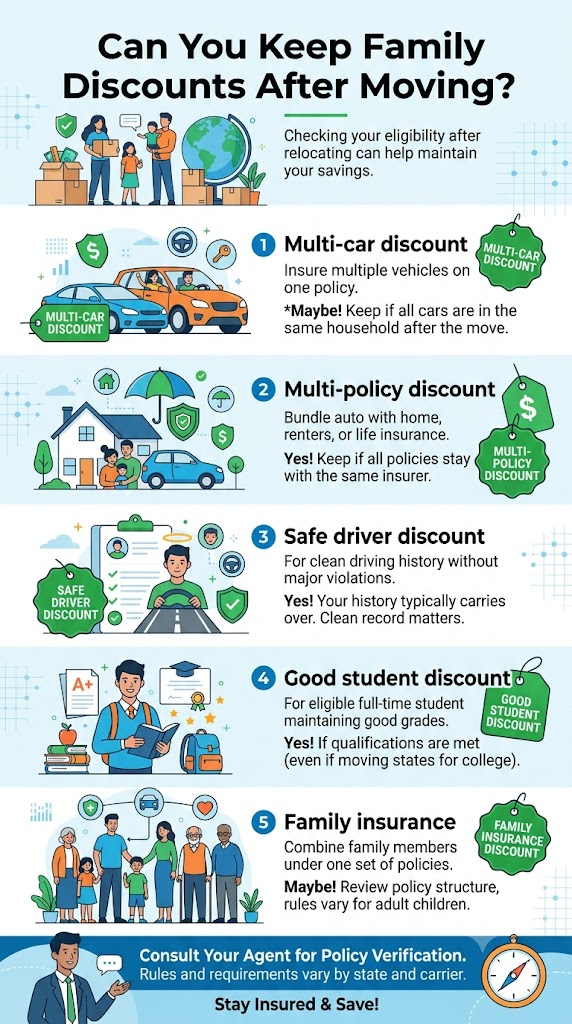
Some discounts may continue, including:
Multi-Car Discount
Available when multiple vehicles remain insured under the same policy.
Multi-Policy Discount
If your parents bundle auto insurance with homeowners or renters insurance, some discounts may still apply.
Safe Driver Discount
A clean driving record may continue to qualify you for lower rates.
Good Student Discount
Many insurers continue offering this discount if you meet academic requirements, even while attending college in another state.
What Happens If You Buy a New Car After Moving?
Buying a vehicle after relocating can change your insurance requirements.
You should notify your insurer if:
- You purchase a new vehicle.
- You trade in your existing car.
- The vehicle is titled in your name.
- The car will be kept permanently in another state.
Depending on your situation, the insurer may recommend transferring the vehicle to a separate policy.
What If You Frequently Drive Between Two States?
Some people split their time between two states for work, school, or family.
Examples include:
- Students returning home during breaks
- Seasonal workers
- Remote employees
- Families with two residences
Insurance companies generally want to know where the vehicle is primarily garaged, even if it regularly travels across state lines.
Providing accurate information helps ensure your policy reflects your actual driving situation.
Common Mistakes to Avoid
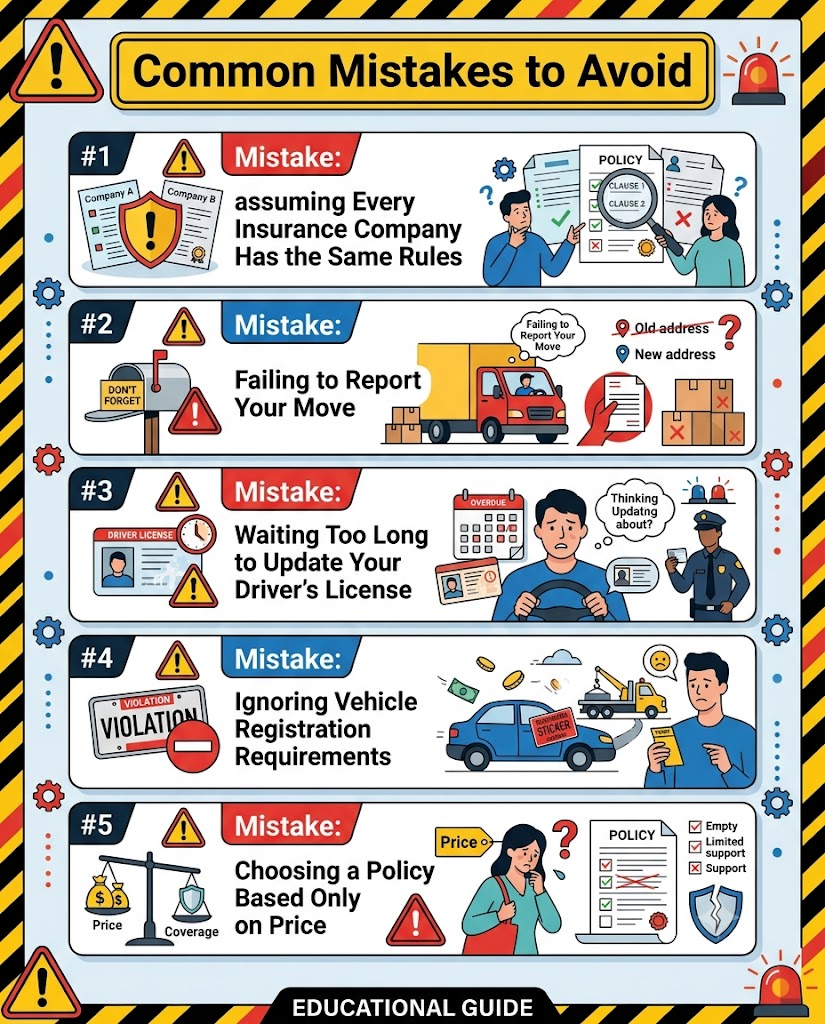
Mistake 1: Assuming Every Insurance Company Has the Same Rules
Each insurer has its own underwriting guidelines.
Never assume another company will treat your situation the same way.
Mistake 2: Failing to Report Your Move
Your insurer should know if:
- Your address changes.
- The vehicle is kept in another state.
- Your driving habits change significantly.
Outdated information can create problems during the claims process.
Mistake 3: Waiting Too Long to Update Your Driver’s License
Most states require new residents to obtain a state driver’s license within a specified period.
Delaying this step may lead to registration or insurance complications.
Mistake 4: Ignoring Vehicle Registration Requirements
Many states require vehicles to be registered shortly after establishing residency.
Check your new state’s deadlines to avoid penalties.
Mistake 5: Choosing a Policy Based Only on Price
The cheapest policy may not provide enough protection.
Compare:
- Liability limits
- Collision coverage
- Comprehensive coverage
- Deductibles
- Customer service
- Claims satisfaction
Should You Call Your Insurance Company Before Moving?
Absolutely.
Contact your insurer before relocating and ask:
- Can I remain on my parents’ policy?
- Will my premium change?
- Does my move affect my coverage?
- Do I need a new policy?
- Are there any state-specific requirements?
Getting answers in advance helps prevent surprises after the move.
Quick Decision Guide
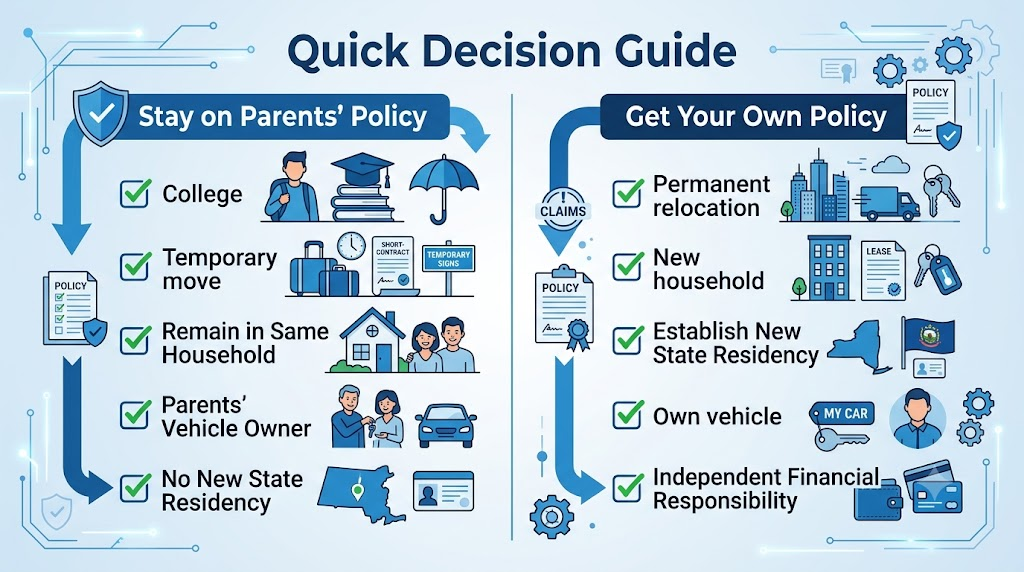
You may be able to stay on your parents’ policy if
- You are attending college temporarily.
- Your parents’ home remains your permanent address.
- The insurer allows out-of-state family members.
- The vehicle ownership and garaging situation meets the company’s guidelines.
You will likely need your own policy if
- You permanently relocate.
- You establish legal residency in another state.
- You own the vehicle.
- You register the vehicle in your new state.
- You form your own household.
Final Thoughts
Whether you can stay on your parents’ car insurance after moving out of state depends on your residency, vehicle ownership, where the car is primarily kept, and your insurer’s specific guidelines.
Temporary moves, such as attending college or completing a short-term work assignment, may allow you to remain on the family policy. Permanent relocations usually require updating your insurance, driver’s license, and vehicle registration to comply with your new state’s laws.
Before moving, contact your insurance company to discuss your plans. Keeping your policy information accurate is one of the best ways to ensure you remain properly covered and avoid unexpected issues if you ever need to file a claim.