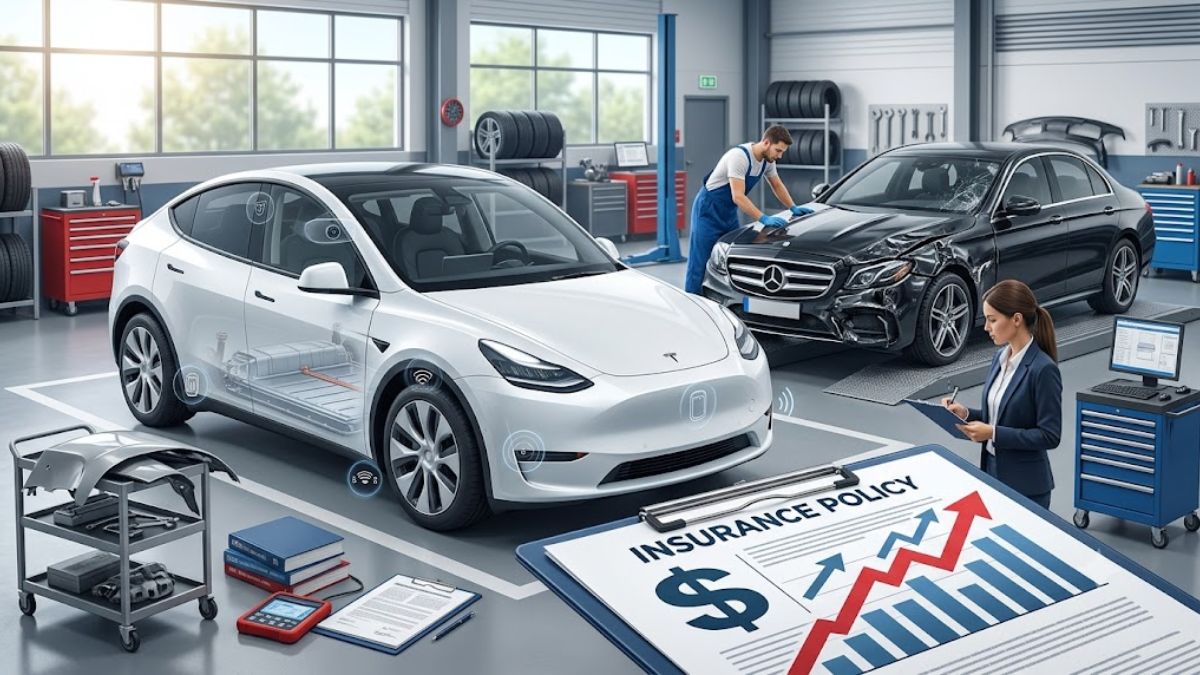

Tesla vehicles are known for their cutting-edge technology, impressive performance, and advanced safety features. However, many owners are surprised when they receive an insurance quote. In many cases, insuring a Tesla costs significantly more than insuring a comparable gasoline-powered vehicle.
Higher insurance premiums do not necessarily mean Teslas are unsafe. In fact, many Tesla models receive top safety ratings. The increased cost is mainly due to expensive repairs, specialized technology, high replacement values, and the way insurance companies calculate risk.
This guide explains why Tesla insurance is often expensive, what factors affect your premium, and what you can do to reduce your insurance costs.
Why is Insurance for A Tesla So Expensive
There isn’t one single reason.
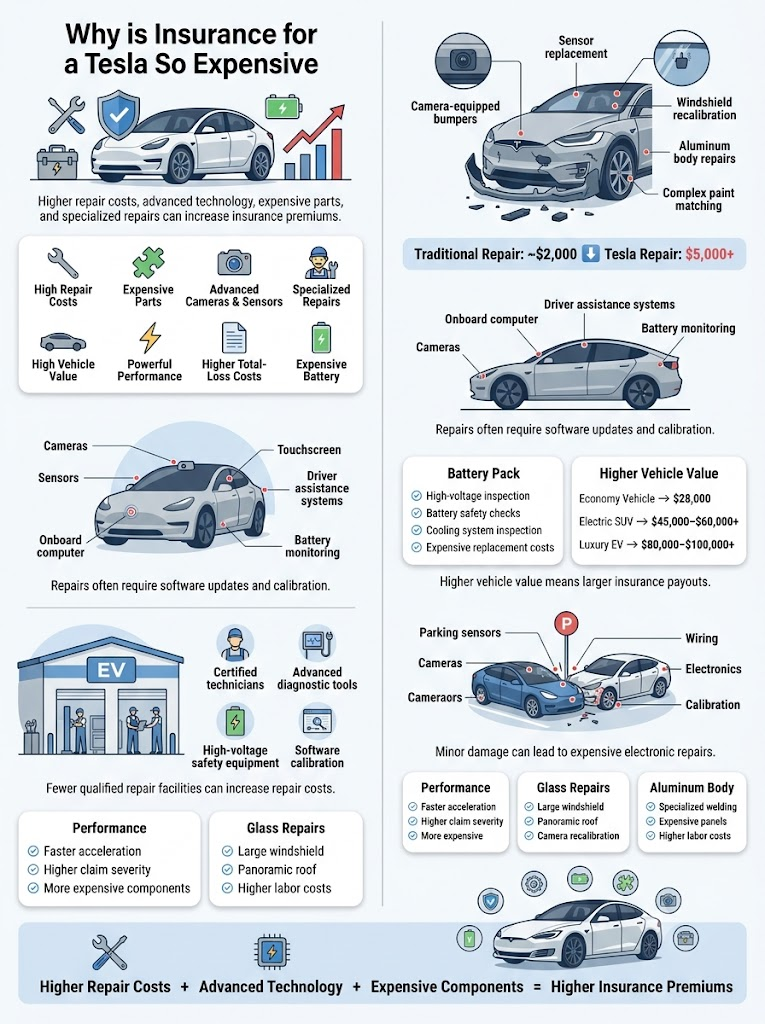
Instead, insurers consider several factors that increase the expected cost of claims.
The biggest reasons include:
- High repair costs
- Expensive replacement parts
- Advanced cameras and sensors
- Specialized repair requirements
- High vehicle value
- Powerful acceleration
- Higher total-loss costs
- Limited repair networks
- Expensive batteries
Let’s examine each factor in detail.
Tesla Vehicles Cost More to Repair
One of the biggest reasons Tesla insurance is expensive is repair cost.
Even relatively small accidents can result in surprisingly expensive repair bills.
For example:
- Damaged bumpers may contain cameras and sensors.
- Windshields often require camera recalibration.
- Body panels may require complete replacement.
- Aluminum components can be costly to repair.
- Paint matching is often more complicated.
A repair that might cost $2,000 on a traditional sedan could easily cost $5,000 or more on a Tesla.
Because insurers expect larger claims, premiums increase.
Advanced Technology Makes Repairs More Expensive
Tesla vehicles contain technology throughout the vehicle.
This includes:
- Multiple cameras
- Ultrasonic sensors (older models)
- Radar (some older vehicles)
- High-performance computers
- Touchscreen controls
- Electronic steering systems
- Battery monitoring systems
- Autopilot hardware
Even if these systems aren’t directly damaged, they often require recalibration after repairs.
Calibration adds labor time and specialized equipment.
Insurance companies factor these additional costs into premiums.
Battery Packs Are Extremely Expensive
The battery is the single most expensive component of a Tesla.
If a battery pack is severely damaged in an accident, replacement can cost thousands of dollars.
Although batteries are well protected and serious damage is uncommon, insurers prepare for worst-case scenarios.
Even inspections after an accident can be costly because technicians must verify that:
- No internal battery damage exists
- No coolant leaks occurred
- High-voltage systems remain safe
- Thermal damage is absent
Battery-related claims increase potential insurance losses.
Teslas Have High Market Values
Insurance companies pay the vehicle’s actual cash value if it is declared a total loss.
Since many Tesla models have relatively high values, insurers may have to pay significantly more than they would for an average sedan.
For example:
| Vehicle | Approximate Value |
|---|---|
| Economy sedan | $28,000 |
| Mid-size SUV | $35,000 |
| Tesla Model Y | $45,000–$60,000+ |
| Tesla Model S | $80,000–$100,000+ |
Higher vehicle values usually mean:
- Higher collision coverage costs
- Higher comprehensive coverage costs
- Larger claim payouts
Limited Repair Networks Increase Costs
Unlike many traditional vehicles, Teslas often require repairs from:
- Tesla Service Centers
- Tesla-approved body shops
- Certified EV repair facilities
These repair shops require:
- Specialized technician training
- Tesla-approved repair procedures
- Advanced diagnostic equipment
- High-voltage safety certifications
Since fewer repair facilities are available, repairs may cost more due to limited competition and specialized labor.
Replacement Parts Can Be Expensive
Tesla replacement parts are not always as widely available as parts for long-established automakers.
Examples include:
- Cameras
- Radar modules
- Touchscreens
- Battery cooling components
- Aluminum body panels
- Charging hardware
- Electronic control modules
Some repairs may involve waiting for specific components.
Longer repair times also increase rental car costs, which insurers often pay under certain policies.
Labor Costs Are Higher
Repairing electric vehicles requires technicians with specialized knowledge.
They must understand:
- High-voltage electrical systems
- Battery safety
- Thermal management systems
- Tesla software
- Calibration procedures
Specialized labor typically costs more than standard automotive repairs.
Insurance companies account for these higher labor costs when pricing policies.
Even Minor Accidents Can Become Expensive Claims
A simple parking lot accident may appear minor.
However, hidden damage can include:
- Parking sensors
- Cameras
- Wiring harnesses
- Radar calibration
- Bumper electronics
What looks like a cosmetic repair may actually involve replacing multiple electronic components.
As claim costs rise, insurance premiums also increase.
Tesla Repairs Often Require Software Calibration
Modern Teslas rely heavily on software.
After repairs, technicians may need to recalibrate:
- Cameras
- Driver assistance systems
- Steering systems
- Braking systems
- Sensors
Calibration requires specialized equipment and trained technicians.
This adds both time and cost to repairs.
Performance Increases Insurance Risk
Many Tesla models accelerate extremely quickly.
Examples include:
| Tesla Model | Approximate 0–60 mph |
|---|---|
| Model 3 Performance | Around 3 seconds |
| Model S Plaid | Around 2 seconds |
| Model X Plaid | Around 2.5 seconds |
Insurance companies know that high-performance vehicles generally have:
- More expensive claims
- Higher repair costs
- Greater accident severity
- Higher claim payouts
Performance alone does not make premiums expensive, but it contributes to the overall risk profile.
Expensive Glass and Roof Repairs
Tesla vehicles often feature:
- Large panoramic glass roofs
- Advanced windshields
- Integrated cameras
Replacing these components is more expensive than replacing standard automotive glass.
Windshield replacement may also require:
- Camera calibration
- Sensor testing
- Software verification
The total repair bill can be substantially higher than for conventional vehicles.
Aluminum Construction Can Increase Repair Costs
Some Tesla models use aluminum extensively.
Although aluminum helps reduce weight, it presents challenges:
- Specialized welding
- Different repair methods
- More expensive replacement panels
- Higher labor costs
Many repair shops lack the equipment needed for aluminum repairs.
As a result, owners may need certified repair facilities, increasing claim costs.
How Insurance Companies Calculate Tesla Insurance Premiums
Insurance companies don’t simply charge more because a vehicle is electric.
They evaluate several risk factors, including:
- Vehicle value
- Repair history
- Average claim costs
- Theft rates
- Safety ratings
- Driver demographics
- Local accident frequency
- Repair network availability
- Cost of replacement parts
- Vehicle performance
Tesla scores high in several categories that increase expected claim costs, even though it performs well in safety tests.
Does Tesla’s Excellent Safety Rating Reduce Insurance Costs?
Tesla vehicles consistently perform well in crash testing and include advanced safety technologies that can help prevent accidents.
Features such as automatic emergency braking, lane-keeping assistance, collision warnings, and advanced driver-assistance systems may reduce the likelihood of certain crashes.
However, insurers evaluate both how often claims occur and how much those claims cost.
While strong safety performance can help lower the frequency of severe injuries, the cost to repair a Tesla after an accident often remains high due to specialized parts, electronics, and labor.
As a result, excellent safety ratings do not always translate into lower insurance premiums.
Which Tesla Models Are the Most Expensive to Insure?
Insurance costs vary significantly across Tesla’s lineup. Generally, vehicles with higher purchase prices, greater performance, and more expensive repair costs have higher premiums.
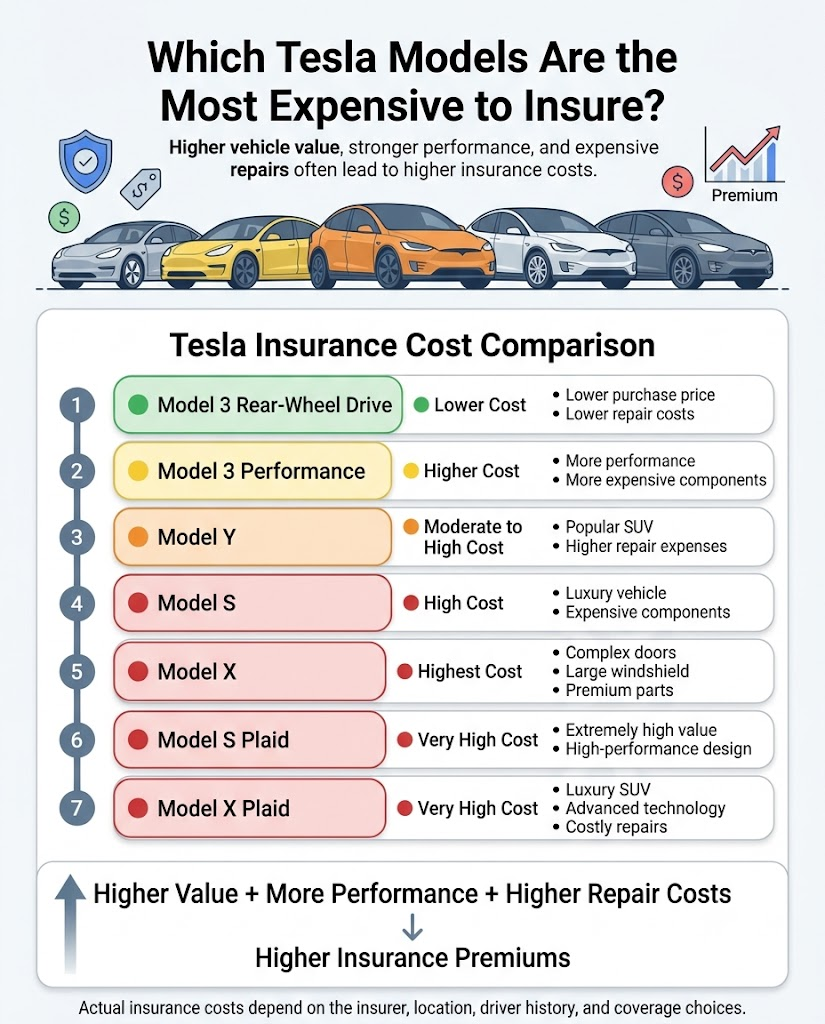
Here’s a general comparison:
| Tesla Model | Typical Insurance Cost | Why? |
|---|---|---|
| Model 3 Rear-Wheel Drive | Lowest among Tesla models | Lower purchase price and repair costs |
| Model 3 Performance | Higher | Greater performance and more expensive parts |
| Model Y | Moderate to High | Popular SUV with relatively high repair costs |
| Model S | High | Luxury vehicle with expensive components |
| Model X | Highest | Falcon Wing doors, large windshield, premium parts |
| Model S Plaid | Very High | Extremely high value and performance |
| Model X Plaid | Very High | Luxury SUV with advanced technology and costly repairs |
The exact premium depends on the insurer, location, and driver profile, but in general, the Model S and Model X are among the most expensive Teslas to insure.
Why the Tesla Model X Is Especially Expensive to Insure
The Model X has several features that increase repair costs.
These include:
- Falcon Wing rear doors
- Large panoramic windshield
- Premium suspension
- Multiple cameras and sensors
- Luxury interior
- Expensive replacement parts
Even minor side impacts can require repairs to the complex door system, leading to larger insurance claims.
Why Performance Models Cost More to Insure
Tesla’s Performance and Plaid models are among the quickest production vehicles in the world.
These vehicles typically feature:
- Larger motors
- Higher top speeds
- Faster acceleration
- Premium brakes
- Larger wheels and tires
Insurance companies generally view high-performance vehicles as having greater claim potential due to higher repair costs and increased accident severity.
This often results in higher premiums compared to standard versions.
Does Full Self-Driving (FSD) Affect Insurance?
Many buyers assume that Full Self-Driving (FSD) automatically lowers insurance premiums.
In reality, the effect is usually limited.
Insurance companies primarily focus on:
- Repair costs
- Claim history
- Vehicle value
- Driver history
- Local accident statistics
Although FSD includes advanced driver-assistance features that may help reduce certain crashes, it also adds expensive hardware and software to the vehicle.
If those components are damaged, repair costs may increase.
As a result, having FSD does not necessarily reduce insurance costs and, in some cases, may slightly increase them because of the higher vehicle value.
Does Autopilot Reduce Insurance Costs?
Autopilot provides features such as:
- Adaptive cruise control
- Lane centering
- Automatic emergency braking
- Traffic-aware cruise control
These technologies can improve safety in many driving situations.
However, insurers are more concerned with actual claim data than individual features.
If the average cost of repairing Tesla vehicles remains high, premiums may stay elevated even when advanced safety systems are present.
Why Tesla Insurance Costs Differ by State
Insurance rates can vary dramatically depending on where you live.
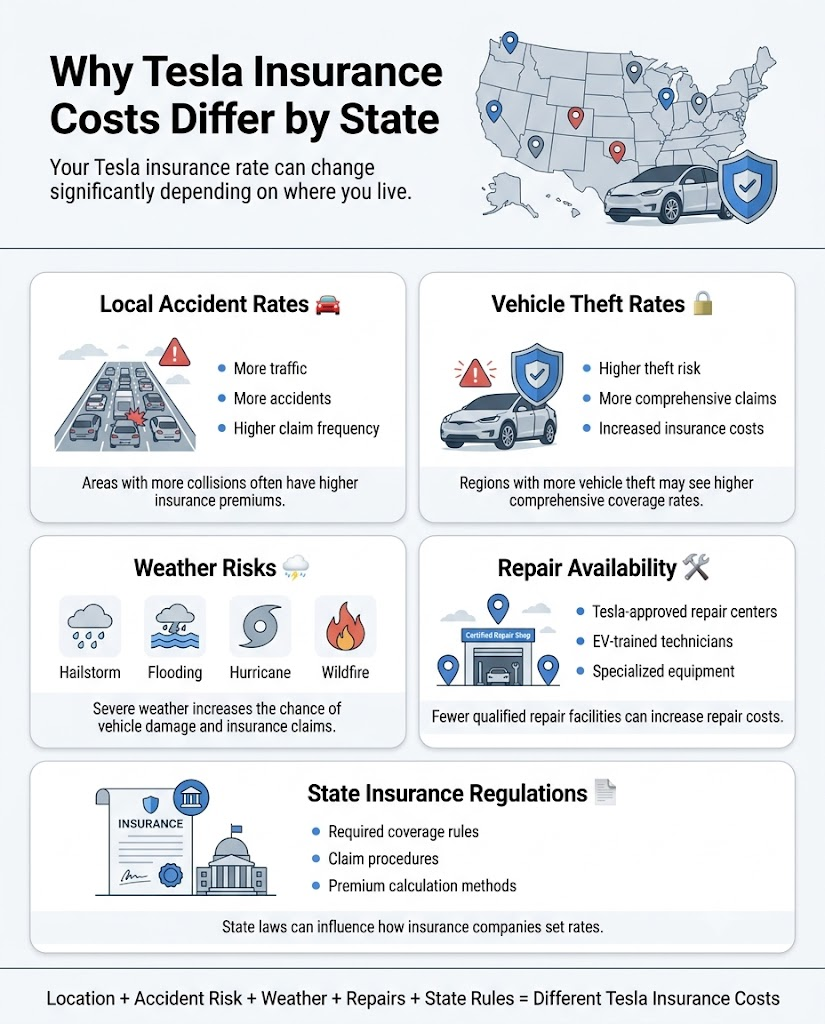
Factors include:
Local Accident Rates
Areas with more traffic and collisions generally have higher premiums.
Vehicle Theft Rates
If Teslas are stolen more frequently in a particular area, comprehensive insurance costs may increase.
Weather Risks
Regions prone to:
- Hailstorms
- Flooding
- Hurricanes
- Wildfires
typically have higher comprehensive insurance rates because of the increased risk of damage.
Repair Availability
States with fewer Tesla-approved repair facilities may have higher repair costs, leading insurers to charge more.
State Insurance Regulations
Some states have unique insurance laws that influence:
- Required coverages
- Claim procedures
- Premium calculations
These regulations can make premiums higher or lower compared to other states.
How Your Age Affects Tesla Insurance
Age is one of the most important factors insurers consider.
Drivers Under 25
Younger drivers often pay the highest premiums because they are statistically more likely to be involved in accidents.
Combining youthful driving risk with the high repair costs of a Tesla can result in particularly expensive insurance.
Drivers Between 25 and 60
Drivers with:
- Clean driving records
- Stable insurance history
- Good credit (where allowed)
- Several years of driving experience
often qualify for more competitive rates.
Senior Drivers
Insurance costs for older drivers vary depending on:
- Driving history
- Annual mileage
- Health-related driving considerations
- Claim history
Some may see modest increases as they age, while others continue to receive favorable rates.
How Driving History Affects Tesla Insurance
A clean driving record can significantly reduce insurance costs.
Insurers look at factors such as:
- At-fault accidents
- Speeding tickets
- Reckless driving violations
- DUI convictions
- Previous insurance claims
- Lapses in insurance coverage
Drivers with multiple violations are generally viewed as higher risk and can expect substantially higher premiums.
How Credit Can Affect Tesla Insurance
In many U.S. states, insurers use a credit-based insurance score when calculating premiums.
Drivers with stronger insurance scores may receive lower rates because historical data suggests they file fewer or less costly claims.
However, several states restrict or prohibit the use of credit information in auto insurance pricing.
Why Teslas Are Often Declared Total Losses
One reason insurers price Tesla coverage higher is the possibility of costly total-loss claims.
A vehicle may be declared a total loss when the estimated repair cost approaches or exceeds its actual cash value.
With Teslas, this can happen because:
- Battery damage is expensive to repair.
- Structural repairs can be extensive.
- Electronic systems are costly to replace.
- Specialized labor increases repair bills.
Even accidents that appear moderate can result in repair estimates high enough for the insurer to consider the vehicle a total loss.
Does Tesla Insurance Cost More Than Other Electric Vehicles?
Not always, but Tesla insurance is often higher than many competing EVs.
Here’s a general comparison:
| Vehicle | Typical Insurance Cost |
|---|---|
| Nissan Leaf | Lower |
| Hyundai Ioniq 5 | Lower to Moderate |
| Kia EV6 | Moderate |
| Chevrolet Equinox EV | Moderate |
| Ford Mustang Mach-E | Moderate to High |
| Tesla Model Y | High |
| Tesla Model S | Very High |
| Tesla Model X | Very High |
The difference is largely driven by Tesla’s repair costs, parts pricing, and specialized service requirements rather than the fact that the vehicles are electric.
Tesla Insurance vs Traditional Insurance Companies
Tesla owners have two main options for insuring their vehicle:
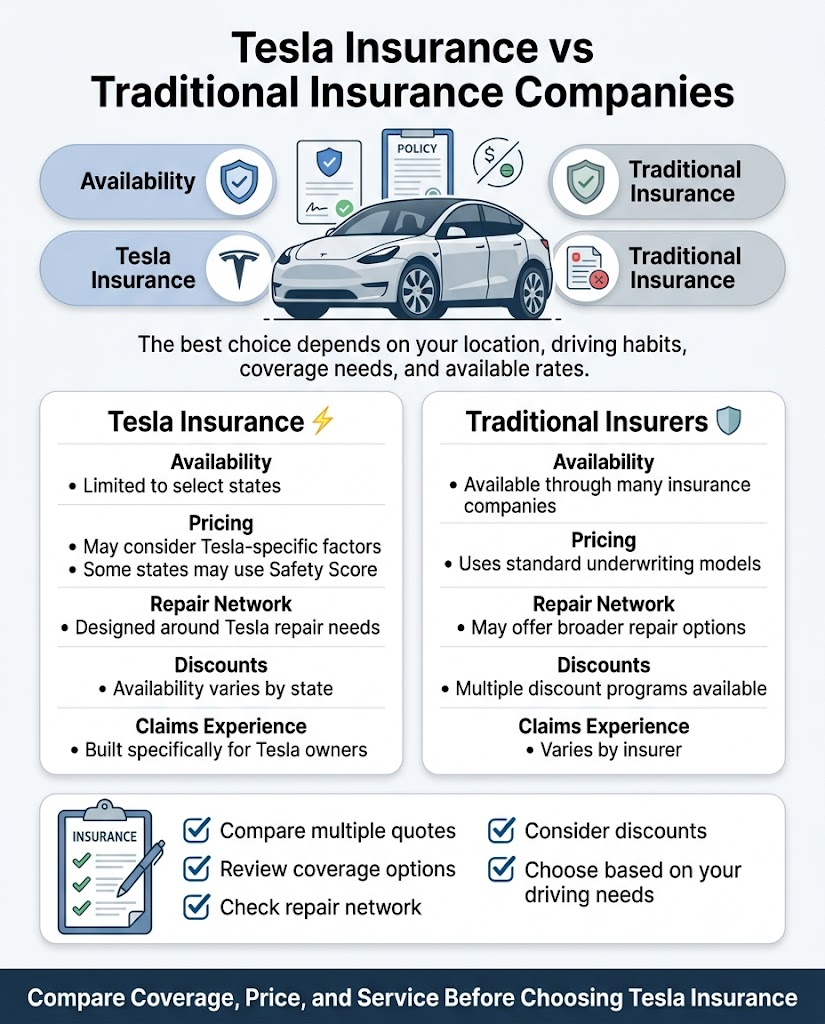
- Tesla Insurance (available in certain U.S. states)
- Traditional auto insurance companies
The right choice depends on your location, driving habits, and the rates you receive.
Here’s a comparison:
| Feature | Tesla Insurance | Traditional Insurers |
|---|---|---|
| Availability | Limited to select states | Available nationwide through many companies |
| Pricing | May consider Tesla-specific factors and, in some states, Safety Score | Uses the insurer’s underwriting model |
| Repair Network | Familiar with Tesla repairs | May have broader repair networks depending on the company |
| Discounts | Vary by state | Wide range of discounts may be available |
| Claims Experience | Designed for Tesla owners | Varies by insurer |
Since premiums vary widely, it’s worth comparing multiple quotes before choosing a policy.
How to Lower Tesla Insurance Costs
Although Tesla insurance can be expensive, there are several ways to reduce your premium.
Compare Quotes from Multiple Insurers
Insurance companies calculate risk differently.
One insurer may charge hundreds or even thousands of dollars more per year than another for the same driver and vehicle.
Always compare quotes from several companies before purchasing coverage.
Increase Your Deductible
Choosing a higher deductible generally lowers your monthly or annual premium.
For example:
| Deductible | Typical Premium |
|---|---|
| $500 | Higher |
| $1,000 | Lower |
| $2,000 | Even Lower |
A higher deductible means you’ll pay more out of pocket if you file a covered claim, so choose an amount you can comfortably afford.
Maintain a Clean Driving Record
Safe drivers usually qualify for better insurance rates.
Avoid:
- Speeding tickets
- At-fault accidents
- Reckless driving citations
- DUI convictions
A clean record over several years can significantly reduce premiums.
Bundle Your Insurance Policies
Many insurers offer discounts if you combine:
- Auto insurance
- Homeowners insurance
- Renters insurance
- Condo insurance
Bundling can result in meaningful savings.
Ask About Available Discounts
Depending on the insurer, you may qualify for discounts such as:
- Multi-vehicle discount
- Safe driver discount
- Good student discount
- Military discount
- Professional organization discount
- Low-mileage discount
- Defensive driving course discount
- Automatic payment discount
- Paperless billing discount
Not every insurer offers the same discounts, so ask what is available.
Reduce Your Annual Mileage
Drivers who travel fewer miles each year often pay lower premiums because they spend less time on the road.
If you:
- Work from home
- Drive only occasionally
- Use public transportation frequently
you may qualify for a low-mileage discount.
Improve Vehicle Security
While Teslas already include advanced security features, additional measures such as secure garage parking or other theft-deterrent practices may help reduce risk and could qualify for discounts with some insurers.
Avoid Small Claims
If the repair cost is only slightly above your deductible, paying for minor damage yourself may help preserve a favorable claims history.
Fewer claims can contribute to lower premiums over time, though every situation is different.
Common Mistakes Tesla Owners Make
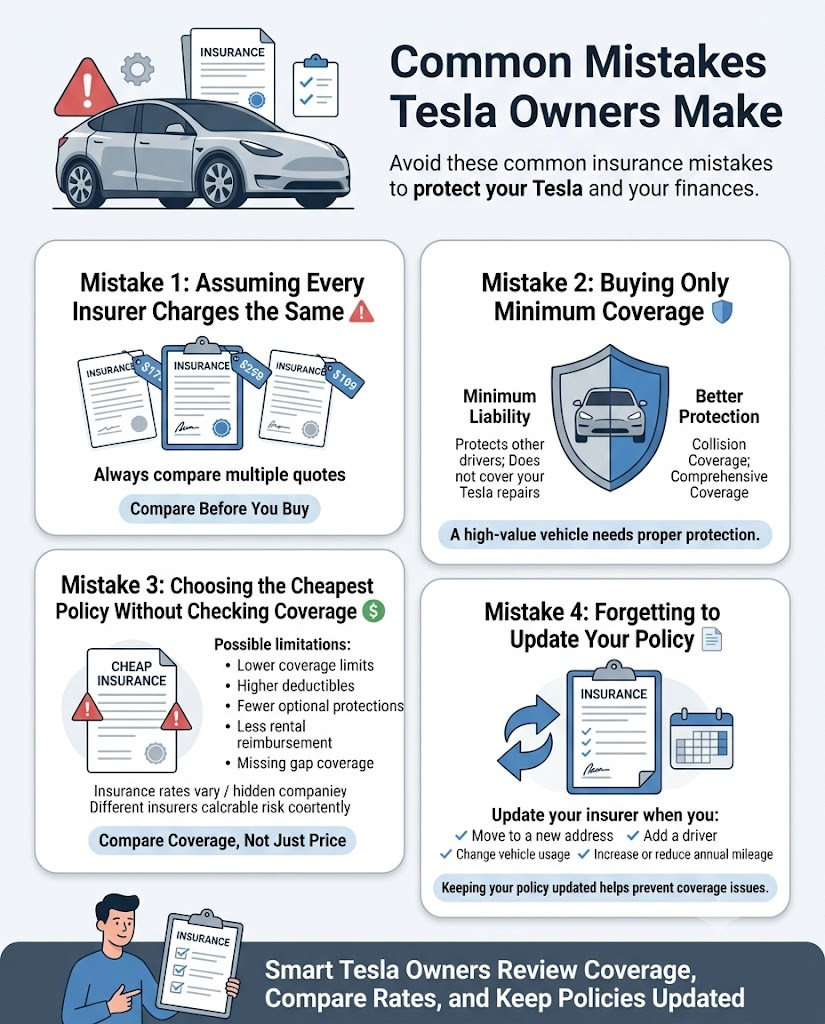
Assuming Every Insurer Charges the Same
Premiums can vary dramatically between companies.
Always compare multiple quotes.
Buying Only the Minimum Required Coverage
A Tesla is a high-value vehicle.
State minimum liability coverage protects others but does not pay to repair or replace your own vehicle after a covered collision or other covered loss.
Many owners choose collision and comprehensive coverage for greater financial protection.
Choosing the Lowest Price Without Reviewing Coverage
A cheaper policy may have:
- Lower coverage limits
- Higher deductibles
- Fewer optional protections
- Less rental reimbursement
- No gap coverage (if needed)
Compare coverage, not just price.
Forgetting to Update the Policy
Notify your insurer if you:
- Move to a new address
- Add a driver
- Change how you use the vehicle
- Significantly increase or reduce annual mileage
Keeping your policy current helps avoid coverage issues.
Final Thoughts
Tesla vehicles offer outstanding performance, advanced technology, and excellent safety features, but these benefits often come with higher insurance premiums.
The main reason isn’t that Teslas are unsafe. Instead, insurers expect higher claim costs due to expensive batteries, advanced electronics, specialized repairs, certified labor, and high vehicle values.
Fortunately, you can often reduce your insurance costs by comparing quotes from multiple insurers, maintaining a clean driving record, selecting an appropriate deductible, taking advantage of available discounts, and choosing the coverage that best fits your needs.
Before purchasing a Tesla, it’s a good idea to obtain insurance quotes from several providers. Understanding your expected insurance costs ahead of time can help you budget more accurately and avoid surprises after taking delivery of your vehicle.