
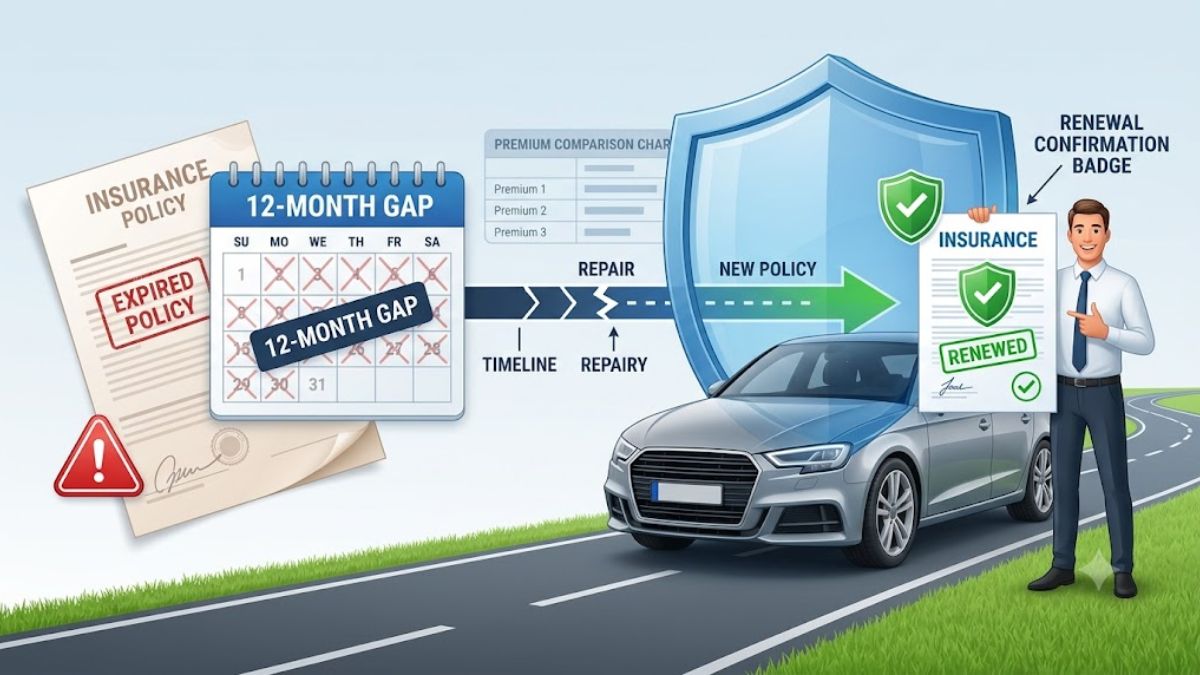

A gap in car insurance coverage can happen for many reasons. You may have stopped driving for a while, sold another vehicle, moved to a different state, faced financial difficulties, or simply forgot to renew your policy.
While a short lapse may be easy to fix, a Car Insurance After A Lapse of 1 Year can create additional challenges when you try to get coverage again.
Insurance companies consider a long coverage gap a higher risk because there is no recent record showing continuous protection. As a result, you may face higher premiums, fewer available options, or additional requirements before a company agrees to insure your vehicle.
However, a one-year lapse does not mean you cannot get car insurance. In most cases, you can still purchase a new policy by understanding how insurers evaluate your situation and taking the right steps before applying.
What Is a Car Insurance Lapse?
A car insurance lapse occurs when your auto insurance policy ends and there is no active replacement coverage in place.
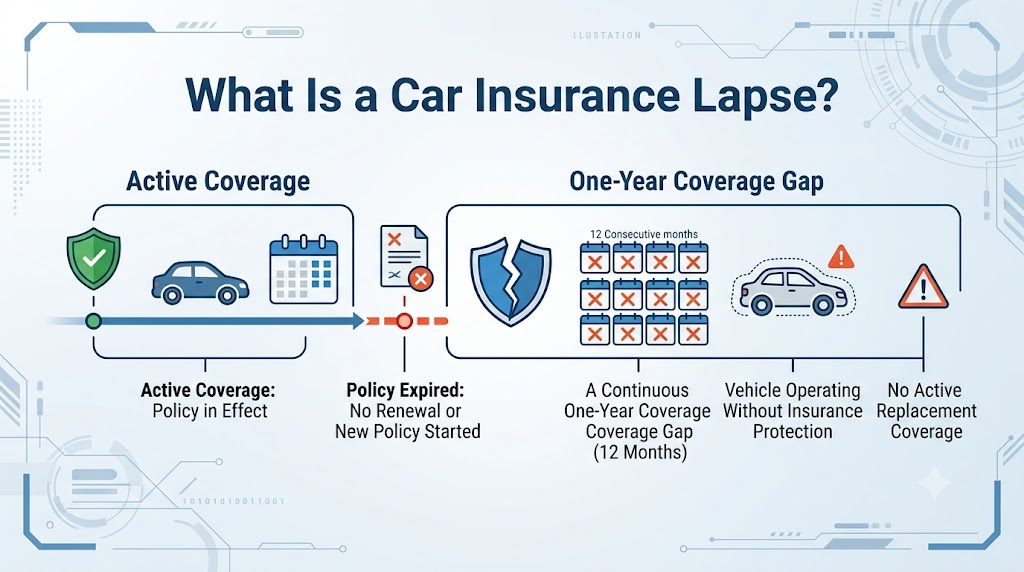
Common reasons for a lapse include:
- Forgetting to renew the policy
- Not paying the premium on time
- Temporarily not driving the vehicle
- Leaving the vehicle unused for an extended period
- Selling a vehicle and buying another one later
- Financial problems affecting monthly payments
- Moving and delaying insurance arrangements
A lapse can last for a few days, several months, or even years. A 1-year lapse is considered a significant coverage gap by many insurers.
For example:
- Your policy expired on January 1, 2025
- You did not purchase new coverage until January 1, 2026
During that entire period, your vehicle had no active insurance history.
Car Insurance After A Lapse of 1 Year?
Yes, you can usually get car insurance after a one-year lapse.
Insurance companies do not permanently deny coverage simply because you were uninsured for a year. However, they may view you as a higher-risk customer compared with someone who maintained continuous coverage.
When applying again, insurers may look at:
- Your previous insurance history
- Reason for the lapse
- Driving record
- Number of claims
- Vehicle type
- Location
- Credit-based insurance score (where allowed)
- Previous policy cancellation reason
If your driving record is clean and you have no serious violations, getting coverage is usually much easier.
Why Is Car Insurance More Expensive After a 1-Year Lapse?
A coverage gap can increase your insurance cost because insurers use continuous coverage as an indicator of responsible vehicle ownership.
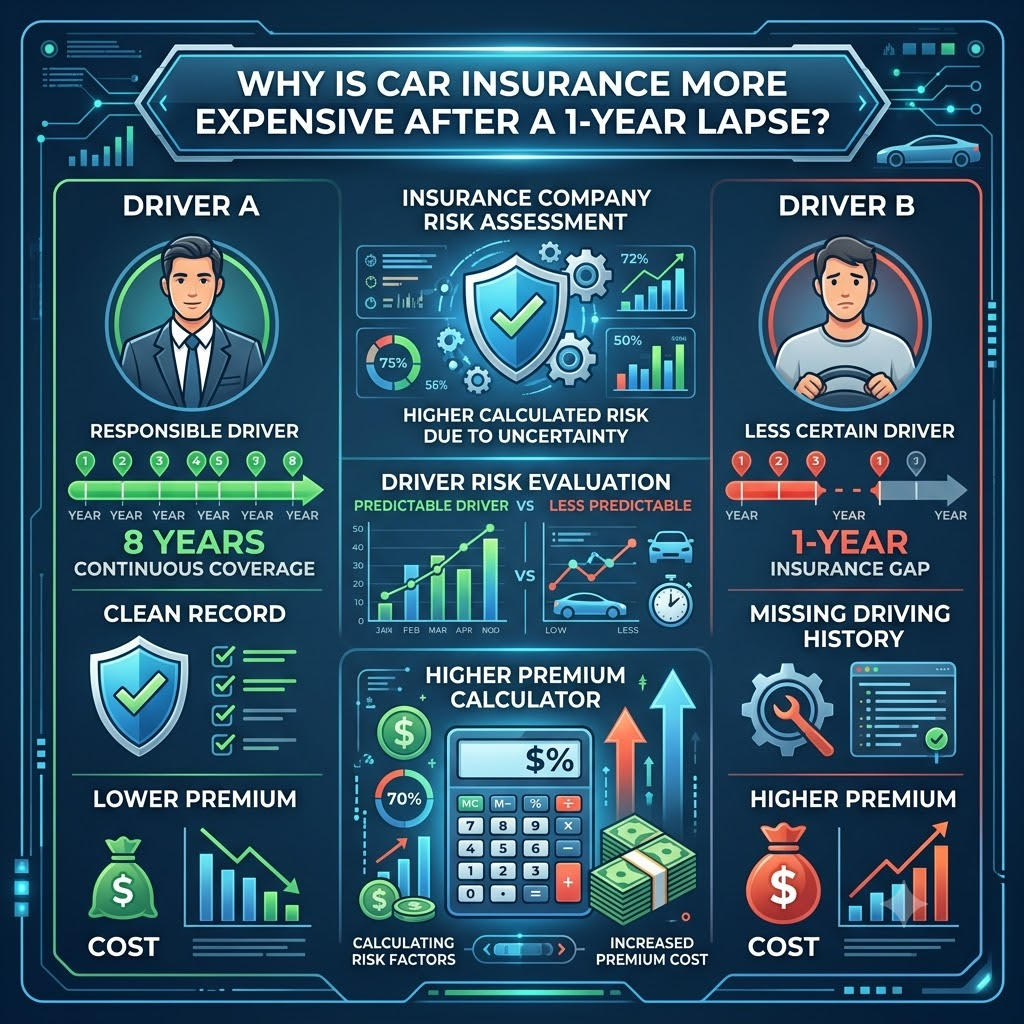
Drivers with uninterrupted insurance history are often considered lower risk because:
- They maintain financial responsibility
- They are less likely to drive uninsured
- They have a documented claims history
- Their driving behavior is easier to evaluate
After a one-year lapse, an insurer may apply a higher rate because they have less recent information about your risk level.
For example:
Driver A
- Continuous insurance for 8 years
- Clean driving record
- No claims
Estimated premium: $1,200/year
Driver B
- Same driving record
- 1-year insurance gap
Estimated premium: $1,500-$1,800/year
The difference depends on the insurer, location, and personal factors.
Does a 1-Year Insurance Lapse Affect Your Driving Record?
No. A car insurance lapse does not directly damage your driving record.
Your driving record usually includes:
- Traffic violations
- Accidents
- License suspensions
- DUI offenses
- Other driving-related incidents
However, insurance companies maintain their own records and may consider your previous insurance history when calculating your premium.
A lapse is not the same as having:
- Multiple accidents
- Speeding tickets
- License suspension
A driver with a clean record but a one-year lapse may still qualify for standard insurance.
What Happens If You Drove Without Insurance for a Year?
The consequences depend on your location and whether you were caught driving uninsured.
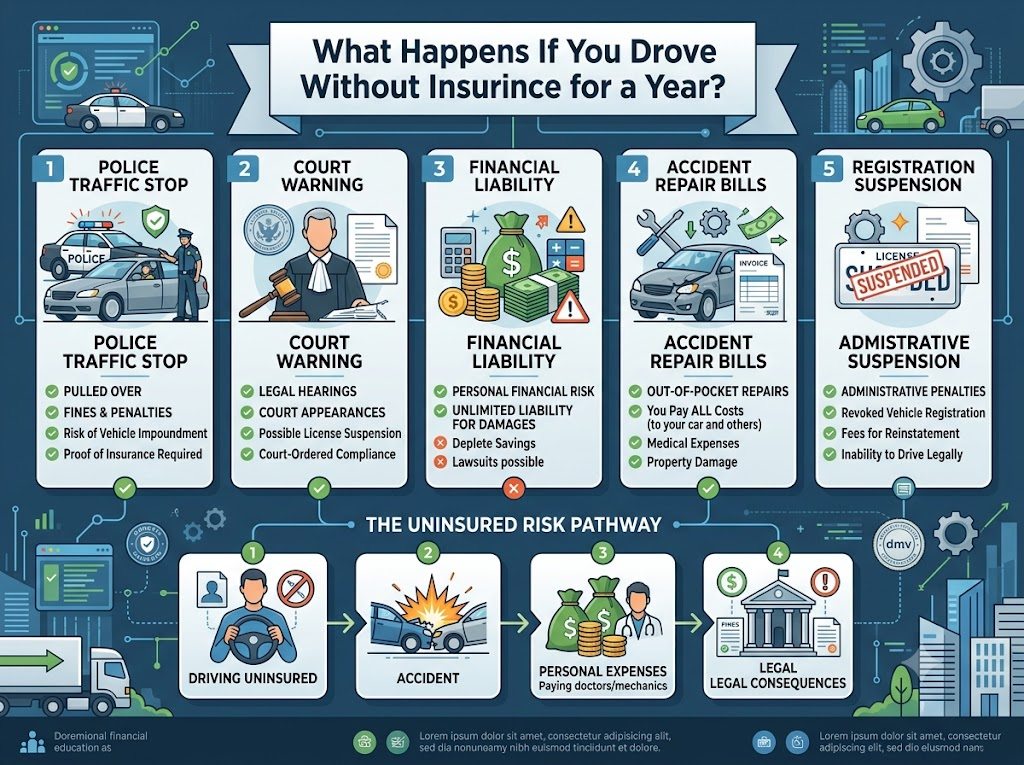
If your vehicle was simply parked and you did not drive it, the consequences are usually limited to difficulty finding cheaper insurance later.
However, driving without insurance can lead to:
- Fines
- Registration suspension
- License suspension
- Vehicle impoundment
- Legal penalties
- Personal financial responsibility after an accident
If you caused an accident while uninsured, you could be responsible for:
- Vehicle repair costs
- Medical expenses
- Property damage
- Legal claims
A one-year lapse becomes more serious if you continued driving during that period.
Can You Buy Full Coverage Insurance After a 1-Year Lapse?
Yes, you can still buy full coverage insurance after a one-year gap.
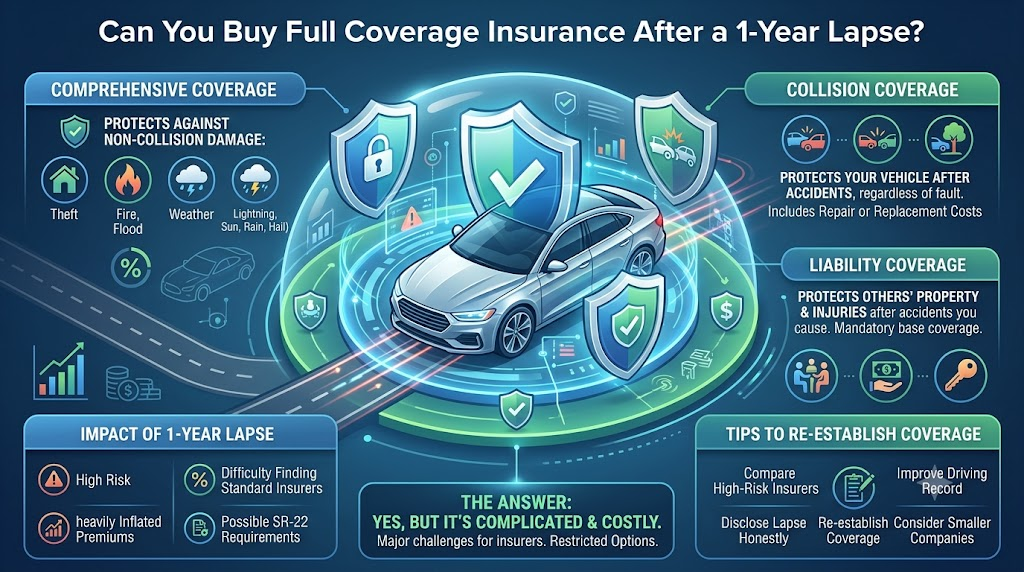
Full coverage usually includes:
Liability Coverage
Pays for damage or injuries you cause to others.
Collision Coverage
Pays for damage to your own vehicle after a crash.
Comprehensive Coverage
Covers non-collision damage such as:
- Theft
- Fire
- Flood
- Storm damage
- Animal collisions
- Vandalism
However, insurers may be more cautious when offering comprehensive or collision coverage after a long lapse.
Some companies may:
- Require vehicle inspection
- Ask for photos of the car
- Limit certain coverage options
- Charge a higher premium initially
Will Insurance Companies Ask Why Your Policy Lapsed?
Many insurers will ask about the reason for the gap.
Common acceptable explanations include:
- “The vehicle was not being driven.”
- “I temporarily did not own a vehicle.”
- “I was traveling.”
- “I had financial difficulties.”
- “I forgot to renew the policy.”
Be honest when answering. Providing false information can create problems later, especially during a claim.
How to Buy Car Insurance After a 1-Year Lapse (Basic Steps)
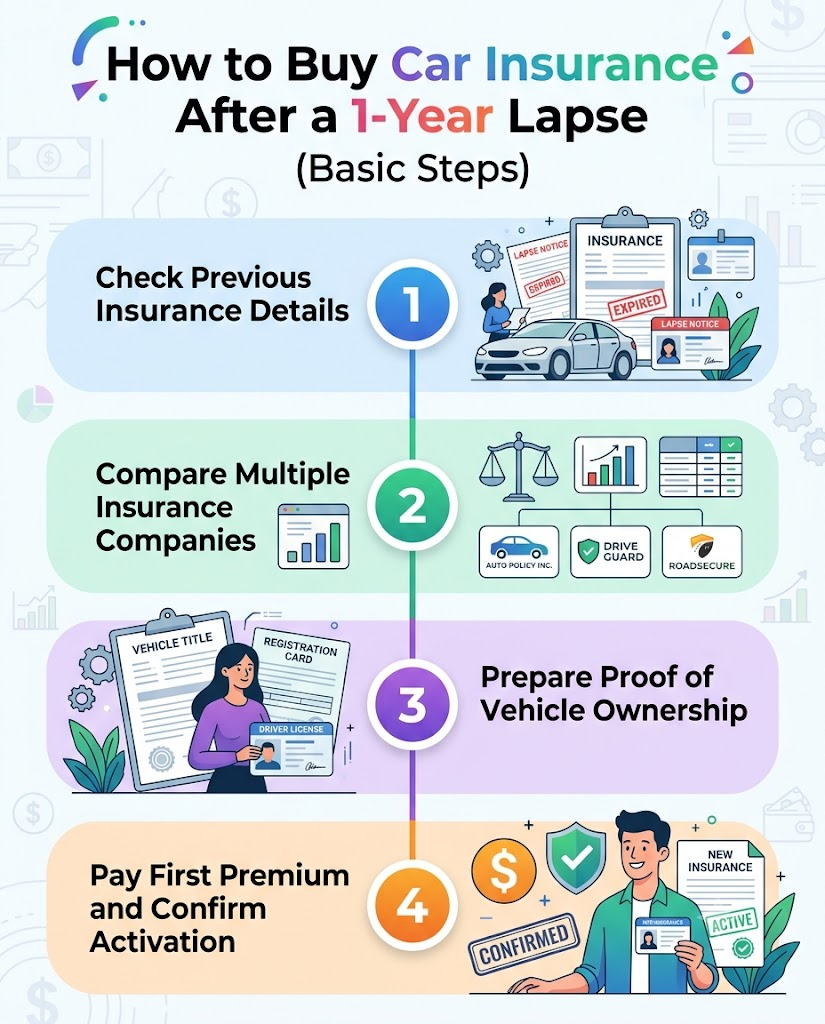
Step 1: Check Your Previous Insurance Details
Before shopping for a new policy, collect:
- Previous insurer name
- Policy number (if available)
- Expiration date
- Claims history
- Vehicle registration details
This information helps insurers understand your history.
Step 2: Compare Multiple Insurance Companies
Do not accept the first quote after a lapse.
Different insurers treat coverage gaps differently. One company may charge significantly more than another.
Compare:
- Premium cost
- Coverage limits
- Deductibles
- Discounts
- Customer service reputation
Step 3: Prepare Proof of Vehicle Ownership
You may need:
- Vehicle registration
- Driver’s license
- VIN number
- Address information
- Previous insurance details
Step 4: Consider Paying the First Premium Immediately
After a lapse, insurers may require immediate payment before coverage begins.
Avoid assuming that your policy is active until you receive confirmation.
How Much Does Car Insurance Increase After a 1-Year Lapse?
A one-year insurance lapse can result in higher premiums because insurers consider continuous coverage an important risk factor.
In many cases, drivers with a lapse may see an increase of:
- 10% to 30% higher premiums compared with drivers with similar profiles and continuous coverage
- Sometimes more if combined with other risk factors such as tickets, accidents, or poor credit history
For example:
Driver with continuous coverage: Annual premium: $1,200
Same driver after a 1-year lapse: Possible premium: $1,400 to $1,600
The actual increase depends heavily on the insurance company. Some insurers penalize gaps more aggressively than others.
Factors That Determine Your New Insurance Rate After a Lapse
Insurance companies do not look only at the lapse itself. They evaluate your entire risk profile.
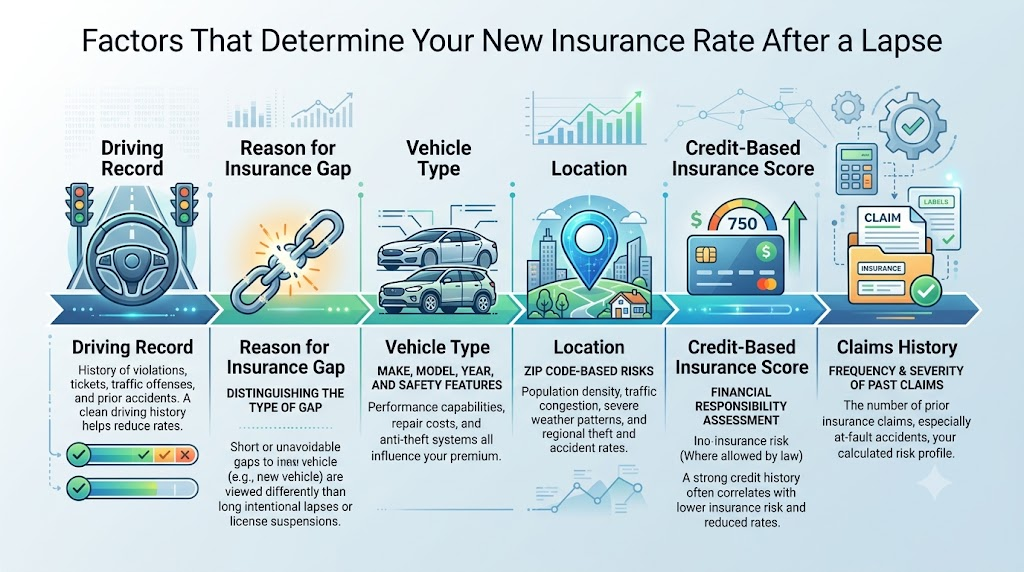
Driving Record
Your driving history is one of the biggest factors affecting your premium.
A driver with:
- No accidents
- No speeding tickets
- No DUI history
- No license violations
may still qualify for reasonable rates after a lapse.
On the other hand, a lapse combined with a poor driving record can make insurance significantly more expensive.
Reason for the Insurance Gap
The reason behind your lapse can influence how insurers view your risk.
Lower-risk explanations
- You did not own a vehicle
- The car was stored and not driven
- You were away for an extended period
- You temporarily stopped driving
Higher-risk explanations
- You drove without insurance
- Your previous policy was canceled for non-payment
- You had repeated coverage interruptions
Some insurance companies ask whether you owned and operated a vehicle during the uninsured period.
Your Vehicle Type
The car you insure affects your premium after a lapse.
A newer or expensive vehicle may result in higher rates because:
- Repairs cost more
- Replacement value is higher
- Comprehensive claims are more expensive
Older vehicles with lower market value may be cheaper to insure.
For example:
A driver returning after a one-year lapse may pay less insuring an older sedan compared with a luxury SUV or sports car.
Location
Insurance rates vary significantly depending on where you live.
Areas with:
- More accidents
- Higher theft rates
- Heavy traffic
- Higher repair costs
usually have higher premiums.
A one-year lapse in a high-cost insurance area may create a larger price increase than the same lapse in a lower-cost area.
Credit-Based Insurance Score
In many states, insurers can use credit-based insurance scores when determining rates.
A strong credit profile may help reduce premiums, while poor credit can increase costs.
Factors that may affect insurance scoring include:
- Payment history
- Outstanding debt
- Credit history length
- Recent credit activity
Some states restrict or prohibit the use of credit information for auto insurance pricing.
How to Lower Car Insurance Costs After a 1-Year Lapse
A lapse does not mean you must accept expensive insurance. Several strategies can help reduce your premium.
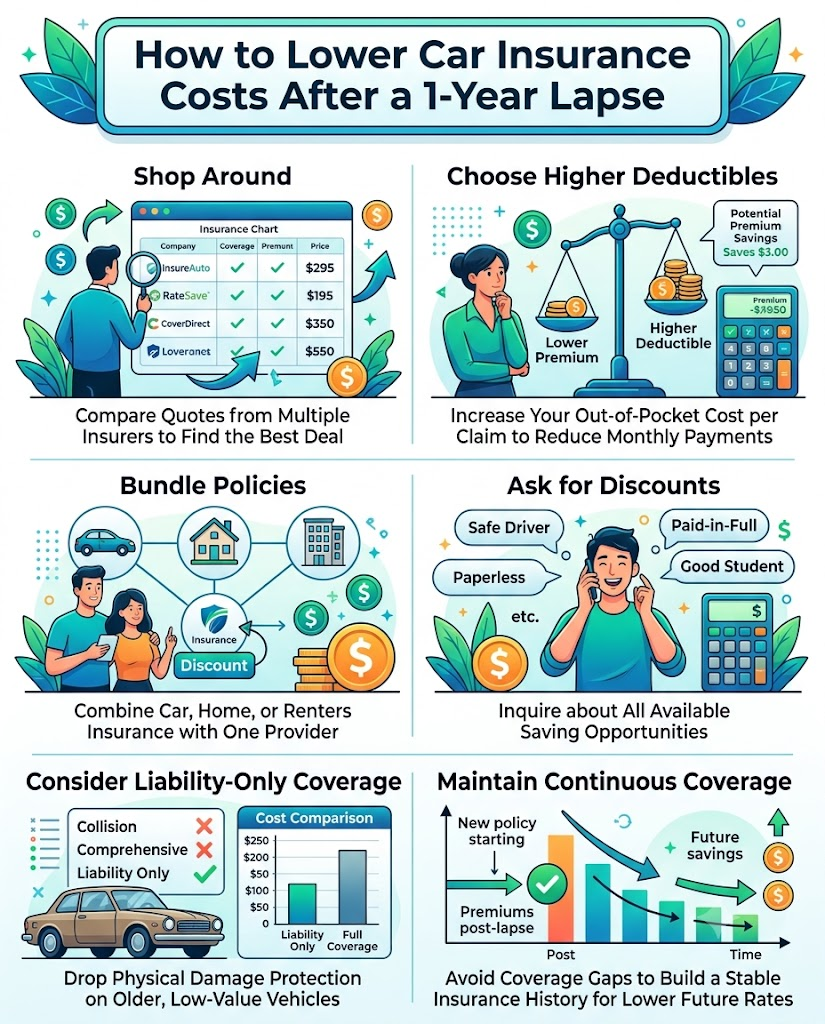
Shop Around With Multiple Insurance Companies
Insurance companies calculate risk differently.
One insurer may consider a one-year lapse a major issue, while another may offer competitive pricing.
Get quotes from:
- Large national insurers
- Regional companies
- Independent insurance agents
- Online insurance marketplaces
Compare the final price after discounts, not just the advertised rates.
Choose Higher Deductibles
Your deductible is the amount you pay before insurance coverage applies.
For example:
A policy with a $500 deductible usually costs more than one with a $1,000 deductible.
Increasing your deductible can lower your monthly premium.
However, make sure you can afford the deductible if you need to file a claim.
Bundle Insurance Policies
Many insurers offer discounts when you combine multiple policies.
Examples:
- Auto + homeowners insurance
- Auto + renters insurance
- Multiple vehicles under one policy
Bundling can reduce your overall insurance cost.
Ask About Available Discounts
After a lapse, discounts become especially valuable.
Common discounts include:
Safe Driver Discount
For drivers with clean records.
Defensive Driving Discount
For completing approved driving courses.
Low Mileage Discount
For drivers who use their vehicle less frequently.
Vehicle Safety Discount
For cars with features like:
- Anti-lock brakes
- Airbags
- Anti-theft systems
- Advanced safety technology
Paid-in-Full Discount
Some companies offer lower rates if you pay the entire premium upfront.
Consider Liability-Only Coverage (If Appropriate)
If your vehicle is older and has a low market value, full coverage may not always be financially practical.
Liability-only insurance covers damage you cause to others but does not protect your own vehicle.
However, if:
- You have a car loan
- Your vehicle has significant value
- You cannot afford repair costs
full coverage may be the better choice.
Maintain Continuous Coverage Going Forward
The best way to recover from a lapse is to avoid another one.
Continuous insurance history can help you qualify for better rates over time.
After maintaining coverage for:
- 6 months
- 1 year
- Several years
some insurers may view you as lower risk again.
Can You Get Cheap Car Insurance After a 1-Year Lapse?
Yes, but finding the cheapest option requires comparison shopping.
Drivers most likely to find affordable rates are those with:
✔ Clean driving records
✔ Older vehicles
✔ Good credit (where used)
✔ Low annual mileage
✔ Multiple discount qualifications
✔ No history of claims
A one-year lapse alone does not automatically make someone a high-risk driver.
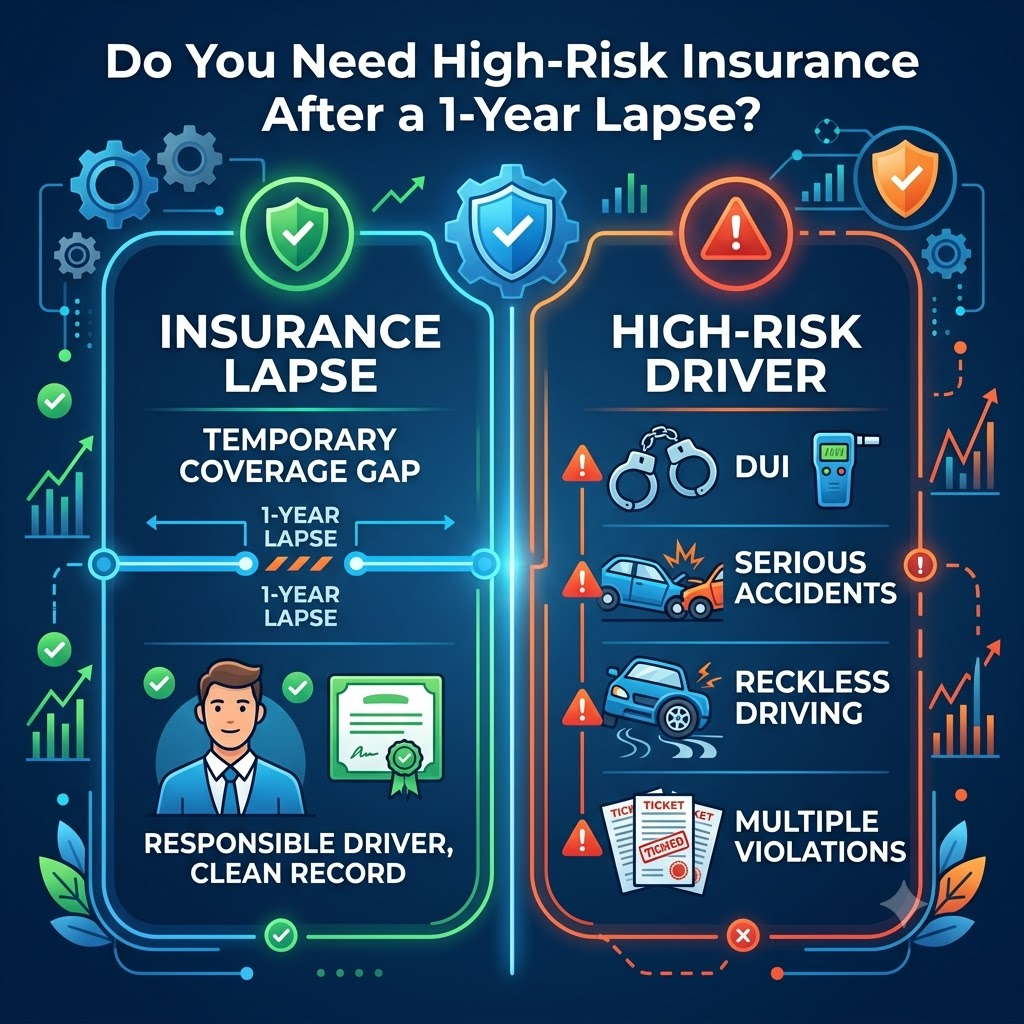
Do You Need High-Risk Insurance After a 1-Year Lapse?
Not always.
Many people confuse a coverage gap with being a high-risk driver. They are not the same.
High-risk insurance is typically associated with situations like:
- Multiple serious accidents
- DUI convictions
- Reckless driving
- License suspension
- Multiple violations
A driver who simply stopped having insurance for one year may still qualify for regular insurance.
Can You Get Car Insurance If You Have No Recent Insurance History?
Yes, you can get car insurance even if you have been uninsured for one year.
Insurance companies do not require every driver to have an active previous policy. However, they may ask additional questions because they cannot verify recent continuous coverage.
You may need to provide:
- Driver’s license information
- Vehicle registration
- Vehicle identification number (VIN)
- Previous insurance details (if available)
- Driving history
- Explanation for the insurance gap
If you recently purchased a vehicle and had no previous insurance, insurers may treat you similarly to someone starting a new policy.
What If You Cannot Find Your Old Insurance Policy Information?
Many drivers worry when they no longer have documents from their previous insurer.
You can usually still buy insurance.
If you cannot find your old policy information, an insurance company may ask for:
- Previous insurer name
- Approximate policy dates
- Previous address
- Vehicle information
You can also contact your previous insurance company and request:
- Proof of prior insurance
- Claims history
- Policy history documents
Having proof of previous coverage may help show insurers that you were previously insured and had responsible insurance behavior.
Can an Insurance Company Refuse to Cover You After a 1-Year Lapse?
In most cases, insurers cannot simply refuse someone only because they had a one-year lapse.
However, insurance companies may decline coverage based on factors such as:
- Serious driving violations
- Multiple claims
- Fraud history
- License suspension
- Extremely high-risk vehicle use
A simple insurance gap does not automatically make someone uninsurable.
If one company offers an expensive quote or declines coverage, another insurer may have different underwriting rules.
Do You Need an SR-22 After a 1-Year Insurance Lapse?
A common misconception is that every driver with a lapse needs an SR-22.
That is not true.
An SR-22 is usually required because of certain serious driving-related issues, not simply because your insurance expired.
You may need an SR-22 after situations such as:
- Driving without required insurance and being caught
- DUI or DWI conviction
- Serious traffic violations
- License suspension or reinstatement requirements
- Multiple violations within a short period
If you simply allowed your insurance to expire and did not have any violations, you may not need an SR-22.
What Is an SR-22?
An SR-22 is a certificate filed by an insurance company proving that you carry the required minimum insurance coverage.
It is not an insurance policy itself.
If your state requires an SR-22:
- You purchase an auto insurance policy
- Your insurer files the SR-22 form with the state
- You maintain continuous coverage for the required period
Failing to maintain coverage while an SR-22 is required can result in license-related penalties.
What Happens If Your Car Was Financed During the Insurance Lapse?
A one-year lapse can create serious issues if you had a car loan or lease.
Most lenders require borrowers to maintain:
- Comprehensive coverage
- Collision coverage
- Liability coverage
If your insurance expired, your lender may have purchased insurance on your behalf.
This is called force-placed insurance.
Force-placed insurance is usually:
- More expensive
- Designed to protect the lender, not the driver
- Limited in coverage
If this happened, contact your lender and insurance company to understand your options.
Can You Drive Immediately After Buying Insurance Again?
Usually, your coverage begins after your policy becomes active.
However, do not assume you are insured immediately after submitting payment.
Before driving, confirm:
- Policy effective date
- Coverage limits
- Proof of insurance availability
- Vehicle information is correct
Driving even one day without active coverage can create another lapse.
Does a One-Year Lapse Affect Your Insurance Forever?
No.
A coverage gap does not permanently follow you.
Insurance companies usually focus on your recent history.
Over time, maintaining continuous coverage can help reduce the impact of the lapse.
For example:
After getting insurance again
First 6 months
- Insurer sees recent continuous coverage
After 1 year
- Your insurance history begins improving
After several years
- The previous lapse may have much less influence
The exact timeline depends on the insurer and location.
Should You Explain Your Insurance Gap to the Company?
Yes. Be honest about why your coverage ended.
Providing an accurate explanation helps avoid problems later.
Examples:
Good explanation
“I was not driving the vehicle because I was away for work, and the car was parked.”
Good explanation
“I sold my previous vehicle and did not own a car during that period.”
Problematic approach
Claiming you had coverage when you did not.
Incorrect information can cause problems during underwriting or when filing a claim.
What If You Bought a Car After Being Uninsured for a Year?
Many people experience this situation:
- They sold their old vehicle
- Did not own a car for one year
- Bought another vehicle later
- Need insurance immediately
In this case, explain that you did not have a vehicle during the gap.
Some insurers may view this differently from someone who owned and regularly drove an uninsured vehicle.
You may be able to provide:
- Bill of sale for your previous vehicle
- Registration records
- Purchase documents for your new vehicle
Can You Transfer Your Old Insurance Discounts After a Long Lapse?
It depends on the insurer.
Some discounts may continue if:
- The lapse was short
- You stayed with the same company
- You maintained a good history
After a one-year gap, some insurers may no longer consider previous loyalty discounts.
However, your clean driving record can still help you get competitive rates.
Key Points to Remember
A one-year insurance lapse can make buying coverage more expensive, but it does not prevent you from getting insured.
Remember:
✔ Shop with multiple insurers
✔ Be honest about the coverage gap
✔ Maintain continuous coverage after restarting
✔ Check whether SR-22 is actually required
✔ Avoid driving until your new policy is active
✔ Keep records of your previous insurance history
Does a 1-Year Insurance Lapse Affect Your Vehicle Registration?
In many states, vehicle registration and insurance are connected.
If your insurance company reports that your coverage ended, your state motor vehicle department may take action depending on local laws.
Possible consequences include:
- Registration suspension
- Fines or reinstatement fees
- Requirement to provide proof of new insurance
- Restrictions on renewing registration
However, the impact depends on:
- Whether the vehicle was registered during the uninsured period
- Whether you drove the vehicle
- State-specific insurance laws
- Whether your insurer notified the DMV
What Should You Do Before Driving Again After a 1-Year Lapse?
Before using your vehicle again, follow these steps:
Step 1: Purchase Active Insurance
Do not drive until your policy is officially active.
Make sure you receive:
- Insurance ID card
- Policy number
- Effective date
- Coverage details
Step 2: Check Your Registration Status
Verify that your vehicle registration is:
- Active
- Not suspended
- Properly renewed
If your registration was suspended, you may need to complete additional steps before driving legally.
Step 3: Check for Required Documents
Keep these documents available:
- Driver’s license
- Vehicle registration
- Proof of insurance
- Loan or lease information (if applicable)
Can You Get Car Insurance After a Lapse If Your License Is Suspended?
A suspended license can make getting insurance more complicated, but it does not always prevent you from obtaining coverage.
Some drivers need insurance to:
- Reinstate their license
- Satisfy court requirements
- Maintain a registered vehicle
- Prepare for future driving privileges
Insurance companies may offer limited options depending on the reason for suspension.
Insurance Options With a Suspended License
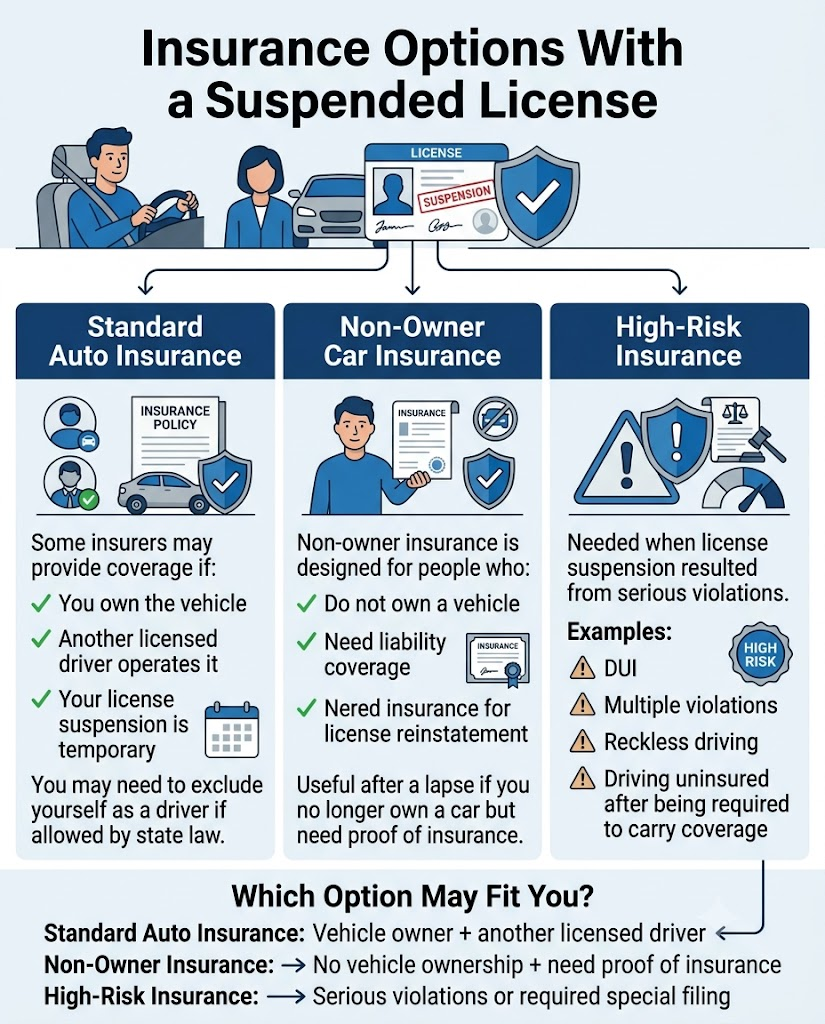
Standard Auto Insurance
Some insurers may provide coverage if:
- You own the vehicle
- Another licensed driver operates it
- Your license suspension is temporary
You may need to exclude yourself as a driver if allowed by state law.
Non-Owner Car Insurance
Non-owner insurance is designed for people who:
- Do not own a vehicle
- Need liability coverage
- Need insurance for license reinstatement
It can be useful after a lapse if you no longer own a car but need proof of insurance.
High-Risk Insurance
If your license suspension resulted from serious violations, you may need a high-risk insurer.
Examples:
- DUI
- Multiple violations
- Reckless driving
- Driving uninsured after being required to carry coverage
Can You Get Insurance for a Car You Own But Do Not Drive?
Yes.
Many people stop driving temporarily but keep their vehicle.
Examples:
- Military deployment
- Extended travel
- Health-related breaks from driving
- Vehicle storage
If the vehicle remains registered, keeping insurance may still be necessary.
Some options include:
Comprehensive-Only Coverage
Also called storage coverage in some cases.
It may protect against:
- Theft
- Fire
- Weather damage
- Vandalism
However, it usually does not provide coverage for driving on public roads.
What Happens If You Had a Car Sitting Uninsured for One Year?
If your vehicle was parked and unused, the situation is generally less serious than actively driving uninsured.
However, consider:
- Was the registration active?
- Was the vehicle stored privately?
- Was insurance required by a lender?
- Did your state require continuous coverage?
A parked vehicle can still face risks:
- Theft
- Storm damage
- Fire
- Accidental damage
Keeping appropriate coverage can protect against these situations.
Can You Buy Insurance After a Lapse If You Have an Auto Loan?
Yes, but you may need to provide additional information.
Lenders usually require insurance throughout the loan period.
After a one-year lapse, your lender may:
- Request proof of insurance
- Add force-placed coverage
- Require specific coverage limits
- Charge additional fees
Contact your lender after purchasing insurance to confirm that your policy meets loan requirements.
What Happens If You Switch Insurance Companies After a 1-Year Gap?
Switching insurers after a lapse is allowed.
You do not have to return to your previous insurance company.
In fact, comparing different insurers is often recommended because companies evaluate lapses differently.
When getting quotes, ask:
- Does your company consider a one-year lapse?
- Will my previous driving history count?
- Are there additional fees?
- Are discounts available?
Can a Teen Driver or New Driver Get Insurance After a Lapse?
Young drivers may face more difficulty because they already have limited insurance history.
A one-year lapse combined with:
- Young age
- Limited driving experience
- No prior policy
can result in higher premiums.
Ways to reduce costs include:
- Staying on a family policy
- Maintaining good grades
- Completing driver education
- Choosing a safer vehicle
- Comparing multiple insurers
How Long Does an Insurance Lapse Stay on Your Record?
The answer depends on the insurer and location.
Insurance companies may review:
- Recent insurance history
- Prior coverage dates
- Claims history
- Driving record
A one-year lapse may affect rates for several years, but its impact usually decreases as you maintain continuous coverage.
The most important thing after restarting insurance is avoiding another gap.
Common Mistakes People Make After a 1-Year Insurance Lapse
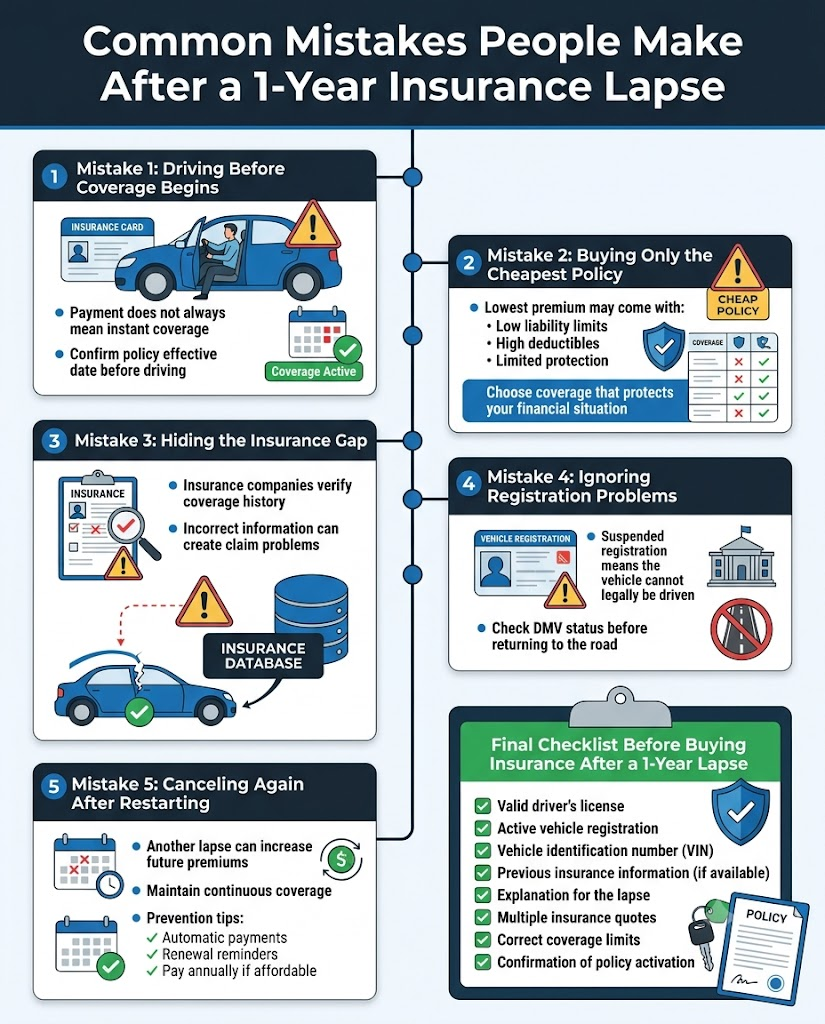
Mistake 1: Driving Before Coverage Begins
Some drivers assume payment means instant coverage.
Always confirm the policy effective date.
Mistake 2: Buying Only the Cheapest Policy
The lowest premium may come with:
- Low liability limits
- High deductibles
- Limited protection
Choose coverage that protects your financial situation.
Mistake 3: Hiding the Insurance Gap
Insurance companies can verify coverage history.
Providing incorrect information may cause claim problems later.
Mistake 4: Ignoring Registration Problems
A vehicle with suspended registration cannot legally be driven.
Check your DMV status before getting back on the road.
Mistake 5: Canceling Again After Restarting
Another lapse can make future insurance even more expensive.
Consider:
- Automatic payments
- Renewal reminders
- Paying annually if affordable
Final Checklist Before Buying Insurance After a 1-Year Lapse
Before purchasing your new policy, make sure you have:
✅ Valid driver’s license
✅ Active vehicle registration
✅ Vehicle identification number (VIN)
✅ Previous insurance information (if available)
✅ Explanation for the lapse
✅ Multiple insurance quotes
✅ Correct coverage limits
✅ Confirmation of policy activation
How to Rebuild Your Insurance History After a 1-Year Lapse
A coverage gap can temporarily affect your insurance profile, but you can improve your situation by following a few important steps.
Maintain Continuous Coverage Going Forward
The most important step is avoiding another lapse.
Insurance companies prefer drivers who maintain uninterrupted coverage because it shows financial responsibility.
To prevent future lapses:
- Set up automatic premium payments
- Choose payment reminders
- Renew your policy before expiration
- Keep your insurance documents updated
- Review your policy before renewal
Even a short lapse after your previous one can make future insurance shopping more difficult.
Avoid Filing Small Claims
Insurance is designed for major financial protection, but frequent small claims can increase your premiums.
For minor repairs, consider whether paying out of pocket makes financial sense.
Examples:
- Small scratches
- Minor dents
- Small windshield damage
However, never avoid reporting a serious accident just to protect your premium. Failing to report required claims can create bigger problems.
Maintain a Clean Driving Record
After returning to insurance, your driving behavior becomes even more important.
Avoid:
- Speeding tickets
- Reckless driving
- Distracted driving violations
- At-fault accidents
- DUI-related offenses
A clean record combined with continuous coverage can help offset the impact of your previous lapse.
Review Your Coverage Every Year
Many drivers keep the same insurance policy for years without checking whether it still fits their needs.
Review:
- Liability limits
- Deductibles
- Comprehensive coverage
- Collision coverage
- Available discounts
Your insurance needs may change because of:
- Vehicle age
- Driving habits
- Mileage changes
- Financial situation
How to Lower Insurance Premiums After a 1-Year Lapse
If your first quotes after a lapse seem expensive, several strategies can help reduce costs.
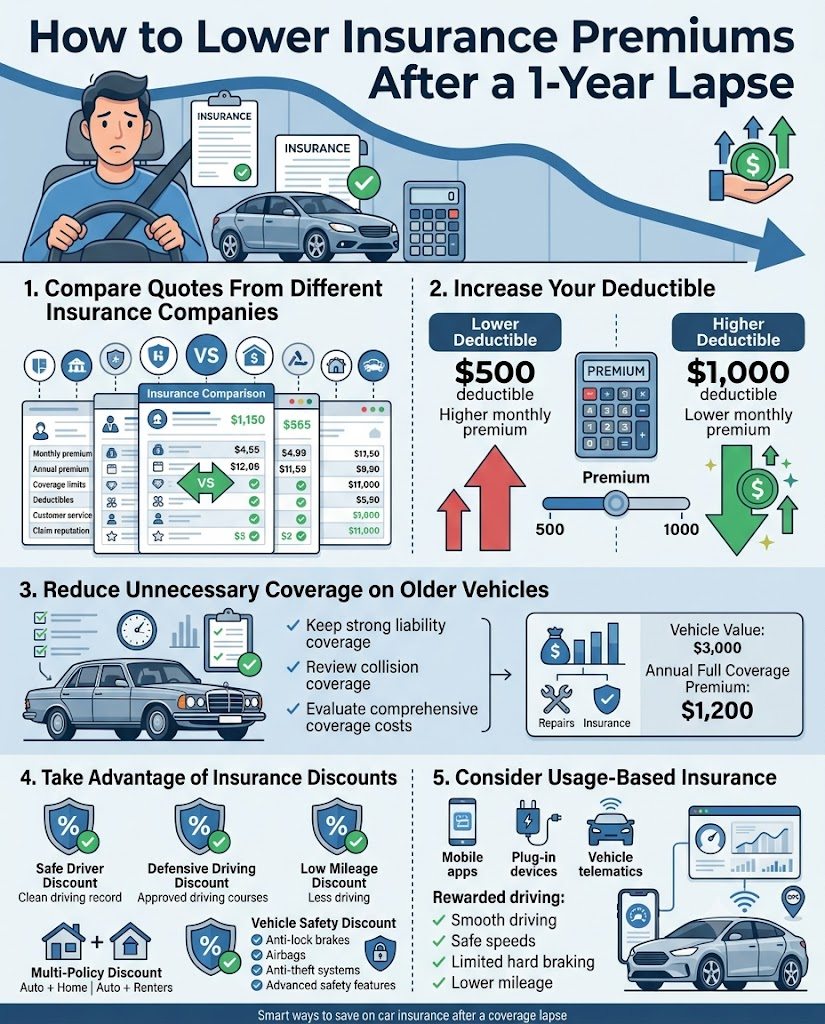
Compare Quotes From Different Insurance Companies
Never assume your previous insurer will offer the best rate.
Insurance companies use different formulas to calculate risk.
One insurer may heavily penalize a one-year lapse, while another may offer a more competitive price.
Compare:
- Monthly premium
- Annual premium
- Coverage limits
- Deductibles
- Customer service
- Claim reputation
Increase Your Deductible
A higher deductible generally lowers your insurance premium.
Example:
Lower deductible
- $500 deductible
- Higher monthly premium
Higher deductible
- $1,000 deductible
- Lower monthly premium
Choose a deductible amount you can comfortably afford if you need repairs.
Reduce Unnecessary Coverage on Older Vehicles
If your vehicle has a low market value, paying for expensive coverage may not always make financial sense.
For older vehicles, consider:
- Keeping strong liability coverage
- Reviewing collision coverage
- Evaluating comprehensive coverage costs
A simple calculation can help:
If your vehicle is worth $3,000 and your yearly full coverage premium is $1,200, you may want to review whether the cost is worthwhile.
Take Advantage of Insurance Discounts
Ask your insurer about available discounts.
Common discounts include:
Safe Driver Discount
Available for drivers with clean records.
Defensive Driving Discount
Some insurers provide discounts after completing approved courses.
Low Mileage Discount
Useful for drivers who do not drive frequently.
Multi-Policy Discount
Combining policies may reduce costs.
Examples:
- Auto + home insurance
- Auto + renters insurance
Vehicle Safety Discount
Safety equipment may reduce premiums.
Examples:
- Anti-lock brakes
- Airbags
- Anti-theft systems
- Advanced driver assistance features
Consider Usage-Based Insurance
Some insurers offer programs that monitor driving habits through:
- Mobile apps
- Plug-in devices
- Vehicle telematics
These programs may reward drivers who demonstrate:
- Smooth driving
- Safe speeds
- Limited hard braking
- Lower mileage
However, review the privacy terms and understand how driving data is collected before enrolling.
Should You Tell Your New Insurance Company About the Lapse?
Yes.
Honesty is the safest approach when applying for coverage.
Insurance companies can often verify:
- Previous policy dates
- Coverage history
- Claims records
Providing inaccurate information can create issues during:
- Policy review
- Claim processing
- Renewal decisions
A simple explanation is usually enough.
Examples:
- “I did not drive during the one-year period.”
- “The vehicle was stored and not used.”
- “I temporarily did not own a vehicle.”
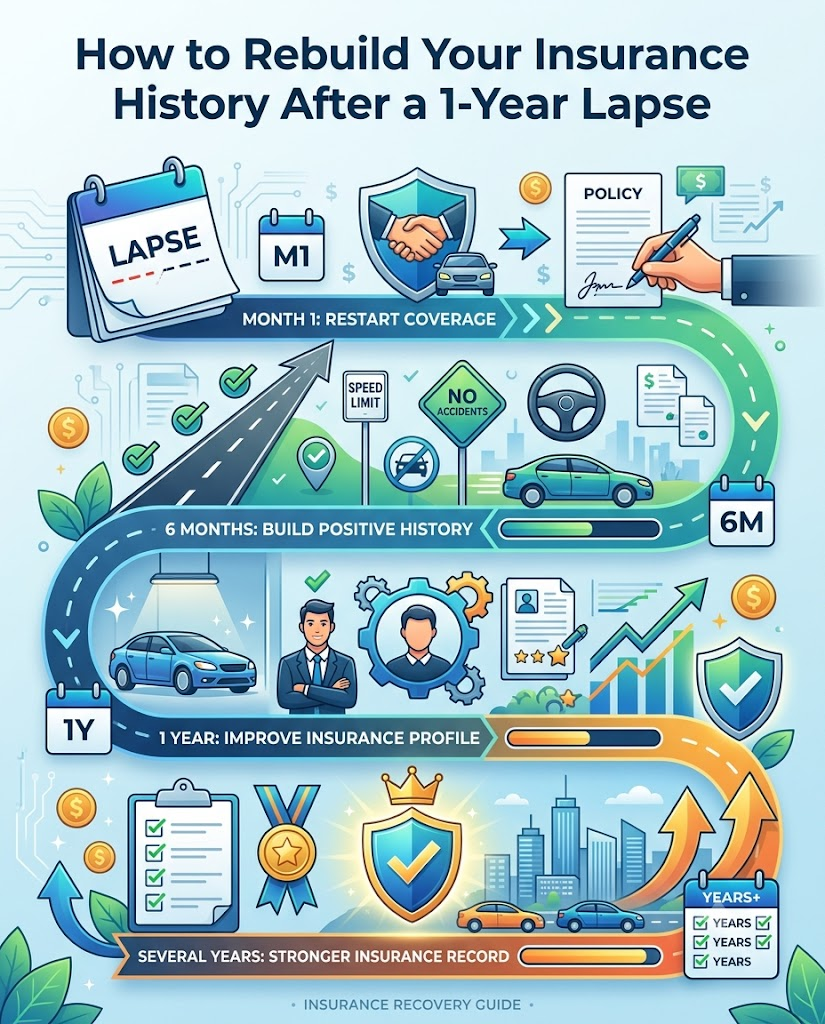
How Long Does It Take to Recover From an Insurance Lapse?
There is no single timeline, but the impact usually decreases as you build new continuous coverage.
A general pattern:
First 6 Months
- Insurers see recent active coverage
- Rates may still reflect the lapse
After 1 Year
- Your insurance history starts improving
- Some insurers may view you more favorably
After Several Years
- The old lapse may have less impact
- Continuous coverage becomes your stronger history
Maintaining a good driving record during this time is important.
What Type of Coverage Should You Buy After a Long Lapse?
The right coverage depends on your vehicle, finances, and personal situation.
Minimum Liability Coverage
Suitable for:
- Older vehicles
- Drivers with limited budgets
- Vehicles with low value
Provides protection for damage you cause to others.
Full Coverage Insurance
Usually better for:
- Newer vehicles
- Financed cars
- Expensive vehicles
- Drivers who cannot afford major repair costs
Includes:
- Liability
- Collision
- Comprehensive coverage
Higher Liability Limits
Many drivers choose higher limits than the legal minimum because medical and repair costs can become extremely expensive after serious accidents.
Questions to Ask an Insurance Agent After a 1-Year Lapse
Before purchasing a policy, ask:
- How does your company handle a one-year insurance gap?
- Will my previous insurance history count?
- Are there any additional fees because of the lapse?
- Do I qualify for discounts?
- What coverage limits do you recommend?
- Will my premium decrease after maintaining coverage?
- Are there payment options to prevent another lapse?
Final Thoughts
Getting car insurance after a one-year lapse may require more effort, but it is completely possible for most drivers.
The biggest factors affecting your future rates are:
- Maintaining continuous coverage
- Keeping a clean driving record
- Comparing multiple insurers
- Choosing appropriate coverage
- Avoiding another lapse
A one-year gap does not define your entire insurance history. By maintaining responsible habits after restarting coverage, you can gradually rebuild your insurance profile and potentially qualify for better rates over time.