

Divorce affects many areas of your financial life, including your car insurance policy. While separating your vehicles and finances may be part of the divorce process, many people are unsure how long after divorce they have to separate car insurance.
The timeline for separating car insurance depends on several factors, including your insurance company’s rules, state laws, whether you are still living together, who owns the vehicles, and whether both spouses remain listed on the same policy.
In many cases, you should update your car insurance shortly after the divorce is finalized to avoid coverage problems, billing issues, or complications during a claim.
This guide explains when you need to separate car insurance after divorce, what happens to your policy, how to handle shared vehicles, and common mistakes to avoid.
Do You Have to Separate Car Insurance After Divorce?
Yes, in most situations, divorced spouses should separate their car insurance policies once they are no longer considered members of the same household.
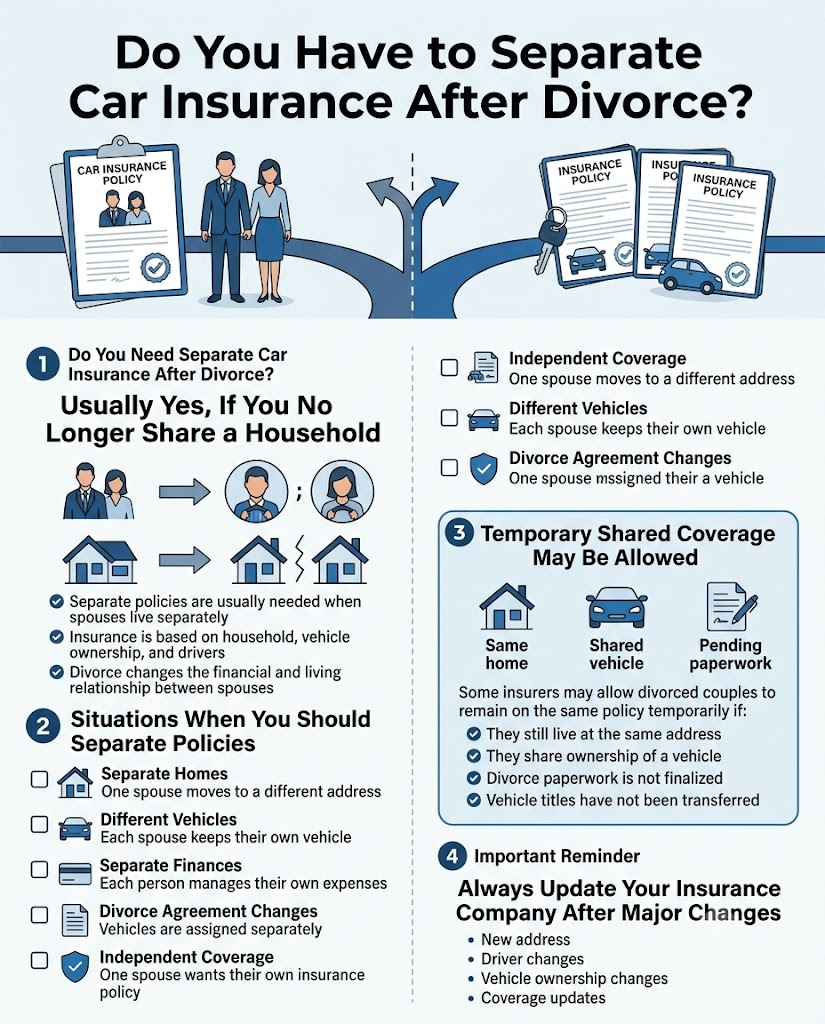
Auto insurance companies usually allow married couples who live together to share one policy because they have a common household and financial relationship. After divorce, that relationship changes.
You may need separate policies if:
- You move into separate homes
- You no longer share vehicles
- You have separate financial responsibilities
- The divorce agreement assigns vehicles separately
- One spouse wants independent coverage
However, divorce itself does not always immediately cancel a shared policy.
Some insurers allow divorced couples to remain on the same policy temporarily, especially if:
- They still live at the same address
- They share ownership of a vehicle
- The divorce process is not fully completed
- They have not yet transferred vehicle titles
How Long After Divorce Do You Have to Separate Car Insurance?
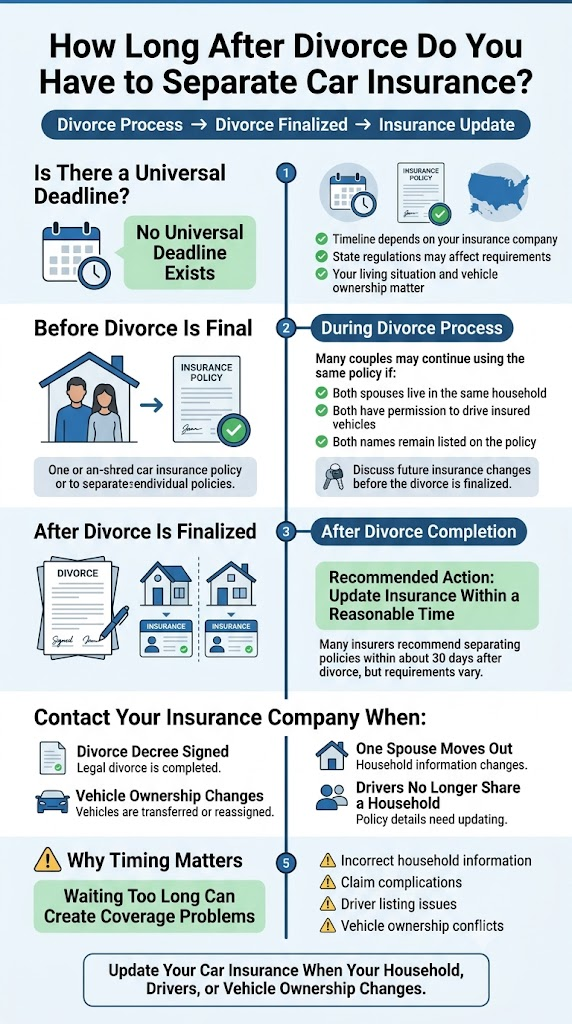
There is no universal deadline that applies to every divorce. The required timeline depends on your insurance provider and state regulations.
Generally:
Before the Divorce Is Final
Many couples continue using the same auto insurance policy during the divorce process.
This is often acceptable if:
- Both spouses live in the same household
- Both spouses have permission to drive insured vehicles
- Both names remain properly listed on the policy
However, it is important to discuss future changes with your insurer before the divorce is finalized.
Immediately After Divorce Finalization
Once the divorce is legally completed, many insurers expect changes to be made within a reasonable period.
A common recommendation is to separate policies within 30 days after the divorce is finalized, although the exact timeframe varies.
You should contact your insurance company as soon as possible after:
- The divorce decree is signed
- Vehicle ownership changes
- One spouse moves out
- Drivers no longer share a household
Waiting too long can create problems if an accident occurs.
Why Should You Separate Car Insurance After Divorce?
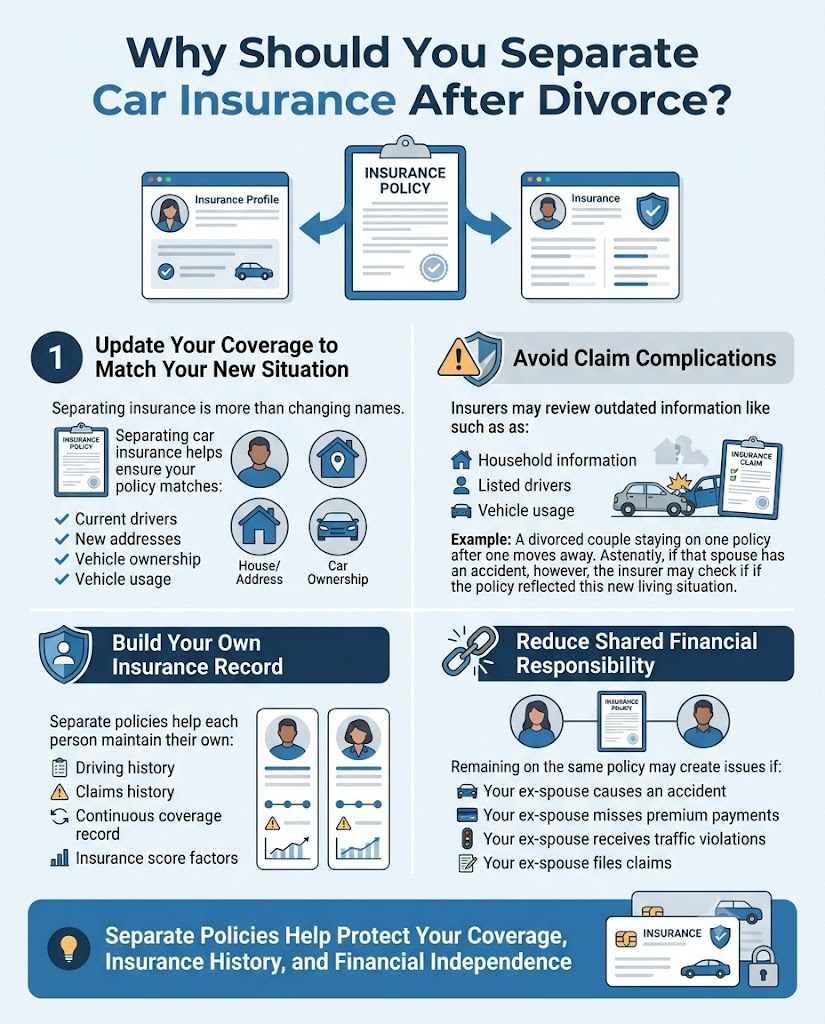
Separating car insurance is not only about changing names on a policy. It helps ensure that your coverage matches your current living situation and vehicle ownership.
Prevent Coverage Problems
Insurance policies are based on accurate information about:
- Drivers
- Addresses
- Vehicle ownership
- Vehicle usage
If your insurer believes your policy information is outdated, it may create complications during a claim investigation.
For example:
A divorced couple continues sharing a policy after one spouse moves to another home. The spouse who moved gets into an accident. The insurer may review whether the policy accurately listed the household members and vehicle usage.
Protect Your Own Insurance History
Keeping separate policies helps establish your independent insurance record.
This can be important because insurers consider:
- Driving history
- Claims history
- Continuous coverage
- Insurance score factors
A separate policy allows each former spouse to maintain their own insurance profile.
Avoid Financial Responsibility for an Ex-Spouse
When both spouses remain on one policy, they may still be financially connected.
Depending on state laws and policy structure, problems can occur if:
- Your former spouse causes an accident
- Your former spouse fails to pay premiums
- Your former spouse receives tickets
- Your former spouse files claims
Separating policies reduces these connections.
What Happens to Car Insurance During Divorce?
During divorce proceedings, the existing car insurance policy usually remains active unless changes are made.
Both spouses should continue maintaining required coverage until decisions are made about:
- Vehicle ownership
- Registration
- Policy ownership
- Future insurance arrangements
Canceling coverage too early can create serious problems, including:
- Driving without insurance
- Registration issues
- Financial liability after an accident
Who Keeps the Existing Car Insurance Policy After Divorce?
Usually, the person listed as the named insured can continue the policy, but the final arrangement depends on the insurer and vehicle ownership.
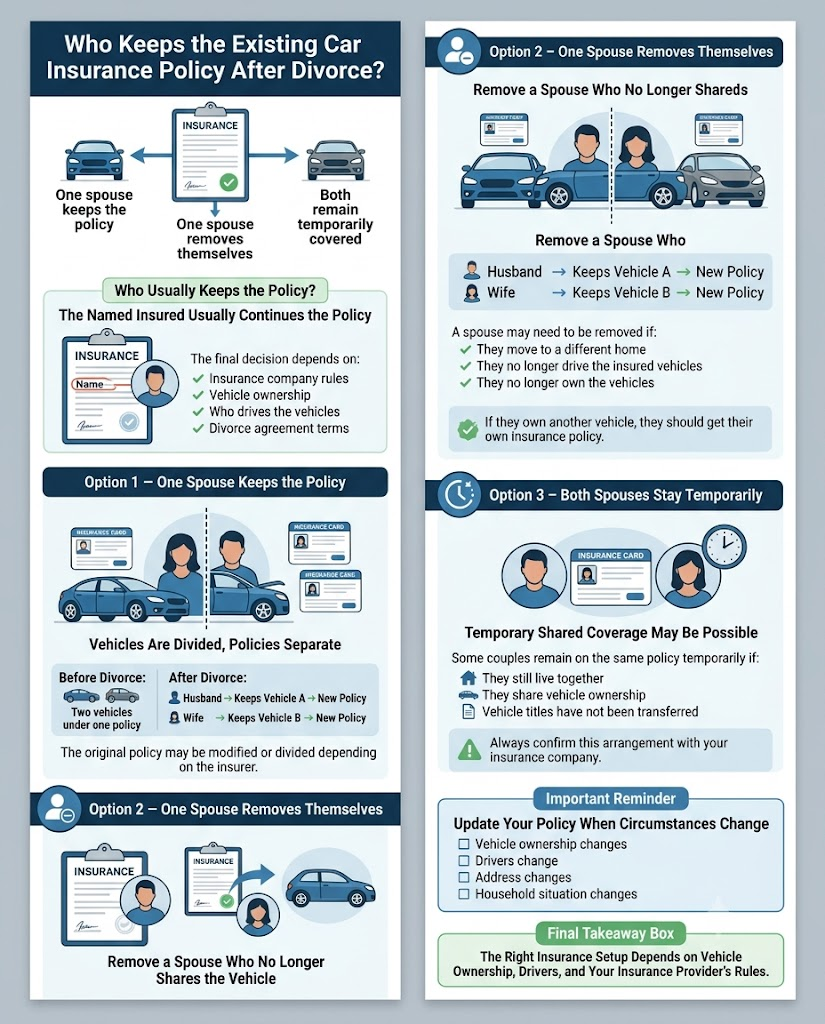
Common situations include:
One Spouse Keeps the Policy
Example:
A husband and wife share two vehicles under one policy. After divorce:
- Husband keeps his vehicle
- Wife keeps her vehicle
- Each starts separate policies
The original policy may be changed or divided depending on the insurer.
One Spouse Removes Themselves From The Policy
If one spouse moves out and no longer owns or drives the insured vehicles, they may need to be removed from the policy.
They should obtain their own insurance if they own another vehicle.
Both Spouses Stay on the Policy Temporarily
Some divorced couples remain on one policy temporarily when:
- They are still living together
- They share vehicle ownership
- They are waiting for title transfers
However, this should be discussed with the insurer.
How to Separate Car Insurance After Divorce Step-by-Step
Separating car insurance after divorce involves more than removing a name from a policy. You need to make sure your vehicles, drivers, addresses, and coverage details are updated correctly.
Follow these steps to make the transition smoother.
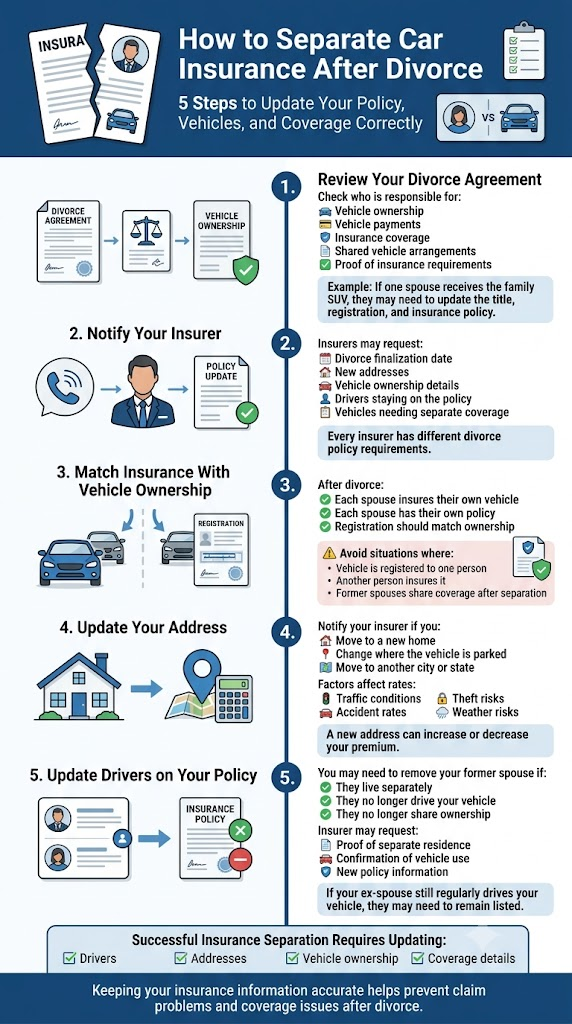
Step 1: Review Your Divorce Agreement
Before making insurance changes, review your divorce settlement or court order.
The agreement may specify:
- Who keeps each vehicle
- Who is responsible for vehicle payments
- Who maintains insurance coverage
- How shared vehicles should be handled
- Whether one spouse must provide proof of insurance
For example:
If the divorce agreement states that one spouse receives ownership of the family SUV, that spouse will usually need to update the title, registration, and insurance policy.
Step 2: Contact Your Insurance Company
Notify your insurance company about the divorce as soon as possible.
Your insurer will ask for information such as:
- Divorce finalization date
- New addresses
- Vehicle ownership details
- Which drivers should remain on the policy
- Which vehicles need separate coverage
Insurance companies handle divorce differently, so it is important to ask about their specific requirements.
Step 3: Separate Vehicle Ownership
Insurance coverage should match vehicle ownership.
If both spouses own vehicles separately after divorce:
- Each spouse should insure their own vehicle
- Each spouse should have their own policy
- Each spouse should be listed correctly on the vehicle registration
Problems can occur when:
- A vehicle is registered in one person’s name
- Another person insures it
- Both spouses continue sharing a policy after separation
Insurance companies generally want the policyholder to have an insurable interest in the vehicle.
Step 4: Update Your Address
Your address is one of the most important factors in determining insurance rates.
After divorce, update your insurance company if you:
- Move to a new home
- Change your garage location
- Move to another city or state
Your premium may change because insurers consider:
- Local accident rates
- Theft risks
- Traffic conditions
- Weather-related risks
A change of address can increase or decrease your insurance cost.
Step 5: Remove or Add Drivers Correctly
After divorce, you may need to remove your former spouse from your policy.
However, simply removing a name does not always end their coverage.
Your insurer may require:
- Proof of separate residence
- Confirmation that the spouse no longer regularly drives your vehicle
- A new policy for the removed driver
If your former spouse continues driving your vehicle, they may still need to be listed as a driver.
What Happens If Both Names Are on the Car Title?
A common issue after divorce is when both spouses remain listed on a vehicle title.
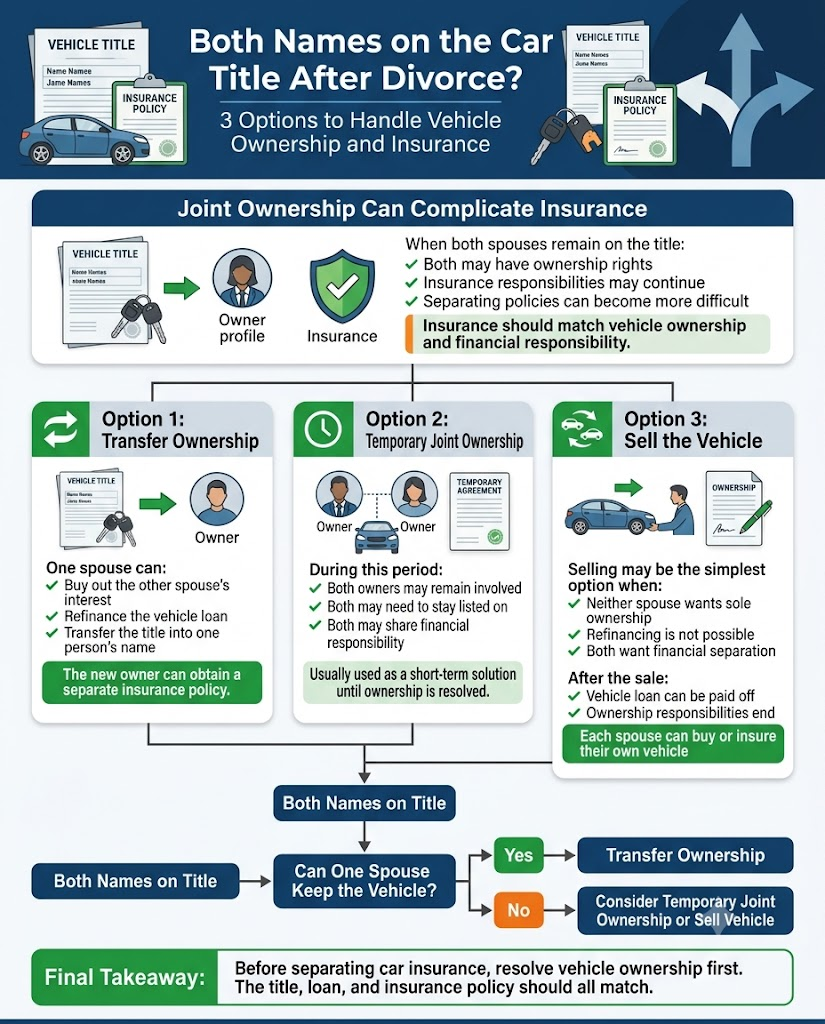
In this situation, separating insurance can become complicated.
Possible solutions include:
Option 1: Transfer Ownership
One spouse can:
- Buy out the other spouse’s interest
- Refinance the vehicle loan
- Transfer the title into one person’s name
The new owner can then obtain separate insurance.
Option 2: Keep Joint Ownership Temporarily
Some divorced couples continue sharing ownership for a limited time.
During this period:
- Both owners may need to remain involved
- Both may need to be listed on insurance
- Both may share financial responsibility
This is usually a temporary solution.
Option 3: Sell the Vehicle
If neither spouse wants sole ownership, selling the vehicle may be the simplest option.
After the sale:
- The loan can be paid off
- Ownership responsibilities end
- Each spouse can purchase or insure their own vehicle
Can You Stay on Your Ex-Spouse’s Car Insurance After Divorce?
In some cases, yes, but it depends on your circumstances and insurer rules.
You may be able to stay on the same policy temporarily if:
- You still live together
- You share vehicles
- You have joint ownership
- The insurer allows it
However, many insurers require divorced spouses living separately to obtain separate policies.
Continuing on an ex-spouse’s policy after moving out may create issues because insurance companies typically base eligibility on household relationships.
What If You Still Live Together After Divorce?
Some divorced couples continue living in the same home for financial or family reasons.
In this situation, separating car insurance may not be immediately necessary.
You may be able to remain on one policy if:
- Both drivers live at the same address
- Both vehicles are properly listed
- The insurer permits divorced household members to share coverage
However, you should inform the insurer about the divorce.
Failing to disclose a major change in marital status or household situation could create complications during a claim.
What Happens If You Do Not Separate Car Insurance After Divorce?
Failing to update your policy can create several risks.
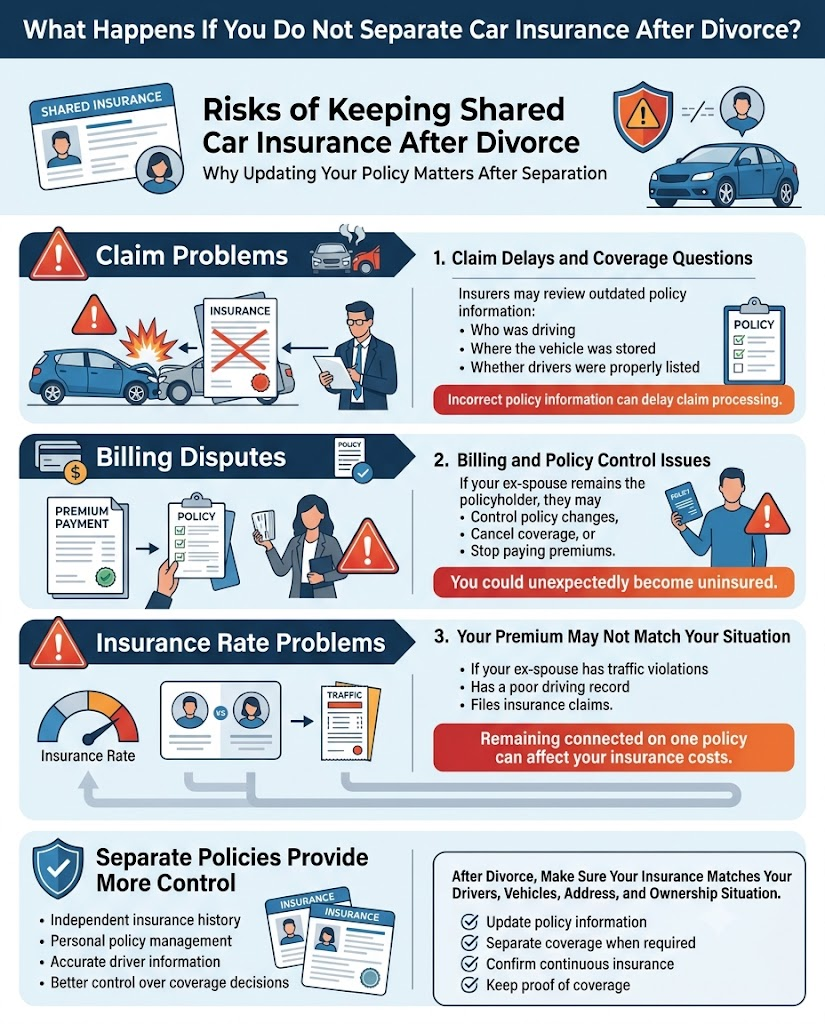
Claim Problems
If your policy information is outdated, the insurer may investigate:
- Who was driving
- Where the vehicle was stored
- Whether drivers were properly listed
This may delay claim processing.
Billing Disputes
If your ex-spouse remains the policyholder:
- They may control policy changes
- They may cancel coverage
- They may stop paying premiums
This can leave you unexpectedly uninsured.
Rate Problems
Your premium may not accurately reflect your situation.
For example:
- Your ex-spouse has a poor driving record
- They receive traffic violations
- They file claims
Your insurance costs may be affected if you remain connected on the same policy.
How Does Divorce Affect Car Insurance Rates?
Divorce can affect your car insurance premiums because insurance companies calculate rates based on several personal and household factors.
When a married couple separates, insurers may recalculate premiums based on:
- Individual driving history
- New address
- Number of vehicles insured
- Coverage limits
- Discounts that may no longer apply
- Credit-based insurance score (where allowed)
- Claims history
The impact can be different for each person.
Some drivers may see their rates increase after divorce, while others may pay less after getting their own policy.
Reasons Rates May Increase After Divorce
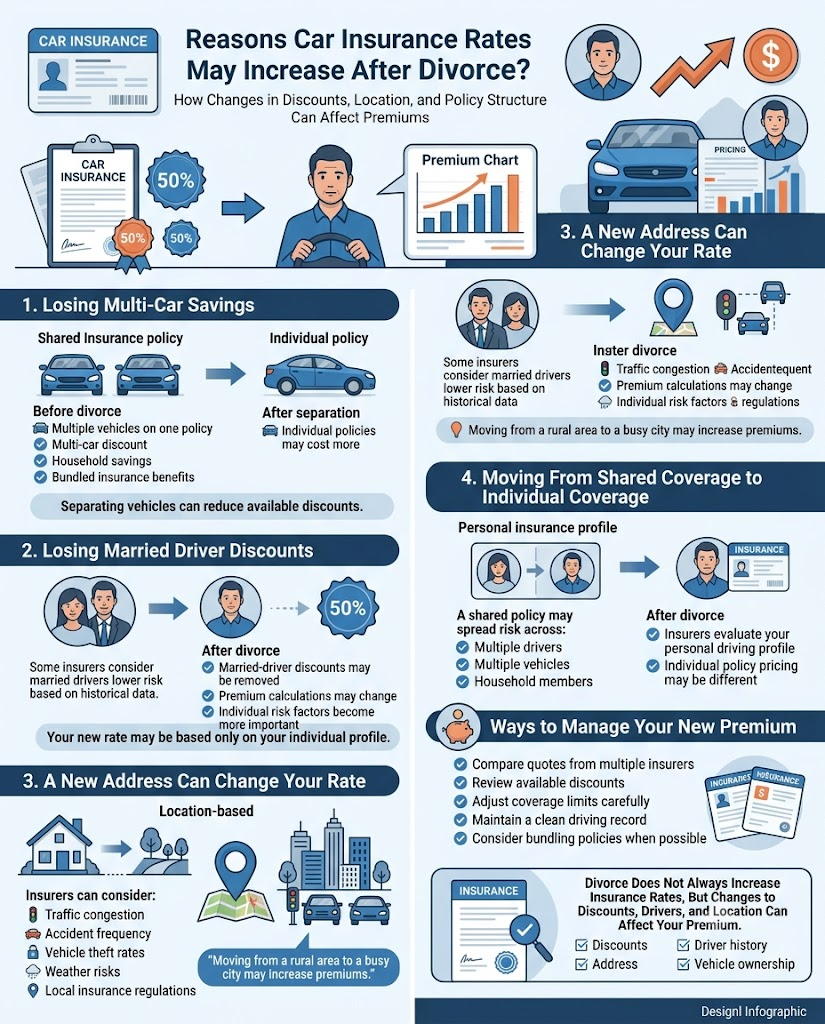
Losing a Multi-Car Discount
Married couples often insure multiple vehicles under one policy.
After separation, each person may have only one vehicle, which can result in losing:
- Multi-car discounts
- Household discounts
- Bundled insurance savings
This may increase the cost of individual policies.
Losing a Married Driver Discount
Many insurance companies consider married drivers lower risk based on historical claims data.
After divorce, some insurers may remove the married-driver discount, causing premiums to change.
Moving to a Different Location
Moving after divorce is common.
Your new address can affect your premium based on:
- Traffic congestion
- Accident frequency
- Vehicle theft rates
- Weather risks
- Local insurance regulations
For example, moving from a rural area to a large city may result in higher premiums.
Becoming the Only Driver on a Policy
A shared policy may spread risk between multiple drivers and vehicles.
After divorce, an individual policy may have different pricing because the insurer evaluates only your personal information.
Can Divorce Lower Car Insurance Rates?
Yes, divorce can sometimes reduce insurance costs.
This may happen if:
- Your former spouse had accidents
- Your former spouse had traffic violations
- Your former spouse had a poor insurance history
- You remove an expensive vehicle from your policy
- You qualify for new discounts
Example:
A couple shares a policy, but one spouse has multiple speeding tickets. After divorce, the other spouse creates an individual policy and may receive a lower rate.
How to Get Your Own Car Insurance After Divorce
If you need your own policy after divorce, follow these steps.
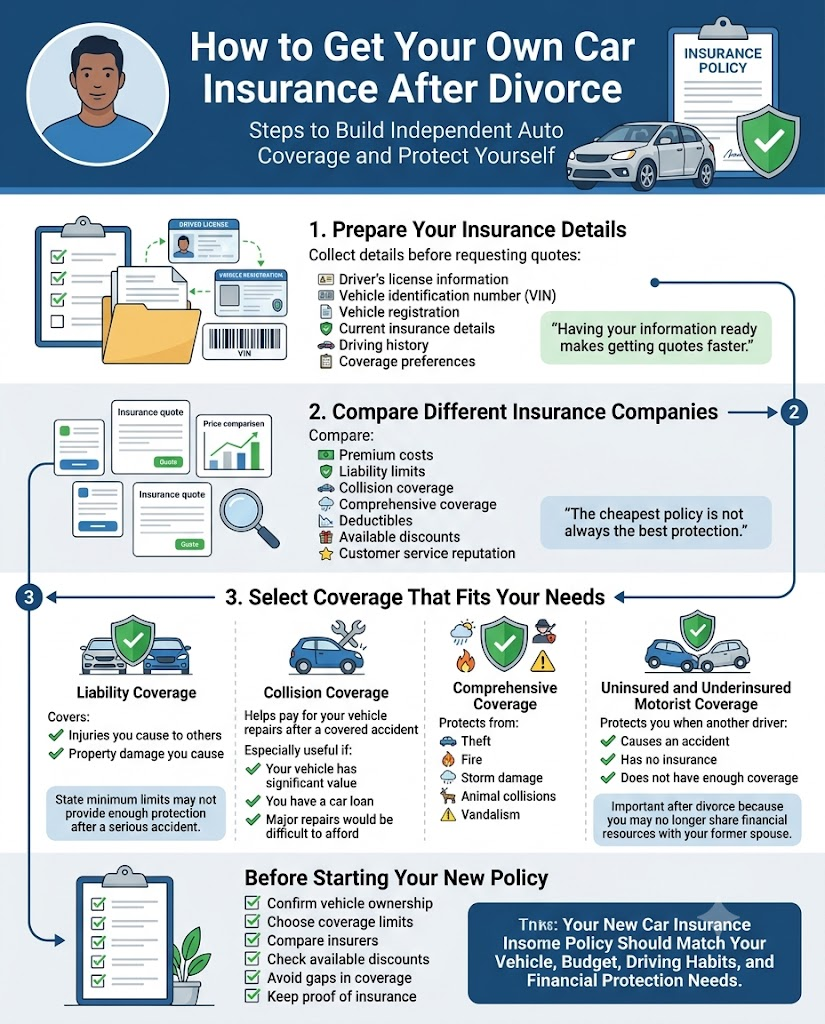
Gather Your Information
Before requesting quotes, prepare:
- Driver’s license information
- Vehicle identification number (VIN)
- Vehicle registration
- Current insurance details
- Driving history
- Coverage preferences
Having this information ready makes the process faster.
Compare Multiple Insurance Quotes
Insurance prices can vary significantly between companies.
Compare:
- Liability limits
- Collision coverage
- Comprehensive coverage
- Deductibles
- Discounts
- Customer service reputation
The cheapest policy is not always the best option. Make sure the coverage is adequate for your financial situation.
Choose Your Coverage Limits
After divorce, review whether your current coverage still makes sense.
Important coverage options include:
Liability Coverage
Pays for injuries and property damage you cause to others.
Many states require minimum liability coverage, but minimum limits may not provide enough protection after a serious accident.
Collision Coverage
Helps pay for repairs to your vehicle after a covered accident.
This is especially important if:
- Your vehicle has significant value
- You have a car loan
- You cannot afford major repairs yourself
Comprehensive Coverage
Protects against non-collision events such as:
- Theft
- Fire
- Storm damage
- Animal collisions
- Vandalism
Uninsured and Underinsured Motorist Coverage
Provides protection if another driver causes an accident and does not have enough insurance.
This coverage can be valuable after divorce because you may no longer have shared financial resources with your former spouse.
What Happens If Your Ex-Spouse Cancels the Car Insurance?
If your former spouse is the policyholder and cancels the insurance without your knowledge, you could face serious problems.
Possible consequences include:
- Driving without insurance
- Registration suspension
- Personal financial liability after an accident
- Higher future insurance rates due to a coverage lapse
To avoid this:
- Create your own policy before separation is complete
- Confirm the effective date of your new coverage
- Request proof of insurance
- Avoid any gap between policies
Can Your Ex-Spouse Remove You From Car Insurance Without Telling You?
It depends on the policy and insurer.
If your ex-spouse is the primary policyholder, they may have the ability to request policy changes.
However, insurance companies generally follow specific procedures before removing drivers or canceling coverage.
If you depend on the shared policy, it is safer to arrange your own insurance rather than relying on your former spouse.
How Long Does It Take to Get New Car Insurance After Divorce?
Getting a new car insurance policy can usually be completed quickly.
Many insurers can issue coverage:
- Same day
- Within a few hours
- Before your current policy ends
However, you should not wait until the last minute.
Start shopping for insurance before:
- Moving out
- Transferring vehicle ownership
- The divorce becomes final
This helps prevent coverage gaps.
Common Car Insurance Mistakes After Divorce
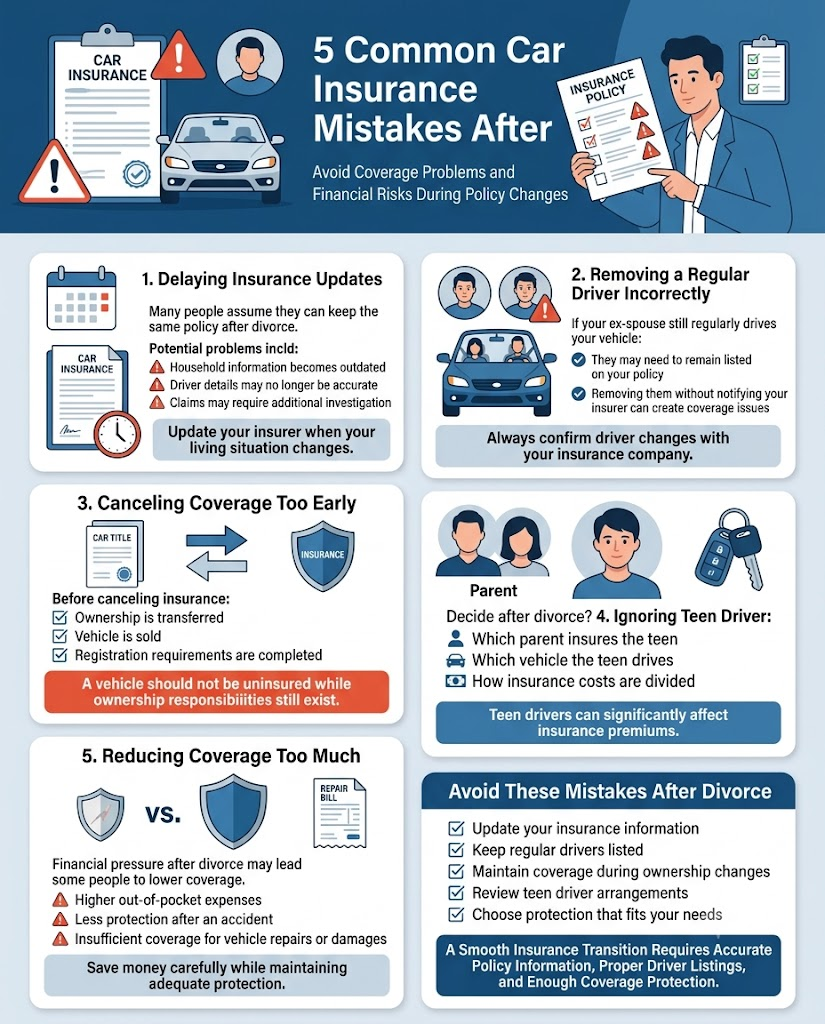
Waiting Too Long to Update the Policy
Many people assume they can keep the same policy indefinitely after divorce.
This can create problems if household circumstances have changed.
Removing a Spouse Who Still Drives the Vehicle
If your ex-spouse still regularly drives your vehicle, removing them without notifying your insurer could create coverage issues.
Canceling Insurance Before Ownership Is Transferred
A vehicle should remain insured until:
- Ownership is transferred
- The vehicle is sold
- Registration requirements are completed
Forgetting About Teen Drivers
If children are involved, decide:
- Which parent insures them
- Which vehicles they drive
- How premiums are divided
Teen drivers can significantly affect insurance costs.
Choosing Lower Coverage to Save Money
Divorce may create financial pressure, but reducing coverage too much can expose you to major expenses after an accident.
Review your budget while maintaining appropriate protection.
Can You Remove Your Ex-Spouse From Car Insurance If They Are on the Loan?
Not always.
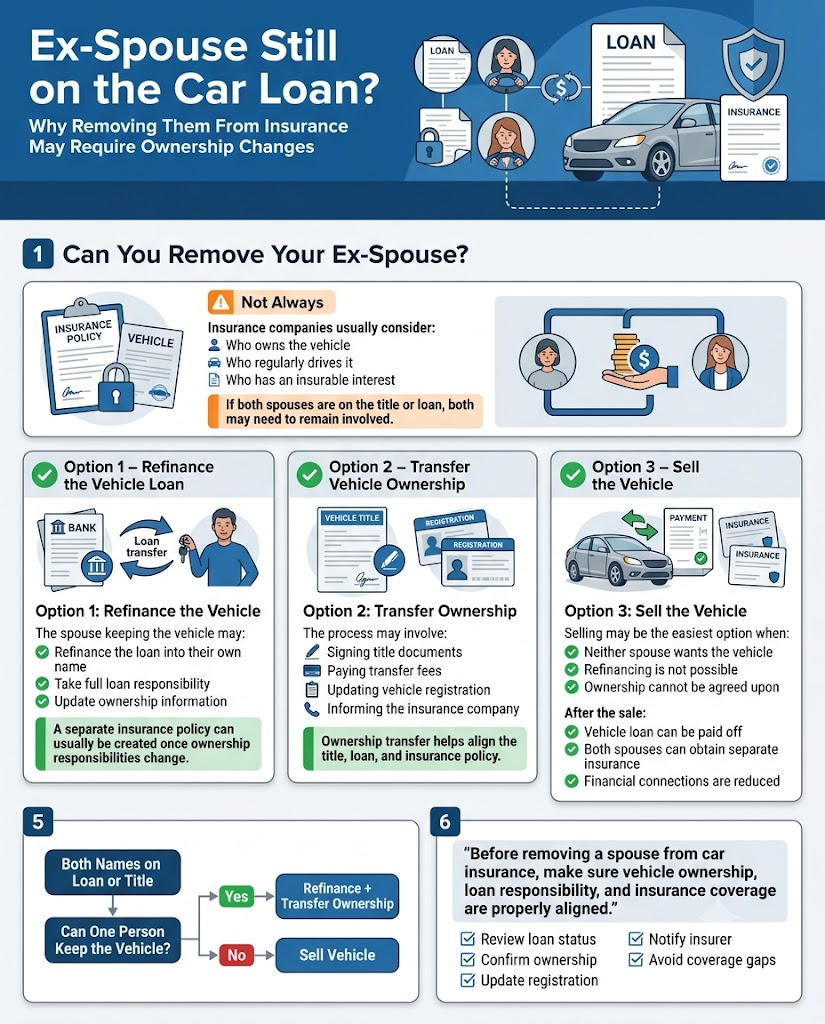
Insurance companies generally focus on:
- Who owns the vehicle
- Who regularly drives the vehicle
- Who has an insurable interest in the vehicle
If both spouses are listed on the vehicle title or loan, the insurer may require both parties to remain involved.
Possible solutions include:
Refinancing the Vehicle
The spouse keeping the vehicle may refinance the loan into their own name.
After refinancing:
- The loan responsibility changes
- Ownership may be updated
- A separate insurance policy can usually be created
Transferring Vehicle Ownership
A vehicle title transfer may be required depending on the divorce agreement.
The process may involve:
- Signing title documents
- Paying transfer fees
- Updating registration
- Informing the insurance company
Selling the Vehicle
If neither spouse can refinance or agree on ownership, selling the vehicle may be the easiest solution.
After the sale:
- The loan can be paid off
- Both spouses can obtain separate insurance
- Financial connections are reduced
What Happens If Both Spouses Own a Vehicle Together After Divorce?
Joint ownership after divorce can create insurance complications.
If both names remain on the title:
- Both people may have an ownership interest
- Both may need to remain listed
- Insurance responsibilities should be clearly documented
Even if only one person drives the vehicle, the other owner may still have financial interest in protecting it.
How to Handle Car Insurance When You Share a Vehicle After Divorce
Some divorced couples continue sharing a vehicle because of:
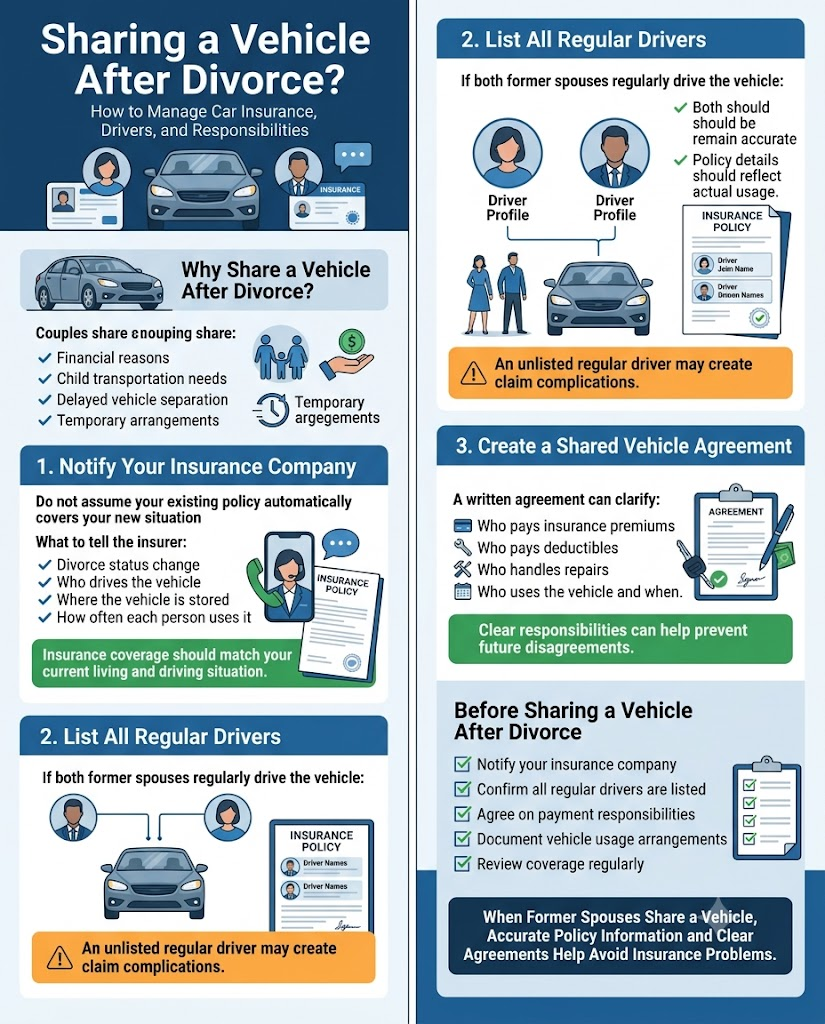
- Financial reasons
- Child transportation needs
- Delayed vehicle separation
- Temporary arrangements
If you share a vehicle after divorce:
Inform Your Insurance Company
Do not assume your existing policy automatically covers your new situation.
Tell your insurer:
- That you are divorced
- Who drives the vehicle
- Where the vehicle is stored
- How frequently each person uses it
Keep Both Drivers Properly Listed
If both former spouses drive the vehicle regularly, both should usually be listed as drivers.
Failing to list a regular driver can create problems during a claim.
Create a Written Agreement
A written agreement can help clarify:
- Who pays insurance premiums
- Who pays deductibles
- Who handles repairs
- Who uses the vehicle and when
This can prevent future disagreements.
Car Insurance After Divorce When You Have Children
Children can make insurance decisions more complicated after divorce.
Parents need to decide:
- Which parent carries the policy
- Where children primarily live
- Who provides vehicles
- Who pays insurance costs
How Does Divorce Affect Teen Driver Insurance?
Teen drivers are often one of the biggest insurance expenses for divorced families.
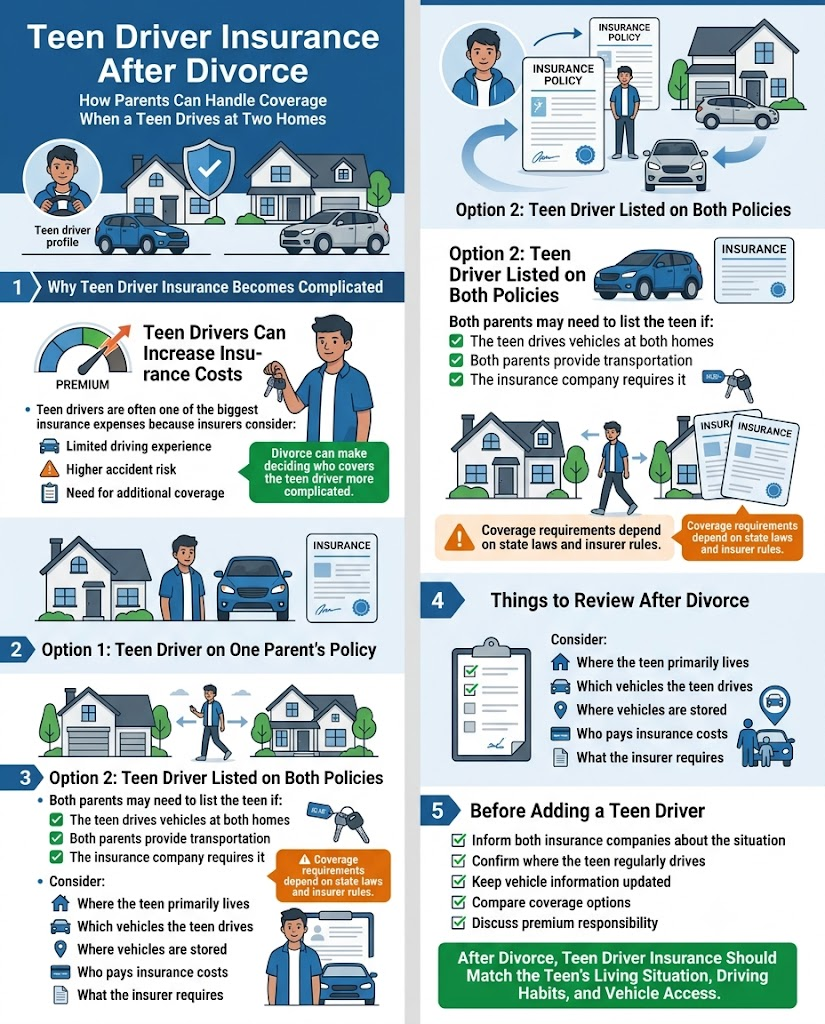
Possible arrangements include:
Teen Driver Listed on One Parent’s Policy
This may happen if:
- The teen primarily lives with one parent
- That parent provides the main vehicle
- The teen regularly drives that vehicle
Teen Driver Listed on Both Policies
In some cases, both parents may need to list the teenager if:
- The teen drives vehicles at both homes
- Both parents provide transportation
- The insurer requires it
Insurance rules vary by state and company.
Who Pays for a Child’s Car Insurance After Divorce?
The divorce agreement may determine responsibility.
Common arrangements include:
- One parent pays the entire premium
- Parents split the cost
- The parent who provides the vehicle pays
- Costs are included in child support calculations
It is important to follow the divorce agreement and keep insurance coverage active.
Can a Divorced Parent Keep a Child on Their Car Insurance?
Usually, yes, if insurance requirements are met.
A parent may keep a child on their policy if:
- The child lives with them
- The child is a dependent
- The child regularly drives an insured vehicle
- The insurer allows it
College students may also sometimes remain on a parent’s policy depending on their living situation and vehicle use.
State Rules About Separating Car Insurance After Divorce
Car insurance laws vary by state.
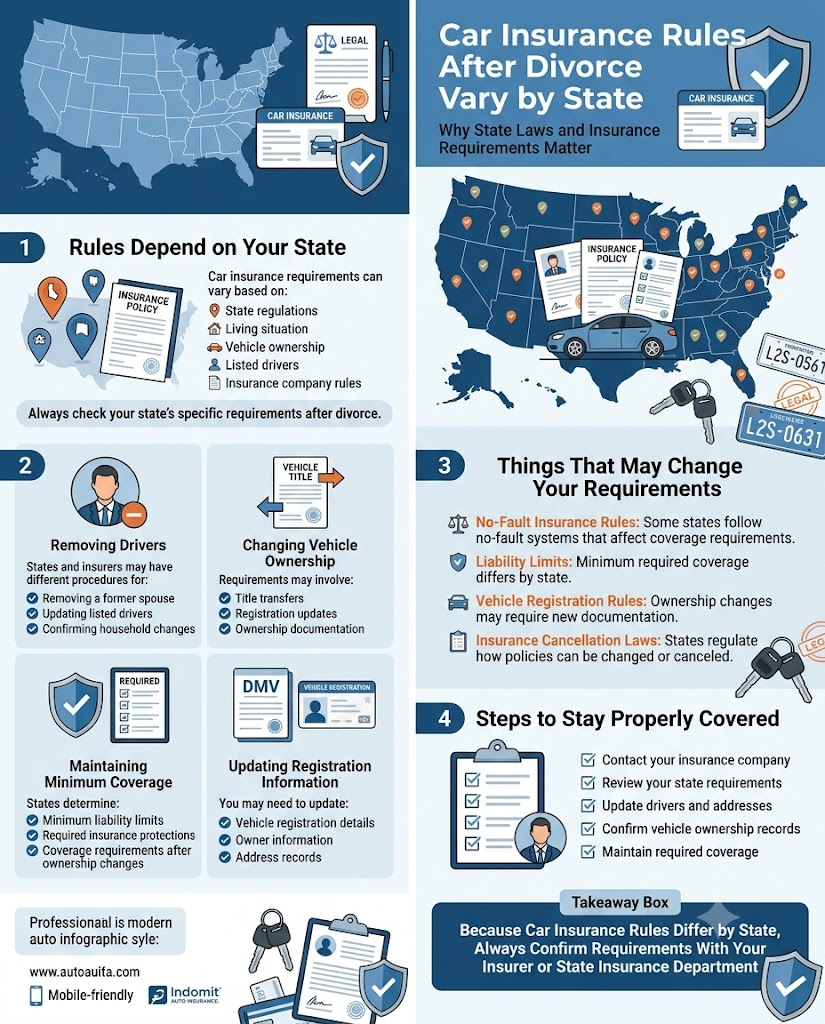
Some states require specific procedures for:
- Removing drivers
- Changing vehicle ownership
- Maintaining minimum coverage
- Updating registration information
Important factors include:
- Whether your state follows no-fault insurance rules
- Required liability limits
- Vehicle registration requirements
- Insurance cancellation laws
Because rules differ, contact your insurance company or state insurance department for exact requirements.
How to Avoid a Car Insurance Gap After Divorce
A lapse in coverage can create serious financial problems.
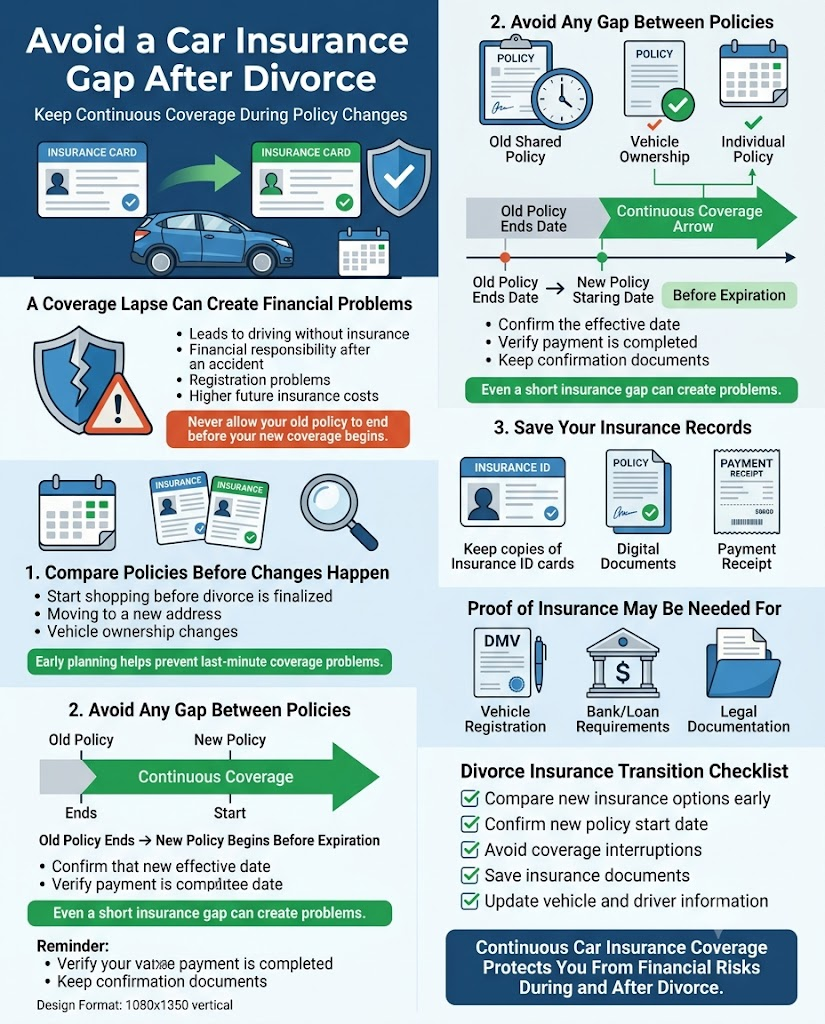
To avoid a gap:
Start Shopping Early
Begin comparing policies before:
- The divorce is finalized
- You move out
- Ownership changes
Set the New Policy Start Date Correctly
Your new policy should begin before your old coverage ends.
Avoid even a short period without insurance.
Keep Proof of Coverage
Save
- Insurance ID cards
- Policy documents
- Payment confirmations
You may need them for
- Vehicle registration
- Loan requirements
- Legal documentation
Final Checklist: Separating Car Insurance After Divorce
Use this checklist to make sure your insurance transition is complete.
Before or During Divorce
☐ Review the divorce agreement
☐ Decide who keeps each vehicle
☐ Check vehicle ownership and loan status
☐ Discuss insurance changes with your provider
After Divorce
☐ Update your marital status
☐ Update your address
☐ Remove or add drivers correctly
☐ Create separate policies if required
☐ Transfer vehicle titles if needed
☐ Confirm continuous coverage
☐ Keep proof of insurance
Key Takeaways
- There is no universal deadline for separating car insurance after divorce.
- Most people should update their insurance shortly after the divorce is finalized or after they begin living separately.
- Your insurance policy should accurately reflect your household, vehicle ownership, and drivers.
- Staying on an ex-spouse’s policy may be possible temporarily, but it can create financial risks.
- Separating policies helps protect your personal insurance history and reduces future complications.
- Always coordinate insurance changes with vehicle ownership and divorce agreements.