

Electric trucks are becoming increasingly popular as drivers look for alternatives to traditional gasoline-powered pickups. Models like the Rivian R1T offer impressive performance, advanced technology, and lower fuel costs compared with conventional gas-powered trucks.
However, one important factor many buyers consider before switching to an electric truck is insurance cost.
Is Rivian insurance more expensive than a gas truck?
In many cases, a Rivian can cost more to insure than a similar gasoline-powered truck because of higher repair costs, expensive parts, advanced technology, and specialized repair requirements. However, insurance rates depend on several factors, including the driver’s profile, location, coverage choices, and the specific truck being compared.
A gas truck may have lower insurance premiums upfront, but higher fuel and maintenance costs can affect total ownership expenses.
This guide explains the differences between Rivian auto insurance costs and gas truck insurance costs, what makes electric trucks more expensive to insure, and how owners can reduce their premiums.
Rivian Auto Insurance Cost vs Gas Truck
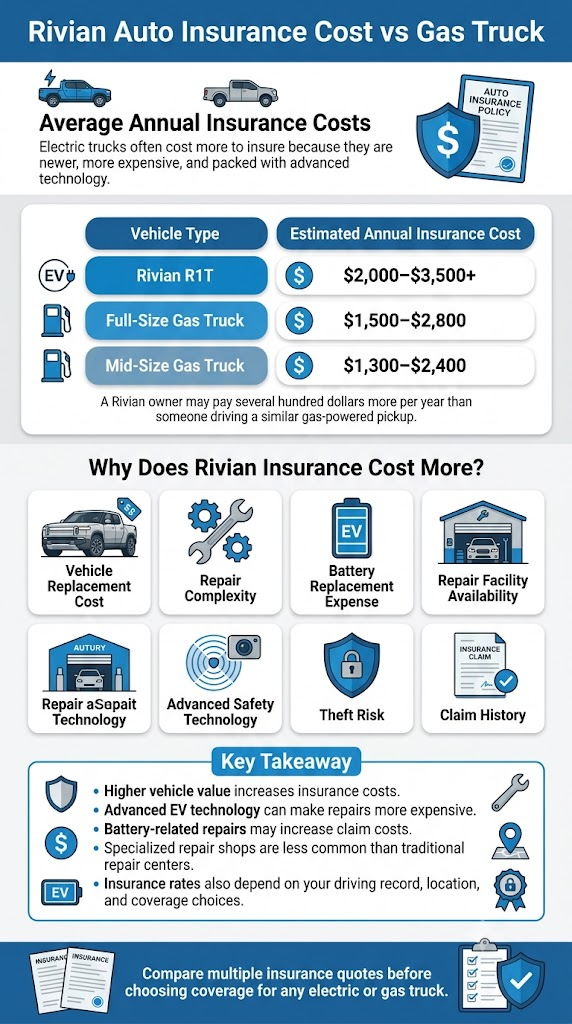
The cost of insuring any vehicle varies widely, but electric trucks often fall into a higher insurance category because they are newer, more expensive, and equipped with advanced technology.
Average Annual Insurance Comparison
| Vehicle Type | Estimated Annual Insurance Cost |
|---|---|
| Rivian R1T | $2,000–$3,500+ per year |
| Full-size gas truck (Ford F-150, Chevy Silverado, Ram 1500) | $1,500–$2,800 per year |
| Mid-size gas truck (Toyota Tacoma, Ford Ranger) | $1,300–$2,400 per year |
A Rivian owner may pay several hundred dollars more per year compared with a similar gas pickup.
However, the difference is not only based on the electric drivetrain.
Insurance companies consider several additional factors:
- Vehicle replacement cost
- Repair complexity
- Battery replacement expense
- Availability of repair facilities
- Safety technology
- Theft risk
- Claim history
Why Is Rivian Insurance Often More Expensive?
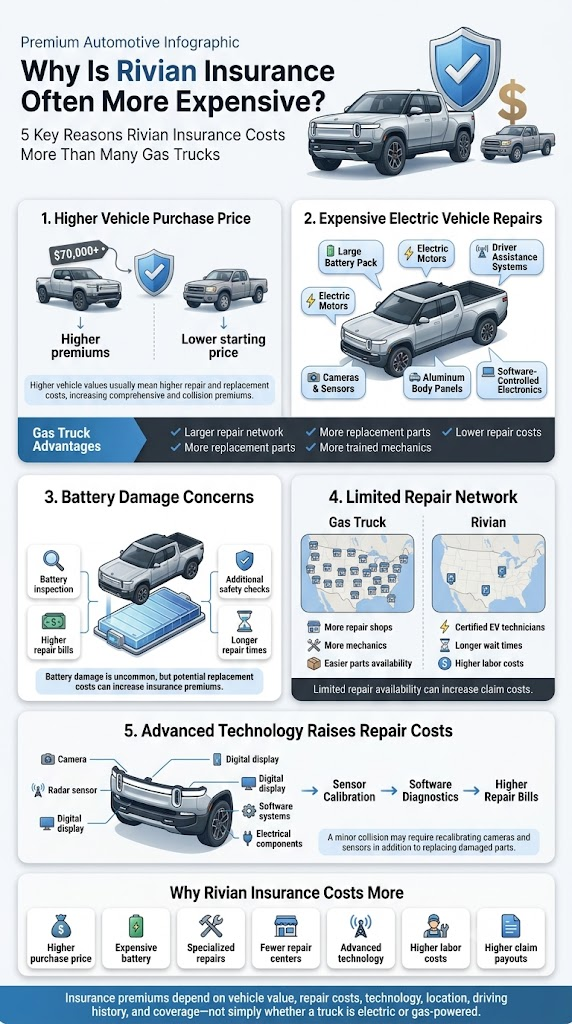
Higher Vehicle Purchase Price
One of the biggest reasons Rivian insurance can cost more is the vehicle’s value.
A new Rivian R1T typically costs significantly more than many traditional pickups.
For example:
- A Rivian R1T may cost around $70,000 or more depending on configuration.
- A gas truck like a base Ford F-150 or Chevrolet Silverado may start much lower.
Insurance companies calculate comprehensive and collision premiums partly based on how much it would cost to repair or replace the vehicle.
A more expensive vehicle usually means a higher potential payout after an accident.
Expensive Electric Vehicle Repairs
Electric trucks use advanced components that can increase repair costs.
A Rivian includes:
- Large battery pack
- Electric motors
- Advanced driver assistance systems
- Cameras and sensors
- Aluminum body components
- Complex software systems
A minor collision that damages sensors, cameras, or battery-related components may require specialized repairs.
Traditional gas trucks often have:
- Larger repair networks
- More available parts
- More mechanics trained on repairs
- Lower-cost replacement components
This can make gas trucks cheaper to repair after accidents.
Battery Damage Concerns
The battery pack is one of the most expensive components in an electric vehicle.
Although battery damage from normal accidents is uncommon, insurance companies consider the potential cost if a battery pack needs replacement.
A severe collision involving the battery area may lead to:
- Battery inspection requirements
- Additional safety checks
- Higher repair bills
- Longer repair times
These risks can influence premiums.
Limited Repair Network
Gas trucks have been sold for decades, creating a large repair ecosystem.
Popular trucks like:
- Ford F-150
- Chevrolet Silverado
- Ram 1500
- Toyota Tacoma
have thousands of repair shops familiar with their systems.
Rivian vehicles require technicians trained specifically for electric vehicle systems.
Limited repair availability can mean:
- Higher labor costs
- Longer repair times
- Fewer repair options
Insurance companies may factor these risks into pricing.
Advanced Technology Increases Repair Costs
Modern trucks already include technology, but Rivian vehicles rely heavily on software and electronic systems.
Features that can increase repair expenses include:
- Driver assistance sensors
- Cameras
- Digital displays
- Software-controlled vehicle systems
- Complex electrical components
For example, replacing a damaged bumper on a modern truck may require recalibrating cameras and sensors.
These additional procedures can increase insurance claim costs.
Rivian Insurance vs Gas Truck: Coverage Cost Differences
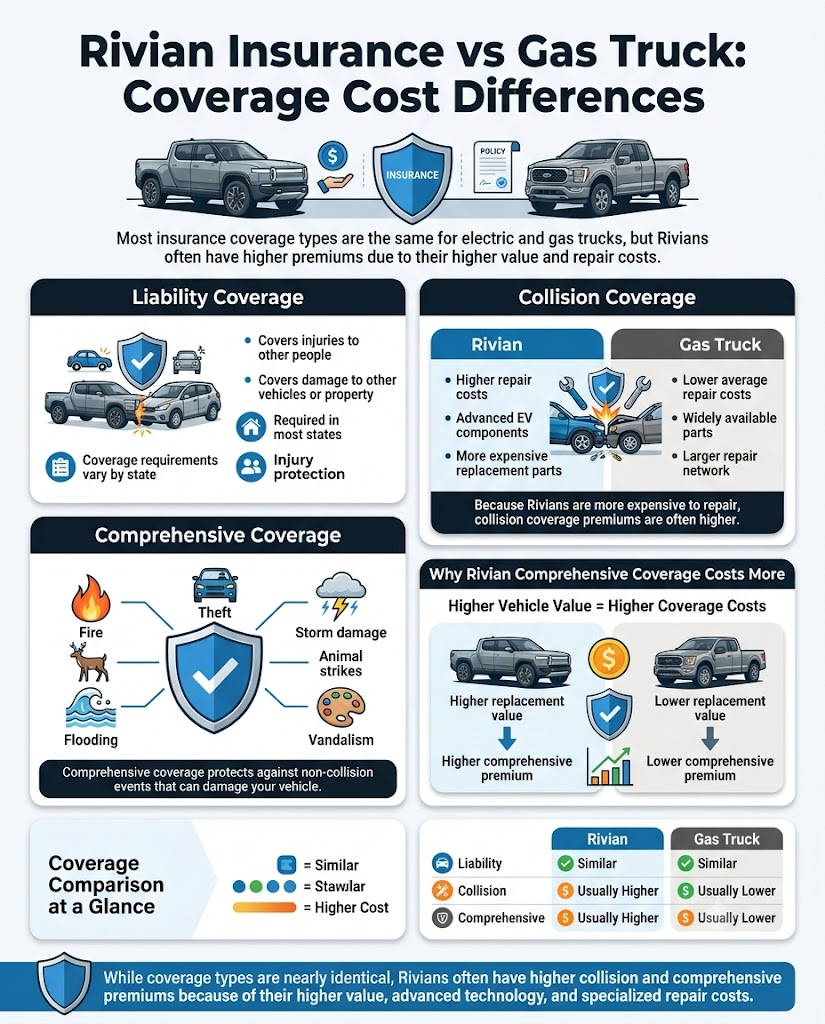
Most owners purchase similar coverage types regardless of vehicle type.
Common coverage includes:
Liability Coverage
Pays for injuries and property damage you cause to others.
Requirements vary by state.
Collision Coverage
Pays for damage to your vehicle after an accident.
Because Rivians are expensive vehicles, collision coverage is often costly.
Comprehensive Coverage
Protects against non-collision damage such as:
- Theft
- Fire
- Storm damage
- Flooding
- Animal strikes
- Vandalism
Electric vehicles may have higher comprehensive costs because of their higher replacement value.
Uninsured and Underinsured Motorist Coverage
Protects you if another driver causes an accident and does not have enough insurance.
This coverage is important regardless of whether you drive an EV truck or gas truck.
When comparing Rivian insurance costs with traditional gas-powered trucks, the closest comparisons are usually full-size pickups that compete in the same lifestyle category.
Popular gas truck alternatives include:
- Ford F-150
- Chevrolet Silverado 1500
- Ram 1500
- Toyota Tundra
While these trucks may have similar utility and capability, insurance costs can vary significantly.
Rivian R1T vs Ford F-150 Insurance Cost
The Ford F-150 has been one of the best-selling trucks for decades, which gives it several insurance advantages.
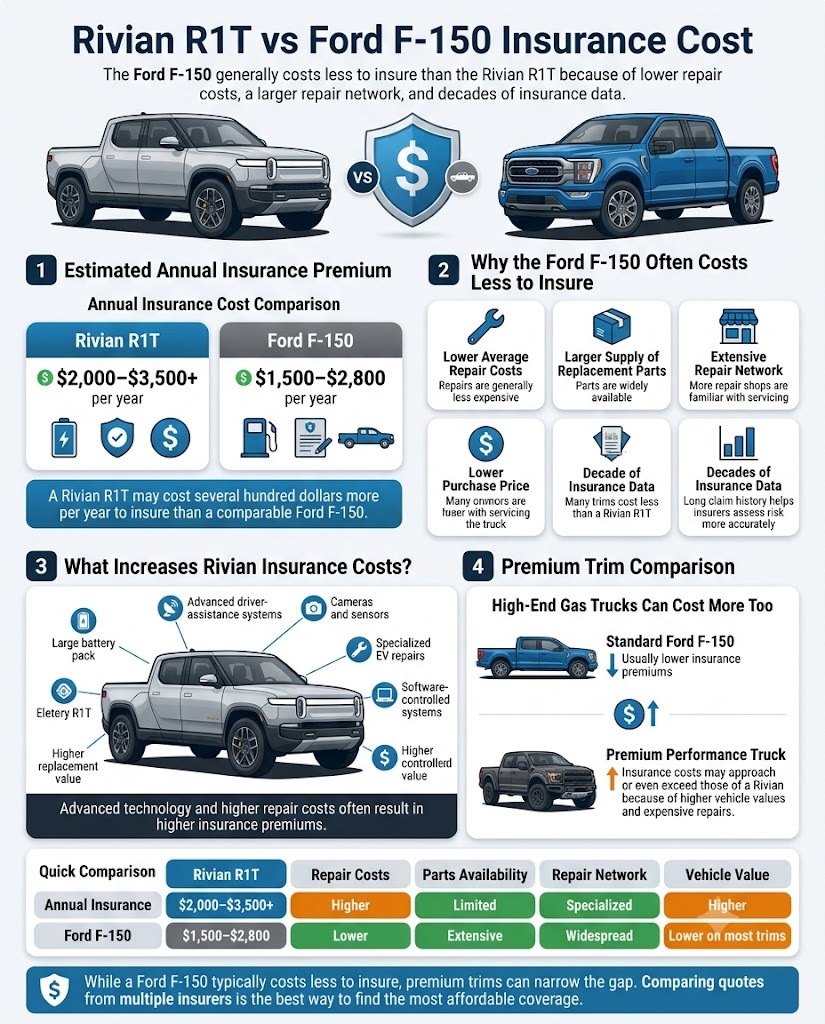
Ford F-150 Insurance Advantages
- Lower average repair costs
- Large supply of replacement parts
- More repair shops familiar with the vehicle
- Lower purchase prices on many trims
- Long history of insurance data
A basic or mid-level F-150 may cost less to insure than a Rivian R1T.
However, premium F-150 models such as the Raptor or high-end trims can approach or exceed Rivian insurance costs because of their high value.
Estimated Annual Insurance Difference
| Vehicle | Estimated Annual Premium |
|---|---|
| Rivian R1T | $2,000–$3,500+ |
| Ford F-150 | $1,500–$2,800 |
The Rivian may cost several hundred dollars more per year to insure.
Rivian R1T vs Chevrolet Silverado 1500 Insurance Cost
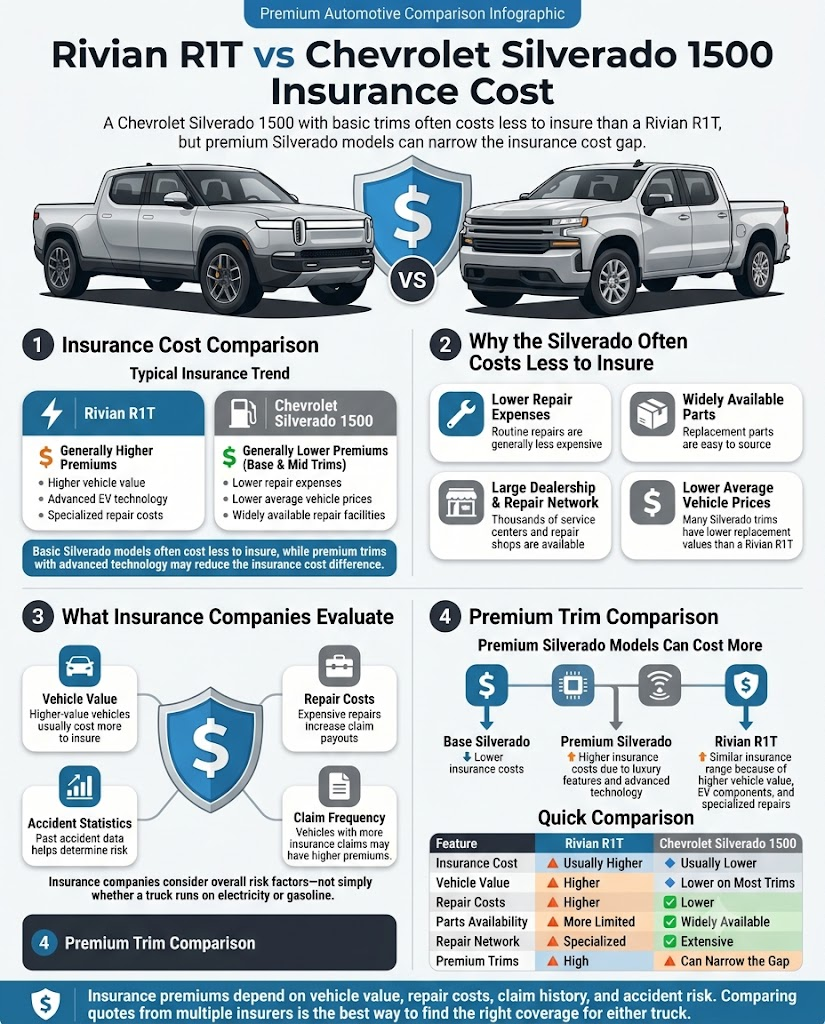
The Chevrolet Silverado 1500 benefits from:
- Lower repair expenses
- Widely available parts
- Large dealership network
- Lower average vehicle prices
A Silverado with basic features may have lower insurance costs compared with a Rivian.
However, expensive Silverado trims with advanced technology can reduce the difference.
Insurance companies mainly look at:
- Vehicle value
- Repair costs
- Accident statistics
- Claim frequency
rather than simply whether the vehicle uses electricity or gasoline.
Rivian R1T vs Ram 1500 Insurance Cost
The Ram 1500 is another popular alternative to the Rivian.
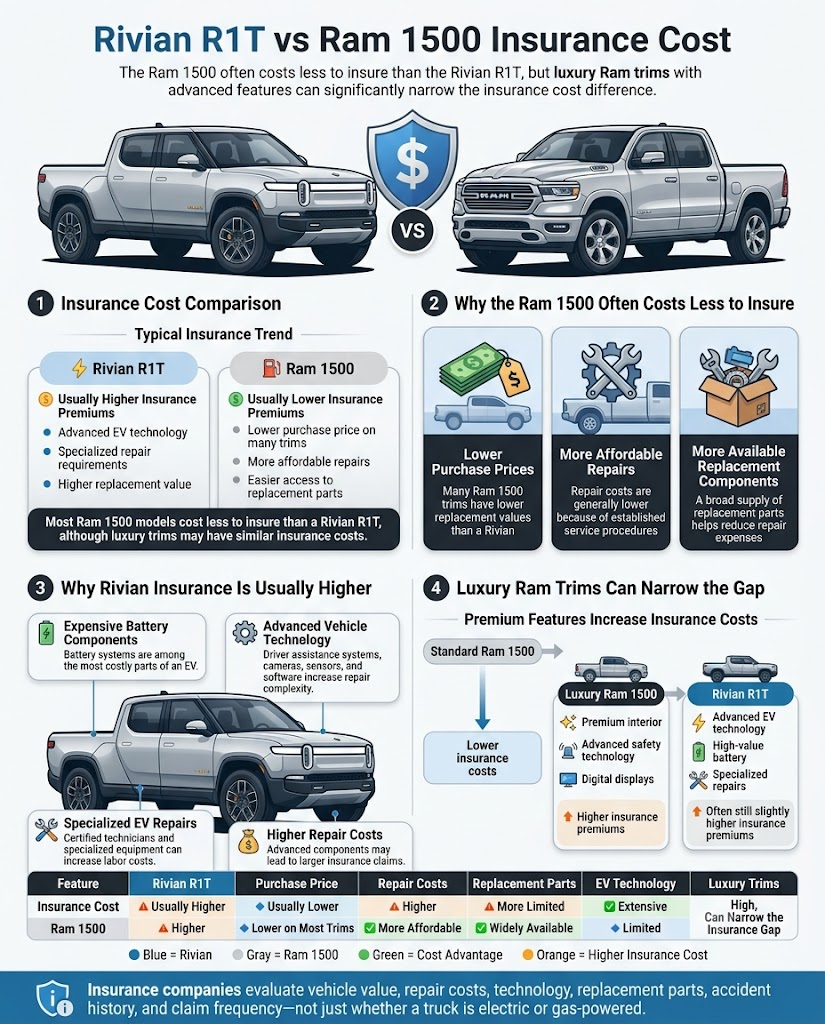
Gas-powered Ram trucks generally have:
- Lower purchase prices
- More affordable repairs
- More available replacement components
However, luxury Ram trims with premium interiors and advanced safety systems can become expensive to insure.
A Rivian will often still have a higher premium because of:
- Higher technology costs
- EV repair complexity
- Expensive battery components
Why Gas Trucks Can Sometimes Cost More to Insure
Although Rivian insurance is often higher, gas trucks are not always cheaper.
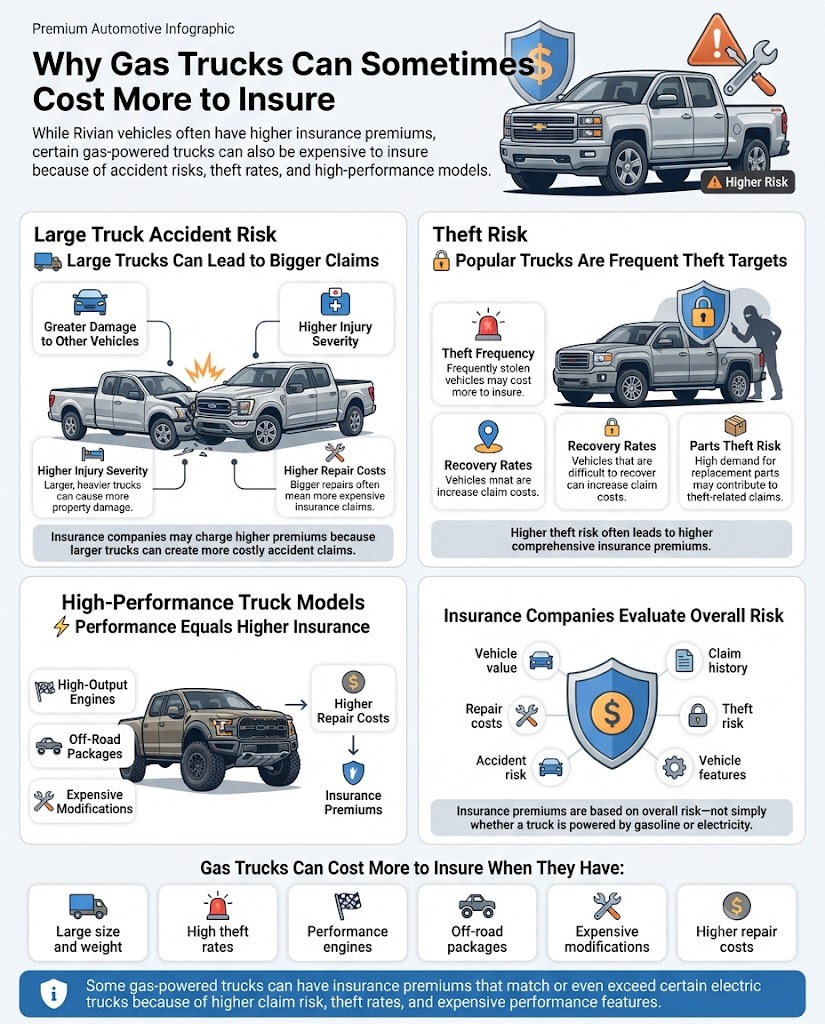
Several factors can increase gas truck insurance rates.
Large Truck Accident Risk
Pickup trucks are larger and heavier than many vehicles.
Insurance companies consider:
- Potential damage caused to other vehicles
- Injury severity in accidents
- Repair costs after collisions
A large truck involved in an accident may create expensive claims.
Theft Risk
Some popular gas trucks have high theft rates.
Vehicles commonly targeted by thieves may have higher comprehensive insurance costs.
Insurance companies consider:
- Theft frequency
- Recovery rates
- Parts theft risk
High-Performance Truck Models
Performance trucks can be expensive to insure.
Examples include:
- High-output engines
- Off-road packages
- Expensive modifications
A powerful gas truck may have insurance costs similar to or higher than some electric trucks.
Fuel Savings: Rivian vs Gas Truck
Insurance is only one part of ownership cost.
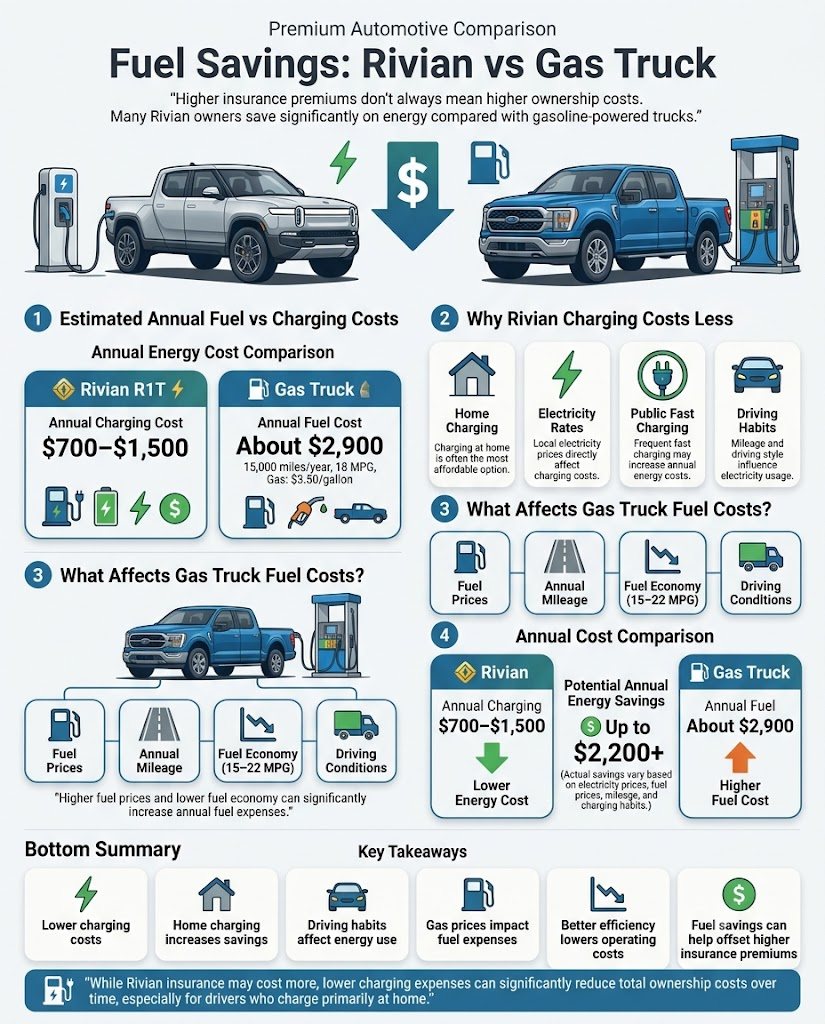
Many Rivian owners accept higher insurance premiums because electric trucks can reduce fuel expenses.
Gas Truck Fuel Costs
A traditional gas pickup may achieve around:
- 15–22 miles per gallon
Assuming:
- 15,000 miles driven per year
- Gas price: $3.50 per gallon
- Fuel economy: 18 MPG
Annual fuel cost:
15,000 ÷ 18 × $3.50 = about $2,900 per year
Rivian Charging Costs
Electric trucks use electricity instead of gasoline.
Charging costs depend on:
- Electricity rates
- Home charging availability
- Public fast charging usage
- Driving habits
Many Rivian owners who charge mostly at home spend significantly less on energy compared with gasoline.
Annual charging costs may often be around:
- $700–$1,500 per year
depending on electricity prices and driving patterns.
Insurance Difference vs Fuel Savings
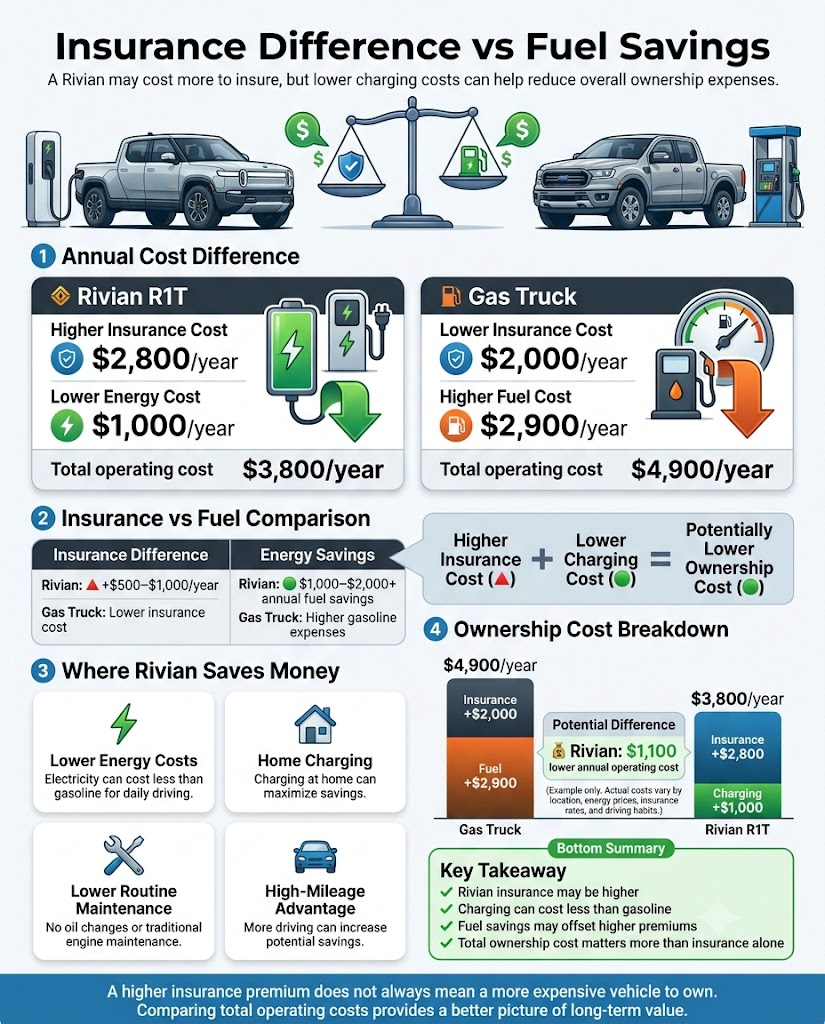
A Rivian may cost:
$500–$1,000 more per year in insurance
but may save:
$1,000–$2,000+ per year in fuel costs
This means the higher insurance premium does not automatically make the Rivian more expensive to own.
Example:
Gas Truck
Insurance: $2,000/year
Fuel: $2,900/year
Total: $4,900/year
Rivian R1T
Insurance: $2,800/year
Charging: $1,000/year
Total: $3,800/year
Even with higher insurance costs, the Rivian may have lower operating expenses.
Maintenance Cost Differences
Another major ownership factor is maintenance.
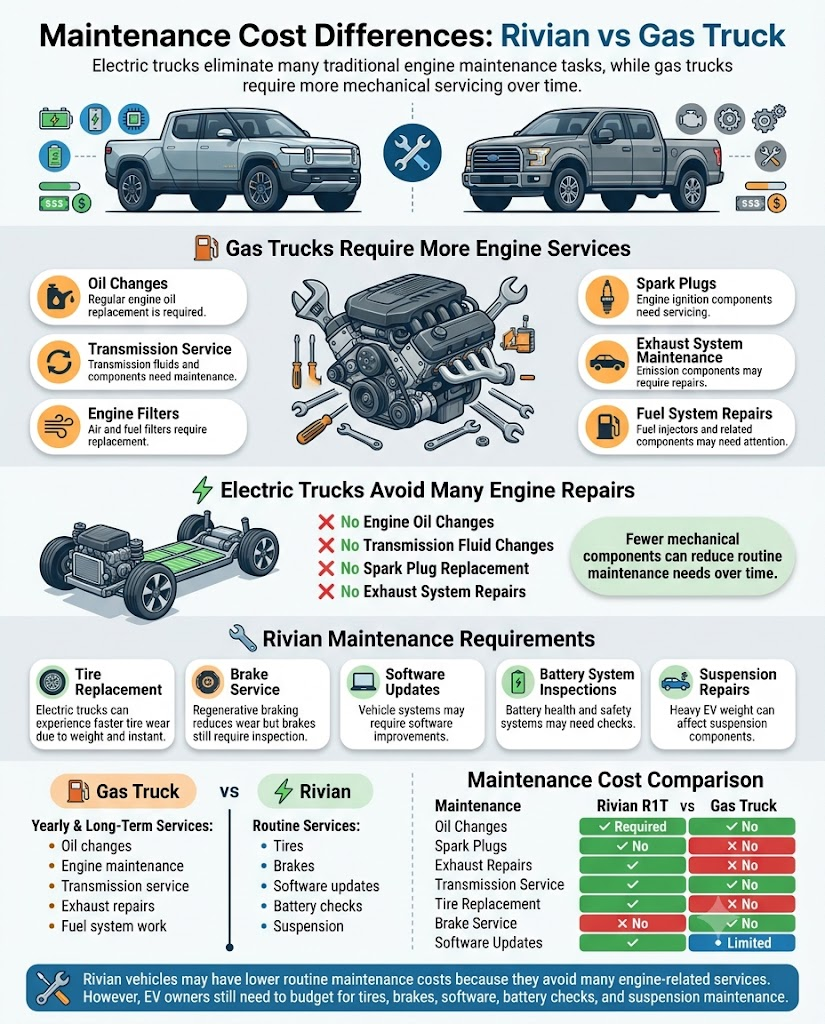
Gas Truck Maintenance
Gas trucks require:
- Oil changes
- Engine filters
- Transmission service
- Spark plugs
- Exhaust system maintenance
- Fuel system repairs
Over several years, these costs can add up.
Rivian Maintenance
Electric trucks generally avoid many engine-related services.
They do not require:
- Engine oil changes
- Transmission fluid changes
- Spark plugs
- Exhaust repairs
However, EV maintenance can include:
- Tire replacement
- Brake service
- Software updates
- Battery system inspections
- Suspension repairs
Which Has Lower Total Ownership Cost?
The answer depends on driving habits.
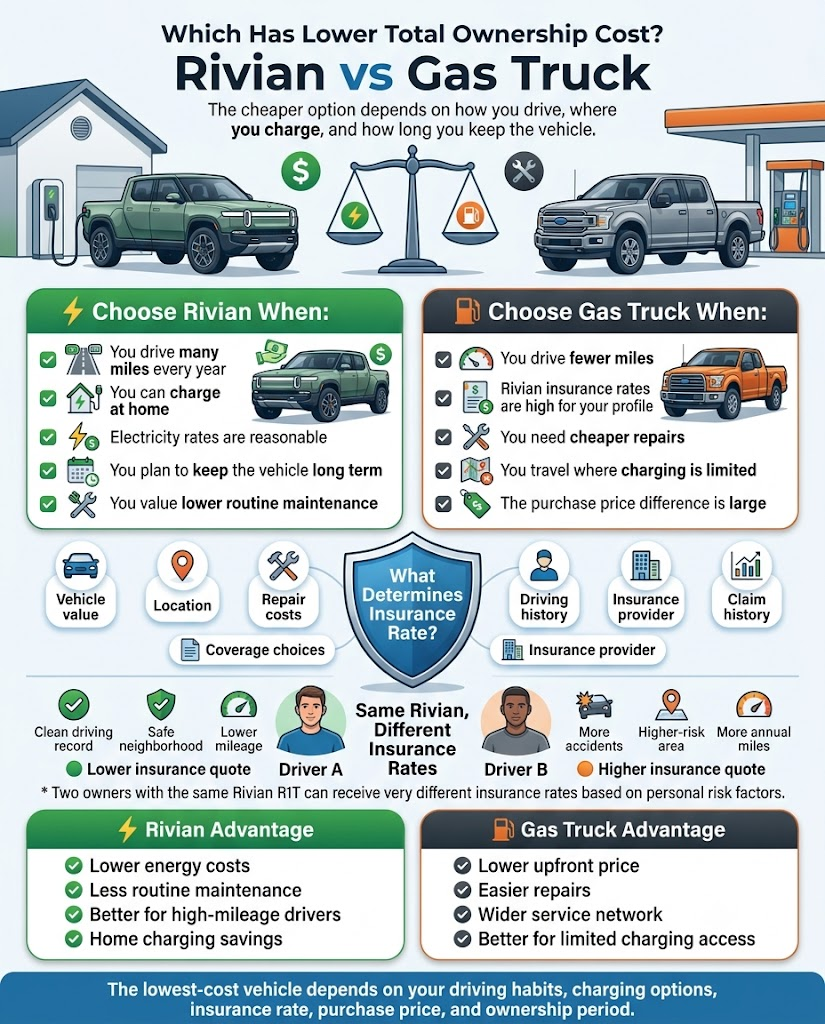
Rivian May Be Cheaper If
✔ You drive many miles every year
✔ You can charge at home
✔ Electricity rates are reasonable
✔ You plan to keep the vehicle long term
✔ You value lower maintenance costs
Gas Truck May Be Cheaper If
✔ You drive fewer miles
✔ Insurance rates for your Rivian are high
✔ You need cheaper repairs
✔ You frequently travel where charging is limited
✔ The truck purchase price difference is large
The cost of insuring a Rivian depends on much more than the fact that it is an electric truck. Insurance companies analyze dozens of factors when calculating premiums.
Two Rivian owners with the same vehicle can receive very different quotes because of differences in location, driving history, coverage choices, and insurance provider.
Factors That Determine Rivian Insurance Cost
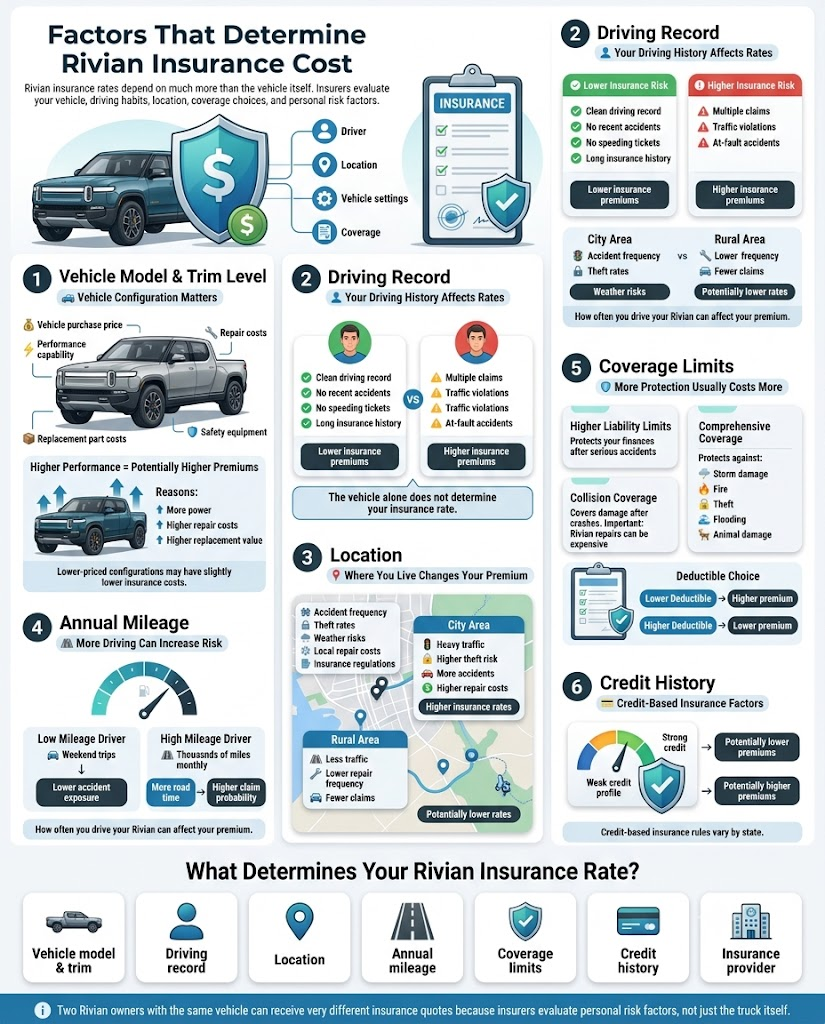
Vehicle Model and Trim Level
Not every Rivian costs the same to insure.
Insurance companies consider:
- Vehicle purchase price
- Performance capability
- Repair costs
- Replacement part costs
- Safety equipment
A higher-performance Rivian model may have higher premiums because:
- It has more power
- It may cost more to repair
- Replacement costs are higher
A lower-priced configuration may have slightly lower insurance costs.
Your Driving Record
Your driving history is one of the biggest factors affecting insurance premiums.
Drivers with:
- Clean records
- No recent accidents
- No speeding tickets
- Long insurance history
usually receive lower rates.
Drivers with:
- Multiple claims
- Traffic violations
- At-fault accidents
may pay significantly more.
The vehicle alone does not determine your premium.
Location
Where you live can dramatically change Rivian insurance costs.
Insurance companies consider:
- Accident frequency
- Vehicle theft rates
- Weather risks
- Repair costs in the area
- Local insurance regulations
For example:
A Rivian owner in a large city with high traffic and theft risk may pay much more than someone in a rural area with fewer claims.
Annual Mileage
How much you drive affects your premium.
Higher mileage means:
- More time on the road
- Greater accident exposure
- Higher claim probability
A driver who uses a Rivian mainly for weekend trips may pay less than someone who drives thousands of miles monthly.
Coverage Limits
Choosing higher protection increases insurance costs.
Many Rivian owners choose higher coverage limits because of the vehicle’s value.
Common choices include:
Higher Liability Limits
Protects your finances if you cause a serious accident.
Collision Coverage
Important because Rivian repairs can be expensive.
Comprehensive Coverage
Protects against:
- Theft
- Storm damage
- Fire
- Flooding
- Animal damage
Lower Deductibles
A lower deductible means the insurance company pays more during a claim, which usually increases premiums.
Credit History
In many states, insurers may consider credit-based insurance scores when setting rates.
A stronger credit profile may help some drivers qualify for lower premiums.
However, rules vary by location.
Rivian Insurance vs Traditional Insurance Companies
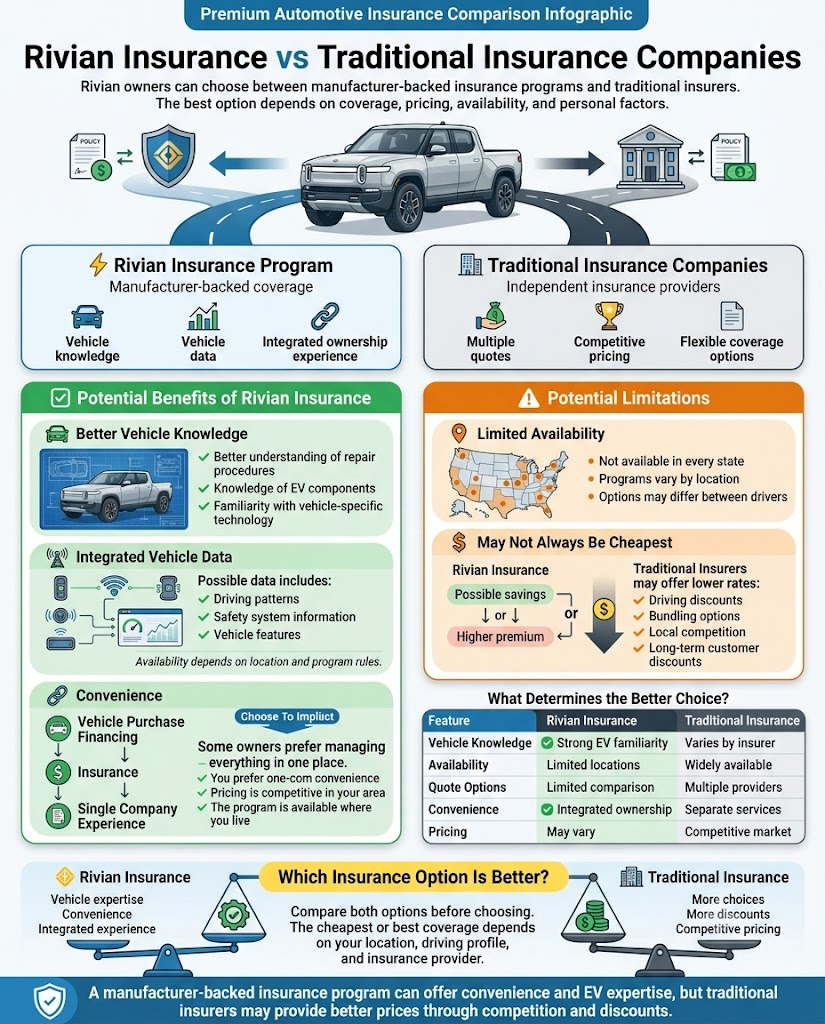
Rivian owners generally have two options:
- Rivian’s own insurance program (where available)
- Traditional insurance companies
Each option has advantages and disadvantages.
Rivian Insurance Advantages
Potentially Better Vehicle Knowledge
A manufacturer-backed insurance program may understand the vehicle better.
This can help with:
- Repair procedures
- Parts availability
- Vehicle-specific technology
Integrated Vehicle Data
Some EV manufacturers use vehicle information to help personalize insurance pricing.
Data may include:
- Driving patterns
- Safety systems
- Vehicle features
Availability depends on location and program rules.
Convenience
Some owners prefer having:
- Vehicle purchase
- Financing
- Insurance
managed through one company.
Rivian Insurance Disadvantages
Limited Availability
Manufacturer insurance programs are not available everywhere.
Your state may not offer the same options.
May Not Always Be Cheapest
A manufacturer insurance option is not automatically the lowest price.
Traditional insurers may offer better rates depending on:
- Your driving record
- Discounts
- Bundling options
- Local competition
How to Lower Rivian Insurance Costs
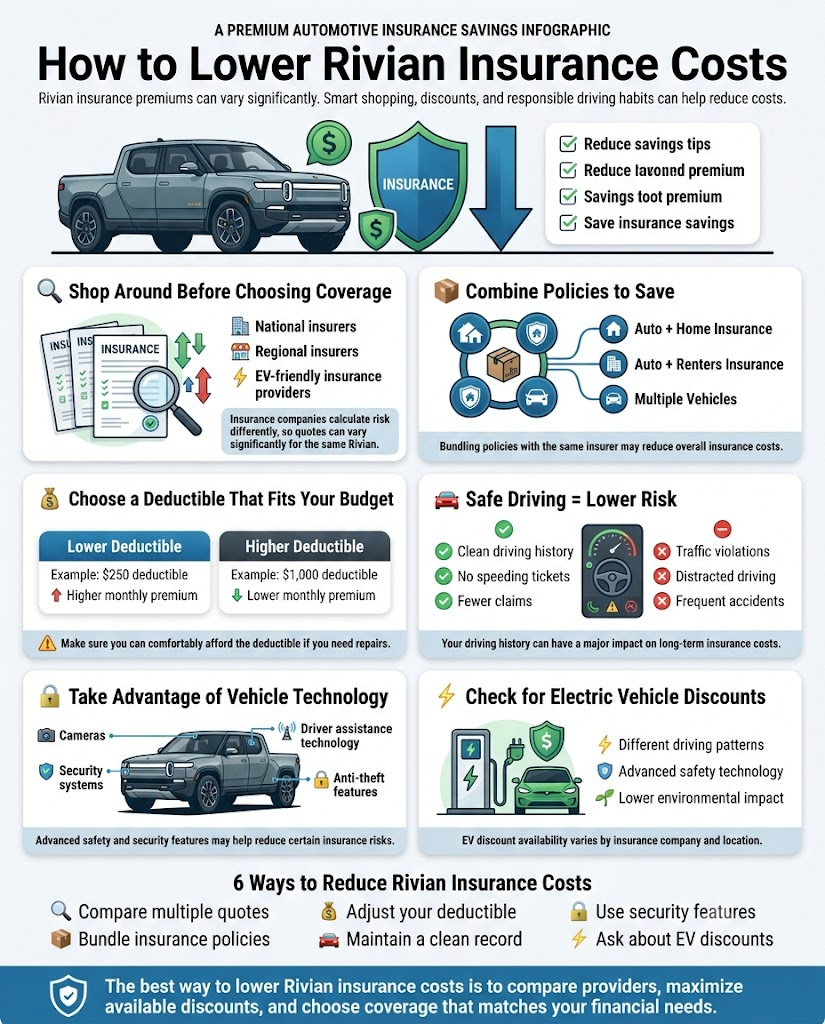
Compare Multiple Insurance Quotes
One of the biggest mistakes EV owners make is assuming all companies charge similar rates.
Insurance pricing varies significantly.
Compare:
- National insurers
- Regional insurers
- EV-friendly insurance providers
Bundle Policies
Combining insurance policies can reduce costs.
Possible discounts may include:
- Auto + home insurance
- Auto + renters insurance
- Multiple vehicles
Increase Your Deductible
A higher deductible can reduce monthly premiums.
Example:
A $1,000 deductible usually costs less than a $250 deductible.
However, make sure you can comfortably pay the deductible if you need repairs.
Maintain a Clean Driving Record
Safe driving habits can have a major impact on long-term insurance costs.
Avoid:
- Speeding violations
- Distracted driving
- Frequent claims
Install Security Features
Some insurers may consider safety and security features when calculating premiums.
Rivian vehicles already include advanced security technology, which may help reduce certain risks.
Ask About EV Discounts
Some insurers offer discounts for electric vehicles because EV owners may have:
- Different driving patterns
- Advanced safety features
- Lower environmental impact
Discount availability varies by company.
Common Mistakes Rivian Owners Make When Buying Insurance
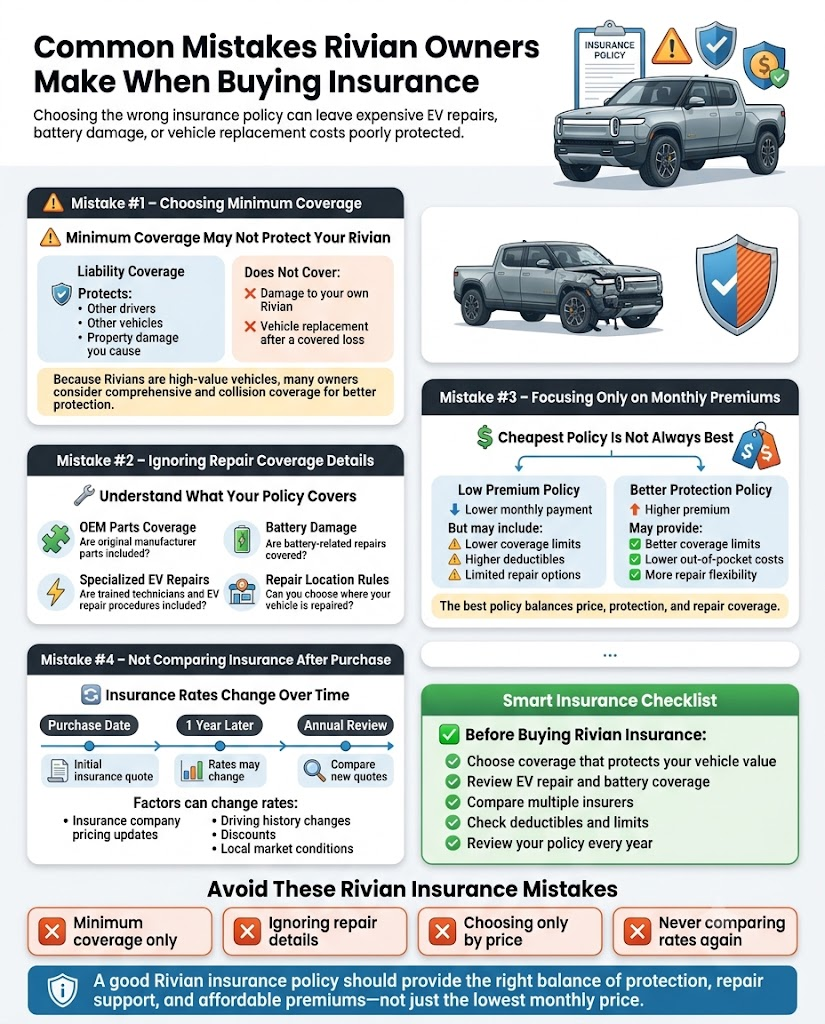
Mistake 1: Choosing Minimum Coverage
A Rivian is an expensive vehicle.
Minimum liability coverage may protect others but does not pay for damage to your own truck.
Many owners choose comprehensive and collision coverage because replacing a Rivian can be costly.
Mistake 2: Ignoring Repair Coverage Details
Before buying a policy, check:
- Are OEM parts covered?
- Are battery-related damages covered?
- Are specialized repairs included?
- Are there limitations on repair locations?
Mistake 3: Focusing Only on Monthly Premiums
The cheapest policy is not always the best.
A lower premium may come with:
- Lower coverage limits
- Higher deductibles
- Limited repair options
Mistake 4: Not Comparing After Purchase
Insurance rates change over time.
A company that offered the best price when you bought your Rivian may not remain the cheapest later.
Reviewing quotes annually can help reduce costs.
Rivian Insurance vs Gas Truck: Quick Comparison
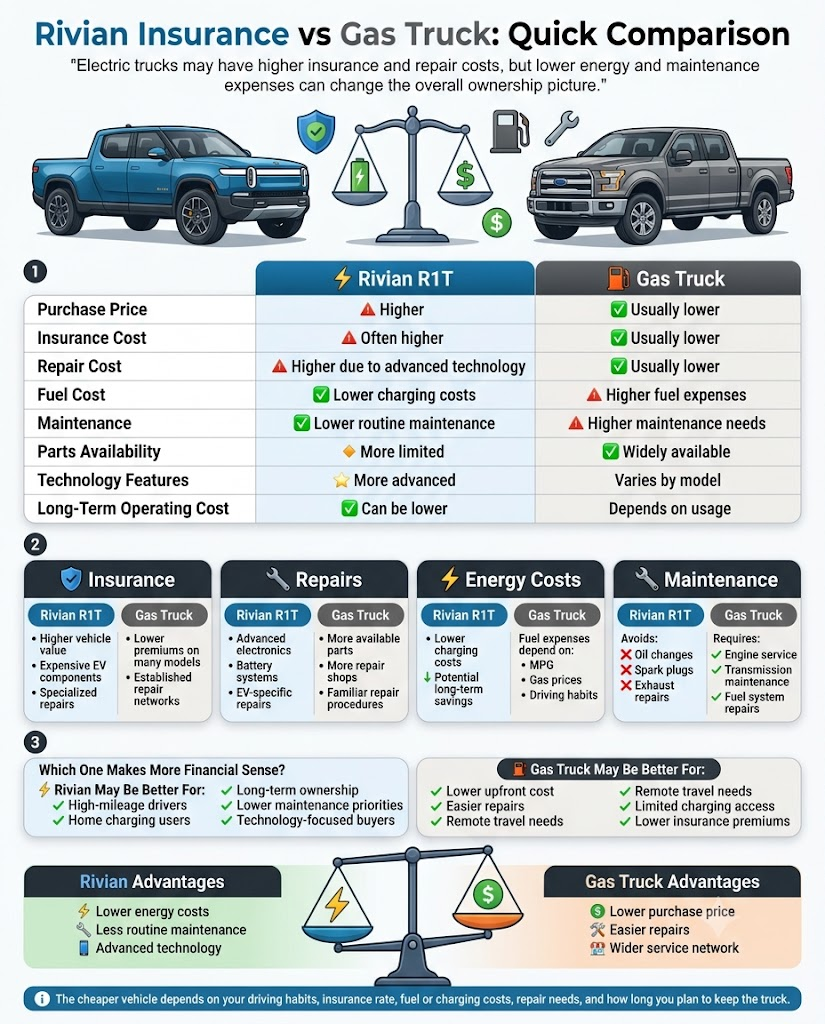
| Factor | Rivian R1T | Gas Truck |
|---|---|---|
| Purchase Price | Higher | Usually lower |
| Insurance Cost | Often higher | Usually lower |
| Repair Cost | Higher due to technology | Usually lower |
| Fuel Cost | Lower | Higher |
| Maintenance | Lower routine maintenance | Higher maintenance |
| Parts Availability | More limited | Widely available |
| Technology Features | More advanced | Varies |
| Long-Term Operating Cost | Can be lower | Depends on usage |
5-Year Ownership Cost: Rivian vs Gas Truck
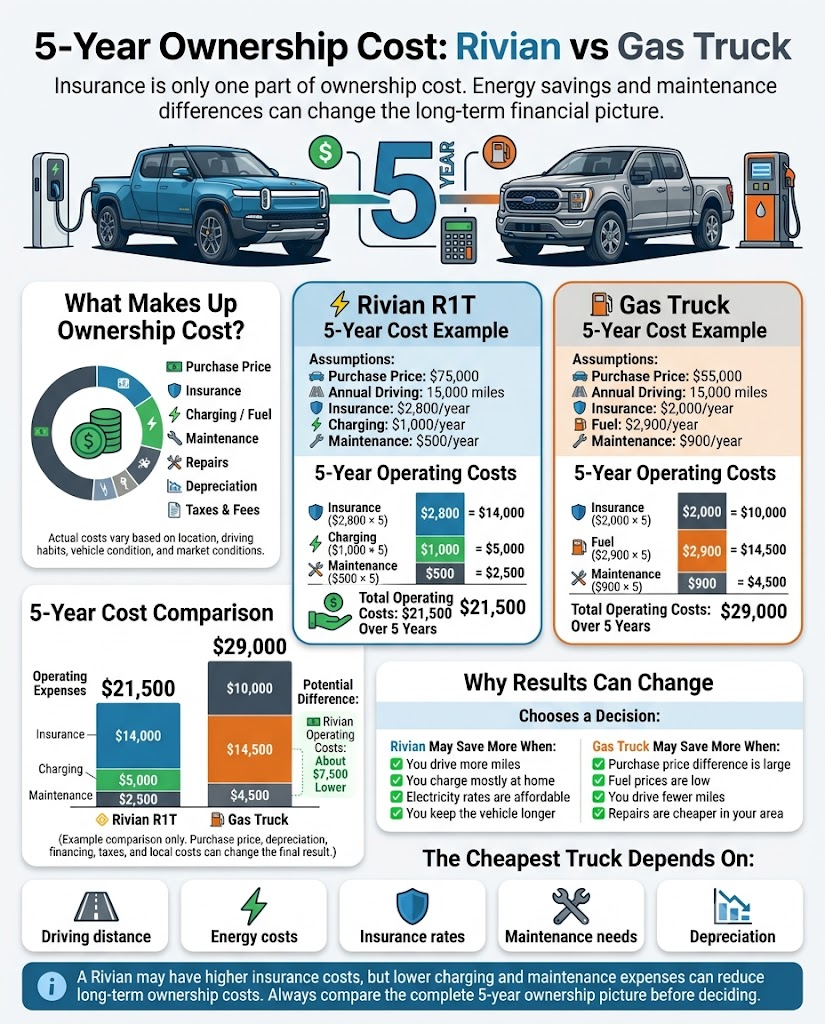
The total cost of ownership includes:
- Purchase price
- Insurance
- Charging or fuel costs
- Maintenance
- Repairs
- Depreciation
- Taxes and fees
The numbers vary depending on location and driving habits, but a general comparison shows where each vehicle has advantages.
Example: Rivian R1T 5-Year Ownership Costs
Assumptions:
- Purchase price: $75,000
- Annual driving: 15,000 miles
- Insurance: $2,800 per year
- Charging cost: $1,000 per year
- Maintenance: $500 per year
Estimated 5-Year Expenses
Insurance: $2,800 × 5 = $14,000
Charging: $1,000 × 5 = $5,000
Maintenance: $500 × 5 = $2,500
Total Operating Costs
Approximately: $21,500 over five years
Example: Gas Truck 5-Year Ownership Costs
Assumptions:
- Purchase price: $55,000
- Annual driving: 15,000 miles
- Insurance: $2,000 per year
- Fuel cost: $2,900 per year
- Maintenance: $900 per year
Estimated 5-Year Expenses
Insurance: $2,000 × 5 = $10,000
Fuel: $2,900 × 5 = $14,500
Maintenance: $900 × 5 = $4,500
Total Operating Costs
Approximately:: $29,000 over five years
Why Rivian Can Still Be Cheaper Despite Higher Insurance
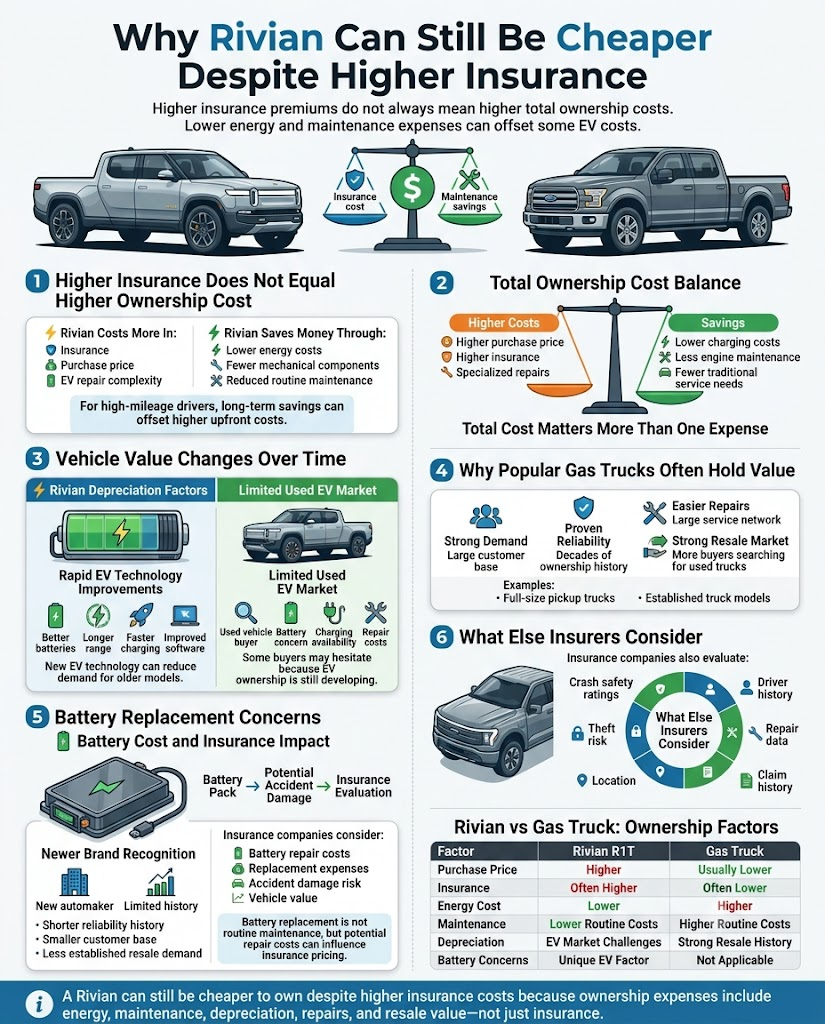
The Rivian example shows an important point:
A higher insurance premium does not always mean higher ownership costs.
The Rivian may cost:
- More to insure
- More to purchase
But it can save money through:
- Lower energy costs
- Fewer mechanical components
- Reduced routine maintenance
For drivers who travel many miles, these savings can become significant.
Depreciation: Rivian vs Gas Truck
Depreciation is one of the largest ownership expenses.
A vehicle loses value over time because of:
- Age
- Mileage
- Market demand
- Technology changes
- Reliability perception
Rivian Depreciation Factors
Electric vehicles can experience unique depreciation challenges.
Factors affecting Rivian resale value include:
Rapid EV Technology Improvements
Battery technology improves quickly.
Newer EVs may offer:
- Longer range
- Faster charging
- Better software
Older EV models may lose value faster as technology advances.
Limited Used EV Market
The used EV market is still developing.
Some buyers may hesitate because of concerns about:
- Battery life
- Charging availability
- Repair costs
Brand Recognition
Rivian is a newer automaker compared with companies that have produced trucks for decades.
Traditional truck buyers often trust established brands because of:
- Long-term reliability history
- Easier repairs
- Strong resale demand
Gas Truck Depreciation Advantages
Popular trucks often hold value well because of:
- Strong demand
- Proven reliability
- Large customer base
- Established repair networks
Models like the Ford F-150 and Toyota Tundra often maintain strong resale values.
However, depreciation depends heavily on:
- Trim level
- Condition
- Mileage
- Market conditions
Battery Replacement Concerns and Insurance Impact
One common concern among potential Rivian buyers is battery replacement cost.
The battery pack is the most expensive component in an electric vehicle.
However, battery replacement is not a routine maintenance item.
Modern EV batteries are designed to last many years and often come with long-term warranties.
How Battery Concerns Affect Insurance
Insurance companies consider:
- Battery repair costs
- Accident damage risk
- Replacement expenses
- Vehicle value
A damaged battery after a serious accident can increase claim costs.
This can contribute to higher premiums.
However, insurers also consider:
- Crash safety ratings
- Theft risk
- Driver history
- Repair data
Battery concerns are only one part of the pricing calculation.
Insurance Claim Differences: Rivian vs Gas Truck
The claims process can differ between an electric truck and a traditional pickup.
Rivian Claims May Involve
- Specialized repair centers
- EV-trained technicians
- Battery inspection
- Sensor calibration
- Software diagnostics
These steps can increase repair time.
Gas Truck Claims Usually Benefit From
- More repair shops
- More available parts
- More experienced mechanics
- Established repair procedures
This can make repairs faster and sometimes less expensive.
Which Truck Is Better for Different Types of Drivers?
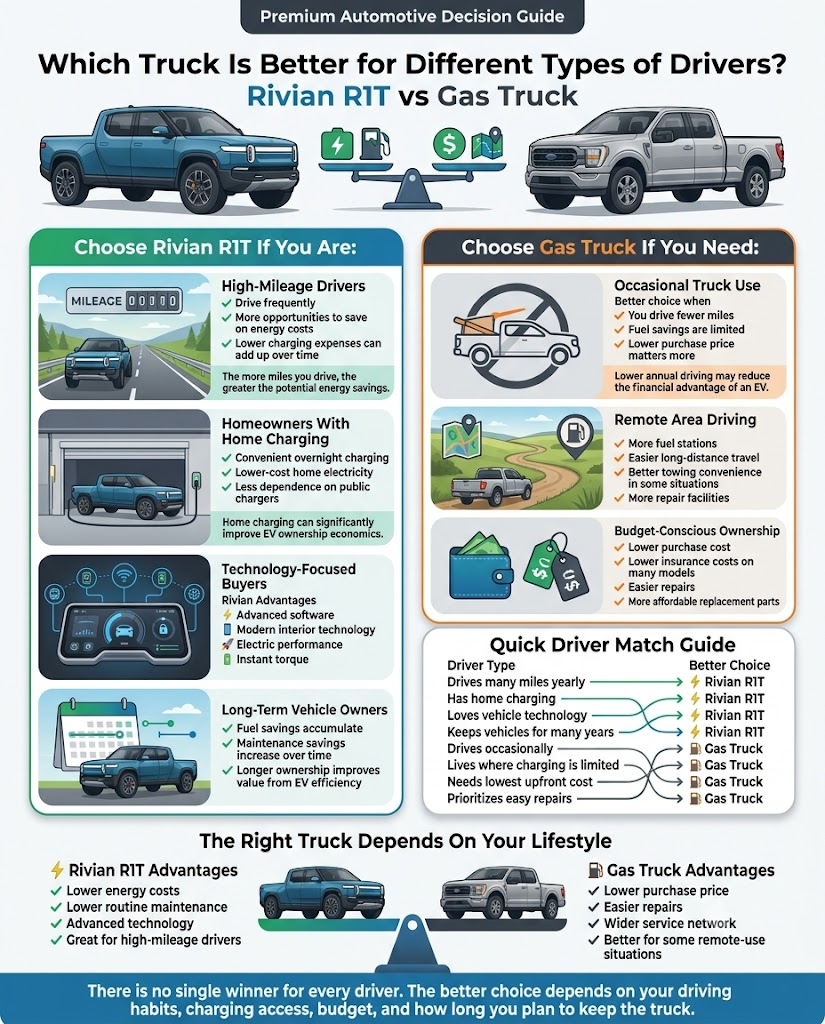
Rivian R1T May Be Better For
High-Mileage Drivers
People who drive frequently may save more through lower energy costs.
Homeowners With Home Charging
Home charging can make EV ownership much cheaper.
Technology-Focused Buyers
Rivian offers:
- Advanced software
- Modern interior technology
- Electric performance
Drivers Keeping Vehicles Long Term
Long ownership periods allow fuel and maintenance savings to accumulate.
Gas Truck May Be Better For
Occasional Truck Users
If you drive fewer miles, fuel savings may not offset the higher purchase price of a Rivian.
Remote Area Drivers
Gas trucks have advantages where:
- Charging stations are limited
- Long-distance towing is common
- Repair facilities are more important
Budget-Conscious Buyers
A gas truck usually offers:
- Lower purchase cost
- Lower insurance
- Easier repairs
Final Verdict: Is Rivian Insurance Worth the Extra Cost?
A Rivian R1T is generally more expensive to insure than many comparable gas trucks because of:
- Higher vehicle value
- Expensive EV components
- Specialized repairs
- Advanced technology
However, insurance is only one piece of ownership cost.
For drivers who charge at home and drive regularly, a Rivian can offset higher insurance costs through:
- Lower fuel expenses
- Lower routine maintenance
- Electric drivetrain efficiency
A gas truck may still be the better financial choice for buyers who prioritize:
- Lower upfront cost
- Cheaper repairs
- Long-distance convenience
- Established service networks
The better choice depends on your driving habits, budget, and how long you plan to own the vehicle.
Key Takeaways
Rivian insurance is often higher than gas truck insurance.
Repair costs and vehicle value are major reasons for higher premiums.
Gas trucks usually have cheaper insurance and repairs.
Rivian owners may save money through lower charging and maintenance costs.
Total ownership cost matters more than insurance price alone.
Comparing multiple insurance quotes is essential before buying any expensive vehicle.