
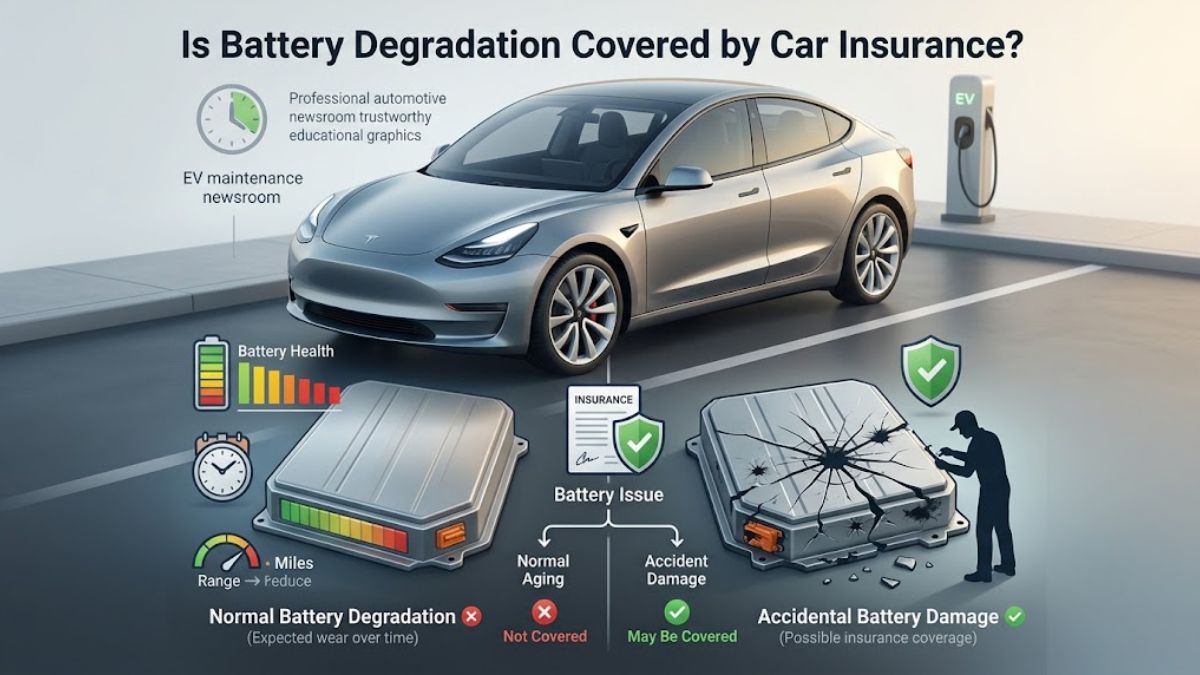

Electric vehicles (EVs) are becoming increasingly popular because they offer lower fuel costs, fewer emissions, and advanced technology. However, one concern many EV owners have is battery health. Since the battery pack is one of the most expensive components of an electric vehicle, many drivers wonder:
Is battery degradation covered by car insurance?
The short answer is usually no. Standard car insurance policies generally do not cover normal battery degradation caused by aging, usage, and natural loss of capacity over time.
However, insurance may cover certain types of battery damage caused by accidents, fire, theft, flooding, or other covered events.
Understanding the difference between battery degradation and battery damage can help EV owners know what protection they actually have.
What Is Battery Degradation?
Battery degradation refers to the gradual loss of an EV battery’s ability to store and deliver energy over time.
When a battery degrades, the vehicle does not necessarily stop working. Instead, the usable battery capacity decreases, which reduces the driving range.
For example:
- A new EV may have a range of 300 miles.
- After several years, battery degradation may reduce the range to 250 miles.
- The vehicle still operates normally, but it cannot travel as far on a full charge.
This process is similar to how smartphone batteries lose capacity after years of charging cycles.
Why Does EV Battery Degradation Happen?
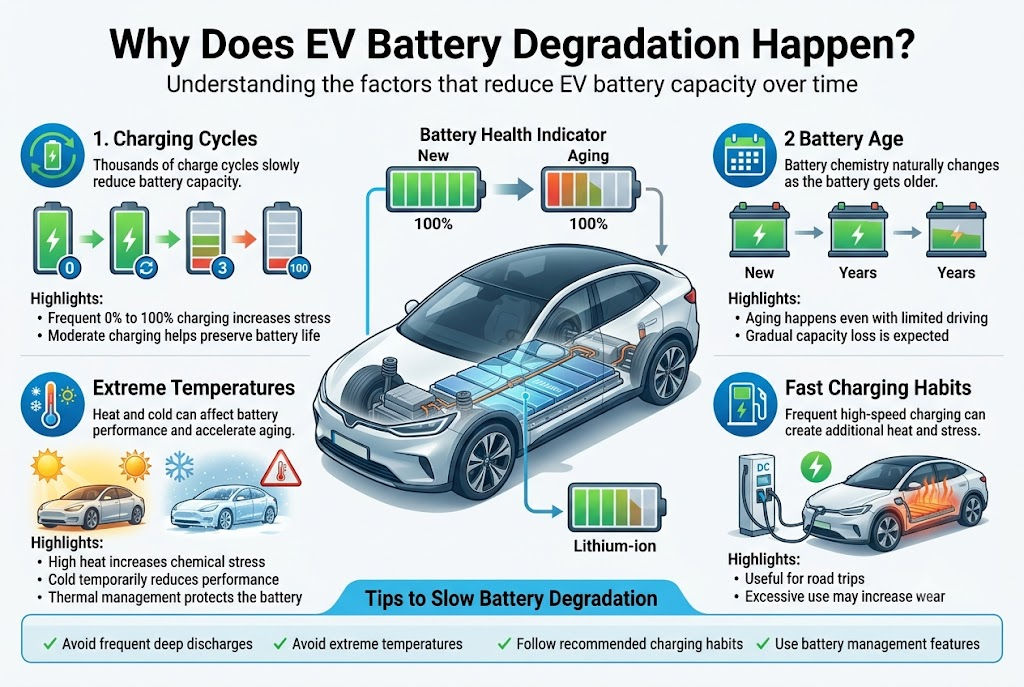
Several factors contribute to battery degradation.
Charging Cycles
Every time an EV battery is charged and discharged, it completes a charging cycle.
Over thousands of cycles, battery cells naturally lose some capacity.
Frequent deep charging and discharging can accelerate battery wear.
Example:
- Regularly draining the battery to 0% and charging to 100% may increase stress.
- Maintaining a moderate charge level can help preserve battery health.
Battery Age
Even if an EV is not driven frequently, the battery can lose capacity over time.
Battery chemistry naturally changes as the vehicle gets older.
Most modern EV batteries are designed to last many years, but gradual capacity loss is expected.
Extreme Temperatures
Temperature has a major impact on lithium-ion batteries.
High heat can accelerate chemical reactions inside battery cells, while extremely cold temperatures can temporarily reduce performance.
Factors that may increase degradation include:
- Parking in extreme heat for long periods
- Frequent exposure to freezing temperatures
- Lack of proper battery temperature management
Fast Charging Habits
DC fast charging is convenient because it can recharge an EV quickly.
However, frequent use of high-speed charging may create additional heat and stress on battery cells.
Occasional fast charging is generally not a problem, but relying on it regularly may contribute to faster battery aging.
Does Car Insurance Cover Normal Battery Degradation?
In most cases, car insurance does not cover normal battery degradation.
Insurance is designed to protect against unexpected events and sudden damage, not regular wear and tear.
Normal battery degradation is considered:
- Expected aging
- Mechanical wear
- Loss of performance over time
- Maintenance-related expense
Similar examples include:
- Worn brake pads
- Aging tires
- Faded paint
- Reduced engine performance due to normal use
Insurance companies generally do not pay for these types of expenses.
Why Insurance Companies Usually Exclude Battery Degradation
Insurance companies calculate premiums based on unpredictable risks.
For example:
Covered risks may include:
- Collision damage
- Theft
- Fire
- Storm damage
- Flood damage
Battery degradation is different because it happens gradually and predictably.
Every EV battery loses some capacity over time, so insurers generally treat it as ownership maintenance rather than an insurable loss.
Battery Degradation vs Battery Damage: Important Difference
Many EV owners confuse battery degradation with battery damage.
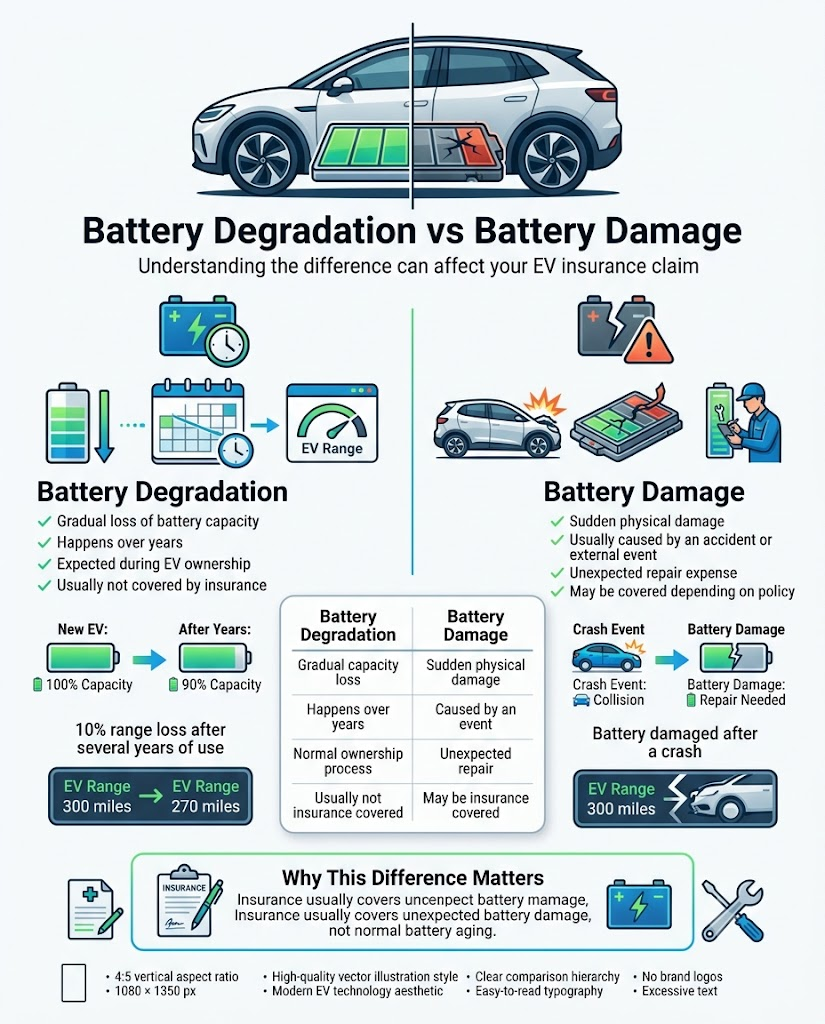
They are not the same.
| Battery Degradation | Battery Damage |
|---|---|
| Gradual loss of capacity | Sudden physical damage |
| Happens over years | Usually caused by an event |
| Expected during ownership | Unexpected repair expense |
| Usually not covered by insurance | May be covered depending on policy |
| Example: losing 10% range after years | Example: battery damaged in a crash |
Understanding this difference is important when filing an insurance claim.
When Can Car Insurance Cover EV Battery Damage?
Although normal degradation is not covered, insurance may pay for battery repairs or replacement if the damage results from a covered event.
Common situations include:
Accident Damage
If an accident damages the battery pack, comprehensive or collision coverage may help pay for repairs.
Examples:
- A crash damages the battery housing.
- A collision impacts the underside of the vehicle.
- The battery pack is damaged after a severe accident.
Coverage depends on:
- Policy terms
- Deductible amount
- Damage assessment
- State insurance requirements
Fire Damage
If an EV battery is damaged because of a covered vehicle fire, insurance may cover the loss.
Examples:
- Battery fire after an accident
- Electrical fire
- Covered fire incident
However, insurers may investigate the cause of the fire before approving a claim.
Flood or Water Damage
Water damage can seriously affect EV battery systems.
If flooding damages the battery pack, comprehensive insurance may provide coverage.
Examples:
- Vehicle submerged during a flood
- Storm-related water damage
- Rising water damages battery components
Theft or Vandalism
If someone damages the battery system during theft or vandalism, insurance may cover repairs.
Examples:
- Battery components damaged during attempted theft
- Vehicle vandalized
- Charging system damaged intentionally
Falling Objects or Natural Disasters
Comprehensive coverage may also protect against certain external events.
Examples:
- Tree falling on the vehicle
- Hail damage
- Storm debris damaging the battery area
Battery Warranty vs Car Insurance: What Covers What?
Many EV owners assume that because the battery is expensive, their car insurance will cover any battery-related issue. However, battery warranty coverage and car insurance serve different purposes.
A battery warranty protects against problems related to:
- Manufacturing defects
- Premature battery failure
- Excessive loss of battery capacity within warranty limits
Car insurance protects against:
- Accidents
- Theft
- Fire
- Flooding
- Collision damage
- Other unexpected events
The two types of protection work differently.
| Coverage Type | Battery Warranty | Car Insurance |
|---|---|---|
| Normal battery aging | Usually not covered | Not covered |
| Manufacturing defect | Covered | Not covered |
| Sudden battery failure | May be covered | Usually not covered unless caused by an insured event |
| Accident damage | Usually not covered | May be covered |
| Fire damage | Depends on warranty terms | May be covered |
| Flood damage | Usually not covered | May be covered with comprehensive coverage |
| Reduced driving range over years | Limited coverage | Not covered |
Does EV Battery Warranty Cover Battery Degradation?
While car insurance generally does not cover battery degradation, many EV manufacturers provide battery warranties that protect against excessive capacity loss.
Most EV manufacturers offer battery warranties that include:
- A specific number of years
- A mileage limit
- Minimum battery capacity requirements
For example, many EV battery warranties guarantee that the battery will maintain a certain percentage of its original capacity during the warranty period.
If the battery falls below the manufacturer’s guaranteed capacity level, the manufacturer may repair or replace affected battery components.
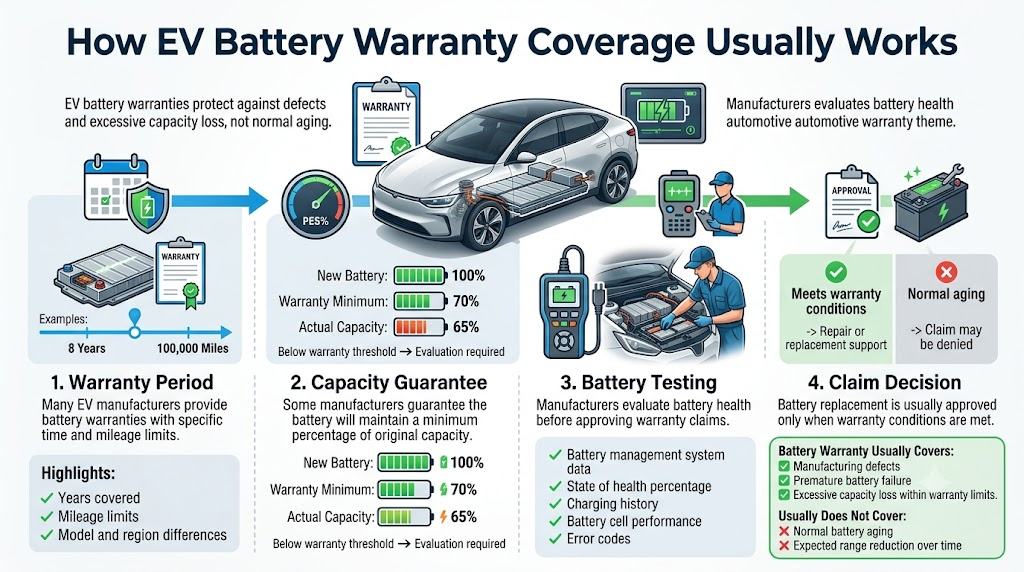
How EV Battery Warranty Coverage Usually Works
Battery warranty terms vary by manufacturer, but common requirements include:
Warranty Period
Many EV manufacturers provide battery warranties lasting around:
- 8 years
- 100,000 miles
Some manufacturers offer longer coverage depending on the vehicle model or region.
Minimum Battery Capacity Guarantee
Some manufacturers guarantee that the battery will retain a minimum percentage of its original capacity.
For example:
- Original battery capacity: 100%
- Warranty guarantee: 70%
- Actual capacity after several years: 65%
The manufacturer may evaluate the battery and provide warranty assistance if it qualifies.
Battery Diagnostic Testing
Before approving a warranty claim, manufacturers typically perform battery health testing.
They may check:
- Battery management system data
- State of health percentage
- Charging history
- Individual battery cell performance
- Error codes
A battery replacement is usually approved only if the battery fails to meet warranty conditions.
Does Tesla Insurance Cover Battery Degradation?
Owners of Tesla vehicles often ask whether Tesla insurance covers battery degradation.
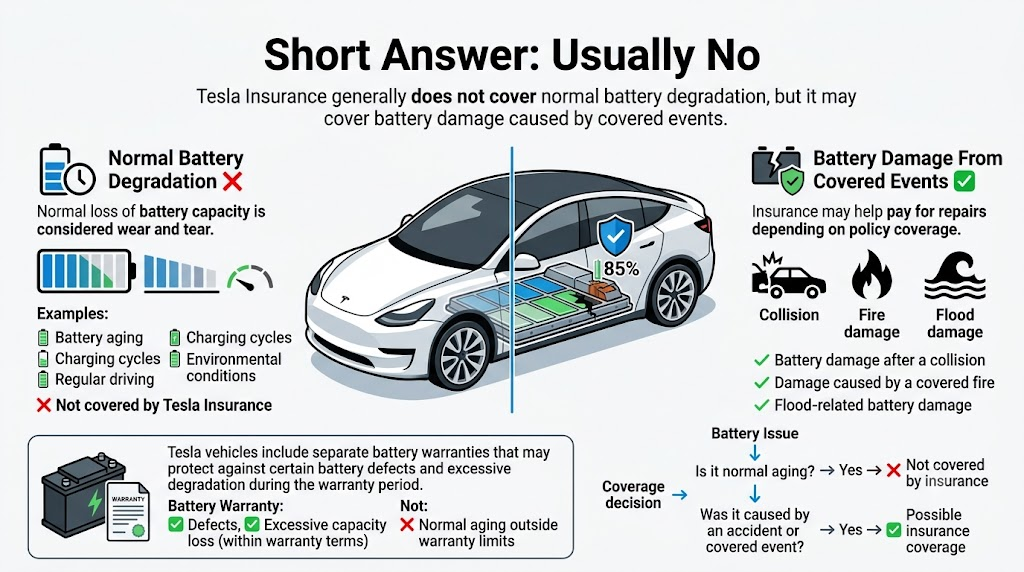
The answer is generally no.
Normal battery capacity loss due to:
- Age
- Charging cycles
- Regular driving
- Environmental conditions
is considered normal wear and is not covered by Tesla insurance.
However, battery damage caused by covered events may be eligible for repair under an applicable insurance policy.
Examples:
Covered situations may include:
- Battery damage after a collision
- Damage caused by a covered fire
- Flood damage
Tesla vehicles also come with separate battery warranties that protect against certain battery defects and excessive degradation during the warranty period.
Does Rivian Insurance Cover Battery Degradation?
Like most insurers, Rivian insurance generally does not cover normal battery degradation.
The loss of battery capacity over time is considered expected EV ownership behavior.
However, insurance may cover battery damage caused by:
- Accidents
- Theft
- Fire
- Weather-related events
Rivian vehicles also include separate battery warranty coverage from the manufacturer.
Does Hyundai, Kia, Ford, and Other EV Insurance Cover Battery Degradation?
Most EV insurance policies follow the same approach:
Normal battery degradation is not covered.
This applies to EVs from manufacturers such as:
- Hyundai
- Kia
- Ford
- Chevrolet
- Volkswagen
- BMW
- Mercedes-Benz
Insurance companies generally do not pay for reduced battery range caused by normal aging.
However, manufacturer warranties may cover:
- Battery defects
- Premature failure
- Excessive capacity loss within warranty conditions
Can You Buy Additional Insurance for EV Battery Degradation?
Currently, most traditional auto insurance companies do not offer separate coverage specifically for normal battery degradation.
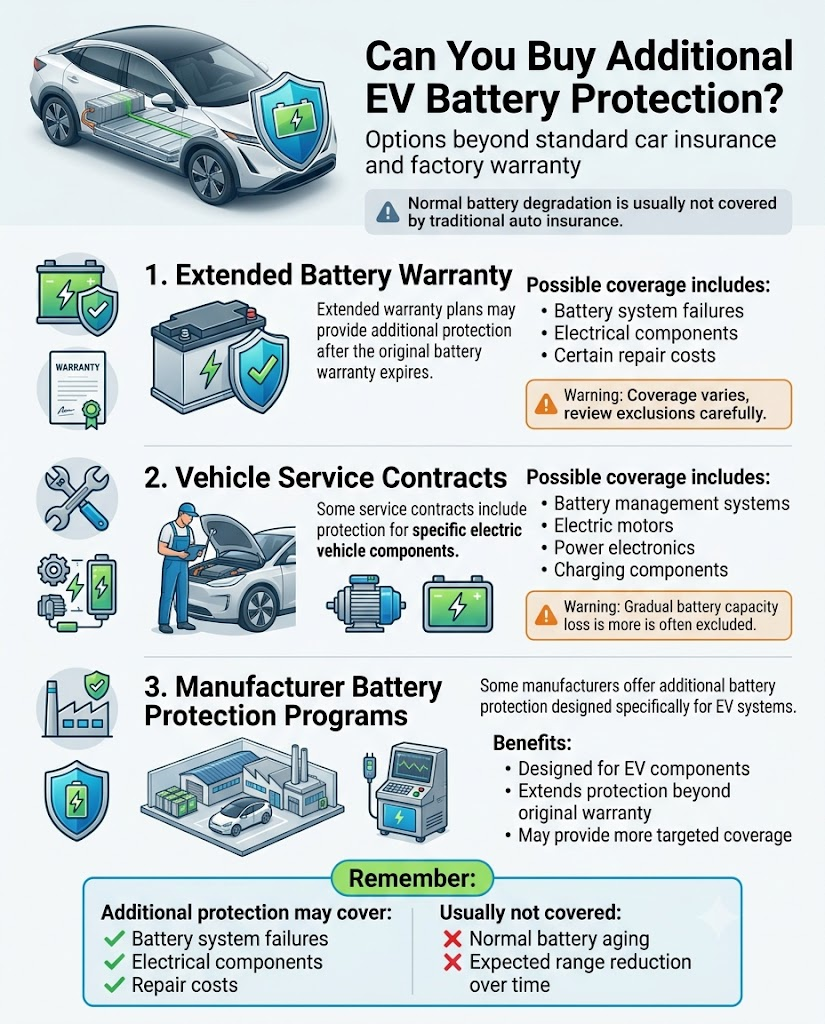
However, EV owners may have other protection options.
Extended Battery Warranty
Some manufacturers and third-party providers offer extended warranty plans.
These plans may cover:
- Battery system failures
- Electrical components
- Certain repair costs
Coverage varies significantly, so owners should carefully review exclusions.
Vehicle Service Contracts
Some EV service contracts may include protection for specific electric components.
Possible covered parts may include:
- Battery management systems
- Electric motors
- Power electronics
- Charging components
However, gradual battery capacity loss is often excluded.
Manufacturer Battery Protection Programs
Some manufacturers provide additional protection programs that extend battery coverage beyond the original warranty.
These may be more suitable than general vehicle service contracts because they are designed specifically for EV components.
How Much Does EV Battery Replacement Cost?
The battery pack is one of the most expensive components in an electric vehicle.
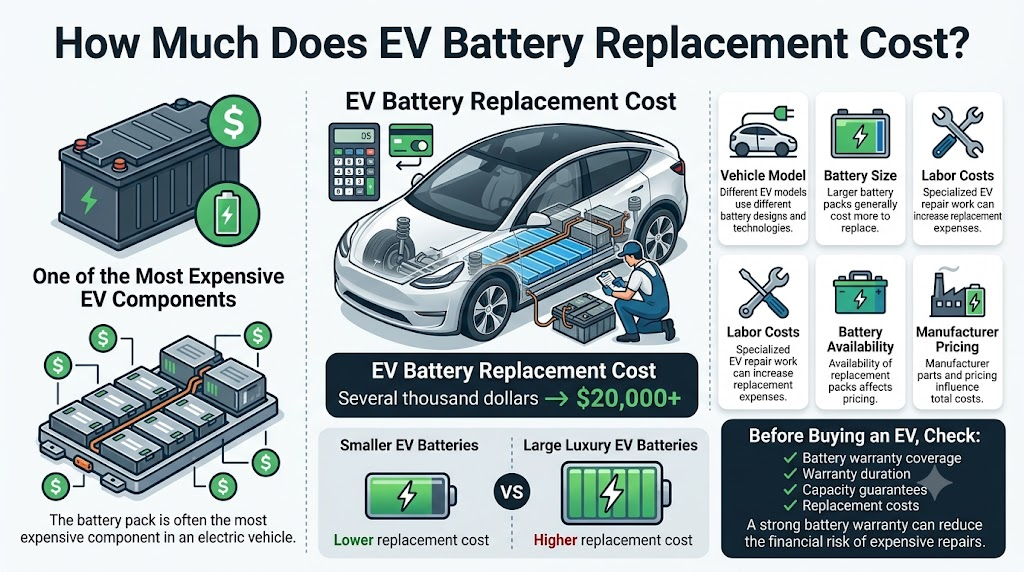
Replacement costs depend on:
- Vehicle model
- Battery size
- Labor costs
- Battery availability
- Manufacturer pricing
Typical EV battery replacement costs can range from several thousand dollars to over $20,000 for some vehicles.
For example:
- Smaller EV battery packs may cost less.
- Large luxury EV battery packs can be significantly more expensive.
Because of these high costs, many EV buyers prioritize understanding battery warranty coverage before purchasing a vehicle.
Does Replacing a Degraded Battery Make Sense?
A battery replacement is not always necessary when degradation occurs.
Many EV batteries continue working effectively even after losing some capacity.
For example:
A vehicle that loses 15% battery capacity may still provide enough range for daily driving.
Owners should consider:
- Current driving needs
- Remaining vehicle value
- Replacement cost
- Availability of refurbished battery packs
Sometimes replacing the vehicle may be financially better than replacing the battery.
Common Mistakes EV Owners Make About Battery Insurance
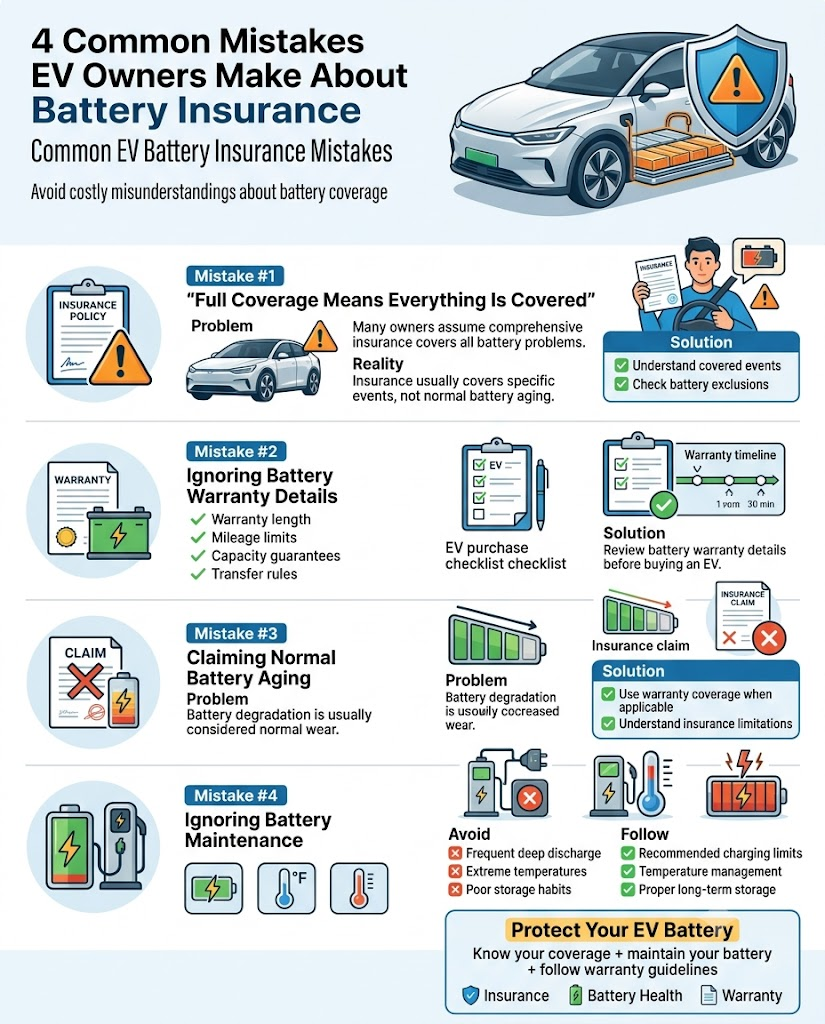
Mistake 1: Assuming Full Coverage Means Everything Is Covered
Many drivers believe comprehensive insurance covers every battery issue.
However, comprehensive coverage usually protects against specific events, not normal battery aging.
Mistake 2: Ignoring Battery Warranty Terms
Before buying an EV, owners should review:
- Battery warranty length
- Mileage limits
- Capacity guarantees
- Warranty transfer rules
Mistake 3: Filing Claims for Normal Degradation
Insurance claims for expected battery aging may be denied because degradation is considered normal wear.
Mistake 4: Not Maintaining Battery Health
Poor charging habits can accelerate battery aging.
Owners should follow manufacturer recommendations for:
- Charging limits
- Temperature management
- Long-term storage
How to Reduce EV Battery Degradation
Although battery degradation is unavoidable, EV owners can take steps to slow down battery aging and maintain better range over time.
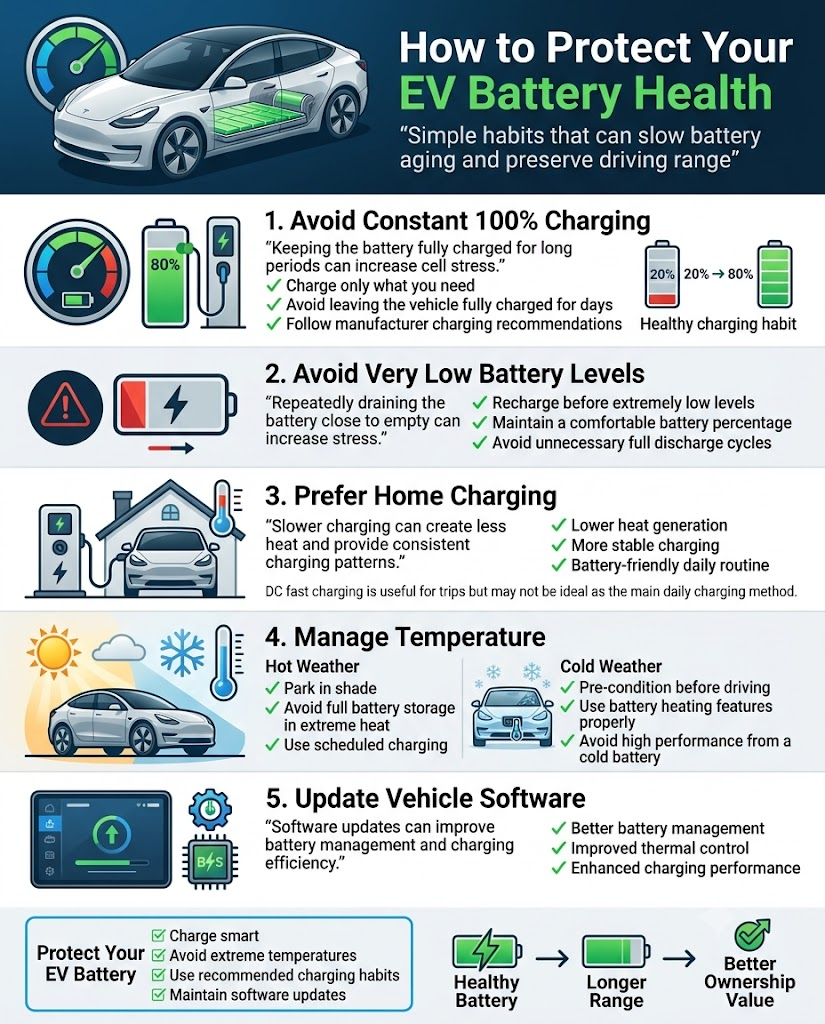
A well-maintained battery can help:
- Preserve driving range
- Improve vehicle resale value
- Reduce long-term ownership costs
- Avoid premature battery issues
Avoid Charging to 100% Regularly
Keeping an EV battery at maximum charge for long periods can increase stress on battery cells.
For daily driving, many manufacturers recommend keeping the battery within a moderate charging range.
Good practices include:
- Charging only as much as needed for daily trips
- Avoiding leaving the vehicle fully charged for several days
- Following manufacturer charging recommendations
A full charge may be useful before long trips, but it may not be necessary for everyday use.
Avoid Frequent Deep Discharges
Allowing the battery to repeatedly drop to very low levels can increase battery stress.
Instead of regularly driving until the battery is nearly empty:
- Recharge before reaching extremely low levels
- Maintain a comfortable battery percentage
- Avoid unnecessary full discharge cycles
Use Home Charging When Possible
Home charging is often considered one of the most battery-friendly charging methods.
Benefits include:
- Slower charging speeds
- Lower heat generation
- More consistent charging patterns
DC fast charging is useful for road trips but may not be ideal as the primary charging method for everyday use.
Protect the Vehicle From Extreme Temperatures
Temperature management plays an important role in battery health.
Helpful practices include:
In Hot Weather
- Park in shaded areas when possible
- Avoid leaving the battery fully charged in extreme heat
- Use scheduled charging features
In Cold Weather
- Pre-condition the vehicle before driving
- Keep the vehicle connected to charging when using battery heating features
- Avoid demanding high performance from a cold battery
Maintain Software Updates
Many modern EVs use software to manage battery performance.
Manufacturers release updates that can improve:
- Battery management systems
- Charging efficiency
- Thermal control
- Overall battery performance
Keeping the vehicle software updated can support long-term battery health.
Does Comprehensive Insurance Cover EV Battery Replacement?
Comprehensive insurance may cover battery replacement only when the damage is caused by a covered event.
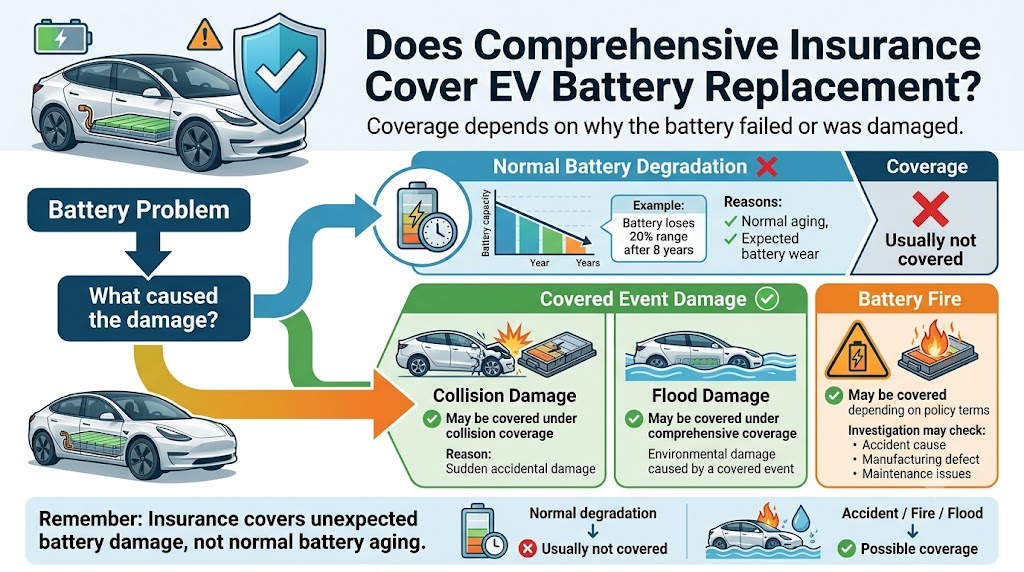
It generally does not pay for battery replacement because the battery has naturally lost capacity.
For example:
Scenario 1: Battery Degradation
An EV loses 20% of its range after eight years.
Insurance coverage: Usually not covered.
Reason:
- Normal aging
- Expected battery wear
Scenario 2: Collision Damage
A vehicle accident damages the battery pack.
Insurance coverage: May be covered under collision coverage.
Reason:
- Sudden accidental damage
Scenario 3: Flood Damage
An EV is damaged after being submerged in flood water.
Insurance coverage: May be covered under comprehensive coverage.
Reason:
- Environmental damage caused by a covered event
Scenario 4: Battery Fire
A battery fire damages the vehicle.
Insurance coverage: May be covered depending on the cause and policy terms.
The insurer may investigate:
- Whether the fire was caused by an accident
- Whether there was a manufacturing defect
- Whether maintenance issues contributed
What Happens If an EV Battery Fails After Warranty?
A major concern for EV owners is battery failure after the warranty expires.
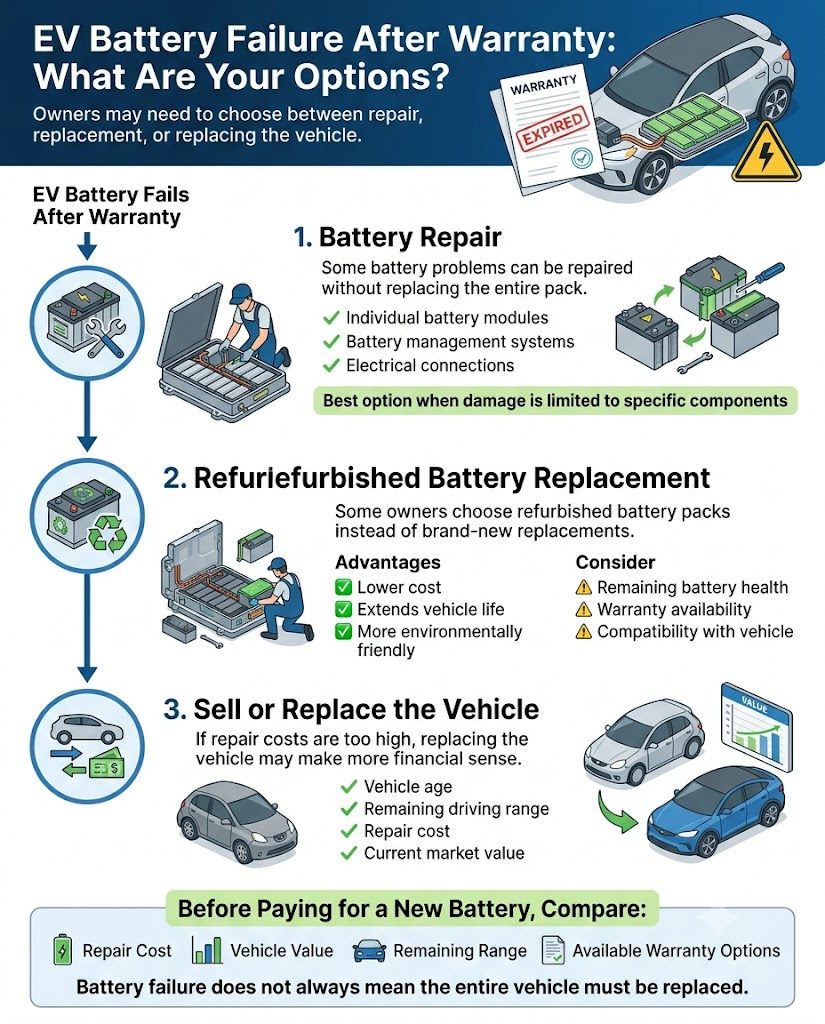
If the battery fails outside warranty coverage, the owner may have to pay repair or replacement costs.
Possible options include:
Battery Repair
Not every battery issue requires complete replacement.
Specialized repair facilities may repair:
- Individual battery modules
- Battery management systems
- Electrical connections
Refurbished Battery Replacement
Some EV owners choose refurbished battery packs instead of brand-new replacements.
Advantages:
- Lower cost
- Extends vehicle life
- More environmentally friendly
Potential concerns:
- Remaining battery health
- Warranty availability
- Compatibility
Selling or Replacing the Vehicle
If battery replacement costs exceed the vehicle’s value, some owners may decide to sell the vehicle or purchase another one.
Factors to consider:
- Vehicle age
- Remaining range
- Repair cost
- Current market value
How Battery Degradation Can Affect EV Resale Value
Battery health is becoming an important factor in the used EV market.
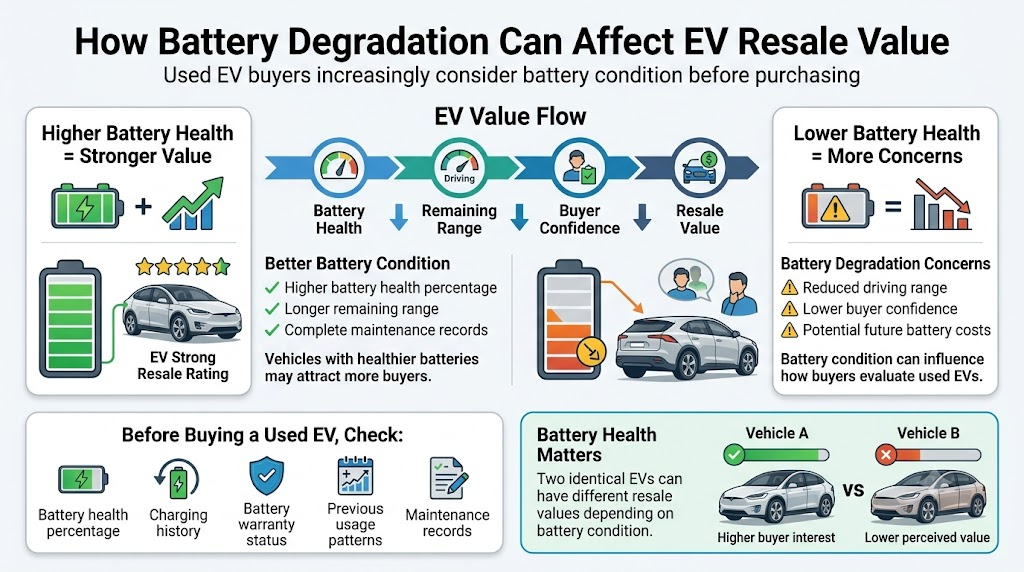
Two identical EVs may have different values depending on battery condition.
A vehicle with:
- Higher battery health
- Longer remaining range
- Complete maintenance records
may attract more buyers.
Before purchasing a used EV, buyers should check:
- Battery health percentage
- Charging history
- Warranty status
- Previous usage patterns
Should EV Owners Buy Additional Battery Protection?
Whether additional protection is worthwhile depends on several factors.
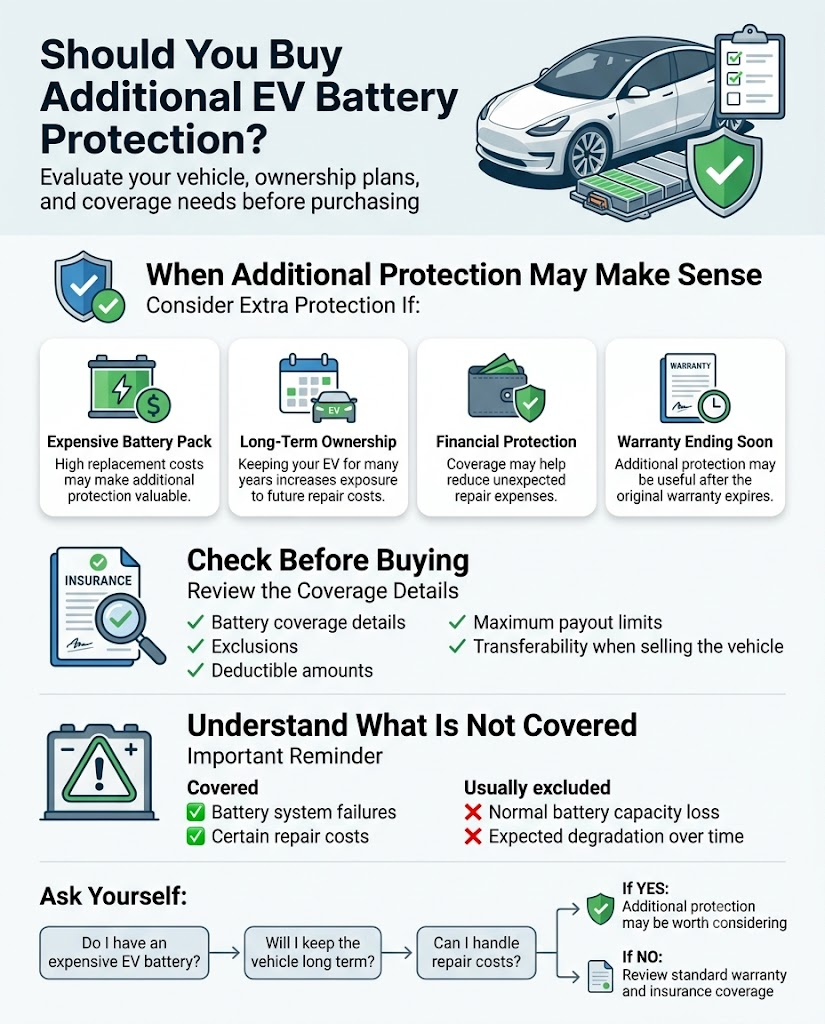
Consider additional coverage if:
- The vehicle has an expensive battery pack
- You plan to keep the EV for many years
- Repair costs would create financial difficulty
- The original battery warranty is ending
Before purchasing an extended warranty or service contract, check:
- Battery coverage details
- Exclusions
- Deductible amounts
- Maximum payout limits
- Transferability when selling the vehicle
Some plans may cover battery system failures but exclude normal capacity loss.
Questions to Ask Before Buying EV Insurance
EV owners should ask insurers:
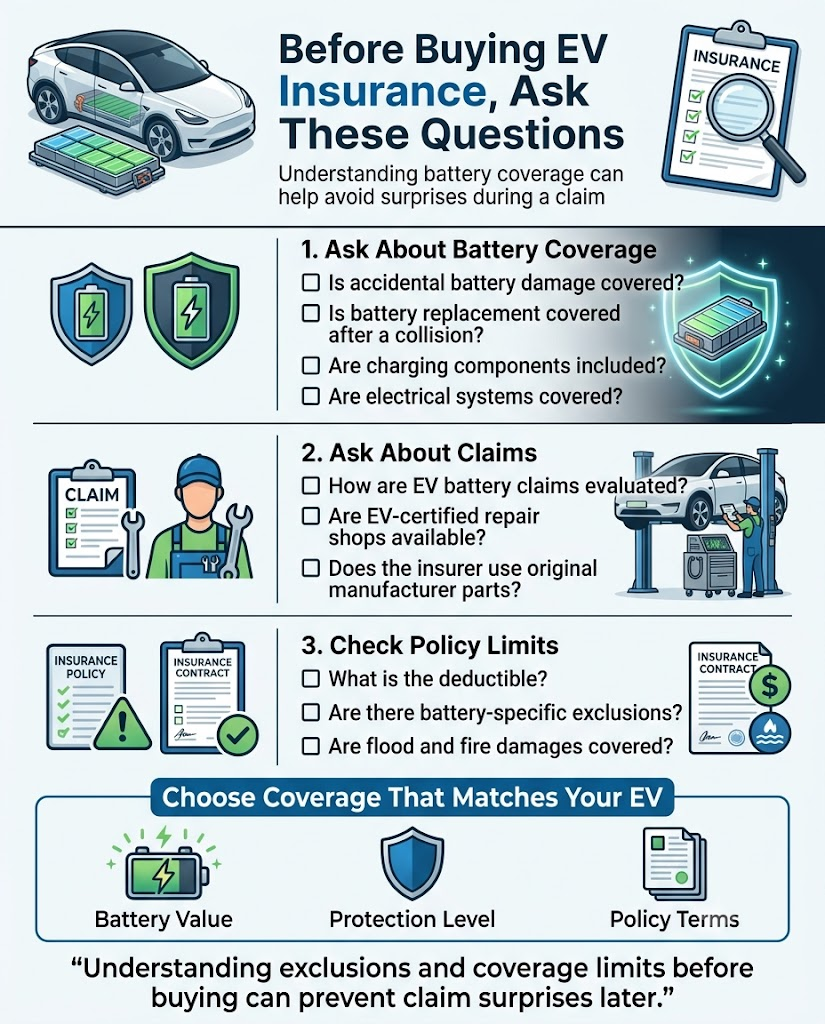
About Battery Coverage
- Is accidental battery damage covered?
- Is battery replacement covered after a collision?
- Are charging components included?
- Are electrical systems covered?
About Claims
- How are EV battery claims evaluated?
- Are EV-certified repair shops available?
- Does the insurer use original manufacturer parts?
About Policy Limits
- What is the deductible?
- Are there battery-specific exclusions?
- Are flood and fire damages covered?
Final Thoughts: Is Battery Degradation Covered by Car Insurance?
Battery degradation is usually not covered by car insurance because it is considered a normal part of EV ownership.
Insurance protects against unexpected events such as:
- Accidents
- Fire
- Flooding
- Theft
- Collision damage
Battery warranties, not auto insurance, are typically responsible for protecting against battery defects and excessive capacity loss during the warranty period.
For EV owners, the best approach is to:
- Understand battery warranty terms
- Choose appropriate insurance coverage
- Practice good charging habits
- Monitor battery health regularly
A properly maintained EV battery can provide reliable performance for many years, while the right insurance policy can protect against expensive unexpected battery damage.