
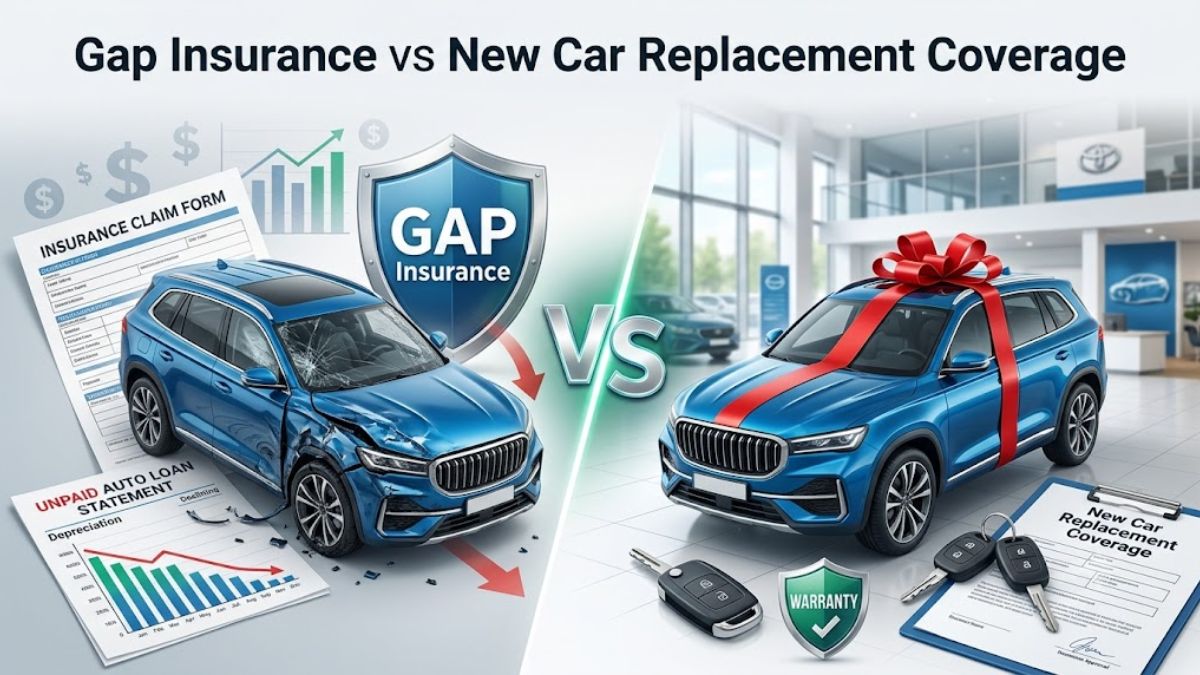

Buying a new vehicle is exciting, but it also comes with financial risks that many drivers overlook. One of the biggest risks occurs when your car is totaled or stolen shortly after purchase. In these situations, your standard auto insurance may not pay enough to cover what you owe on your loan or the cost of replacing your vehicle.
That’s where gap insurance and new car replacement coverage come into play.
Although both coverages provide additional financial protection after a total loss, they work in completely different ways. Gap insurance protects your outstanding loan balance, while new car replacement coverage helps you buy a brand-new vehicle instead of receiving only the depreciated value.
Understanding the difference can save you thousands of dollars and help you choose the right protection based on your financial situation.
In this guide, we’ll compare gap insurance vs new car replacement coverage, explain how each works, discuss costs, eligibility, pros and cons, and help you determine which option is best for your needs.
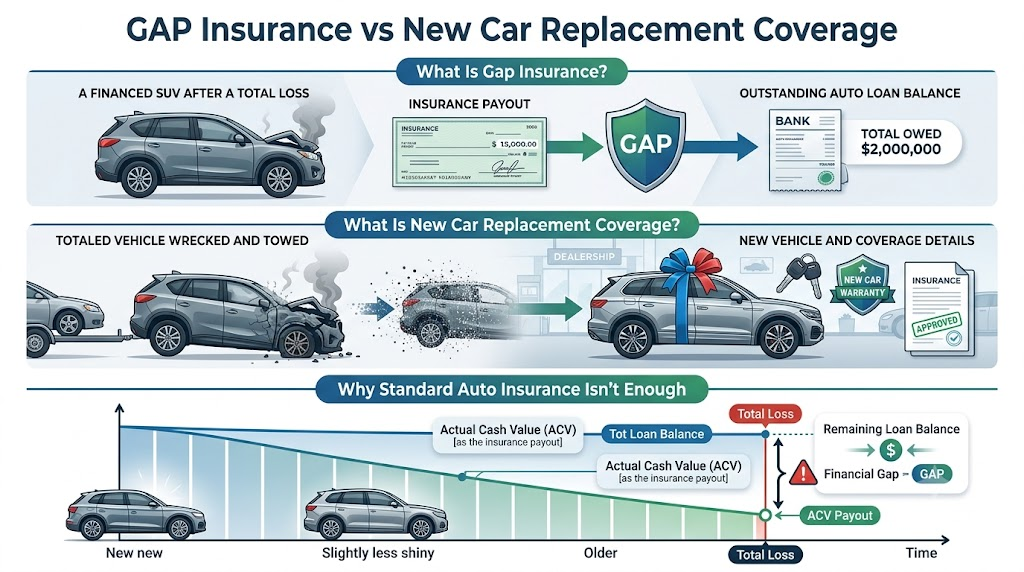
What Is Gap Insurance?
Gap insurance, officially called Guaranteed Asset Protection (GAP) Insurance, pays the difference between:
- Your vehicle’s Actual Cash Value (ACV)
- The remaining balance on your auto loan or lease
If your car is declared a total loss after an accident or theft, your standard collision or comprehensive insurance only pays the vehicle’s current market value, not the amount you still owe your lender.
Because new cars depreciate quickly, many owners owe more than the car is worth during the first few years of ownership.
Gap insurance fills this “gap.”
Example
Purchase price: New SUV: $40,000
Down payment: $2,000
Loan balance after one year: $34,000
Current Actual Cash Value: $28,500
Insurance payout: $28,500
Remaining loan: $34,000
Without gap insurance:
You still owe: $5,500
With gap insurance:
Gap insurer pays the remaining $5,500, so you don’t continue making payments on a car you no longer own.
What Is New Car Replacement Coverage?
New car replacement coverage is an optional insurance endorsement that replaces your totaled vehicle with a brand-new vehicle of the same make and model (or the closest available equivalent) instead of paying only its depreciated market value.
Unlike gap insurance, this coverage focuses on replacing your vehicle—not paying your loan.
Example
Original purchase price: $35,000
Vehicle value after 18 months: $27,000
Replacement cost of new model: $38,500
Standard insurance pays: $27,000
New car replacement coverage pays enough to purchase a brand-new equivalent vehicle, subject to policy limits.
Instead of receiving $27,000, you may receive nearly $38,500 toward a new replacement.
Why Standard Auto Insurance Isn’t Enough
Most drivers assume full coverage insurance pays for a brand-new replacement after a total loss.
It doesn’t.
Standard auto insurance typically covers only:
- Actual Cash Value (ACV)
- Fair market value
- Depreciated value
Insurance companies calculate ACV using factors such as:
- Age
- Mileage
- Condition
- Wear and tear
- Local market prices
- Previous damage
Since vehicles depreciate rapidly, many owners receive significantly less than the original purchase price.
For example:
| Time After Purchase | Average Vehicle Depreciation |
|---|---|
| Drive off dealership | 8%–12% |
| End of first year | 18%–25% |
| After 3 years | 35%–45% |
| After 5 years | 50%–60% |
This depreciation creates two possible financial problems:
- You owe more than insurance pays.
- You can’t afford to buy another equivalent new vehicle.
Gap insurance solves the first problem.
New car replacement coverage solves the second.
Gap Insurance vs New Car Replacement Coverage: Quick Comparison
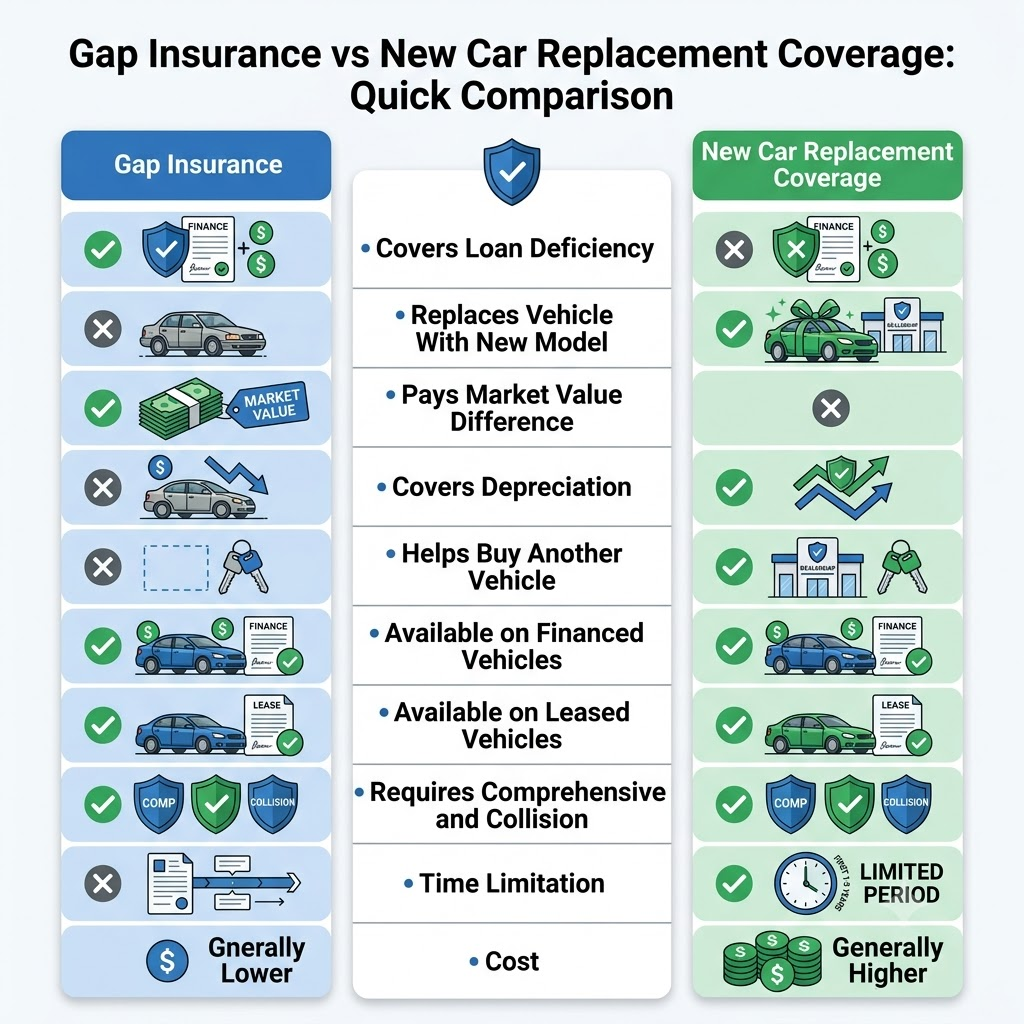
| Feature | Gap Insurance | New Car Replacement Coverage |
|---|---|---|
| Covers loan deficiency | ✅ Yes | ❌ No |
| Replaces vehicle with new model | ❌ No | ✅ Yes |
| Pays market value difference | ✅ Yes | Indirectly |
| Covers depreciation | Only loan gap | Yes |
| Helps buy another vehicle | Only if loan paid off | Yes |
| Available on financed vehicles | Yes | Yes |
| Available on leased vehicles | Yes | Rarely |
| Requires comprehensive and collision | Usually | Yes |
| Time limitation | Loan duration | Usually first 1–3 years |
| Cost | Lower | Higher |
How Gap Insurance Works Step by Step
Understanding the claims process makes it easier to see why gap insurance can be valuable.
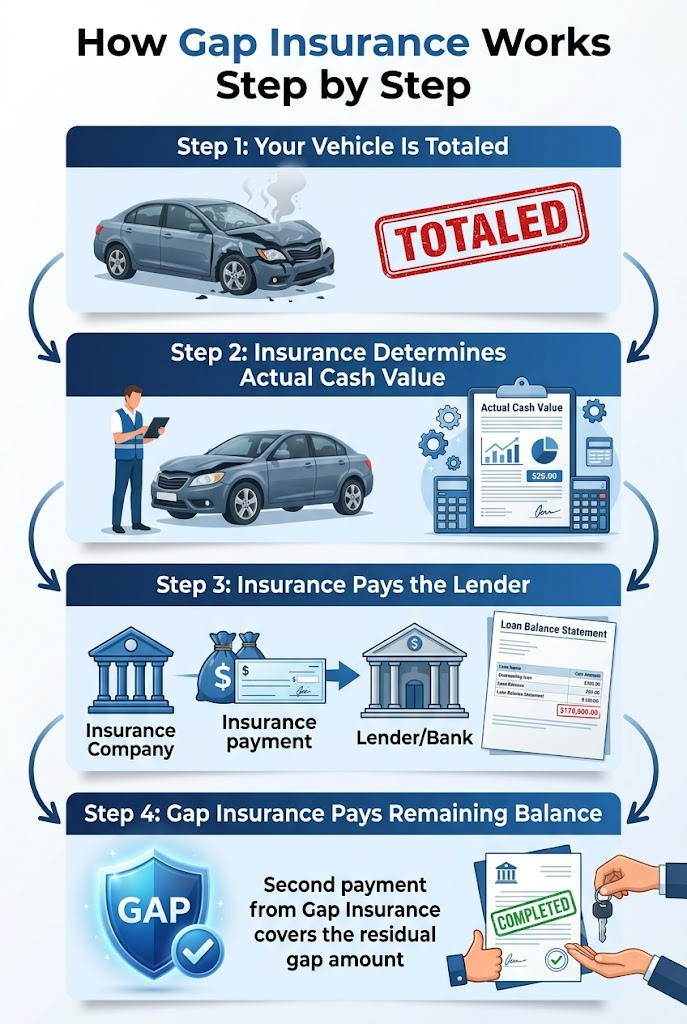
Step 1: Your Vehicle Is Totaled
A serious collision, flood, fire, or theft results in your insurance company declaring the vehicle a total loss.
Step 2: Insurance Determines Actual Cash Value
The insurer evaluates the vehicle and determines its depreciated market value.
Example:
Vehicle value: $26,000
Step 3: Insurance Pays the Lender
Suppose your loan balance is: $31,500
Insurance pays: $26,000
Outstanding balance: $5,500
Step 4: Gap Insurance Pays Remaining Balance
Gap insurance covers the unpaid portion of the loan (subject to policy terms and limits), preventing you from paying for a vehicle you no longer own.
How New Car Replacement Coverage Works
The claims process differs significantly.
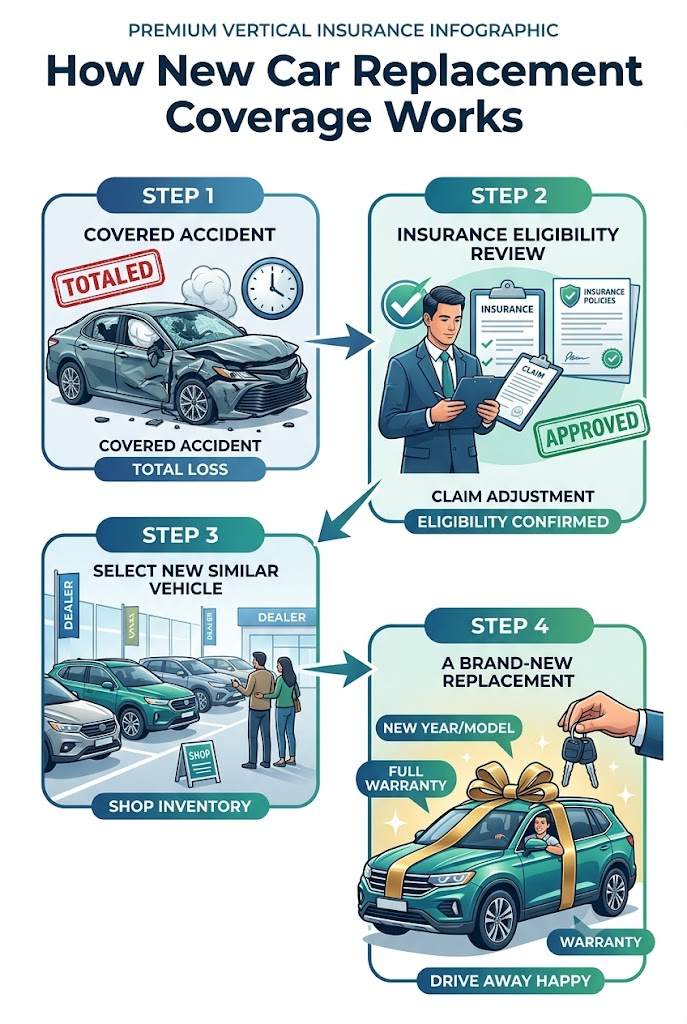
Step 1
Your nearly new vehicle is declared a total loss.
Step 2
Instead of calculating only depreciation, the insurer confirms that your vehicle qualifies for new car replacement coverage.
Step 3
The insurer determines the cost of purchasing a comparable new vehicle.
Step 4
The insurance company pays the amount required under the policy to replace your totaled car with a new equivalent model, rather than limiting the settlement to its depreciated value.
This can significantly reduce the out-of-pocket cost of getting back into a new car.
Key Differences Between Gap Insurance and New Car Replacement Coverage
Although both types of coverage help after a total loss, they protect different financial risks.
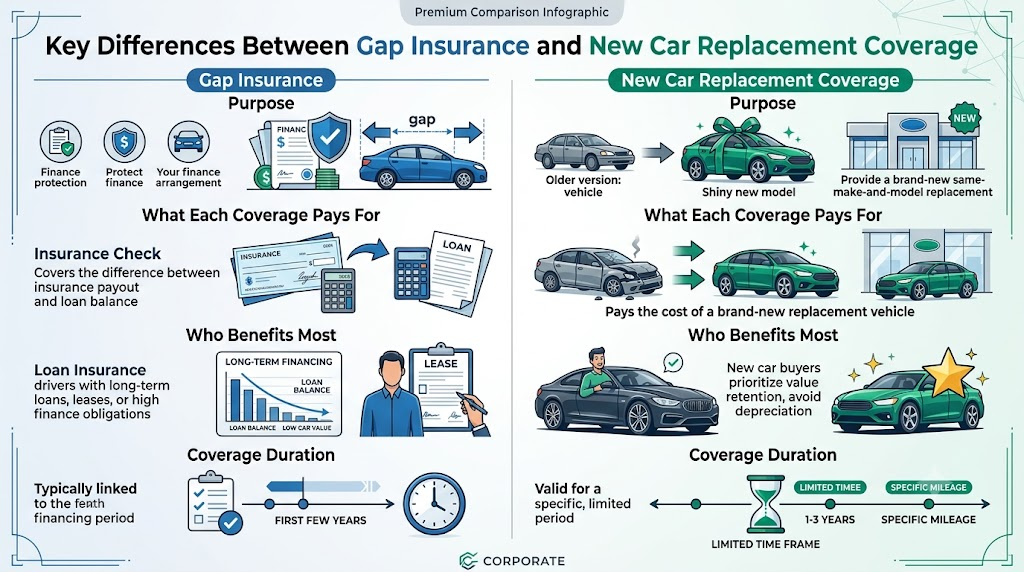
Purpose
Gap insurance is designed to protect your finances if your loan balance is higher than your vehicle’s value. It focuses on debt rather than replacing the car itself.
New car replacement coverage is intended to help you replace your totaled vehicle with a new one, avoiding the impact of rapid depreciation.
What Each Coverage Pays For
Gap insurance pays the difference between the insurance settlement and your remaining loan or lease balance.
New car replacement coverage pays toward the cost of a brand-new replacement vehicle, according to the terms of your policy.
Who Benefits Most
Gap insurance is especially useful for drivers who:
- Financed with a small or no down payment
- Chose a long-term loan
- Have high-interest financing
- Lease their vehicle
New car replacement coverage is often a better fit for drivers who:
- Bought a brand-new car
- Want to replace it with another new vehicle after a total loss
- Plan to keep the vehicle for several years
Coverage Duration
Gap insurance typically lasts until the loan balance no longer exceeds the vehicle’s value or until the loan is paid off.
New car replacement coverage is usually available only for a limited period after purchase, often the first one to three years, depending on the insurer.
Can You Have Both Coverages?
Yes. Many drivers choose to carry both gap insurance and new car replacement coverage because they address different financial risks.
For example, if your new vehicle is totaled:
- New car replacement coverage may help you obtain a brand-new replacement vehicle.
- Gap insurance may help pay any remaining loan balance if there is still a shortfall after the settlement.
Whether both apply in the same claim depends on the insurer’s policy language, settlement method, and loan balance.
Who Should Buy Gap Insurance?
Gap insurance is most valuable for drivers who are likely to owe more on their auto loan than the vehicle is worth during the early years of ownership.
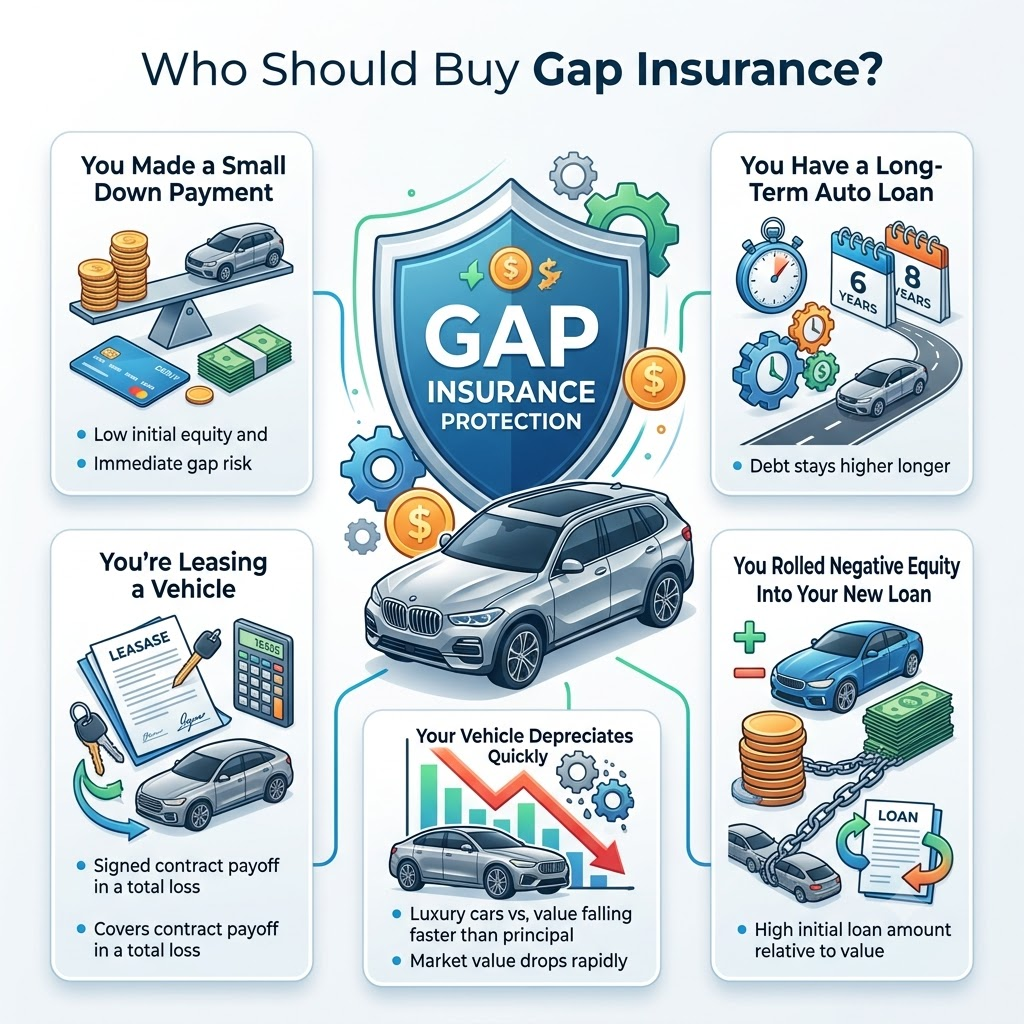
You should strongly consider gap insurance if any of the following apply:
You Made a Small Down Payment
If you put down less than 20% when purchasing your vehicle, there’s a higher chance your loan balance will exceed the car’s value after depreciation.
For example:
- Vehicle price: $45,000
- Down payment: $2,000
- Loan amount: $43,000
A major accident within the first year could leave you owing thousands of dollars after your insurer pays only the vehicle’s actual cash value.
You Have a Long-Term Auto Loan
Loans lasting 72, 84, or even 96 months reduce monthly payments but slow down the rate at which your loan balance decreases.
Meanwhile, the vehicle continues to depreciate quickly.
Gap insurance helps protect against this imbalance.
You’re Leasing a Vehicle
Many leasing companies require gap insurance because leased vehicles often have high remaining balances if they’re totaled.
Some lease agreements include gap coverage automatically, while others require you to purchase it separately.
Always review your lease contract to avoid paying for duplicate coverage.
Your Vehicle Depreciates Quickly
Certain vehicles lose value faster than others, including:
- Luxury vehicles
- Electric vehicles in some markets
- Vehicles with poor resale value
- High-end SUVs
- Premium sedans
Rapid depreciation increases the likelihood of having negative equity.
You Rolled Negative Equity Into Your New Loan
If you traded in a vehicle with an unpaid loan balance and added that debt to your new loan, you’re more likely to owe significantly more than your new vehicle is worth.
Gap insurance can help protect you in this situation.
Who Should Buy New Car Replacement Coverage?
New car replacement coverage is best for drivers who want to replace their totaled vehicle with a brand-new one instead of accepting a payout based on depreciation.
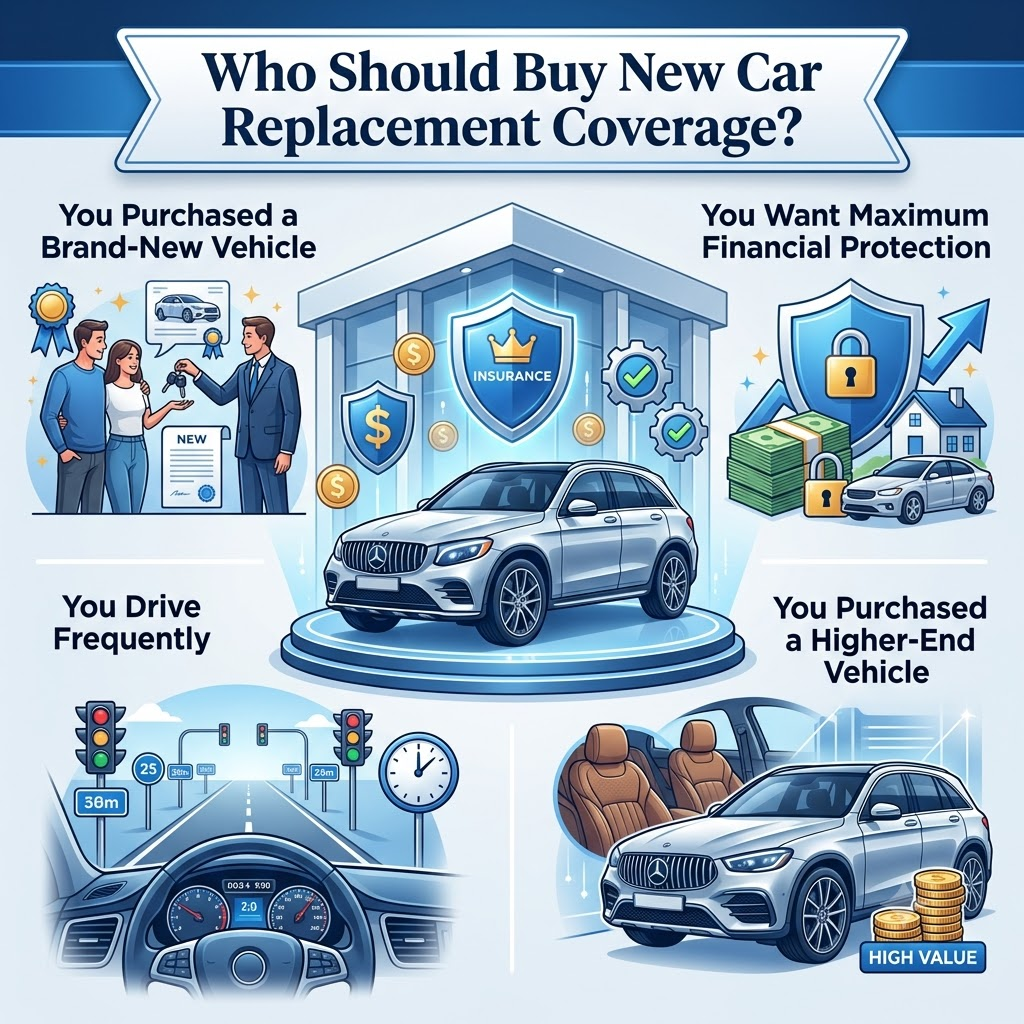
It’s particularly beneficial for buyers who expect to keep their vehicle for several years and want stronger protection during the period of highest depreciation.
You Purchased a Brand-New Vehicle
This coverage is generally available only for new vehicles, often within the first one to three model years.
If your new car is totaled shortly after purchase, replacing it can cost significantly more than its depreciated value.
You Want Maximum Financial Protection
Some drivers aren’t concerned about loan balances—they simply want another brand-new vehicle without paying thousands of dollars out of pocket.
New car replacement coverage helps bridge the gap between a standard insurance payout and the cost of buying a comparable new vehicle.
You Drive Frequently
Drivers with long commutes or frequent travel have a higher exposure to accidents.
The more time you spend on the road, the greater the likelihood of experiencing a total-loss event during the period when your vehicle is still relatively new.
You Purchased a Higher-End Vehicle
Luxury cars, premium SUVs, and trucks often experience substantial depreciation while replacement costs continue to rise.
New car replacement coverage can reduce the financial impact of replacing these vehicles.
Cost Comparison: Gap Insurance vs New Car Replacement Coverage
Although both coverages are relatively affordable compared to the protection they provide, their costs differ.
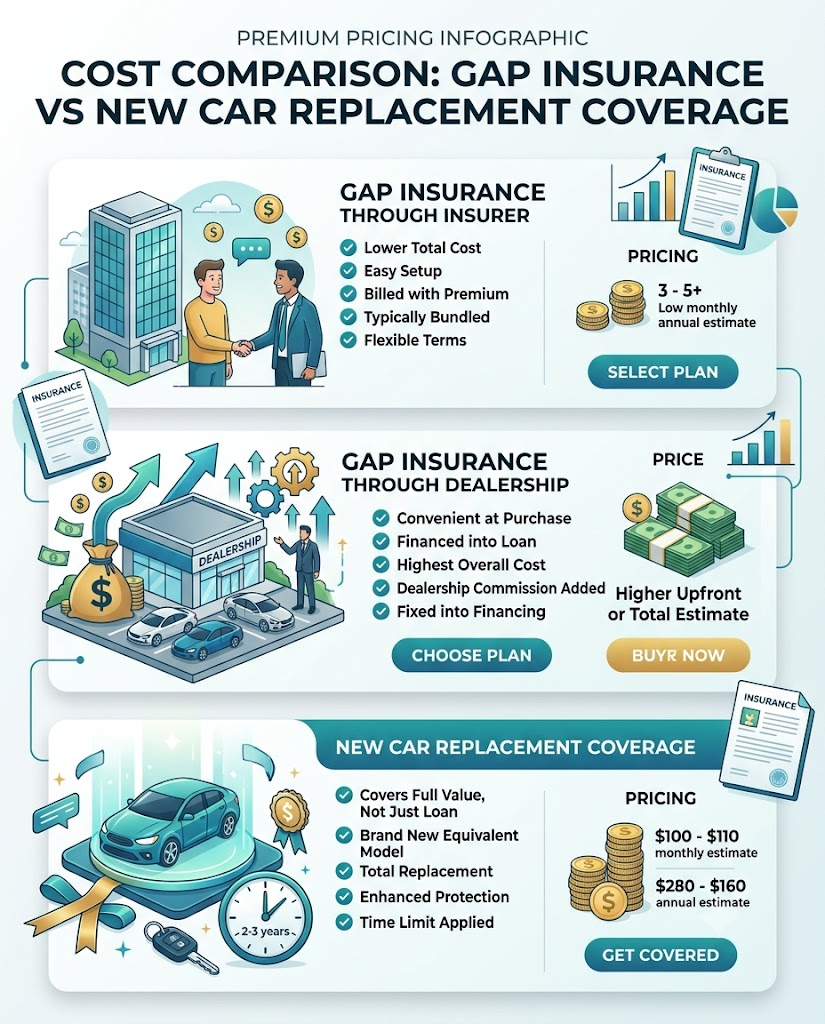
| Coverage Type | Typical Annual Cost |
|---|---|
| Gap insurance through insurer | $20–$60 |
| Gap insurance through dealership | One-time fee of $400–$900 (sometimes more) |
| New car replacement coverage | Approximately $40–$120 added to the annual premium |
Actual pricing varies based on:
- Insurance company
- Vehicle value
- Vehicle type
- Driver profile
- State regulations
- Loan amount
- Claims history
Tip: Purchasing gap insurance through your auto insurer is often less expensive than buying it from a dealership, where the cost may be financed into your loan and accrue interest.
Pros and Cons of Gap Insurance
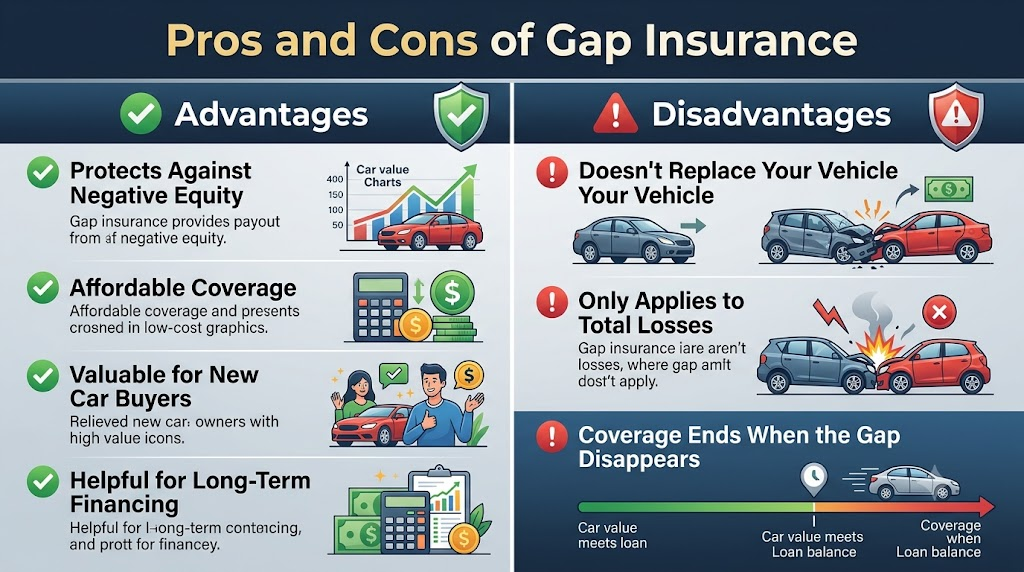
Advantages
Protects Against Negative Equity
The primary benefit is eliminating the financial burden of paying off a loan for a vehicle you no longer own.
Affordable Coverage
Gap insurance is generally one of the least expensive optional auto insurance coverages.
Valuable for New Car Buyers
Because new vehicles depreciate quickly, gap insurance provides meaningful protection during the first few years of ownership.
Helpful for Long-Term Financing
The longer the loan term, the greater the chance of owing more than the vehicle’s value.
Gap insurance reduces that risk.
Disadvantages
Doesn’t Replace Your Vehicle
Gap insurance only pays the loan difference.
It doesn’t help you purchase another vehicle.
Only Applies to Total Losses
Minor accidents and repair costs aren’t covered.
Coverage Ends When the Gap Disappears
Once your loan balance falls below the vehicle’s market value, gap insurance generally provides little or no benefit.
Pros and Cons of New Car Replacement Coverage
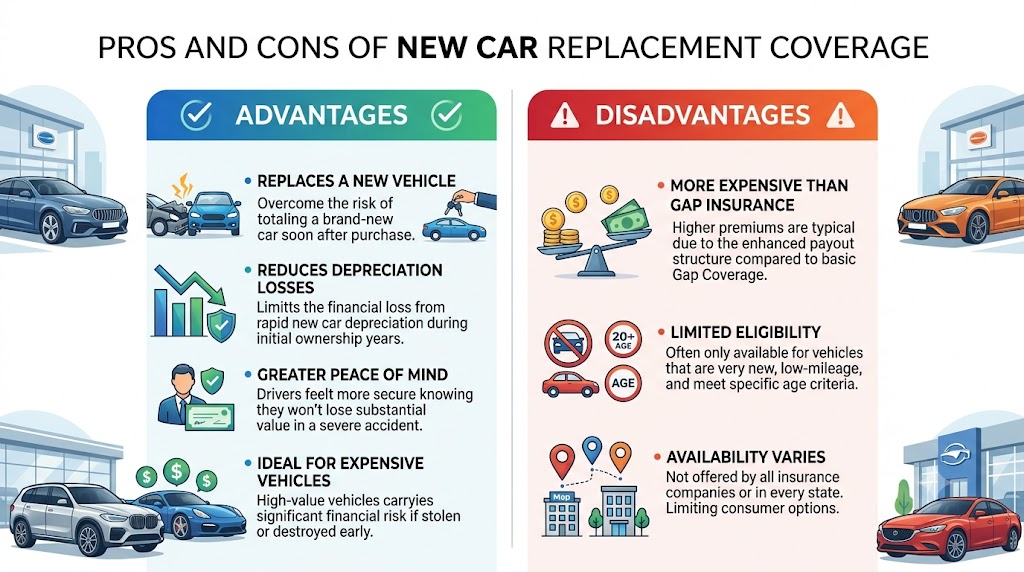
Advantages
Replaces a New Vehicle
Instead of receiving a depreciated payout, you may receive enough to purchase a comparable new vehicle, subject to policy limits.
Reduces Depreciation Losses
The largest financial benefit is avoiding the steep depreciation that occurs during the first few years of ownership.
Greater Peace of Mind
Many drivers appreciate knowing they won’t have to settle for a used replacement after a total loss.
Ideal for Expensive Vehicles
Replacement costs can increase rapidly due to inflation and rising vehicle prices.
This coverage helps offset those increases for eligible claims.
Disadvantages
More Expensive Than Gap Insurance
Although still reasonably priced, it usually costs more than gap insurance.
Limited Eligibility
Most insurers restrict this coverage to:
- Brand-new vehicles
- Original owners
- Vehicles below a certain age
- Vehicles below specified mileage limits
Availability Varies
Not every insurance company offers new car replacement coverage, and eligibility rules differ by insurer.
What Gap Insurance Typically Does Not Cover
Gap insurance is subject to policy exclusions. It generally does not cover:
- Vehicle repairs
- Mechanical breakdowns
- Engine or transmission failures
- Deductibles (unless specifically included)
- Late loan payments
- Loan rollovers beyond policy limits
- Extended warranties
- Negative equity exceeding policy limits
- Rental cars
- Medical expenses
Always review your policy wording to understand the exact exclusions.
What New Car Replacement Coverage Usually Doesn’t Cover
New car replacement coverage also has limitations.
Common exclusions include:
- Used vehicles
- Commercial vehicles
- Classic or antique cars
- Vehicles exceeding age or mileage limits
- Mechanical failures
- Wear and tear
- Routine maintenance
- Partial losses
- Accessories not covered by the policy
If your vehicle can be repaired safely, this coverage generally won’t apply because it’s intended only for total-loss claims.
Can You Buy Gap Insurance After Purchasing a Vehicle?
Yes, in many cases you can.
Many insurers allow you to add gap insurance after buying your vehicle, provided:
- Your vehicle still qualifies under the insurer’s rules.
- You carry collision and comprehensive coverage.
- Your loan balance exceeds the vehicle’s actual cash value.
- The vehicle isn’t too old or beyond the insurer’s eligibility limits.
However, waiting too long may make you ineligible if the loan balance no longer exceeds the vehicle’s value.
Real-World Examples: Gap Insurance vs New Car Replacement Coverage
The easiest way to understand the difference is to see how each type of coverage works in real situations.
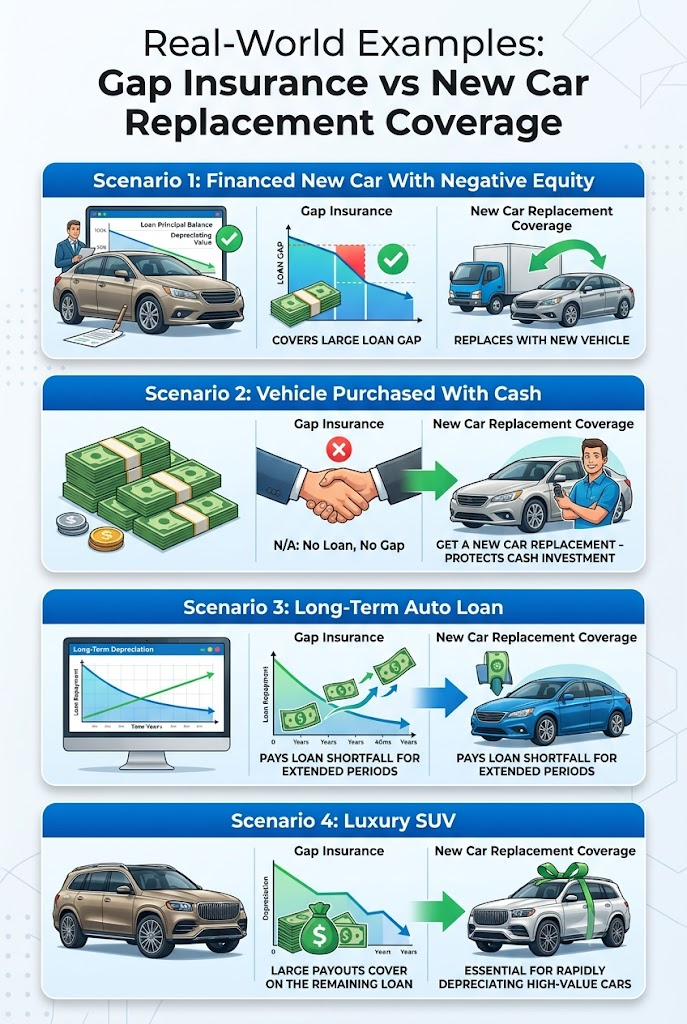
Scenario 1: Financed New Car With Negative Equity
- Vehicle purchase price: $42,000
- Down payment: $2,000
- Loan balance after one year: $36,500
- Actual Cash Value (ACV): $30,000
The vehicle is totaled in an accident.
With Standard Insurance Only
Insurance pays the ACV:
- Insurance settlement: $30,000
- Remaining loan balance: $36,500
The owner must pay the remaining $6,500 out of pocket.
With Gap Insurance
- Standard insurance pays: $30,000
- Gap insurance pays: $6,500
The loan is paid off, but the owner still needs to purchase another vehicle.
With New Car Replacement Coverage
Assume a new equivalent model now costs $44,500.
Instead of receiving only the ACV, the insurer pays according to the policy’s new car replacement terms, allowing the owner to replace the vehicle with a comparable new model.
If a loan balance remains after the settlement, gap insurance may still be beneficial depending on the policy terms.
Scenario 2: Vehicle Purchased With Cash
Sarah buys a new sedan for $36,000 using cash.
Eighteen months later:
- Current market value: $28,000
- Replacement cost of the latest model: $39,000
If the vehicle is totaled:
Gap Insurance
Gap insurance provides no benefit because there is no loan.
New Car Replacement Coverage
The insurer helps cover the cost of a comparable new vehicle (subject to policy terms), potentially saving Sarah thousands compared to receiving only the depreciated value.
Winner: New car replacement coverage.
Scenario 3: Long-Term Auto Loan
David finances a pickup truck over 84 months.
After two years:
- Loan balance: $41,000
- Vehicle value: $33,000
A major accident totals the truck.
Without gap insurance, David owes $8,000 after the insurance settlement.
Gap insurance pays the difference, preventing him from making payments on a vehicle he no longer owns.
Scenario 4: Luxury SUV
A luxury SUV purchased for $80,000 depreciates rapidly.
After one year:
- Current value: $62,000
- Cost of a new equivalent model: $86,000
New car replacement coverage can significantly reduce the financial impact of replacing the SUV by covering the cost of a comparable new model, subject to policy limits.
Can You Have Both Gap Insurance and New Car Replacement Coverage?
Yes.
In fact, many insurance professionals recommend having both if you’re financing a brand-new vehicle and qualify for both coverages.
Together, they address two different financial risks:
- Gap insurance protects you from owing money on your auto loan after a total loss.
- New car replacement coverage helps you replace your totaled vehicle with a new one instead of accepting a depreciated settlement.
Having both may provide more comprehensive financial protection, though exactly how claims are settled depends on your insurer and policy wording.
How to Choose Between Gap Insurance and New Car Replacement Coverage
The right choice depends on your financial situation and the way you purchased your vehicle.
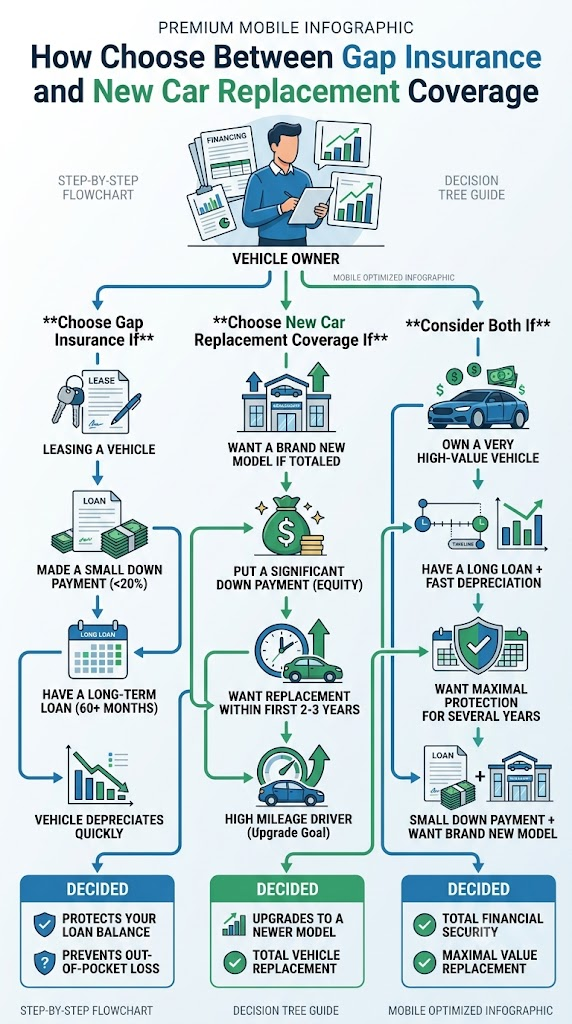
Choose Gap Insurance If
- You financed most of the purchase price.
- Your down payment was less than 20%.
- You have a loan lasting 72 months or longer.
- You rolled negative equity into your new loan.
- You leased your vehicle.
- Your vehicle depreciates quickly.
- Your primary concern is paying off your loan after a total loss.
Choose New Car Replacement Coverage If
- You bought a brand-new vehicle.
- You want another new vehicle after a total loss.
- You can meet the insurer’s eligibility requirements.
- You plan to keep the vehicle for several years.
- Your priority is avoiding depreciation rather than protecting your loan balance.
Consider Both If
Both coverages may be worth considering if:
- Your vehicle is brand new.
- You financed a large portion of the purchase price.
- Your loan term exceeds five years.
- Your vehicle has a high purchase price.
- You want the highest level of financial protection available after a total loss.
Final Verdict
Gap insurance and new car replacement coverage are often confused, but they solve two entirely different financial problems.
Gap insurance protects you from negative equity, ensuring you don’t continue paying for a vehicle that’s been totaled or stolen. It’s especially valuable for drivers with long loan terms, low down payments, or leased vehicles.
New car replacement coverage protects you from rapid depreciation by helping you replace your totaled vehicle with a brand-new equivalent rather than accepting only its depreciated market value.
For many buyers financing a new vehicle, carrying both coverages provides the most complete protection during the years when depreciation is highest and loan balances are still substantial.
Before purchasing either option, compare eligibility requirements, coverage limits, exclusions, and pricing from multiple insurers. A small increase in premium today could save you thousands of dollars if your vehicle is ever declared a total loss.
Key Takeaways
Gap insurance covers the difference between your insurance payout and your remaining loan or lease balance.
New car replacement coverage helps replace your totaled vehicle with a comparable new model instead of paying only its depreciated value.
Standard auto insurance typically pays only the vehicle’s Actual Cash Value (ACV).
Gap insurance is most beneficial for financed or leased vehicles with negative equity.
New car replacement coverage is generally available only for brand-new vehicles and for a limited time after purchase.
Drivers who finance a new car with a small down payment may benefit from carrying both coverages.
Review each insurer’s policy language carefully, as eligibility, limits, and exclusions vary.