
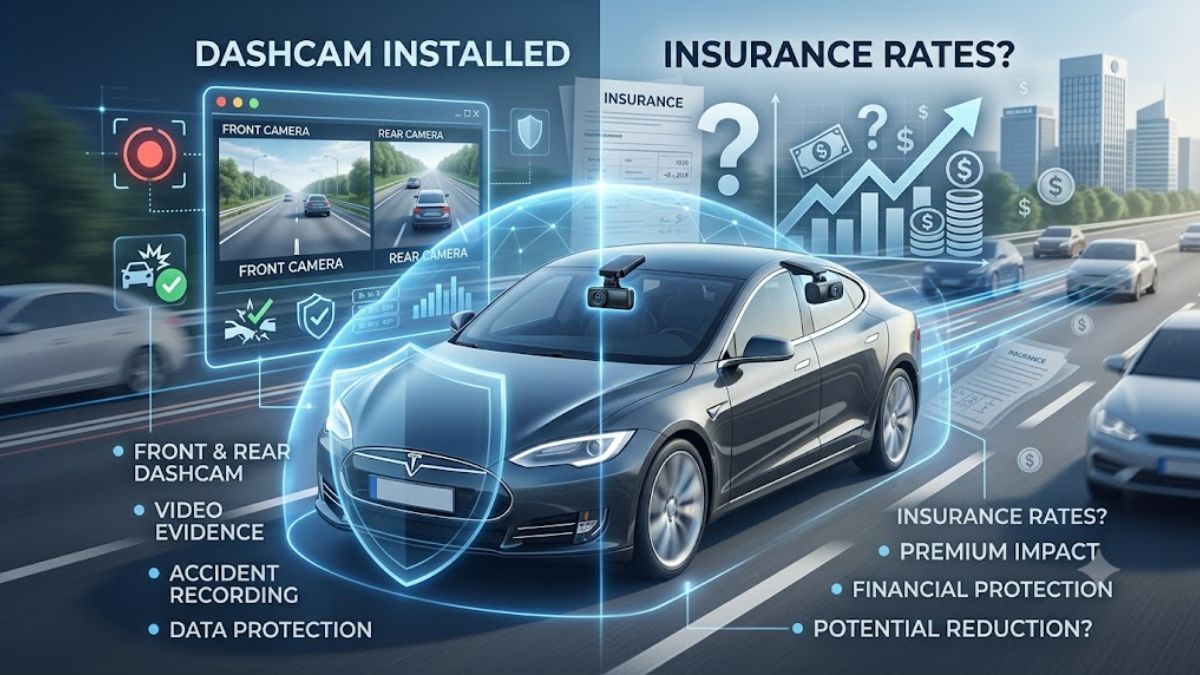

Dashcams have become increasingly popular among drivers who want extra protection on the road. A front and rear dashcam can record everything happening around a vehicle, from accidents and road hazards to insurance disputes and theft attempts.
Many drivers install dashcams hoping they can reduce their insurance costs. Since dashcams provide video evidence after accidents, it seems logical that insurance companies would reward drivers with lower premiums.
But does having a front and rear dashcam actually lower insurance rates?
The answer is usually no, but it can indirectly help you save money.
Most insurance companies do not offer automatic discounts simply because you install a dashcam. However, dashcam footage can make the claims process easier, help prove fault, prevent fraudulent claims, and potentially protect your no-claims discount.
Understanding how dashcams affect insurance can help you decide whether installing one is worth the investment.
Does Having A Front And Rear Dashcam Lower Insurance Rates
No, having a front and rear dashcam usually does not lower insurance rates directly. Most insurance companies do not offer discounts just for installing a dashcam.
However, a dashcam can help you save money indirectly by providing evidence during accidents, preventing false claims, proving you were not at fault, and protecting your no-claim discount. It is mainly a tool for protection rather than an insurance discount.
What Is a Front and Rear Dashcam?
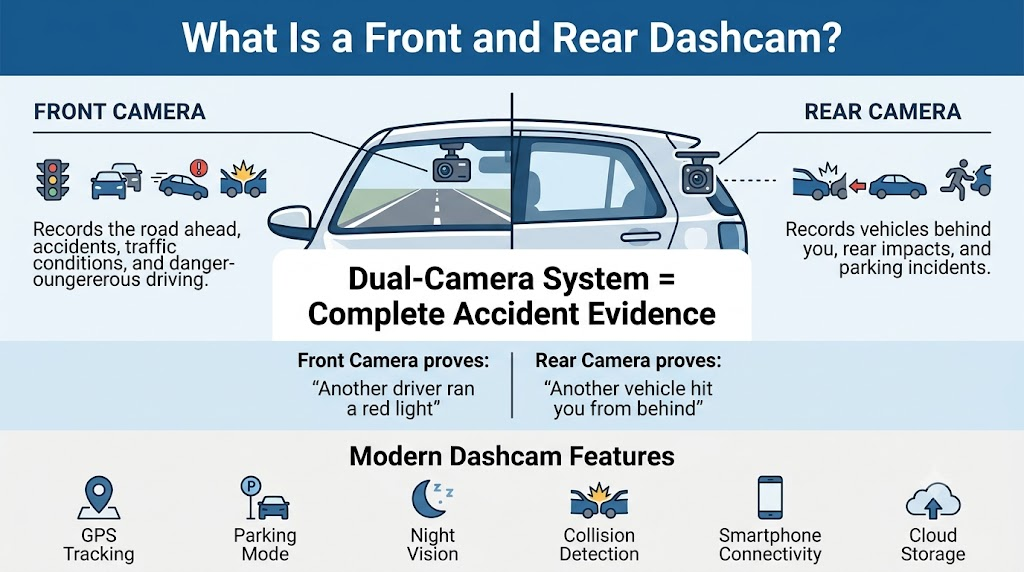
A front and rear dashcam system includes two cameras:
- Front camera: Records the road ahead, including traffic conditions, collisions, sudden braking, and dangerous driving behavior.
- Rear camera: Records what happens behind your vehicle, including rear-end collisions, tailgating, and hit-and-run incidents.
Unlike a single front-facing dashcam, a dual-camera setup provides a more complete view of an accident.
For example:
- A front camera may show that another driver ran a red light.
- A rear camera may prove that another vehicle hit you from behind.
- Both recordings together can provide stronger evidence during an insurance claim.
Modern dashcams may also include features such as:
- GPS tracking
- Parking mode recording
- Night vision
- Collision detection
- Smartphone connectivity
- Cloud storage
These features can make the footage more useful when dealing with insurance claims.
Do Insurance Companies Offer Dashcam Discounts?
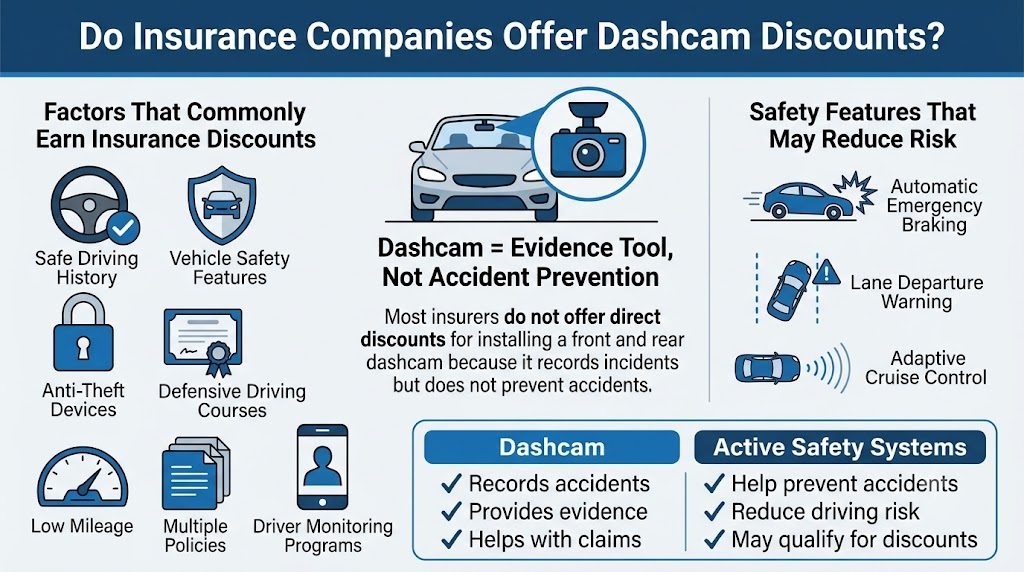
In most cases, insurance companies do not provide a direct discount for having a front and rear dashcam installed.
Insurance discounts are usually based on factors such as:
- Safe driving history
- Vehicle safety features
- Anti-theft devices
- Defensive driving courses
- Low mileage
- Multiple policies
- Driver monitoring programs
A dashcam is considered a recording device rather than an active safety system.
Unlike features such as:
- Automatic emergency braking
- Lane departure warning
- Adaptive cruise control
a dashcam generally does not prevent accidents from happening. It only records events after or during an incident.
Because of this, many insurers do not classify dashcams as a safety feature that qualifies for a premium reduction.
Why a Dashcam May Still Help You Save Money
Even though a dashcam may not directly lower your insurance premium, it can provide financial benefits in other ways.
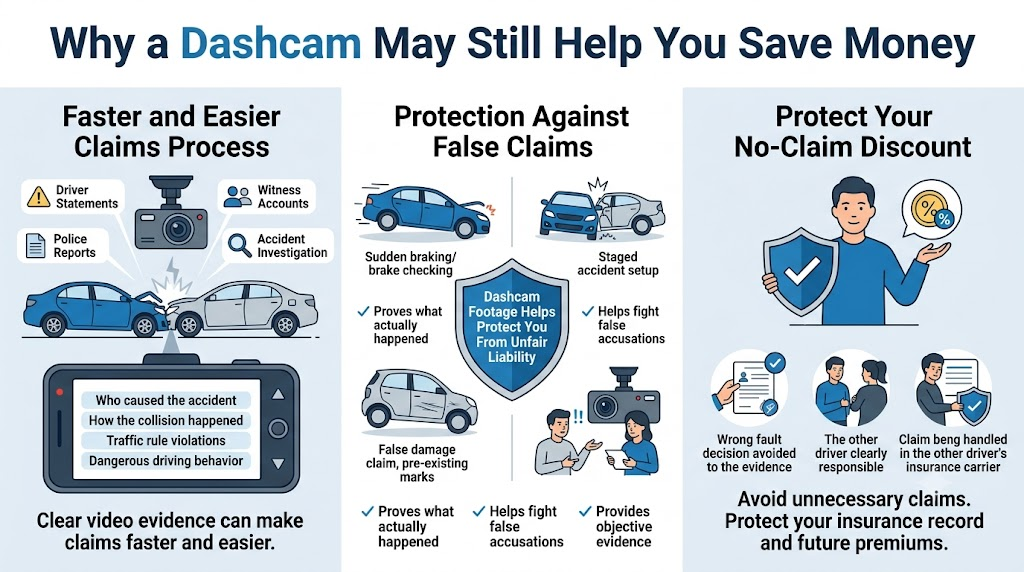
Faster and Easier Claims Process
After an accident, determining who was responsible can become difficult.
Without evidence, insurance companies often rely on:
- Driver statements
- Police reports
- Witness accounts
- Accident investigation
These sources may conflict with each other.
Dashcam footage can provide clear visual evidence showing:
- Who caused the accident
- How the collision happened
- Whether traffic laws were violated
- Whether another driver was behaving dangerously
This can reduce delays and make the claims process smoother.
Protection Against False Claims
Insurance fraud is a major concern for drivers and insurers.
Some drivers intentionally create accidents or make false claims to receive compensation.
Examples include:
- Brake checking another vehicle
- Claiming damage that existed before an accident
- Accusing an innocent driver of causing a collision
- Staged accident scams
A front and rear dashcam can provide evidence that protects you from unfair liability.
If another driver claims you caused an accident, video footage may prove otherwise.
Avoiding an incorrect fault determination can help protect:
- Your insurance record
- Your future premiums
- Your no-claims discount
Protecting Your No-Claim Discount
Many insurance policies reward drivers who avoid making claims through a no-claim discount or safe-driver discount.
If you are wrongly blamed for an accident, your insurer may pay a claim and your future premium could increase.
Dashcam footage may help establish that:
- You were not responsible
- The other driver caused the accident
- A claim should be handled through the other driver’s insurance
This can help prevent unnecessary claims against your policy.
How Insurance Companies View Dashcam Evidence
Although insurance companies usually do not offer a discount for installing a dashcam, many insurers value reliable video evidence during the claims process.
A dashcam recording can help insurers investigate accidents more accurately by showing what actually happened instead of relying only on conflicting statements.
Insurance adjusters may use dashcam footage to determine:
- Which driver was responsible
- Whether traffic laws were violated
- The speed and movement of vehicles
- The severity of the impact
- Whether injuries or damages match the accident details
However, insurers do not automatically accept every dashcam video as complete proof. The footage must be:
- Clear and readable
- Properly recorded
- Time and date stamped
- Relevant to the accident
- Free from signs of editing or manipulation
A high-quality front and rear dashcam can provide stronger evidence compared with a low-resolution camera that does not clearly show license plates, traffic signals, or vehicle movements.
Can Dashcam Footage Reduce Insurance Claim Costs?
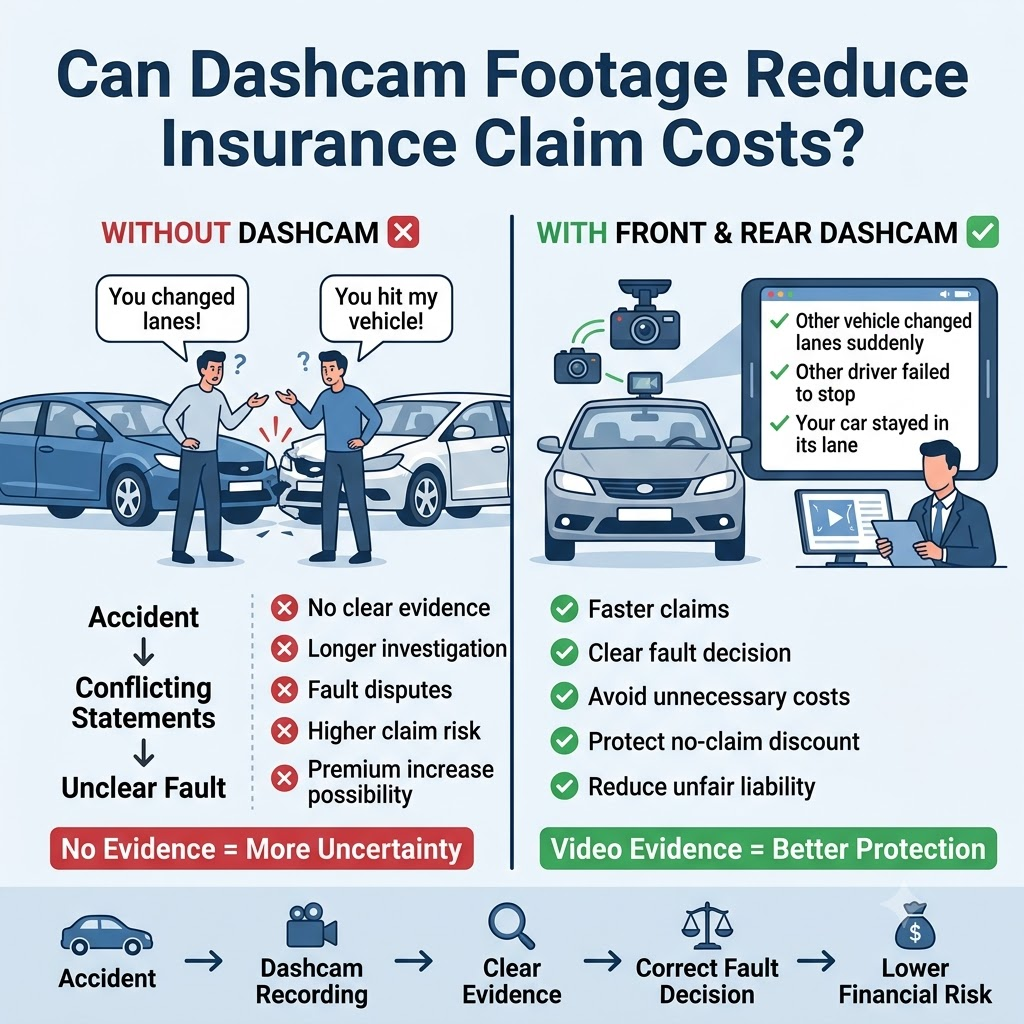
A dashcam does not reduce the cost of repairs or medical expenses directly, but it can reduce unnecessary costs related to disputes and incorrect fault decisions.
For example:
Without Dashcam Evidence
A driver claims you changed lanes and caused a collision.
You claim the other driver hit your vehicle.
Without proof, both insurance companies may investigate the accident for weeks before deciding responsibility.
Possible outcomes:
- Shared fault
- Higher claim costs
- Increased premiums
- Legal disputes
With Front and Rear Dashcam Evidence
Your camera shows:
- The other vehicle suddenly changed lanes
- The other driver failed to stop
- You were driving within your lane
The evidence can help establish that you were not responsible.
This may prevent:
- Paying a deductible unnecessarily
- Losing a no-claim discount
- Having an accident recorded against your policy
Front Dashcam vs Front and Rear Dashcam: Which Helps More?
A front dashcam provides useful protection, but a front and rear dashcam offers more complete coverage.
Front Dashcam Benefits
A front camera can record:
- Head-on collisions
- Vehicles crossing into your lane
- Traffic violations ahead
- Road hazards
- Police interactions
- Hit-and-run incidents from the front
It is often enough for many common accidents.
Front and Rear Dashcam Benefits
A dual-camera system provides additional protection from situations where the front camera cannot help.
Examples include:
Rear-End Accidents
Rear-end collisions are among the most common accidents.
A rear camera can show:
- The other vehicle following too closely
- Failure to brake
- Sudden impact from behind
This can make fault determination easier.
Parking Lot Accidents
Many minor accidents happen while vehicles are parked.
A rear camera with parking mode can capture:
- Vehicles hitting your car while reversing
- Door impacts
- Hit-and-run damage
Aggressive Driving Incidents
A rear camera can document:
- Tailgating
- Road rage behavior
- Unsafe overtaking
This evidence may help explain how an accident occurred.
Situations Where a Front and Rear Dashcam Can Save You Money
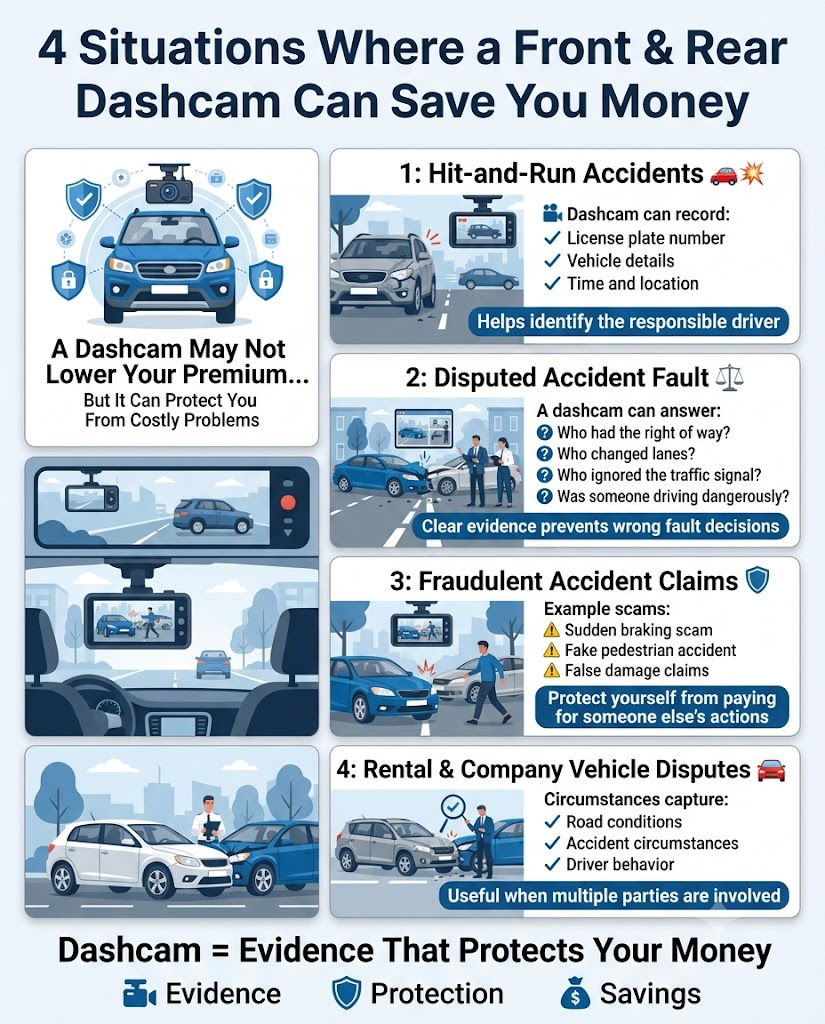
While a dashcam may not lower your monthly insurance premium, it can potentially save thousands of dollars in certain situations.
Hit-and-Run Accidents
If another driver damages your vehicle and leaves the scene, identifying them can be difficult.
A dashcam may capture:
- License plate information
- Vehicle description
- Time and location of the incident
This can help law enforcement and insurance companies process the claim.
Disputed Accident Fault
Many insurance disputes happen because drivers provide different versions of events.
A dashcam can answer questions such as:
- Who had the right of way?
- Who entered another lane?
- Who ignored a traffic signal?
- Was someone driving dangerously?
Clear evidence can prevent you from being incorrectly assigned fault.
Fraudulent Accident Claims
Staged accidents can cause serious financial problems.
Common scams include:
- A vehicle suddenly stopping in front of you
- A pedestrian intentionally stepping into traffic
- Another driver claiming damage that was unrelated
A dashcam recording can protect you from paying for someone else’s actions.
Rental Car or Company Vehicle Disputes
Drivers using rental cars or company vehicles may face additional claim complications.
A dashcam can document:
- Existing road conditions
- Accident circumstances
- Driver behavior
This can be valuable when multiple parties are involved.
Does Installing a Dashcam Increase Insurance Rates?
Installing a dashcam typically does not increase insurance rates.
A dashcam is considered an aftermarket accessory, similar to:
- Phone mounts
- Navigation devices
- Interior cameras
However, there are a few things to consider.
Vehicle Modification Rules
Some insurance companies require drivers to report certain modifications.
A basic dashcam usually does not affect coverage, but expensive integrated systems may need to be disclosed.
Electrical Installation Risks
Poor installation can potentially cause:
- Battery drainage
- Wiring issues
- Electrical problems
If installation damages the vehicle, coverage may depend on your policy terms.
Professional installation is recommended for hardwired dashcams.
Do Dashcams Help With Comprehensive Insurance Claims?
A front and rear dashcam can be useful for many types of insurance claims, including some claims covered under comprehensive insurance.
Comprehensive coverage generally protects against incidents that are not caused by a collision, such as:
- Theft
- Vandalism
- Weather damage
- Falling objects
- Animal-related damage
- Fire
A dashcam cannot prevent these events, but it can provide valuable evidence in certain situations.
For example:
- A parking mode dashcam may record someone damaging your vehicle in a parking lot.
- A camera may capture a person breaking into your vehicle.
- Footage may help confirm when and where damage occurred.
However, a dashcam does not guarantee claim approval. Insurance companies still review:
- Policy coverage
- Damage details
- Evidence provided
- Police reports (when required)
- Claim circumstances
Are Parking Mode Dashcams Worth It?
Parking mode is one of the most valuable features of a front and rear dashcam system.
Normal dashcam recording usually works only when the vehicle is running. Parking mode allows the camera to monitor your vehicle while it is parked.
Depending on the dashcam model, parking mode may record:
- Motion near your vehicle
- Physical impacts
- Attempts to break into the vehicle
- People approaching the car
- Vehicles hitting your parked car
This can be especially useful for drivers who:
- Park outdoors
- Use crowded parking areas
- Leave their vehicle overnight in public spaces
- Own expensive vehicles
How Parking Mode Can Help Insurance Claims
Imagine returning to your vehicle and finding:
- A dented bumper
- Scratches on the door
- A broken mirror
Without evidence, you may have to pay for repairs yourself or file a claim with limited information.
With parking mode footage, you may be able to provide:
- The time of the incident
- The responsible vehicle
- The person involved
- Clear evidence of what happened
This can improve the chances of recovering repair costs.
How to Choose a Dashcam That Helps With Insurance Claims
Not every dashcam provides useful evidence. A cheap camera with poor-quality footage may not help much during a claim.
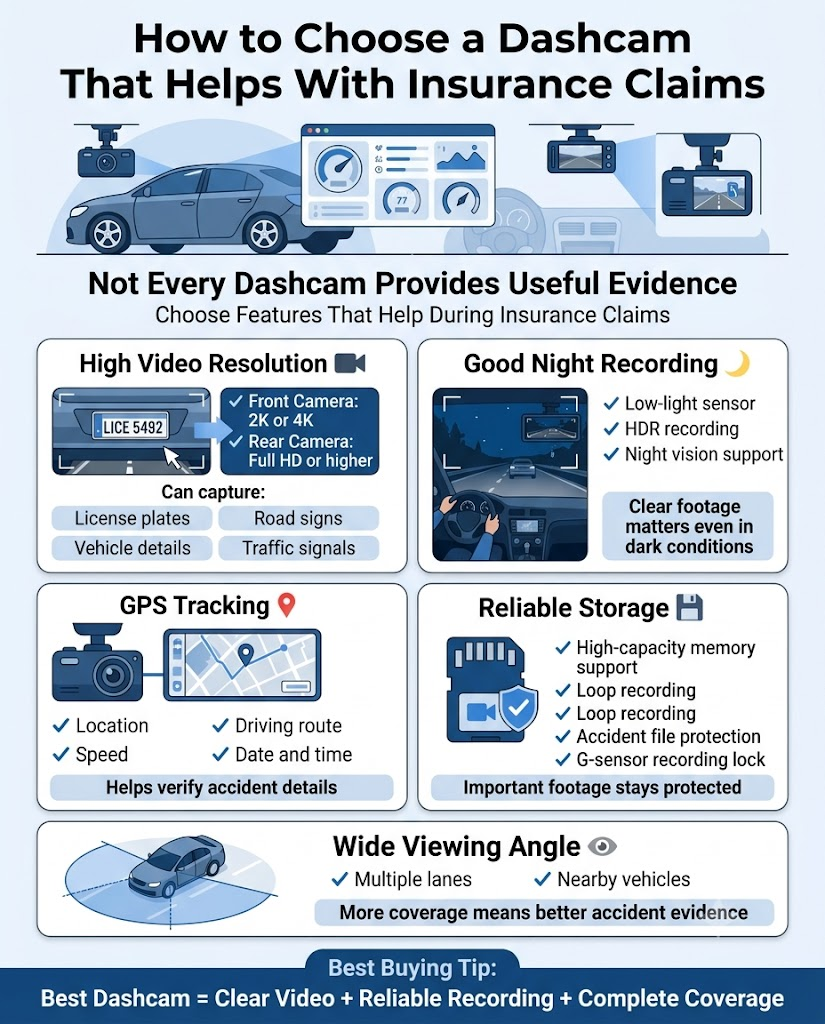
When choosing a front and rear dashcam, consider these features:
High Video Resolution
Resolution affects how clearly details appear.
Recommended options:
- Front camera: 2K or 4K resolution
- Rear camera: Full HD or higher
Higher resolution can help capture:
- License plates
- Road signs
- Vehicle details
- Traffic signals
Good Night Recording
Many accidents happen at night, and poor-quality footage may become unusable.
Look for features such as:
- Low-light sensors
- HDR recording
- Night vision support
Good nighttime footage can make a major difference during investigations.
GPS Tracking
A GPS-enabled dashcam records:
- Location
- Speed
- Driving route
- Time and date
This information can help verify accident details.
For example, GPS data may show:
- You were driving within the speed limit
- Where the accident happened
- The exact location of impact
Reliable Storage
A dashcam is only useful if the footage is available when needed.
Important features include:
- Support for high-capacity memory cards
- Loop recording
- Automatic accident file protection
Many dashcams use a G-sensor that automatically locks footage when it detects a collision.
Wide Viewing Angle
A wider field of view allows the camera to capture more surroundings.
A good dashcam should record:
- Multiple lanes
- Side movements
- Nearby vehicles
However, extremely wide angles can sometimes distort images, so balance is important.
Common Dashcam Mistakes That Can Reduce Its Value
Even if you have a front and rear dashcam, mistakes can make the footage less useful during an insurance claim.
Mistake 1: Poor Camera Placement
A dashcam should have a clear view of the road.
Avoid placing it:
- Behind tinted areas
- Too low on the dashboard
- Where objects block the lens
Mistake 2: Not Maintaining the Camera
Drivers often install a dashcam and forget about it.
Regular maintenance includes:
- Checking memory cards
- Cleaning the lens
- Updating firmware
- Confirming recording works properly
A camera that stopped recording during an accident provides no protection.
Mistake 3: Using a Low-Quality Memory Card
Cheap memory cards may fail because dashcams constantly record and overwrite files.
A damaged memory card can result in:
- Missing footage
- Corrupted files
- Failed recordings
Use a high-endurance memory card designed for continuous recording.
Mistake 4: Editing Accident Footage
Avoid modifying original footage before submitting it to an insurer.
Edited videos may raise questions about authenticity.
Keep:
- Original files
- Backup copies
- Complete recordings before and after the incident
Can Dashcams Prevent Insurance Fraud?
Insurance fraud is one of the biggest reasons drivers consider installing a dashcam.
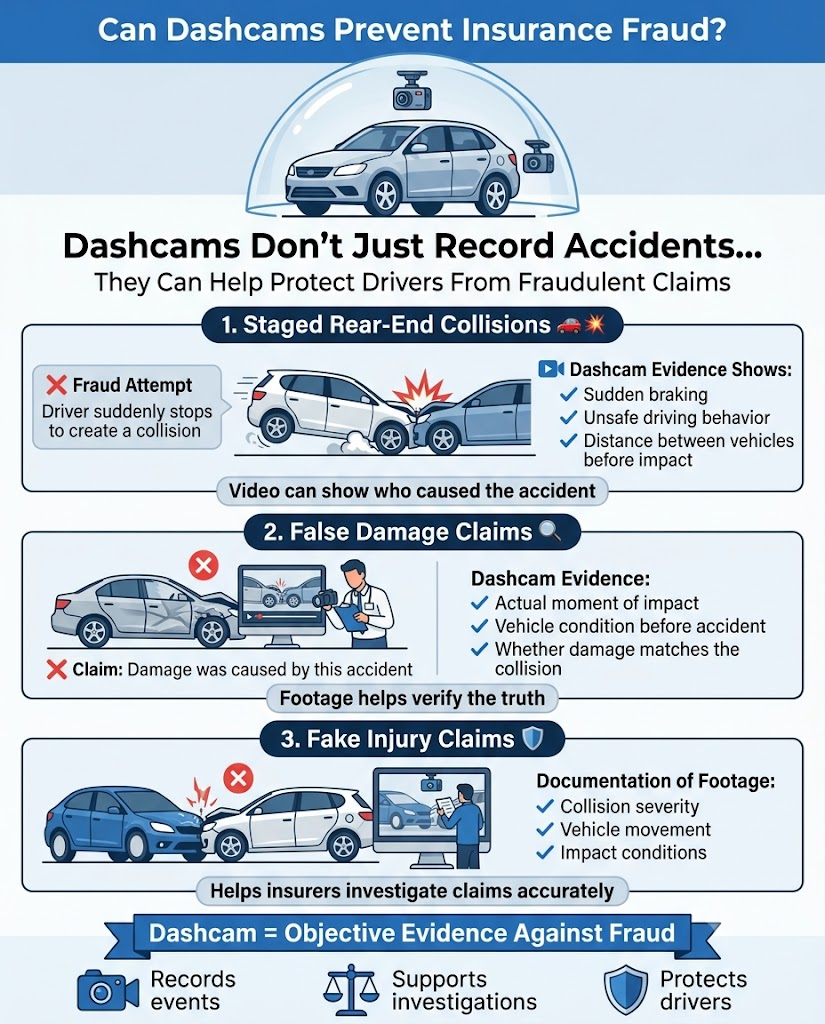
Fraudulent claims can happen when someone intentionally creates an accident, exaggerates damages, or falsely blames another driver. These situations can become expensive and stressful, especially when there is no evidence to prove what actually happened.
A front and rear dashcam can help protect drivers by providing an objective record of events.
Examples of situations where dashcam footage can help include:
Staged Rear-End Collisions
Some drivers intentionally brake suddenly in front of another vehicle to create a collision.
Without evidence, the following driver may be blamed.
A front dashcam can show:
- The other vehicle stopping suddenly
- Unsafe driving behavior
- The distance between vehicles before impact
False Damage Claims
A driver may claim that an accident caused damage that already existed.
Dashcam footage can help show:
- The actual impact
- The condition of vehicles before and after the accident
- Whether the claimed damage matches the incident
Fake Injury Claims
Some accident claims involve exaggerated injury reports.
While a dashcam cannot determine medical conditions, it can document:
- The severity of the collision
- Vehicle movement
- Impact conditions
This information may help insurers investigate the claim more accurately.
Should You Tell Your Insurance Company About Your Dashcam?
In most cases, you do not need to inform your insurance company simply because you installed a dashcam.
A dashcam is generally considered a personal vehicle accessory rather than a policy modification.
However, there are situations where informing your insurer may be beneficial.
You may want to mention your dashcam if:
- You are submitting an accident claim
- You have relevant footage available
- Your insurer requests additional evidence
- The footage can help prove fault
Providing video evidence early can sometimes speed up the claim investigation.
Does a Dashcam Help Lower Car Insurance After an Accident?
A dashcam usually does not directly reduce your insurance premium after an accident.
However, it may help indirectly by preventing an accident from negatively affecting your insurance record.
For example:
Scenario Without Dashcam
You are involved in an accident.
The other driver claims you caused it.
There are no witnesses.
Your insurer determines you share responsibility.
Possible results:
- Claim recorded on your policy
- Higher renewal premium
- Loss of no-claim benefits
Scenario With Dashcam
Your camera shows:
- The other driver ignored a stop sign
- You were driving correctly
- The other vehicle caused the collision
Possible results:
- Fault assigned to the other driver
- Your claim history remains cleaner
- Lower chance of premium increase
The savings may not appear as a discount, but avoiding an unnecessary premium increase can have significant financial value.
Pros and Cons of Installing a Front and Rear Dashcam
Before buying a dashcam, consider both the benefits and limitations.
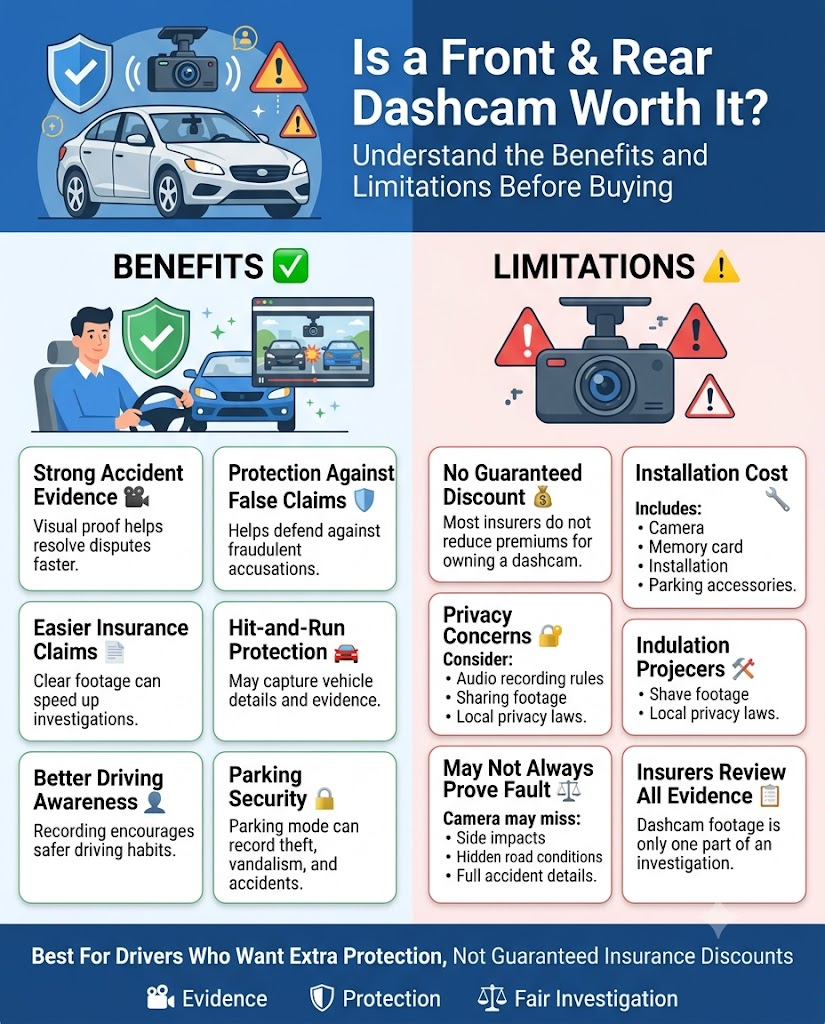
Benefits of a Front and Rear Dashcam
Strong Accident Evidence
A dashcam provides visual proof that can help resolve disputes quickly.
Protection Against False Claims
Video evidence can protect you from fraudulent accident accusations.
Easier Insurance Claims
Clear footage can reduce investigation time.
Hit-and-Run Protection
A camera may capture details about the responsible vehicle.
Improved Driving Awareness
Some drivers become more careful knowing their driving is recorded.
Security While Parked
Parking mode can help document theft, vandalism, and parking accidents.
Limitations of a Front and Rear Dashcam
Despite their advantages, dashcams have limitations.
No Guaranteed Insurance Discount
Most insurers do not reduce premiums simply because you own a dashcam.
Installation Cost
A quality front and rear dashcam system may require:
- Camera purchase cost
- Memory card
- Installation charges
- Optional parking mode accessories
Privacy Concerns
Dashcams record public roads and surroundings.
Drivers should understand local laws regarding:
- Recording audio
- Sharing footage
- Privacy regulations
Footage May Not Always Prove Fault
A camera angle may not capture:
- Side impacts
- Hidden road conditions
- Full accident circumstances
Insurance companies still evaluate the complete situation.
Is a Front and Rear Dashcam Worth the Investment?
For most drivers, a front and rear dashcam is worth considering, not because it lowers insurance rates directly, but because it provides financial protection.
The cost of a quality dashcam is usually much lower than the potential cost of:
- A disputed accident
- A fraudulent claim
- A hit-and-run repair
- Increased insurance premiums after a fault decision
Drivers who may benefit the most include:
- Daily commuters
- Highway drivers
- Rideshare drivers
- New drivers
- People living in areas with heavy traffic
- Owners of expensive vehicles
Final Verdict: Does Having a Front and Rear Dashcam Lower Insurance Rates?
The short answer is: usually no, a front and rear dashcam does not directly lower insurance rates.
Most insurance companies do not offer a premium discount simply because a driver installs a dashcam. Insurers generally provide discounts for features that actively reduce accident risk, such as:
- Automatic emergency braking
- Anti-lock braking systems
- Anti-theft systems
- Defensive driving courses
- Safe driving programs
A dashcam mainly works as an evidence and protection tool rather than an accident prevention device.
However, a front and rear dashcam can still provide significant financial benefits.
It can help you:
- Prove you were not responsible for an accident
- Avoid unfair liability decisions
- Protect your no-claim discount
- Fight fraudulent claims
- Identify hit-and-run drivers
- Speed up insurance investigations
Over time, these benefits may save more money than a small insurance discount would provide.
For many drivers, a dashcam is not about paying less for insurance every month. It is about protecting yourself when something goes wrong.