
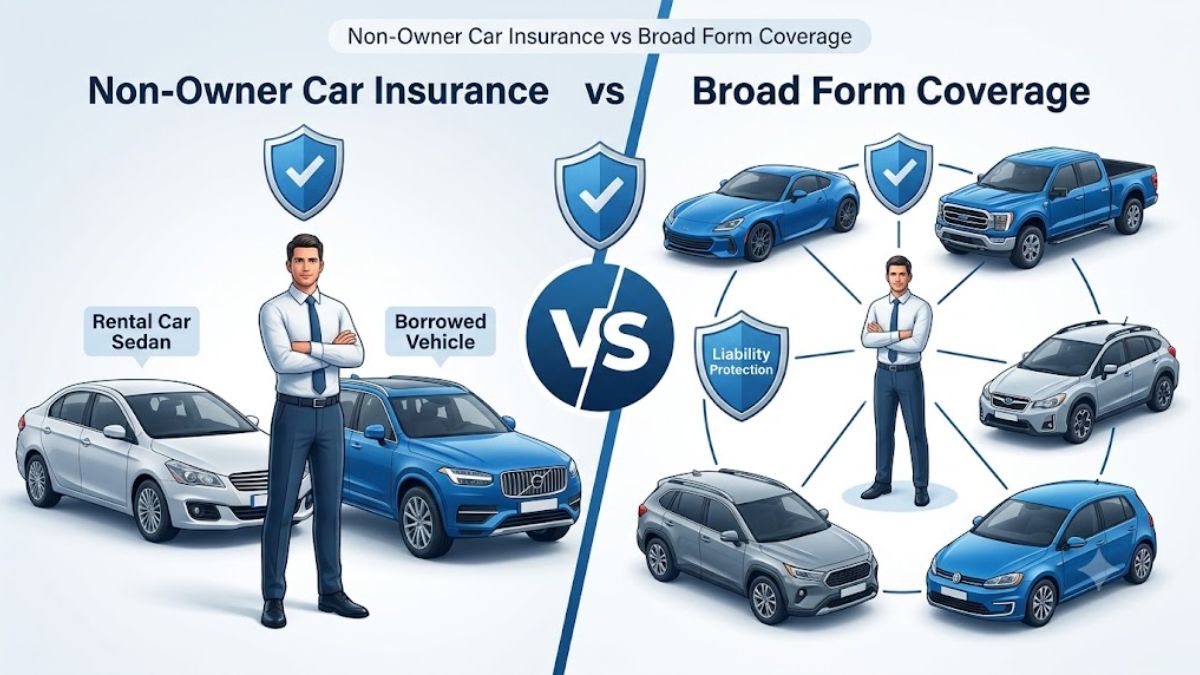

Car insurance is usually associated with vehicle ownership, but not every driver owns a car. Some people regularly drive vehicles they do not own, borrow cars from family members, rent vehicles frequently, or need insurance to maintain continuous coverage. In these situations, traditional auto insurance may not be the right option.
Two types of policies that often create confusion are non-owner car insurance and broad form car insurance.
Both options provide liability protection, but they work differently. A non-owner car insurance policy is designed for drivers who need coverage but do not own a vehicle, while broad form coverage provides personal liability protection that can follow the insured driver across multiple vehicles.
Understanding the difference between non-owner car insurance vs broad form coverage can help you choose the right protection based on your driving habits, vehicle access, and insurance requirements.
What Is Non-Owner Car Insurance?
Non-owner car insurance is a type of auto insurance policy designed for people who drive vehicles they do not own.
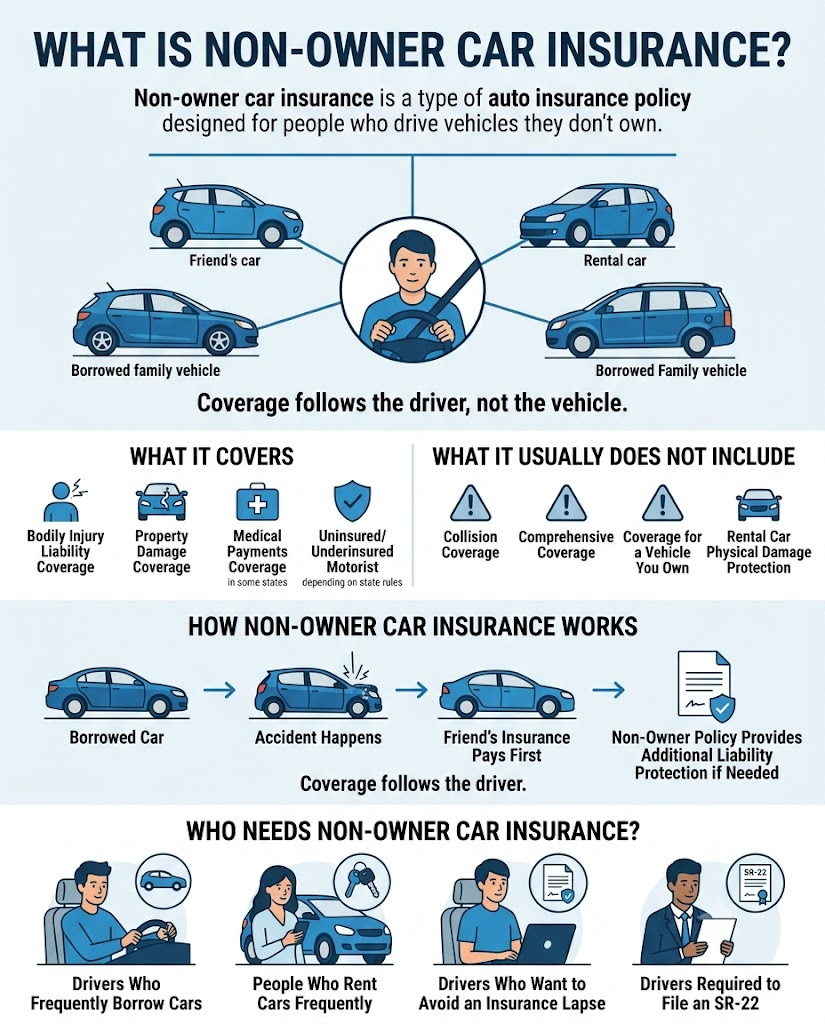
Unlike standard auto insurance, it does not cover a specific vehicle. Instead, it provides liability coverage for the driver when they operate someone else’s vehicle.
A non-owner policy typically includes:
- Bodily injury liability coverage
- Property damage liability coverage
- Medical payments coverage (in some states)
- Uninsured/underinsured motorist coverage (depending on state rules)
However, it usually does not include:
- Collision coverage
- Comprehensive coverage
- Coverage for a vehicle you own
- Rental car physical damage protection
The purpose of this policy is to protect the driver financially if they cause an accident while driving another person’s vehicle.
How Non-Owner Car Insurance Works
With a standard auto insurance policy, coverage follows the vehicle. The policy is attached to a specific car.
With non-owner insurance, coverage follows the driver.
For example:
You frequently borrow your friend’s car but do not own a vehicle yourself. If you cause an accident while driving that car:
- Your friend’s auto insurance usually pays first.
- Your non-owner policy may provide additional liability protection if damages exceed their policy limits.
This is known as secondary liability coverage in many situations.
Who Needs Non-Owner Car Insurance?
Non-owner car insurance may be useful for several situations.
Drivers Who Frequently Borrow Cars
If you regularly drive a family member’s, friend’s, or partner’s vehicle but are not listed on their insurance policy, non-owner coverage can provide additional protection.
Example:
A person living in an apartment does not own a car but occasionally borrows a roommate’s vehicle. A non-owner policy may help provide liability protection.
People Who Rent Cars Frequently
Frequent rental car users may purchase non-owner insurance instead of relying only on rental company coverage.
It may provide liability protection when renting vehicles for personal use.
However, it generally does not cover damage to the rental vehicle itself.
Drivers Who Want to Avoid an Insurance Lapse
A gap in auto insurance coverage can sometimes increase future premiums.
Someone who sells their car but plans to buy another one later may maintain a non-owner policy to keep continuous insurance history.
Drivers Required to File an SR-22
Some states require high-risk drivers to file an SR-22 certificate after violations such as:
- DUI convictions
- Driving without insurance
- Serious traffic violations
If the driver does not own a vehicle, a non-owner policy may satisfy the insurance requirement.
What Is Broad Form Car Insurance?
Broad form car insurance is a type of auto insurance policy where liability coverage is tied primarily to the insured driver rather than a specific vehicle.
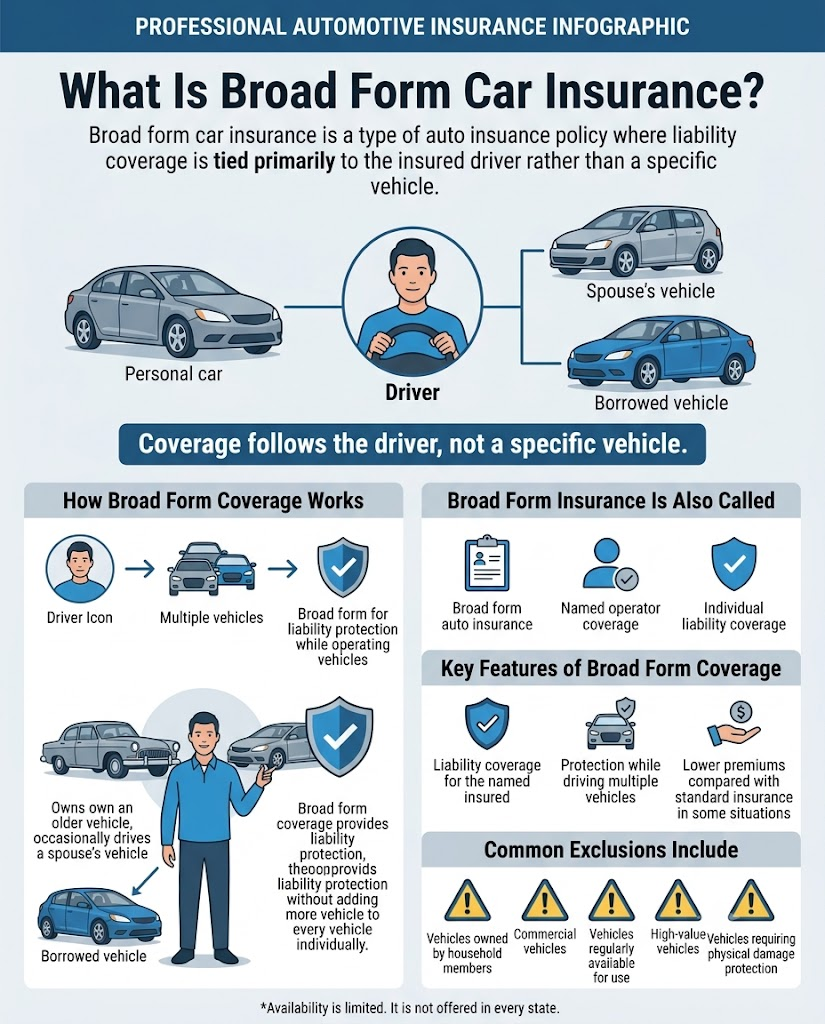
It is designed to provide coverage when the insured person drives multiple vehicles.
Unlike standard policies, broad form coverage may allow one driver to be insured while operating different vehicles without adding each vehicle individually.
Broad form insurance is sometimes called:
- Broad form auto insurance
- Named operator coverage
- Individual liability coverage
However, availability is limited. It is not offered in every state.
How Broad Form Coverage Works
With broad form insurance, the policy generally covers the named driver for liability while operating vehicles.
For example:
A person owns an older vehicle, occasionally drives a spouse’s vehicle, and sometimes borrows another car. Instead of insuring each vehicle separately, broad form coverage may provide liability protection for the driver.
The major difference is that broad form insurance is designed to follow the person more broadly than traditional vehicle-based insurance.
Key Features of Broad Form Coverage
Broad form policies often include:
- Liability coverage for the named insured
- Protection while driving multiple vehicles
- Lower premiums compared with standard insurance in some situations
However, coverage limitations may apply.
Common exclusions include:
- Vehicles owned by household members
- Commercial vehicles
- Vehicles regularly available for use
- High-value vehicles
- Vehicles requiring physical damage protection
Exact rules depend heavily on the state and insurer.
Non-Owner Car Insurance vs Broad Form Coverage: Main Differences
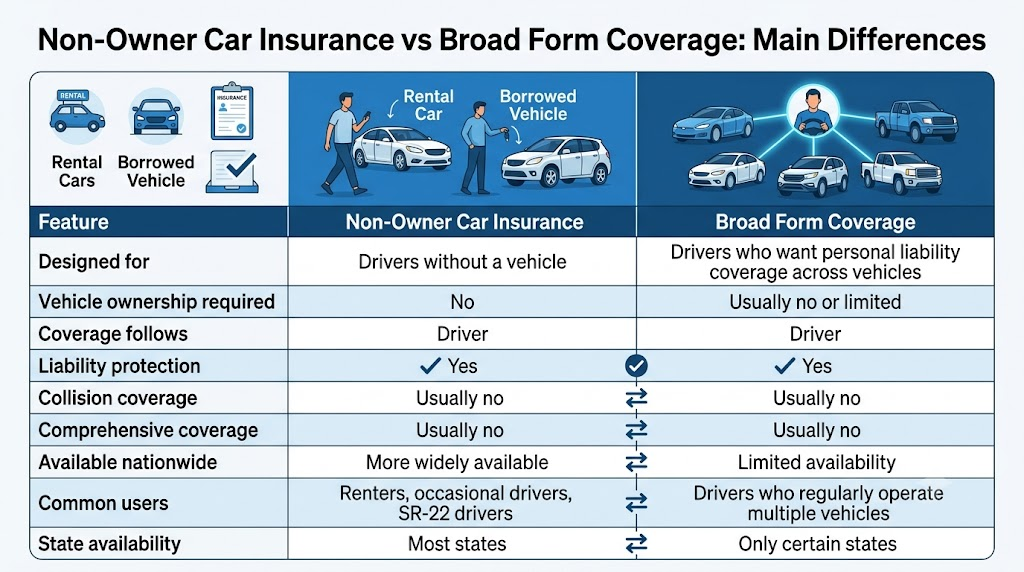
| Feature | Non-Owner Car Insurance | Broad Form Coverage |
|---|---|---|
| Designed for | Drivers without a vehicle | Drivers who want personal liability coverage across vehicles |
| Vehicle ownership required | No | Usually no or limited |
| Coverage follows | Driver | Driver |
| Liability protection | Yes | Yes |
| Collision coverage | Usually no | Usually no |
| Comprehensive coverage | Usually no | Usually no |
| Available nationwide | More widely available | Limited availability |
| Common users | Renters, occasional drivers, SR-22 drivers | Drivers who regularly operate multiple vehicles |
| State availability | Most states | Only certain states |
Coverage Comparison Example
Imagine two drivers:
Driver A: Uses Rental Cars Often
Sarah sold her car and travels frequently for work. She rents vehicles several times a month.
A non-owner policy may be a better option because she needs liability coverage without owning a vehicle.
Driver B: Drives Multiple Family Vehicles
Mike owns one car but frequently drives different vehicles owned by family members.
Broad form coverage may provide broader personal liability protection if available in his state.
Which Policy Is Cheaper?
The cost depends on:
- Driving history
- Location
- Coverage limits
- Age
- Insurance company
- State regulations
Generally:
- Non-owner car insurance is often cheaper than standard auto insurance because it does not cover a specific vehicle.
- Broad form coverage may also be affordable but availability is limited.
Typical non-owner insurance costs may range from around $200 to $700 per year, depending on the driver profile and state.
Non-Owner Car Insurance vs Broad Form Coverage: Pros and Cons
Choosing between non-owner car insurance and broad form coverage depends on your driving situation. Both policies can provide liability protection, but they are designed for different types of drivers.
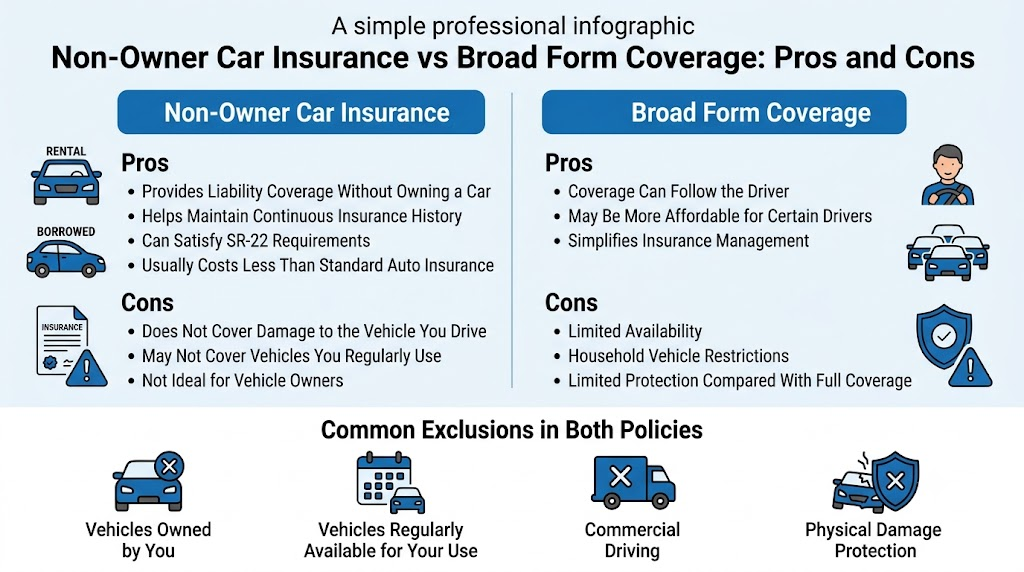
Understanding the advantages and limitations of each option can help you avoid paying for unnecessary coverage or leaving yourself financially exposed.
Pros of Non-Owner Car Insurance
Provides Liability Coverage Without Owning a Car
The biggest advantage of non-owner car insurance is that it allows people without a vehicle to maintain auto insurance coverage.
You can purchase protection even if:
- You do not own a car
- You borrow vehicles occasionally
- You use rental cars regularly
- You are between vehicle purchases
This makes it a flexible option for drivers who still need insurance protection.
Helps Maintain Continuous Insurance History
A lapse in auto insurance coverage can sometimes result in higher premiums when you purchase a new policy later.
A non-owner policy allows drivers to maintain continuous coverage while they:
- Sell a vehicle
- Move to a city where they do not need a car
- Wait before buying another vehicle
- Temporarily stop owning a vehicle
Maintaining uninterrupted coverage may help demonstrate responsible insurance history.
Can Satisfy SR-22 Requirements
Drivers who are required to file an SR-22 often need proof of financial responsibility before they can reinstate their driving privileges.
A non-owner policy can be useful when:
- The driver does not own a vehicle
- The state requires liability coverage
- The driver needs an SR-22 filing
This allows the driver to meet legal requirements without purchasing a vehicle.
Usually Costs Less Than Standard Auto Insurance
Because non-owner insurance does not cover a specific vehicle, it is usually less expensive than a traditional auto policy.
The insurer is not responsible for:
- Vehicle repairs
- Theft losses
- Comprehensive claims
- Collision damage
The policy mainly focuses on liability protection.
Cons of Non-Owner Car Insurance
Does Not Cover Damage to the Vehicle You Drive
One of the biggest limitations of non-owner insurance is that it usually does not include physical damage coverage.
If you damage someone else’s vehicle while driving it, your non-owner policy generally will not pay for repairs.
For example:
You borrow a friend’s car and cause an accident. Their collision coverage may pay for the vehicle damage, but your non-owner policy typically only helps with liability costs.
May Not Cover Vehicles You Regularly Use
Non-owner policies are designed for occasional use.
Coverage may not apply if you regularly drive:
- A spouse’s vehicle
- A household member’s vehicle
- A company vehicle
- A vehicle available for your regular use
Insurance companies may require you to be added to the vehicle owner’s policy instead.
Not Ideal for Vehicle Owners
If you own a car, non-owner insurance is usually not appropriate.
Vehicle owners generally need a standard auto policy that includes:
- Liability coverage
- Collision coverage
- Comprehensive coverage
- Vehicle-specific protection
Pros of Broad Form Coverage
Coverage Can Follow the Driver
The primary advantage of broad form insurance is that it focuses on the insured driver rather than one vehicle.
This can be useful for people who:
- Drive multiple vehicles
- Borrow cars often
- Want personal liability protection
Instead of listing every vehicle separately, the policy may provide protection when the insured operates different vehicles.
May Be More Affordable for Certain Drivers
For some drivers, broad form coverage can be less expensive than traditional insurance because:
- Only one driver may be covered
- Liability coverage is the main focus
- Physical damage coverage may not be included
It can be a cost-effective option for people who do not need full vehicle coverage.
Simplifies Insurance Management
Drivers who frequently operate different vehicles may find broad form coverage easier to manage.
Instead of updating a policy every time they drive a different vehicle, their personal liability protection remains attached to them.
Cons of Broad Form Coverage
Limited Availability
Broad form auto insurance is not available everywhere.
Only certain states and insurers offer this type of policy.
Drivers may need to check with local insurance providers to determine whether it is an option.
Household Vehicle Restrictions
Many broad form policies exclude vehicles owned by:
- The insured person
- A spouse
- Household residents
If you frequently drive a family member’s vehicle, this limitation can become important.
Limited Protection Compared With Full Coverage
Broad form insurance is mainly liability-focused.
It usually does not provide:
- Collision coverage
- Comprehensive coverage
- Rental reimbursement
- Vehicle replacement coverage
Drivers who need protection for a specific vehicle may require a traditional policy.
State Availability Differences
One major difference between non-owner insurance and broad form coverage is availability.
Non-Owner Insurance
Non-owner car insurance is available in most states and is commonly offered by many major insurance companies.
It is widely used for:
- Rental car users
- Drivers without vehicles
- SR-22 requirements
Broad Form Coverage
Broad form insurance is much less common.
It is primarily available in select states and may have different rules depending on local insurance regulations.
Before choosing broad form coverage, drivers should confirm:
- Whether it is available in their state
- What vehicles are excluded
- Whether household vehicles are covered
- Minimum liability requirements
Common Exclusions in Both Policies
Although non-owner and broad form insurance provide liability protection, they often have important exclusions.
Vehicles Owned by You
If you own a vehicle, these policies generally will not replace standard auto insurance.
Vehicles Regularly Available for Your Use
A vehicle that you frequently drive may need to be listed separately.
Examples:
- A partner’s vehicle you use daily
- A company vehicle assigned to you
- A family member’s vehicle kept at your home
Commercial Driving
Personal policies usually exclude vehicles used for business purposes.
Examples:
- Delivery driving
- Rideshare work
- Commercial transportation
Drivers who use vehicles for work may need specialized coverage.
Physical Damage Protection
Neither policy is usually designed to protect the vehicle itself.
They generally do not pay for:
- Collision repairs
- Theft
- Fire damage
- Weather damage
When Should You Choose Non-Owner Insurance?
A non-owner policy may be the better choice if you:
✔ Do not own a vehicle
✔ Rent cars frequently
✔ Borrow cars occasionally
✔ Need an SR-22 filing
✔ Want to avoid an insurance lapse
✔ Plan to purchase a vehicle in the future
When Should You Choose Broad Form Coverage?
Broad form coverage may make more sense if you:
✔ Regularly drive multiple vehicles
✔ Want liability coverage that follows you
✔ Live in a state where broad form insurance is available
✔ Do not need vehicle damage coverage
✔ Want a simpler insurance arrangement
Non-Owner Car Insurance vs Broad Form Coverage: Which One Is Better?
There is no single answer to whether non-owner car insurance or broad form coverage is better. The right choice depends on how often you drive, whether you own a vehicle, where you live, and what type of protection you need.
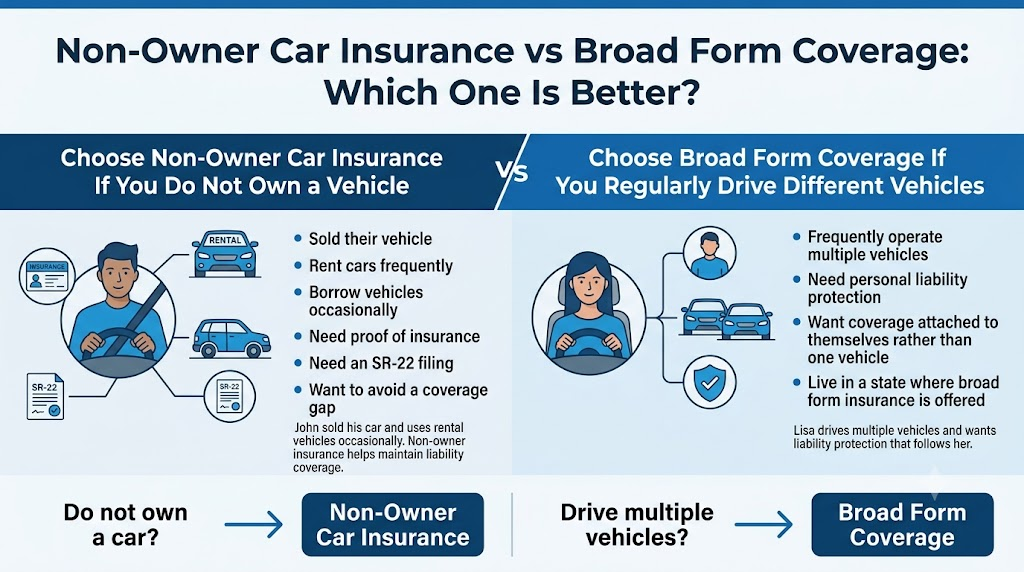
Both policies are designed for drivers who want liability protection without purchasing a traditional full-coverage auto policy. However, their intended uses are different.
Choose Non-Owner Car Insurance If You Do Not Own a Vehicle
Non-owner car insurance is usually the better choice for people who:
- Sold their vehicle
- Rent cars frequently
- Borrow vehicles occasionally
- Need proof of insurance
- Need an SR-22 filing
- Want to avoid a coverage gap
For example:
John sold his car because he moved to an area with public transportation. He still rents a car several times a year for trips. A non-owner policy allows him to maintain liability coverage without paying for insurance on a vehicle he does not own.
Choose Broad Form Coverage If You Regularly Drive Different Vehicles
Broad form coverage may be better for drivers who:
- Frequently operate multiple vehicles
- Need personal liability protection
- Want coverage attached to themselves rather than one vehicle
- Live in a state where broad form insurance is offered
For example:
Lisa drives her own older car, occasionally drives her parent’s vehicle, and borrows a friend’s vehicle during vacations. Broad form coverage may provide broader protection depending on state rules and policy terms.
Cost Comparison: Non-Owner Insurance vs Broad Form Coverage
Insurance prices vary based on several factors, including:
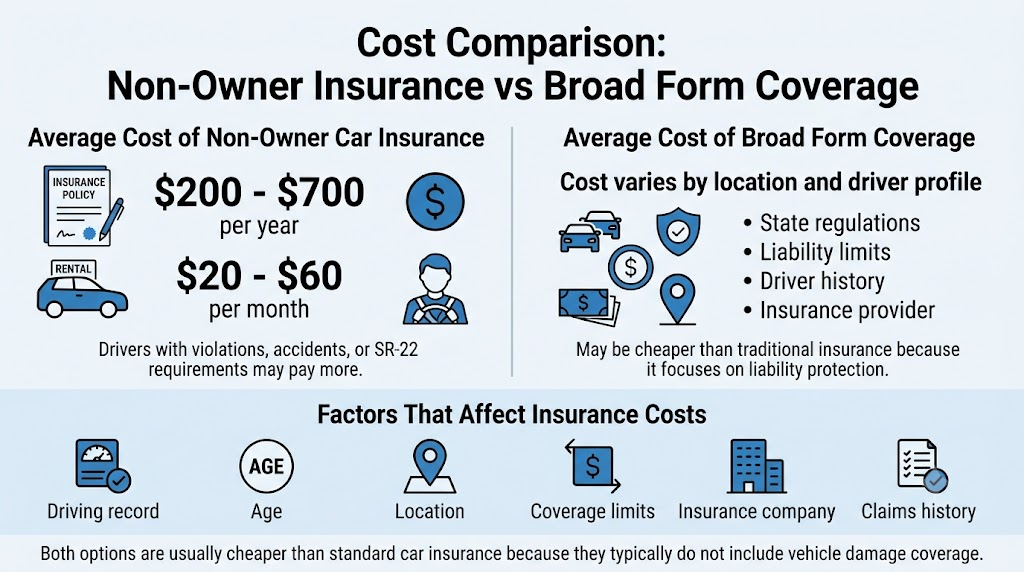
- Driving record
- Age
- Location
- Coverage limits
- Insurance company
- Claims history
However, both options are typically cheaper than standard car insurance because they usually do not include vehicle damage coverage.
Average Cost of Non-Owner Car Insurance
Non-owner insurance commonly costs:
- Around $200 to $700 per year
- Approximately $20 to $60 per month
Drivers with violations, accidents, or SR-22 requirements may pay more.
Average Cost of Broad Form Coverage
Broad form insurance pricing varies significantly because it is only available in certain locations.
Costs may depend on:
- State regulations
- Liability limits
- Driver history
- Insurance provider
Some drivers may find it cheaper than traditional insurance because they are only purchasing liability protection.
Example Scenario: Which Policy Makes More Sense?
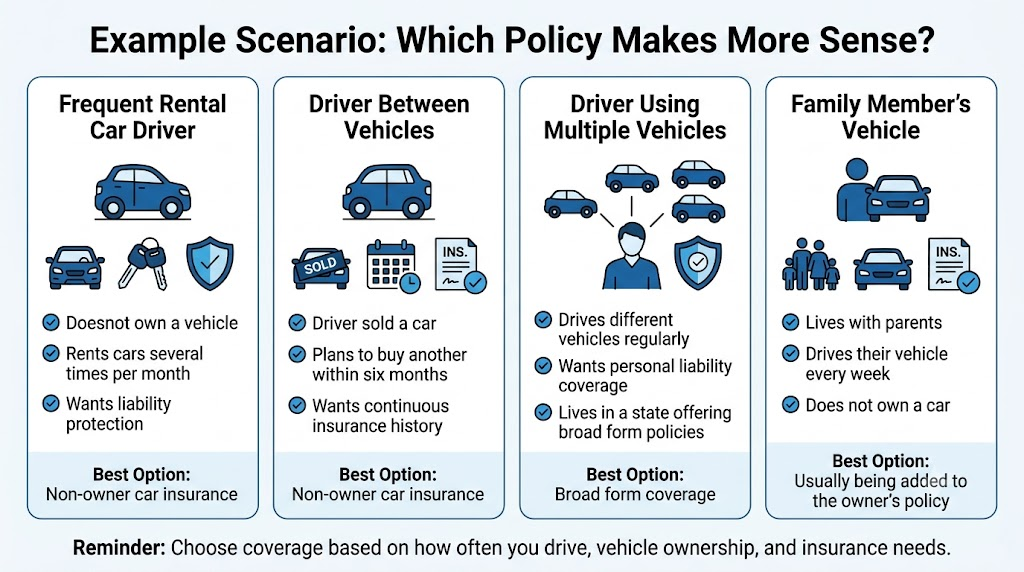
Scenario 1: Frequent Rental Car Driver
Situation:
- Does not own a vehicle
- Rents cars several times per month
- Wants liability protection
Best option: Non-owner car insurance
Why?
The driver needs coverage without insuring a specific vehicle.
Scenario 2: Driver Between Vehicles
Situation:
- Sold a car
- Plans to buy another vehicle within six months
- Wants continuous insurance history
Best option: Non-owner car insurance
Why?
It helps avoid an insurance lapse while the driver does not own a vehicle.
Scenario 3: Driver Using Multiple Vehicles
Situation:
- Drives different vehicles regularly
- Wants personal liability coverage
- Lives in a state offering broad form policies
Best option: Broad form coverage
Why?
The policy is designed around the driver rather than one vehicle.
Scenario 4: Family Member’s Vehicle
Situation:
- Lives with parents
- Drives their vehicle every week
- Does not own a car
Best option: Usually being added to the owner’s policy
Why?
Many non-owner and broad form policies exclude vehicles owned by household members or vehicles regularly available for use.
Can You Have Both Non-Owner Insurance and Broad Form Coverage?
In most cases, drivers do not need both policies.
They serve similar purposes:
- Providing personal liability protection
- Covering drivers without traditional vehicle-based insurance
Having both may result in paying for overlapping coverage.
However, insurance rules vary by state and insurer. A licensed insurance professional can help determine whether combining policies makes sense for a specific situation.
Does Non-Owner Insurance Cover Rental Cars?
Non-owner insurance may provide liability coverage when renting a vehicle, but it usually does not cover damage to the rental car.
Rental companies often offer additional protection such as:
- Collision damage waiver (CDW)
- Loss damage waiver (LDW)
- Supplemental liability coverage
A driver should review their policy before declining rental company coverage.
Does Broad Form Insurance Cover Someone Else Driving My Car?
Generally, broad form coverage is designed to protect the named insured, not other drivers.
If someone else drives your vehicle, their coverage depends on:
- Their own insurance policy
- Your vehicle’s insurance policy
- State laws
- Permission rules
If multiple people drive a vehicle regularly, a standard auto policy may be more appropriate.
Does Non-Owner Insurance Cover a Car You Borrow?
Yes, but only for liability protection.
If you borrow someone else’s vehicle:
- Their insurance usually applies first
- Your non-owner policy may provide additional liability protection
- Your policy generally will not repair the vehicle
You should make sure you have permission to drive the vehicle and understand the owner’s insurance rules.
Common Mistakes When Buying These Policies
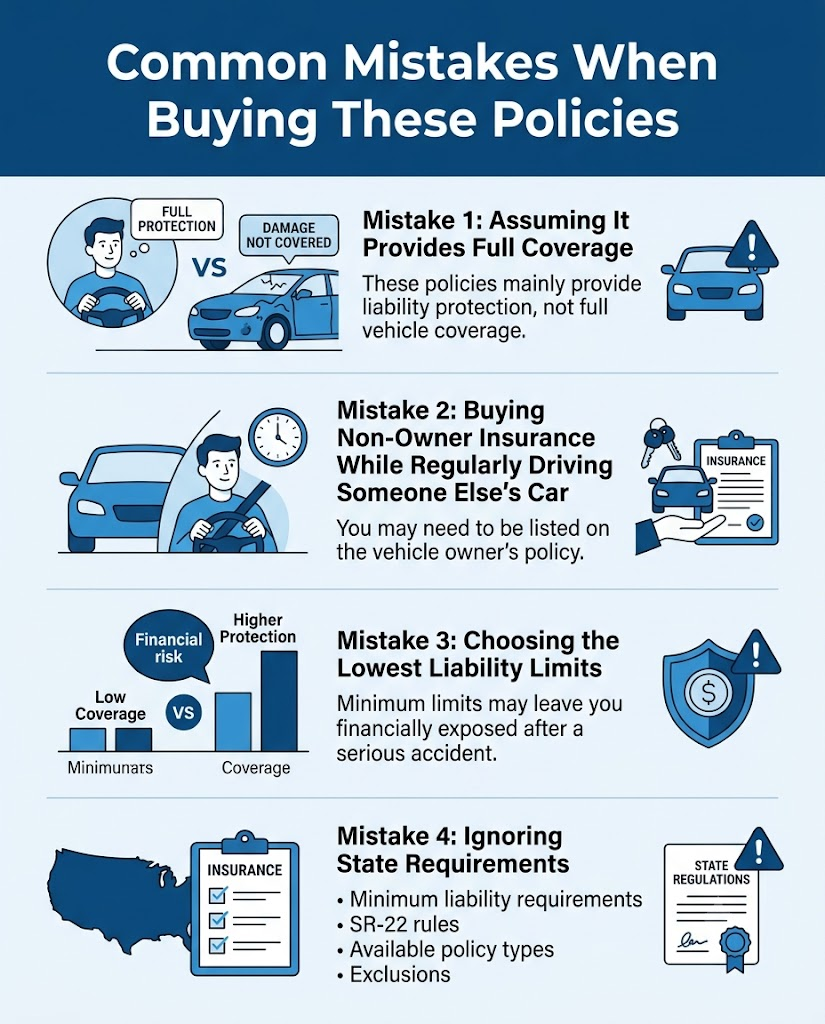
Mistake 1: Assuming It Provides Full Coverage
Many drivers believe these policies protect the vehicle they drive.
They usually do not.
They mainly provide liability protection.
Mistake 2: Buying Non-Owner Insurance While Regularly Driving Someone Else’s Car
If you use a vehicle frequently, especially a household vehicle, the insurer may require you to be listed on that vehicle’s policy.
Mistake 3: Choosing the Lowest Liability Limits
Saving money by choosing minimum coverage limits can leave you financially exposed after a serious accident.
Higher liability limits may provide better protection.
Mistake 4: Ignoring State Requirements
Insurance rules differ by state.
Before purchasing coverage, check:
- Minimum liability requirements
- SR-22 rules
- Available policy types
- Exclusions
Final Thoughts
The choice between non-owner car insurance vs broad form coverage depends on your personal driving situation.
Choose non-owner car insurance if you:
- Do not own a car
- Rent vehicles often
- Need an SR-22
- Want to maintain continuous insurance coverage
Choose broad form coverage if:
- It is available in your state
- You regularly drive multiple vehicles
- You want liability protection that follows you
Before purchasing either policy, compare coverage limits, exclusions, and state requirements. The cheapest option is not always the best option. Selecting the right policy can help you avoid unexpected financial problems after an accident.