
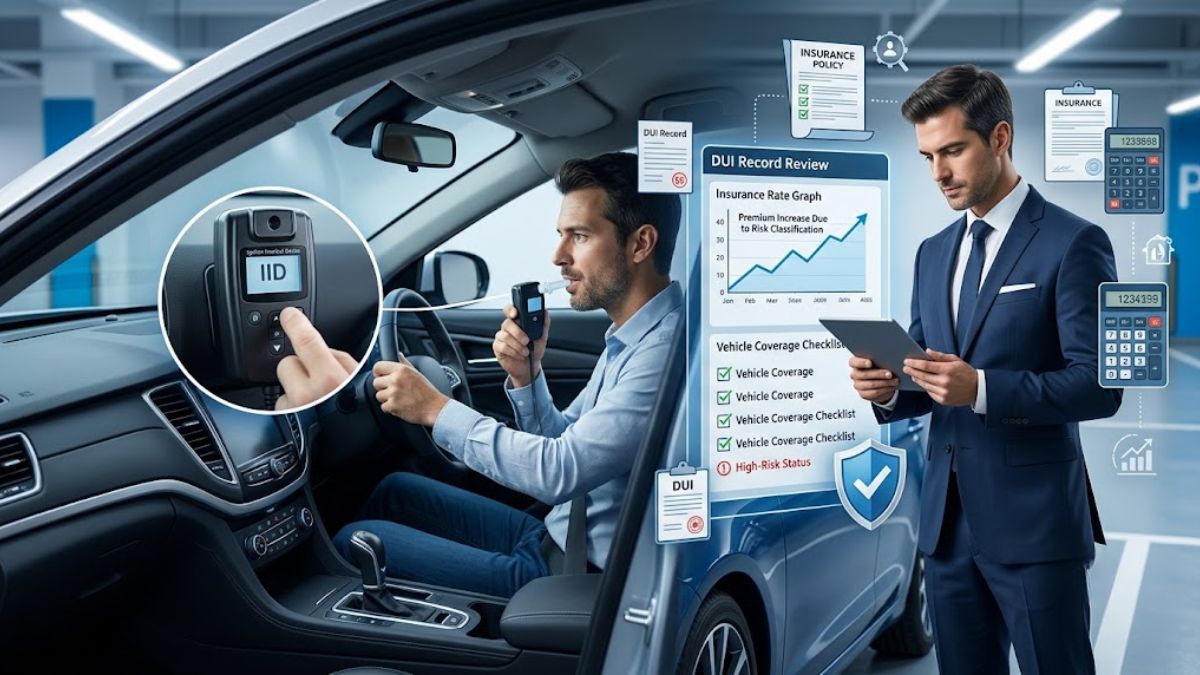

A breathalyzer device, officially known as an Ignition Interlock Device (IID), is a small system installed in a vehicle to prevent a driver from starting the car after consuming alcohol.
The device requires the driver to provide a breath sample before the engine starts, and it may require additional tests while driving to ensure continued compliance.
For many drivers, being required to install an IID happens after a serious driving offense, most commonly a DUI (Driving Under the Influence) or DWI (Driving While Intoxicated) conviction. While an IID can help drivers regain limited driving privileges, it can also create significant changes in their auto insurance situation.
One of the biggest concerns drivers have is:
“How Does a Breathalyzer (IID) Affect My Insurance Rates?”
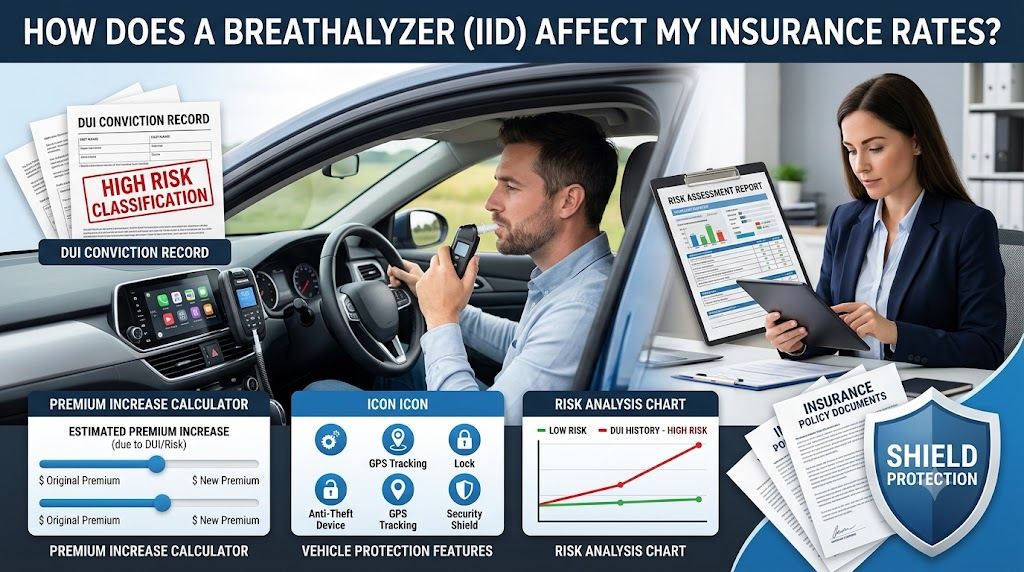
The short answer is that a breathalyzer (IID) can affect your insurance rates, but the device itself is not always the direct reason for higher premiums.
Insurance companies typically focus more on the event that led to the IID requirement, such as a DUI conviction, license suspension, or increased risk classification.
An IID requirement signals to insurers that a driver may have a history of high-risk behavior. Because of this, many insurance companies may increase premiums, require additional documentation, or limit coverage options.
Understanding how a breathalyzer (IID) affects your insurance rates can help drivers make better decisions about coverage, SR-22 requirements, and ways to reduce insurance costs over time.
This guide explains:
- How an IID affects insurance rates
- Why insurers consider IID drivers high risk
- Whether you need SR-22 insurance
- How much insurance may increase after an IID requirement
- Whether you can get normal insurance with an IID
- How long an IID affects your premiums
- Ways to lower insurance costs after a DUI
- Common mistakes to avoid
What Is an Ignition Interlock Device (IID)?
An Ignition Interlock Device is an electronic breathalyzer connected directly to a vehicle’s ignition system.
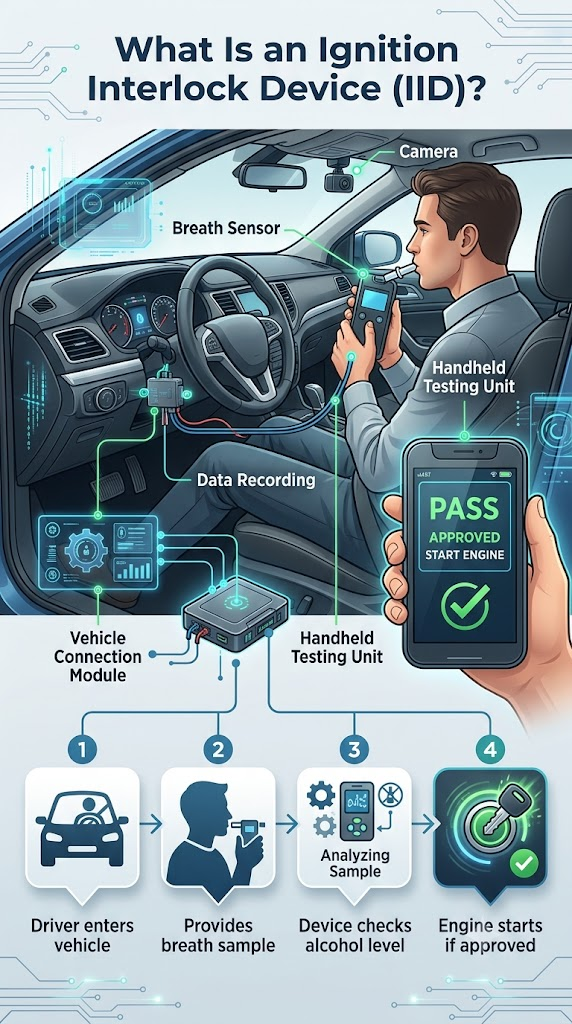
Before starting the vehicle, the driver must:
- Turn on the ignition system
- Blow into the device
- Provide a breath sample below the programmed alcohol limit
- Start the engine if the sample is accepted
If alcohol is detected, the vehicle may prevent the engine from starting.
Many IID systems also require random rolling retests while the vehicle is being driven. These tests are designed to make sure the driver does not consume alcohol after starting the vehicle.
A typical IID includes:
- Breath sensor
- Handheld testing unit
- Vehicle connection module
- Data recording system
- Camera (in some states)
The device records information such as:
- Failed breath tests
- Attempts to bypass the system
- Missed retests
- Device tampering
- Maintenance visits
This information may be reported to monitoring authorities depending on state requirements.
Why Do Courts Require an IID?
An IID requirement is generally part of a DUI or DWI penalty system. The goal is to allow drivers to continue operating a vehicle while reducing the risk of alcohol-related driving.
Depending on state laws and the circumstances of the offense, an IID may be required after:
- DUI conviction
- Repeat alcohol-related offenses
- High blood alcohol concentration (BAC)
- Refusing a chemical test
- License reinstatement after suspension
- Court-approved restricted driving privileges
Requirements vary significantly by state.
Some states require an IID even for first-time offenses, while others apply it mainly to repeat offenses or more serious cases.
Does Having an IID Directly Increase Insurance Rates?
The IID itself usually does not have a separate “insurance surcharge.”
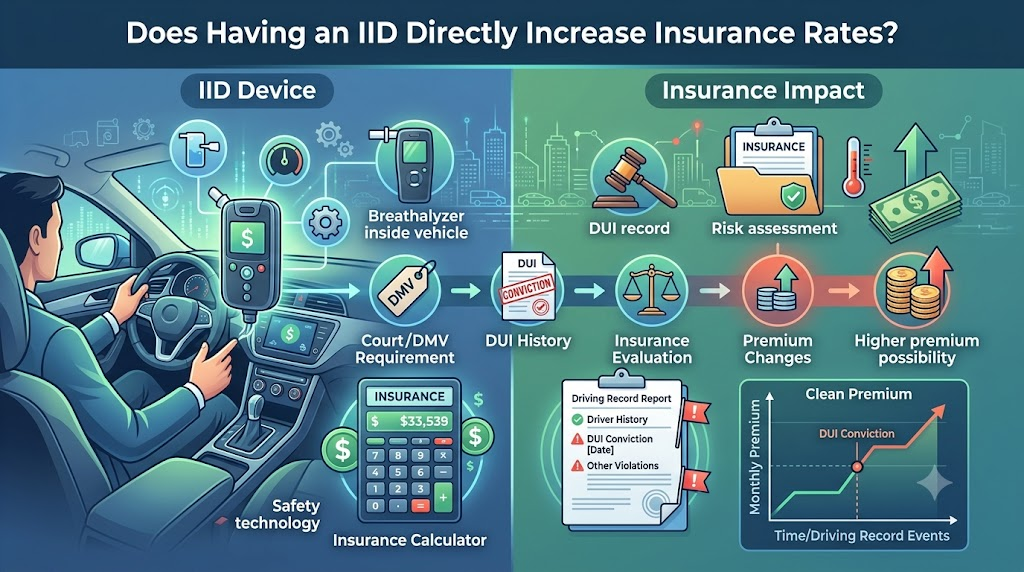
Insurance companies generally do not increase rates simply because a breathalyzer device is installed in your vehicle.
Instead, insurers look at the reason the IID was required.
For example:
Scenario 1: DUI Conviction
A driver receives a DUI, loses driving privileges, and must install an IID.
Insurance companies may consider:
- DUI conviction history
- Increased accident risk
- License restrictions
- Legal violations
This can result in significantly higher premiums.
Scenario 2: Medical or Safety Program
In rare cases, an IID requirement may come from a special program unrelated to a DUI conviction.
The insurance impact may be different depending on the situation and state regulations.
The key point:
The DUI or driving violation usually affects insurance rates more than the IID device itself.
Why Insurance Companies Consider IID Drivers High Risk
Auto insurance companies calculate premiums based on the likelihood and cost of future claims.
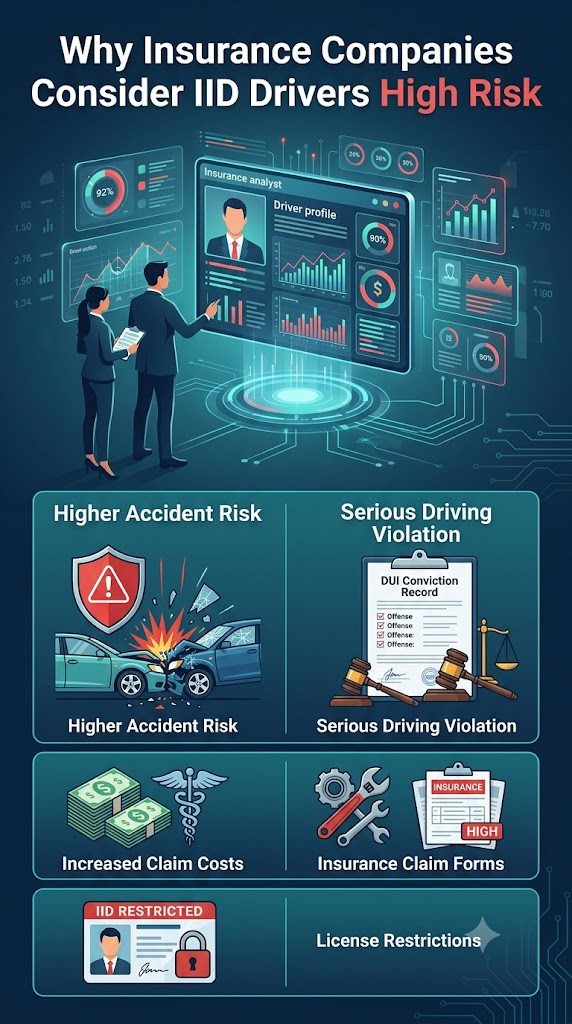
A DUI-related IID requirement can affect several risk factors.
Higher Accident Risk
Statistics show that drivers with alcohol-related violations are considered more likely to be involved in future accidents.
Because insurers price policies based on risk, a DUI history often results in higher premiums.
Serious Driving Violation
A DUI is generally considered one of the most serious traffic offenses.
Insurance companies may view it differently from minor violations such as:
- Speeding tickets
- Parking violations
- Minor moving violations
A DUI can remain on your driving record for several years depending on your state.
Increased Claim Costs
Alcohol-related accidents can involve:
- More severe injuries
- Greater property damage
- Legal expenses
- Higher liability claims
Because potential losses are higher, insurers may charge more to provide coverage.
License Restrictions
Drivers with IID requirements often have:
- Restricted licenses
- Mandatory monitoring
- Additional legal requirements
Insurance companies may consider these factors when determining eligibility and pricing.
How Much Can Insurance Increase After an IID?
There is no fixed amount that insurance increases after an IID requirement.
The cost depends on several factors, including:
- State laws
- Insurance company
- Driver age
- Driving history
- Previous claims
- Type of vehicle
- DUI severity
- Coverage limits
- Length of time since the offense
Some drivers may see their premiums increase by hundreds of dollars per year, while others may experience much larger increases.
A DUI-related increase can sometimes be significant because insurers may classify the driver as high risk.
The IID installation itself may also create additional expenses, including:
- Installation fees
- Monthly monitoring fees
- Maintenance costs
- Removal fees
These costs are separate from insurance premiums.
How Does a Breathalyzer (IID) Affect My Insurance Rates?
Does an IID Require SR-22 Insurance?
In many cases, drivers who are required to install an Ignition Interlock Device may also need SR-22 insurance. However, the IID requirement itself does not automatically mean you need an SR-22.
An SR-22 is not a type of insurance policy. It is a certificate filed by your insurance company with the state to prove that you carry the minimum required auto insurance coverage.
Drivers may need an SR-22 after serious violations such as:
- DUI or DWI conviction
- Driving without insurance
- License suspension
- Multiple traffic violations
- Serious at-fault accidents
If your state requires an SR-22 after a DUI, your insurance company will notify the state that you have the required coverage.
How SR-22 Affects Insurance Costs
The SR-22 filing itself usually has a small administrative fee. The bigger cost increase comes from the reason you need the filing.
A DUI combined with an SR-22 requirement can lead to:
- Higher insurance premiums
- Fewer available insurance companies
- More limited coverage options
- Higher down payments
Insurance companies may classify you as a high-risk driver during the SR-22 period.
How Long Does an IID Affect Insurance Rates?
The length of time an IID affects your insurance depends on several factors, including:
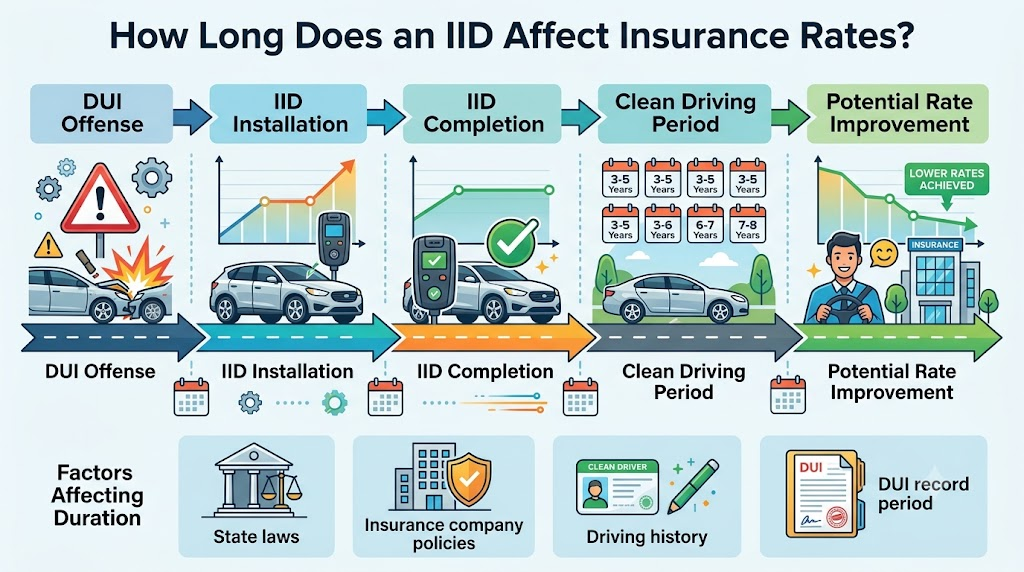
- State laws
- Insurance company policies
- Your driving history
- How long the DUI remains on your record
The IID device itself may only be required for a specific period, such as:
- Several months
- One year
- Multiple years
However, the insurance impact may continue after the device is removed.
DUI Record Period
A DUI can remain visible on your driving record for several years.
During this time, insurers may continue considering it when calculating your premium.
For example:
- A driver installs an IID for one year
- The IID requirement ends
- The DUI remains on the driving record
- Insurance rates may remain elevated until the violation becomes less relevant
Many insurance companies review driving records when policies are renewed, so the impact may gradually decrease over time if you maintain a clean record.
Can You Get Normal Car Insurance With an IID?
Yes, many drivers with an IID can still get car insurance.
However, your options may be more limited compared with drivers who have a clean driving history.
Insurance companies may ask for:
- DUI conviction details
- IID installation information
- SR-22 filing requirements
- Proof of license reinstatement
- Court documents
- Driving history reports
Some standard insurance companies may continue covering you, while others may consider you too high-risk.
Insurance Options for Drivers With an IID
Drivers with an IID typically fall into three categories:
Existing Insurance Company
Your current insurer may allow you to keep your policy after a DUI.
Advantages:
- Existing customer relationship
- Easier policy management
- No need to switch immediately
However, your premium may increase significantly.
High-Risk Insurance Companies
Some insurers specialize in covering drivers with:
- DUI convictions
- License suspensions
- Multiple violations
- SR-22 requirements
These companies may provide coverage when traditional insurers decline.
State Assigned Risk Programs
In some states, drivers who cannot obtain coverage through normal markets may access assigned risk programs.
These programs provide required minimum insurance but may have fewer coverage choices.
Does an IID Affect Full Coverage Insurance?
An IID does not automatically prevent you from getting full coverage.
You may still be able to purchase:
- Liability insurance
- Collision coverage
- Comprehensive coverage
- Uninsured/underinsured motorist coverage
However, the cost may be higher because of your driving history.
Example
A driver with a financed vehicle may be required by the lender to maintain full coverage.
Even with an IID installed, the driver may need:
- Collision insurance to protect against accident damage
- Comprehensive insurance for theft, weather, and other non-collision events
The insurance company may adjust the premium based on the DUI history rather than the IID device itself.
Do All Insurance Companies Accept Drivers With an IID?
No.
Insurance companies have different underwriting rules.
Some insurers may continue coverage after a DUI, while others may cancel or refuse to renew a policy.
Companies consider factors such as:
- Severity of the offense
- Number of DUI convictions
- Time since the violation
- State regulations
- Overall driving history
A first-time DUI offender with no previous claims may have more options than someone with multiple alcohol-related violations.
Will an IID Show Up on Your Insurance Record?
The IID device itself is generally not listed as a traditional insurance violation.
Insurance companies usually learn about the situation through:
- Motor vehicle records
- DUI conviction records
- SR-22 requirements
- License restrictions
The information insurers care about most includes:
- Why the IID was required
- Date of the offense
- Driving restrictions
- Compliance history
A successfully completed IID program may eventually help demonstrate responsible driving behavior, especially when combined with a clean driving record.
Does Completing an IID Program Lower Insurance Rates?
Completing an IID requirement does not immediately guarantee lower premiums.
However, it can help over time.
Insurance companies generally reward:
- Clean driving history
- No new violations
- No accidents
- Continuous insurance coverage
After the DUI becomes older and you demonstrate responsible driving, your premiums may gradually decrease.
Some insurers may also consider:
- Defensive driving courses
- Safe driving programs
- Improved driving history
What Happens to Insurance After IID Removal?
After the IID is removed, your insurance situation does not automatically return to normal.
Your insurer may still consider:
- DUI history
- SR-22 requirement status
- Remaining points or violations
- Claims history
However, removing the IID can eliminate some practical challenges, such as:
- Device maintenance requirements
- Installation fees
- Vehicle restrictions
To improve your insurance rates after removal:
- Maintain continuous coverage
- Avoid traffic violations
- Compare insurance quotes
- Ask insurers about discounts
- Keep a clean driving record
How Does a Breathalyzer (IID) Affect My Insurance Rates?
How to Lower Insurance Rates After Installing an IID
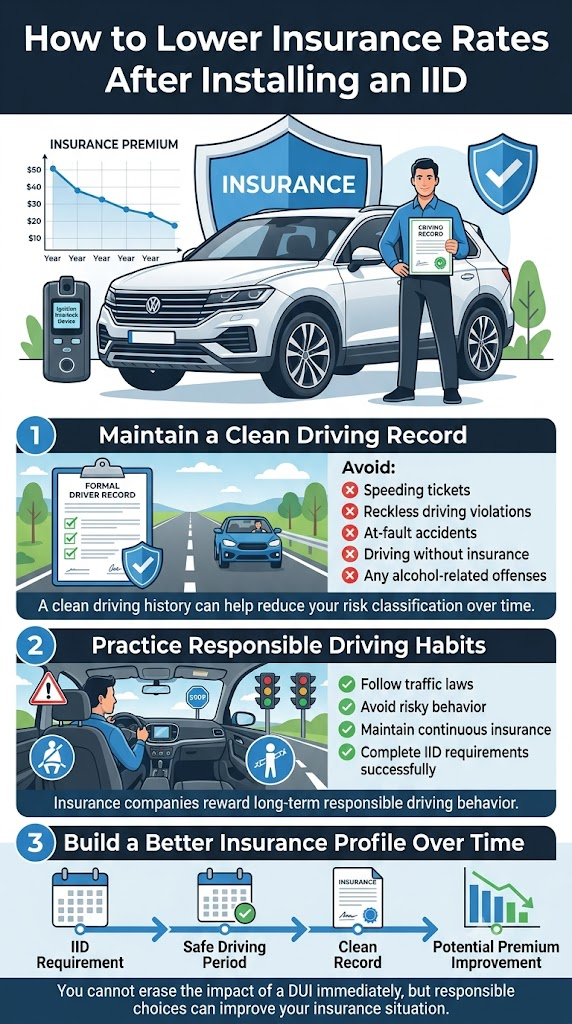
An Ignition Interlock Device requirement can make insurance more expensive, but there are steps drivers can take to reduce costs over time.
While you cannot immediately erase the impact of a DUI or serious driving violation, responsible driving habits and smart insurance choices can help lower premiums.
Maintain a Clean Driving Record
One of the most effective ways to reduce insurance costs after an IID requirement is avoiding additional violations.
Insurance companies pay close attention to your driving history.
Avoid:
- Speeding tickets
- Reckless driving violations
- At-fault accidents
- Driving without insurance
- Any alcohol-related offenses
A clean record after an IID requirement shows insurers that you have improved your driving behavior.
Over time, this may help reduce your risk classification.
Compare Insurance Quotes From Multiple Companies
Not every insurance company evaluates DUI and IID drivers the same way.
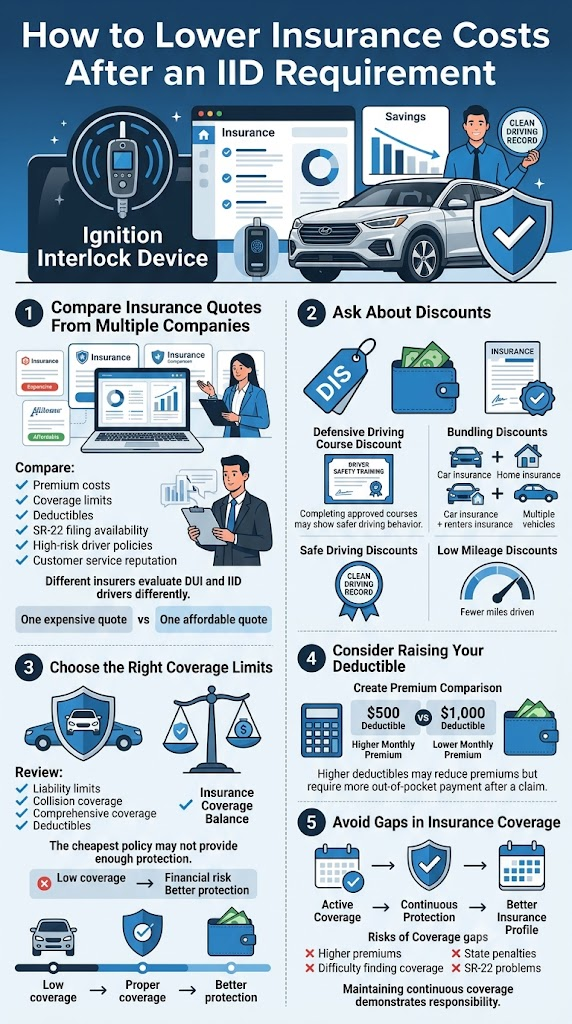
One insurer may increase your premium significantly, while another may offer more affordable coverage.
When shopping for insurance, compare:
- Premium costs
- Coverage limits
- Deductibles
- SR-22 filing availability
- High-risk driver policies
- Customer service reputation
Do not assume your current insurance company offers the best rate after an IID requirement.
Getting multiple quotes can help you find better pricing.
Ask About Discounts
Even after a DUI-related increase, you may still qualify for certain discounts.
Available discounts vary by insurer but may include:
Defensive Driving Course Discount
Some insurance companies offer discounts to drivers who complete approved defensive driving courses.
These courses may help demonstrate a commitment to safer driving.
Bundling Discounts
Combining multiple policies with the same insurer may reduce costs.
Examples:
- Auto insurance + homeowners insurance
- Auto insurance + renters insurance
- Multiple vehicles under one policy
Safe Driving Discounts
After maintaining a clean record, some insurers may offer lower rates through safe driving programs.
Low Mileage Discounts
If you drive fewer miles after receiving an IID, you may qualify for lower premiums.
Insurance companies often consider lower annual mileage a reduced risk factor.
Choose the Right Coverage Limits
Drivers with an IID requirement should avoid making decisions based only on the lowest premium.
Reducing coverage too much can create financial problems after an accident.
Instead, review:
- Liability limits
- Collision coverage
- Comprehensive coverage
- Deductibles
A higher deductible may reduce your premium, but you should ensure you can afford the out-of-pocket cost if you file a claim.
Consider Raising Your Deductible
A deductible is the amount you pay before insurance covers a claim.
For example:
- $500 deductible = higher premium
- $1,000 deductible = lower premium
If you have enough savings to handle a larger deductible, increasing it may reduce your monthly insurance cost.
However, this option is not ideal for every driver.
Avoid Gaps in Insurance Coverage
A lapse in auto insurance can make your situation worse after an IID requirement.
Insurance companies often view coverage gaps as an additional risk factor.
A lapse can result in:
- Higher premiums
- Difficulty finding coverage
- Additional state penalties
- Problems maintaining SR-22 requirements
Maintaining continuous coverage can help demonstrate responsibility.
Can You Remove a DUI From Your Insurance Record?
In most cases, you cannot simply remove a DUI from your insurance history.
Insurance companies rely on official driving records, which are controlled by state agencies.
However, the impact of a DUI generally decreases over time.
Factors that may improve your insurance situation include:
- Completing your IID requirement
- Maintaining a clean driving record
- Avoiding new violations
- Keeping continuous insurance coverage
- Waiting until the DUI becomes older
Some states allow certain offenses to be expunged or sealed under specific circumstances, but this does not always remove the information from every insurance review process.
Common Mistakes That Increase Insurance Costs After an IID
Many drivers make mistakes after receiving an IID requirement that can create additional insurance problems.
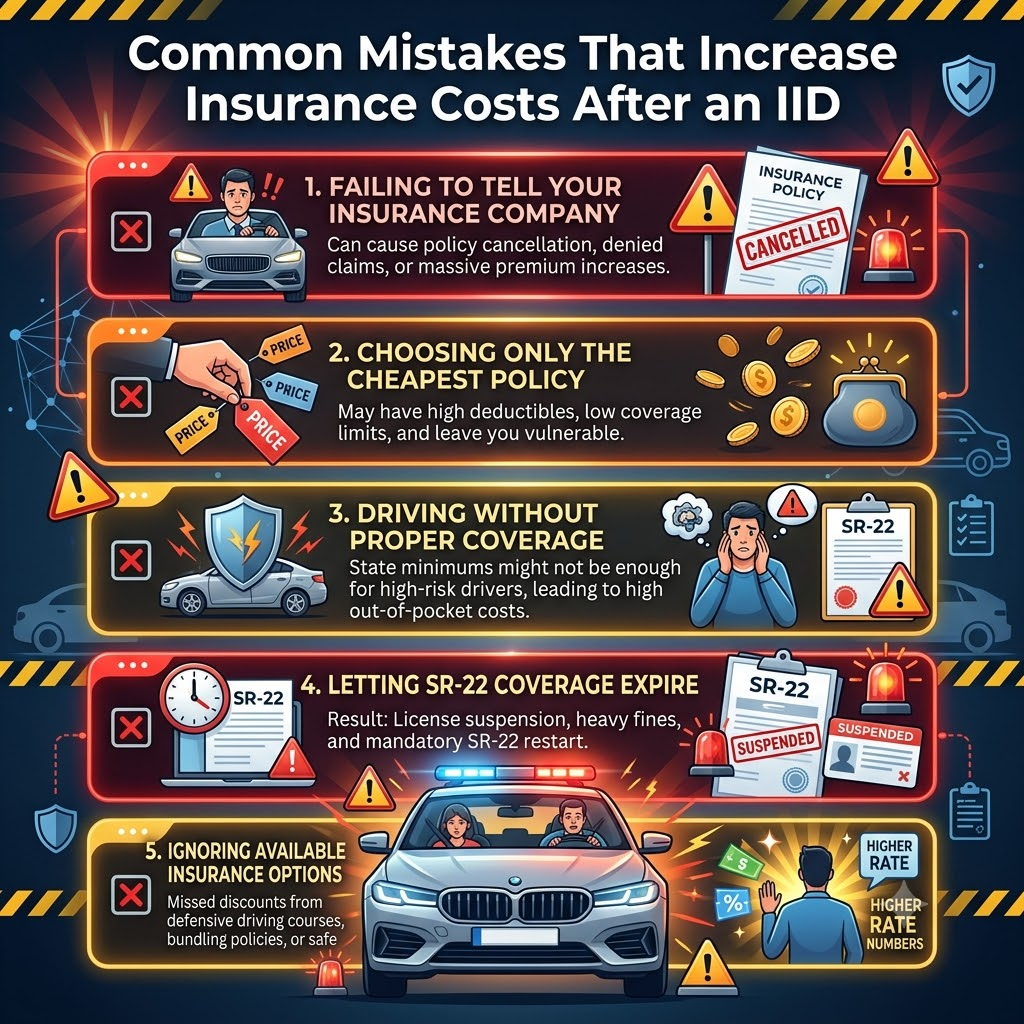
Mistake 1: Failing to Tell Your Insurance Company
Some drivers avoid informing their insurer about a DUI or IID requirement because they fear higher premiums.
However, hiding important information can create serious issues.
Insurance companies may discover violations through:
- Motor vehicle record checks
- Renewal reviews
- SR-22 requirements
Failure to disclose information can lead to:
- Policy cancellation
- Claim complications
- Coverage disputes
Mistake 2: Choosing Only the Cheapest Policy
A low-cost policy may not provide enough protection.
Before selecting insurance, check:
- Coverage limits
- Exclusions
- SR-22 availability
- Claims support
- High-risk driver experience
The cheapest policy is not always the best value.
Mistake 3: Driving Without Proper Coverage
Some drivers reduce coverage after an IID requirement to save money.
This can create major financial risks.
Without adequate insurance, you may personally pay for:
- Vehicle repairs
- Medical expenses
- Property damage
- Legal costs
Always maintain the coverage required by your state and lender.
Mistake 4: Letting SR-22 Coverage Expire
If you are required to carry SR-22 insurance, allowing it to lapse can create serious consequences.
Possible results include:
- License suspension
- Restarting the SR-22 period
- Higher insurance costs
- Additional penalties
Keep your policy active until your state confirms the requirement is complete.
Mistake 5: Ignoring Available Insurance Options
Some drivers stay with their current insurer without comparing alternatives.
After an IID requirement, it is worth exploring:
- High-risk insurers
- Different coverage packages
- Discounts
- Policy adjustments
Insurance markets change, and another company may offer better rates.
How Long Will Insurance Stay Expensive After an IID?
The exact timeline varies.
Insurance costs are usually highest shortly after a DUI because the violation is recent.
Over time, premiums may improve if you:
- Avoid accidents
- Maintain continuous coverage
- Complete your IID program
- Avoid additional violations
The biggest improvement often occurs when the DUI becomes older and has less influence on underwriting decisions.
How Does a Breathalyzer (IID) Affect My Insurance Rates?
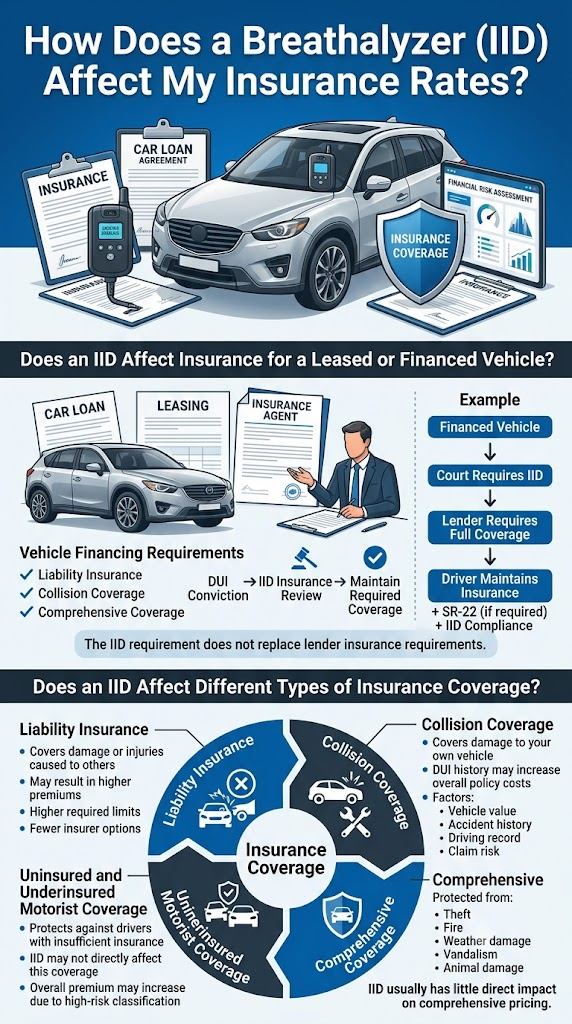
Does an IID Affect Insurance for a Leased or Financed Vehicle?
Having an Ignition Interlock Device installed does not prevent you from keeping a leased or financed vehicle. However, it can create additional requirements depending on your lender or leasing company.
Most lenders require drivers to maintain certain insurance coverage levels throughout the loan or lease period.
This usually includes:
- Liability insurance
- Collision coverage
- Comprehensive coverage
A DUI-related IID requirement may increase your premium, but you are generally still responsible for maintaining the required coverage.
Example
A driver finances a vehicle and receives a DUI conviction.
The court requires an IID installation.
The lender still requires full coverage insurance because the vehicle is being financed.
The driver may need to maintain:
- Full coverage insurance
- SR-22 filing (if required)
- IID compliance
The vehicle loan requirements remain separate from the court’s IID requirement.
Does an IID Affect Different Types of Insurance Coverage?
An IID requirement can influence different parts of your auto insurance policy.
Liability Insurance
Liability insurance covers damage or injuries you cause to others.
After a DUI-related IID requirement, liability coverage is often the area most affected because insurers are concerned about future risk.
Possible changes include:
- Higher premiums
- Higher required limits
- Limited insurer options
Collision Coverage
Collision insurance covers damage to your own vehicle after an accident.
An IID does not directly change collision coverage, but the DUI history behind the IID may increase the overall policy cost.
Factors insurers consider include:
- Vehicle value
- Accident history
- Driving record
- Claim risk
Comprehensive Coverage
Comprehensive coverage protects against non-collision events such as:
- Theft
- Fire
- Weather damage
- Vandalism
- Animal-related damage
The IID itself generally has little impact on comprehensive coverage pricing.
However, the overall insurance premium may still increase because of the DUI history.
Uninsured and Underinsured Motorist Coverage
This coverage protects you if another driver causes an accident and does not have enough insurance.
An IID requirement usually does not directly affect this coverage, but your total premium may increase because of your high-risk classification.
How Do Insurance Companies Evaluate Drivers With an IID?
Insurance companies use several factors when deciding whether to insure a driver with an IID requirement.
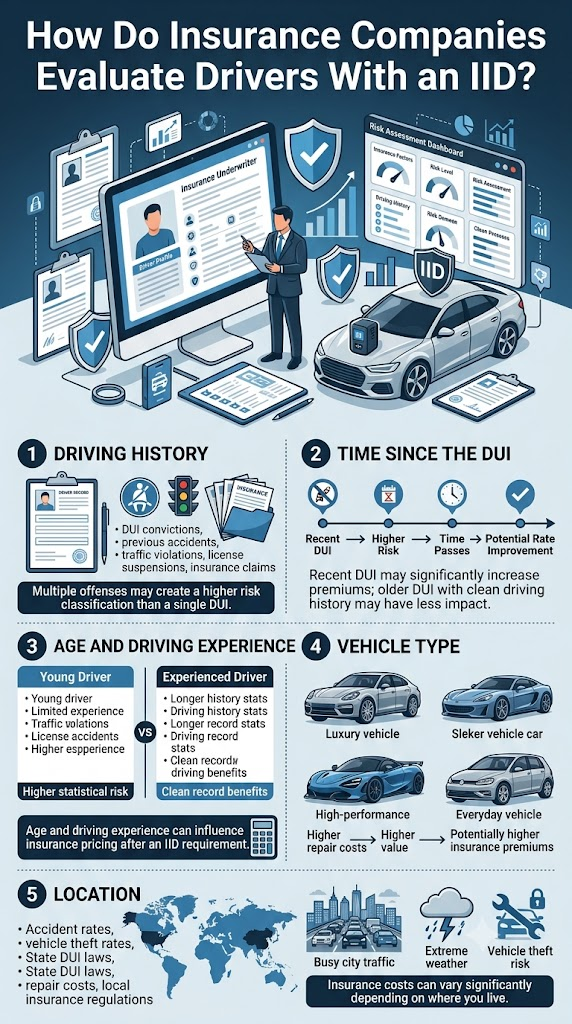
They typically review:
Driving History
Insurers examine:
- DUI convictions
- Previous accidents
- Traffic violations
- License suspensions
- Insurance claims
A single DUI may affect rates differently than multiple offenses.
Time Since the DUI
A recent DUI generally has a larger impact than an older violation.
For example:
A DUI from a few months ago may significantly increase premiums.
A DUI from several years ago with no additional violations may have a smaller impact.
Age and Driving Experience
Younger drivers may already pay higher premiums because of statistical risk.
A DUI combined with limited driving experience can result in even higher rates.
Older drivers with longer clean driving histories may receive more favorable pricing after completing their IID requirement.
Vehicle Type
The type of vehicle you drive also matters.
Insurance may cost more for:
- Luxury vehicles
- Sports cars
- High-performance vehicles
- Expensive-to-repair vehicles
A DUI-related increase combined with a high-value vehicle may create a larger premium increase.
Location
Where you live affects insurance pricing.
Insurers consider:
- Accident rates
- Vehicle theft rates
- State DUI laws
- Repair costs
- Local insurance regulations
A driver with an IID requirement may experience different insurance costs depending on their state.
Can You Switch Insurance Companies While Using an IID?
Yes, drivers with an IID can usually switch insurance companies.
However, you should be prepared to provide accurate information about:
- DUI conviction
- License status
- SR-22 requirements
- IID installation
- Current policy details
Switching insurers may help you find a lower premium, but not all companies will accept drivers with DUI-related records.
When comparing companies, ask:
- Do you insure drivers with IID requirements?
- Do you file SR-22 forms?
- Are there additional fees?
- How long will the DUI affect my rates?
Does Completing the IID Program Improve Insurance Rates?
Successfully completing your IID requirement can be a positive step, but it does not instantly remove the insurance impact.
Insurance companies generally look for long-term evidence of responsible driving.
After completing the program:
- Continue maintaining insurance coverage
- Avoid traffic violations
- Avoid accidents
- Review your policy annually
- Request new quotes periodically
A clean record after an IID requirement can gradually improve your insurance profile.
Final Checklist for Drivers With an Ignition Interlock Device
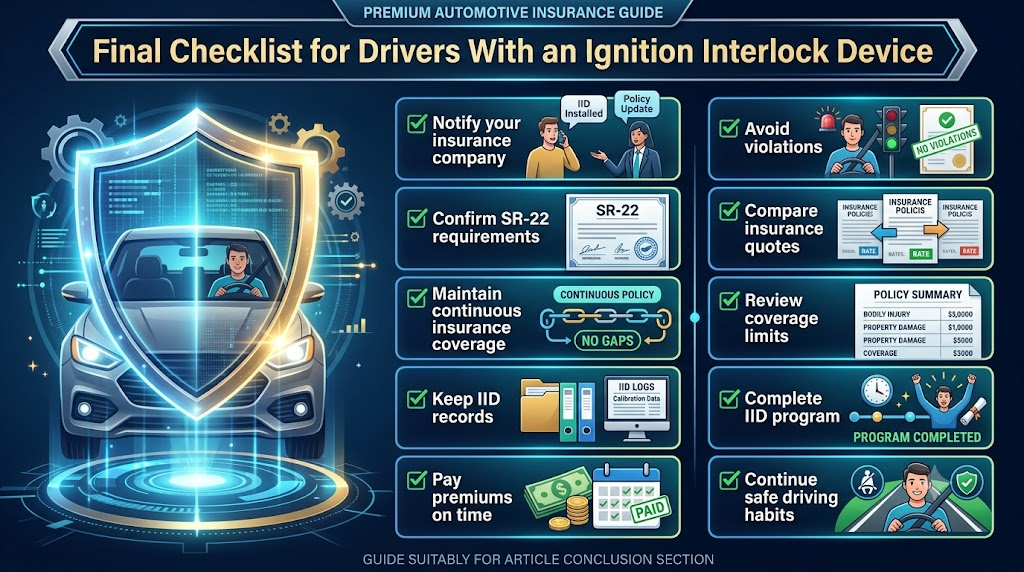
Before, during, and after an IID requirement, follow these steps:
✅ Notify your insurance company about your situation
✅ Confirm whether SR-22 insurance is required
✅ Maintain continuous insurance coverage
✅ Keep your IID installation and compliance records
✅ Pay all insurance premiums on time
✅ Avoid additional traffic violations
✅ Compare insurance quotes from multiple companies
✅ Review coverage limits regularly
✅ Complete the IID program successfully
✅ Continue safe driving habits after removal
Final Thoughts: Does a Breathalyzer (IID) Affect Insurance Rates?
An Ignition Interlock Device can affect your insurance rates, but the device itself is usually not the main reason for higher premiums.
The biggest factor is the event that caused the IID requirement, most commonly a DUI or alcohol-related driving offense.
Insurance companies typically view drivers with DUI-related IID requirements as higher risk, which can lead to:
- Increased premiums
- SR-22 requirements
- Fewer insurance options
- Additional documentation requirements
However, an IID requirement does not mean you will always pay extremely high insurance costs forever.
You can improve your insurance situation by:
- Completing the IID program
- Maintaining a clean driving record
- Avoiding future violations
- Comparing multiple insurance companies
- Choosing appropriate coverage
The best approach is to be transparent with your insurer, understand your coverage, and focus on building a safer driving history over time.
A breathalyzer requirement may create short-term challenges, but responsible driving choices can help reduce its long-term impact on your insurance costs.